
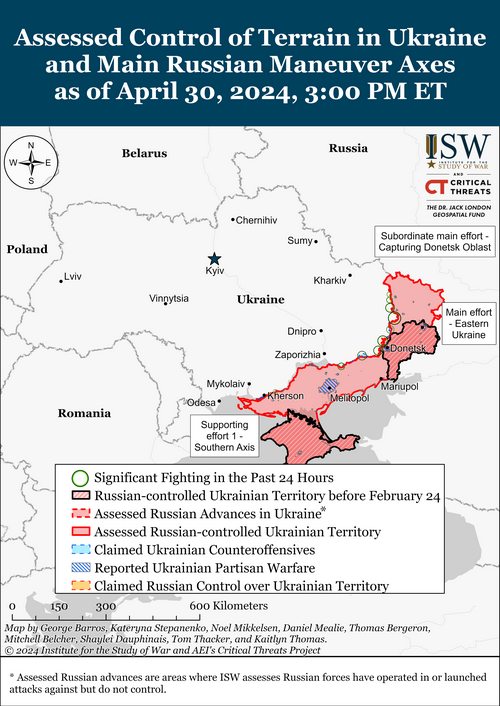
From The Institute for the Study of War:
Russian Offensive Campaign Assessment, April 30, 2024
Nicole Wolkov, Angelica Evans, Christina Harward, Karolina Hird, Kateryna Stepanenko, and Frederick W. Kagan
April 30, 2024, 7:10pm ET
Click here to see ISW’s interactive map of the Russian invasion of Ukraine. This map is updated daily alongside the static maps present in this report.
Click here to see ISW’s 3D control of terrain topographic map of Ukraine. Use of a computer (not a mobile device) is strongly recommended for using this data-heavy tool.
Click here to access ISW’s archive of interactive time-lapse maps of the Russian invasion of Ukraine. These maps complement the static control-of-terrain map that ISW produces daily by showing a dynamic frontline. ISW will update this time-lapse map archive monthly.
Note: The data cut-off for this product was 12:30pm ET on April 30. ISW will cover subsequent reports in the May 1 Russian Offensive Campaign Assessment.
Russian forces did not make any confirmed advances in the Avdiivka area on April 30 for the first time in several days, while Ukrainian sources reported that Russian forces conducted several more attacks in the Bakhmut-Chasiv Yar direction than near Avdiivka. The Ukrainian General Staff’s morning and evening reports on April 30 stated that Ukrainian forces repelled a total of 47 Russian attacks in the Avdiivka direction and 57 Russian attacks in the Bakhmut direction throughout the day, notably a much higher number of attacks in the Chasiv Yar direction than Ukrainian sources have recently reported out on.[1] One day’s worth of reporting is not sufficient to establish a pattern, but it may suggest that Russian forces are somewhat slowing down the rate of attacks around Avdiivka while re-committing to offensive pushes around Chasiv Yar, as ISW recently forecasted they would.[2] Russian forces have focused on building on tactical success near Ocheretyne (northwest of Avdiivka) and Novokalynove (north of Avdiivka) since around April 20, but the rate of confirmed advances appears to have slowed as of April 30. Russian milbloggers claimed that Russian forces advanced 2.7 kilometers wide and 1.52 kilometers deep north of Novokalynove; in southern Keramik (north of Avdiivka); and in an area up to 1.75 kilometers wide and 1.15 kilometers deep northwest of Ocheretyne in the direction of Novooleksandriivka.[3] Russian milbloggers also claimed that Russian forces advanced west of Semenivka and Berdychi (both northwest of Avdiivka).[4] ISW has not observed visual evidence of any of these claims. Russian milbloggers claimed that Russian forces operating near Ocheretyne are 13 kilometers from the T-0504 (Pokrovsk-Kostyantynivka) highway, which is consistent with ISW‘s assessed Russian advances in the area.[5] Fighting also continued northwest of Avdiivka near Arkhanhelske, Sokil, and Solovyove west of Avdiivka near Umanske, and southwest of Avdiivka near Netaylove.[6] Ukrainian military observer Kostyantyn Mashovets stated that elements of the Russian 132nd Motorized Rifle Brigade (1st Donetsk People’s Republic Army Corps [DNR AC]) and 35th Motorized Rifle Brigade (41st Combined Arms Army [CAA], Central Military District [CMD]) are operating near Novokalynove and Keramik; elements of the 30th Motorized Rifle Brigade (2nd CAA, CMD) are attacking toward Novooleksandrivka; elements of the 27th Motorized Rifle Division (2nd CAA) are operating near Solovyove, Berdychi, and Semenivka; elements of the 74th Motorized Rifle Brigade (41st CAA) are operating near Berdychi; and elements of the 114th Motorized Rifle Brigade (1st DNR AC) are operating west of Orlivka.[7]
Russian forces may decide to push from their salient north of Avdiivka towards the Toretsk area to complement Russian offensive operations near Chasiv Yar, which would likely require Russian forces to conduct a tactical pause to concentrate forces for such a drive. Mashovets stated that Russian forces may focus their efforts on the Stara Mykolaivka-Sukha Balka line (north of the Ochertyne-Keramik line and southwest of Toretsk) instead of northwest of Ocheretyne as Russian forces are already struggling to defend the flanks of their salient near Ocheretyne.[8] ISW recently assessed that Russian forces may decide to advance north from their tactical penetration near Ocheretyne along the H-20 (Donetsk City-Kostyantynivka) highway to pressure Ukrainian forces defending in the Toretsk area and possibly threaten the operational rear of the Ukrainian defense in and west of Chasiv Yar.[9] Chasiv Yar is an operationally significant objective as it would provide Russian forces with a staging ground to launch offensive operations against Druzhkivka and Kostyantynivka, which form the fortress belt of four major cities in Donetsk Oblast. Russian forces would likely require a longer pause to reinforce existing units and redeploy additional forces to the Ocheretyne area should they choose to attempt to advance northward to the Toretsk area, however. Mashovets stated that the Russian Central Grouping of Forces (currently responsible for the Avdiivka area) has created a tactical reserve of three small infantry regiments in the Avdiivka direction, and ISW previously assessed that Russian forces have been establishing operational- and strategic-level reserves likely to support an anticipated spring-summer offensive effort.[10]

Russian sources claimed that Ukrainian forces conducted a short-range MGM-140 ATACMS strike against targets in occupied Crimea on the night of April 29 to 30. Crimean occupation administration head Sergei Aksyonov claimed that Ukrainian forces conducted an ATACMS strike against Simferopol and that Russian forces downed the missiles.[11] Aksyonov claimed that undetonated cluster munitions scattered in the area after air defenses downed the missiles but did not specify if the strike caused any damage. Russian milbloggers claimed that Ukrainian forces launched between 12 and 15 ATACMS missiles targeting Simferopol and the Dzhankoi airfield but claimed that Russian air defenses downed all the missiles.[12] The Russian Ministry of Defense (MoD) claimed that Russian air defenses destroyed six ATACMS missiles in an unspecified area, likely referring to occupied Crimea.[13] Russia opposition outlet Astra reported that Ukrainian missiles, presumably ATACMS missiles, struck facilities of the Russian 31st Air Defense Division in Chornomorsk and Saky raions and the Dzhankoi airfield, causing a fire and wounding several Russian servicemen.[14] Ukrainian officials have not responded to the reported strike, and ISW cannot independently verify Russian claims about the strike.
Tajik Foreign Minister Sirojiddin Muhriddin expressed outrage over Russian authorities’ treatment of Central Asian migrants, particularly Tajik citizens, indicating that increased Russian efforts to control migrants living in and entering Russia following the March 22 Crocus City Hall attack are continuing to strain Tajik-Russian relations. Muhriddin stated in an April 30 phone call with Russian Foreign Minister Sergei Lavrov that Russian authorities are violating Tajik citizens’ rights and freedoms in Russia and noted that such treatment of Tajik citizens in Russia does not comply with the Tajik-Russian Friendship, Cooperation, and Mutual Relations and Allied Cooperation treaties.[15] Muhriddin called Lavrov’s claim that Russia has not taken measures against specific ethnicities or religious minorities following the Crocus City Hall attack false and stated that Russian authorities have had an “exclusively“ negative reaction to Tajik citizens. ISW observed increased crackdowns against Russian indigenous and migrant Muslim communities after the Crocus City Hall attack, including crackdowns against Tajik migrants.[16] The BBC News Russian Service reported on March 27 that Russian authorities have initiated a significantly increased number of criminal cases for migration law violations since the Crocus attack, particularly against Tajik citizens.[17] The Russian MFA claimed that Lavrov explained to Muhriddin that Russian authorities are temporarily increasing checks on foreigners attempting to enter Russia in an effort to prevent terrorism following the Crocus City Hall attack.[18] The Russian MFA notably did not report Muhriddin’s criticisms of Russian authorities’ treatment of Tajik citizens in Russia, indicating that Russia is likely attempting to downplay the current rift in Tajik-Russian relations but has no intention of scaling back crackdowns.
Former Georgian Prime Minister and founder of the Georgian Dream political party Bidzina Ivanishvili reiterated a series of standard Kremlin information operations during his first public speech since announcing his return to Georgian public politics in December 2023. Ivanishvili claimed during a Georgina Dream rally in support of Georgia’s “foreign agents” bill on April 29 that Western non-governmental organizations (NGOs) orchestrated Georgia’s pro-democracy and pro-Western 2003 Rose Revolution and installed pro-Western governments that held office between 2004 to 2012.[19] Ivanishvili claimed that Western influence and control over Georgia resulted in the persecution of innocent Georgians and that the West ordered and directed all the policies of pro-Western Georgian governments.[20] Ivanishvili claimed that he attempted to free Georgia from Western control during his time as prime minister and returned to politics in order to finish this work. Ivanishvili accused the “global war party,” which he characterized as unspecified Western actors that have a decisive influence over NATO and the European Union (EU), as only seeing Georgia and Ukraine as “cannon fodder” against Russia and forced Georgia and Ukraine into confrontations with Russia in 2008, 2014, and 2022. The “foreign agents” bill, which the Georgian Parliament’s Legal Affairs Committee recently approved in its second reading amid continued protests against the bill, will require NGOs that receive more than 20 percent of their funding from foreign sources to register as “an organization pursuing the interests of a foreign power.”[21] The Kremlin made similar baseless claims that the West controls Ukraine and orchestrated “color revolutions” in several post-Soviet countries in an effort to delegitimize pro-Western governments in post-Soviet countries and question the sovereignty of those countries.[22] The Kremlin also routinely accuses the West of using Ukraine as a “proxy” in what the Kremlin views as its long-term, existential confrontation with the West and NATO.[23]
Key Takeaways:
- Russian forces did not make any confirmed advances in the Avdiivka area on April 30 for the first time in several days, while Ukrainian sources reported that Russian forces conducted several more attacks in the Bakhmut-Chasiv Yar direction than near Avdiivka.
- Russian forces may decide to push from their salient north of Avdiivka towards the Toretsk area to complement Russian offensive operations near Chasiv Yar, which would likely require Russian forces to conduct a tactical pause to concentrate forces for such a drive.
- Russian sources claimed that Ukrainian forces conducted a short-range MGM-140 ATACMS strike against targets in occupied Crimea on the night of April 29 to 30.
- Tajik Foreign Minister Sirojiddin Muhriddin expressed outrage over Russian authorities’ treatment of Central Asian migrants, particularly Tajik citizens, indicating that increased Russian efforts to control migrants living in and entering Russia following the March 22 Crocus City Hall attack are continuing to strain Tajik-Russian relations.
- Former Georgian Prime Minister and founder of the Georgian Dream political party Bidzina Ivanishvili reiterated a series of standard Kremlin information operations during his first public speech since announcing his return to Georgian public politics in December 2023.
- Russian forces recently made confirmed advances near Kreminna, Chasiv Yar, and Robotyne.
- The Russian Ministry of Defense (MoD) reported on April 30 that Russian Deputy Prime Minister and Minister of Industry and Trade Denis Manturov and First Deputy Defense Minister Ruslan Tsalikov inspected a drone testing ground in an unspecified area of occupied Ukraine.
- An investigation by Russian opposition outlet Vazhnye Istorii implicates Kremlin-appointed Russian Commissioner on Children’s Rights Maria Lvova-Belova and her sister in the deportation of special needs Ukrainian adults to Russia.
Go here to read the rest. I get the feeling the Ukrainian side of the war is currently on auto-pilot. With the failure of the Ukrainian counteroffensive last year, it looks like the Ukrainians had no back up plan except to keep yelling for American aid. They could well lose this war in 2024 unless they get their act together fast.

