
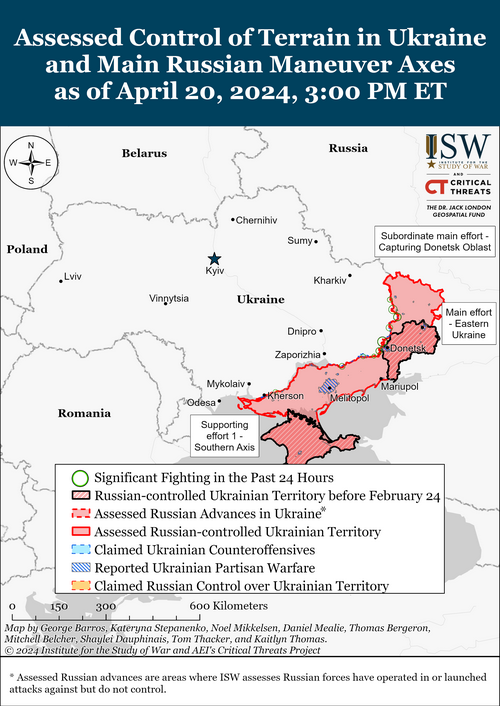
From The Institute for the Study of War:
Russian Offensive Campaign Assessment, April 20, 2024
Riley Bailey, Angelica Evans, Nicole Wolkov, Christina Harward, Kateryna Stepanenko, and Frederick W. Kagan
April 20, 2024, 7:30pm ET
Click here to see ISW’s interactive map of the Russian invasion of Ukraine. This map is updated daily alongside the static maps present in this report.
Click here to see ISW’s 3D control of terrain topographic map of Ukraine. Use of a computer (not a mobile device) is strongly recommended for using this data-heavy tool.
Click here to access ISW’s archive of interactive time-lapse maps of the Russian invasion of Ukraine. These maps complement the static control-of-terrain map that ISW produces daily by showing a dynamic frontline. ISW will update this time-lapse map archive monthly.
Note: The data cut-off for this product was 12:30pm ET on April 20. ISW will cover subsequent reports in the April 21 Russian Offensive Campaign Assessment.
The US House of Representatives passed a supplemental appropriations bill on April 20 providing for roughly $60 billion of assistance to Ukraine.[1] The bill must now be passed by the Senate and signed by the president before aid can begin to flow. These requirements and the logistics of transporting US materiel to the frontline in Ukraine will likely mean that new US assistance will not begin to affect the situation on the front line for several weeks. The frontline situation will therefore likely continue to deteriorate in that time, particularly if Russian forces increase their attacks to take advantage of the limited window before the arrival of new US aid. Ukrainian forces may suffer additional setbacks in the coming weeks while waiting for US security assistance that will allow Ukraine to stabilize the front, but they will likely be able to blunt the current Russian offensive assuming the resumed US assistance arrives promptly. The US Senate will reportedly vote on the bill sometime in the coming week.[2] Pentagon Spokesperson Brigadier General Patrick Ryder stated on April 19 that the Pentagon’s robust logistics system will allow the United States to move security assistance within a matter of “days” and that he believes that the United States will be able to “rush the security assistance in volumes” that the United States believes Ukraine will need to be successful.[3] US Assistant Secretary of Defense for International Security Affairs Celeste Wallander reportedly told US lawmakers that the Pentagon would begin moving ammunition, artillery shells, and air defense assets quickly once Congress approves the aid.[4] US media reported that US officials stated that the US Department of Defense (DoD) has been assembling the first tranche of resumed US security assistance for Ukraine ahead of the vote in the US House of Representatives but noted that the Biden administration has yet to make a final decision on how large the first tranche of aid will be or what it will include.[5] US officials reportedly stated that the United States will be able to “almost immediately” send certain munitions to Ukraine from US storage facilities in Europe, particularly critically needed 155mm artillery shells and air defense missiles.[6] The US officials noted that other security assistance will likely take weeks to arrive in Ukraine depending on where it is currently stored.[7] Ukraine has systematically improved its military logistics operations in recent months, but this new system has not yet accommodated a sudden and large influx of materiel, and no system would be able to immediately distribute large quantities of materiel throughout the frontline.[8]
Ukrainian forces will therefore likely continue to face ongoing shortages of artillery ammunition and air defense interceptors in the coming weeks and the corresponding constraints that these shortages are placing on Ukraine’s ability to conduct effective defensive operations.[9] Ukrainian artillery shortages are letting Russian mechanized forces make marginal tactical gains, and Ukraine’s degraded air defense capabilities are permitting Russian aviation to heavily degrade Ukrainian defenses along the front with glide bomb strikes.[10] Russian forces could continue to leverage these operational advantages in the coming weeks to make further tactical gains and destabilize the Ukrainian defensive line in hopes of achieving operationally significant advances. ISW continues to assess that material shortages are forcing Ukraine to conserve ammunition and prioritize limited resources to critical sectors of the front, increasing the risk of a Russian breakthrough in other less well-provisioned sectors and making the overall frontline more fragile than the current relatively slow rate of Russian advances suggests.[11] The threat of an operationally significant Russian advance in the coming weeks remains, although the Ukrainian command may have more latitude to take short-term risks with dwindling supplies to prevent such an advance once it knows that more materiel will be arriving soon.
Russian forces will likely intensify ongoing offensive operations and missile and drone strikes in the coming weeks in order to exploit the closing window of Ukrainian materiel constraints. Russian forces have maintained and, in some areas, intensified ongoing offensive operations, likely to exploit abnormally dry spring ground conditions and persisting Ukrainian materiel shortages before the arrival of promised Western security assistance.[12] Russian forces have also sought to exploit Ukraine’s degraded air defense capabilities in an effort to collapse the Ukrainian energy grid and cause long-term damage to Ukraine’s infrastructure and defense industrial capacity.[13] The now expected arrival of US security assistance has likely emphasized these considerations for Russian forces, and the Russian military command will likely intensify offensive operations and missile and drone strikes to pursue operationally significant effects that will certainly become harder to achieve against well-provisioned Ukrainian forces. Russian forces have only achieved tactical gains during the past six months of worsening Ukrainian constraints and remain unlikely to achieve a breakthrough that would collapse the frontline.[14] Russian forces may still be able to make operationally significant advances in the coming weeks and may prioritize sectors of the front where the Ukrainian defense appears relatively unstable, particularly west of Avdiivka, or areas of the front where Russian forces are within reach of an operationally significant objective, such as near Chasiv Yar.[15]
Russian forces may hope that continued and possibly intensified missile and drone strikes will be able to collapse the Ukrainian energy grid and force Ukraine to contend with a humanitarian crisis alongside its ongoing defensive operations. Russian forces could also shift their target set to strike Ukrainian transportation infrastructure to constrain Ukraine’s ability to sufficiently distribute manpower and materiel to critical sectors of the front. Russian forces heavily targeted Ukrainian transportation infrastructure in Dnipropetrovsk Oblast on April 19, and Russian forces may intend to expand these strikes in the coming weeks to interdict Ukrainian ground lines of communication (GLOCs).[16] Russian forces will likely also decide to exploit poor Ukrainian air defense coverage along the front and intensify glide bomb strikes in the coming weeks in hopes of causing widespread damage to Ukrainian defensive positions before it becomes riskier for Russian aircraft to conduct these strikes amid an improved Ukrainian air defense umbrella.
Ukraine will likely be in a significantly improved operational position by June 2024 regardless of delays in the arrival of US security assistance to the frontline, and the Russian military command will likely consider significant changes to the large-scale offensive operation that it is expected to launch in June, although it may still proceed as planned. Ukrainian forces will likely leverage sufficient US security assistance to blunt Russian offensive operations in June 2024, which Ukrainian Main Military Intelligence Directorate (GUR) Head Lieutenant General Kyrylo Budanov recently highlighted as the likely month that Russian forces will launch their expected large-scale summer offensive effort.[17] The Russian military has likely been assessing that Ukrainian forces would be unable to defend against current and future Russian offensive operations due to delays in or the permanent end of US military assistance. This assumption was likely an integral part of Russia’s operational planning for this summer.[18] Russian forces have been establishing operational- and strategic-level reserves to support their expected summer offensive effort, but likely have been doing so based on the assumption that even badly-trained and poorly-equipped Russian forces could make advances against Ukrainian forces that lack essential artillery and air defense munitions.[19] Ukraine is also addressing its own manpower challenges and will likely continue to conduct rotations to rest and replenish degraded units, although it will take time for these efforts to generate large-scale effects.[20]
Ukrainian officials have previously indicated that Russian forces will likely continue to conduct offensive operations this summer focused on seizing the remainder of Donetsk and Luhansk oblasts but may also launch an offensive operation to seize Kharkiv City.[21] Russian Foreign Minister Sergei Lavrov notably signaled on April 19 Russia’s intent to seize Kharkiv City.[22] The Russian military command may have envisioned that simultaneous offensive efforts towards Kharkiv City and along the current frontline in eastern Ukraine would stretch and overwhelm poorly-provisioned and undermanned Ukrainian forces and allow Russian forces to achieve a major breakthrough in at least one sector of the frontline. The Ukrainian forces with improving materiel and manpower supplies that will likely hold the frontline in June 2024 will undermine this operational intent of simultaneous Russian offensive operations across a wider front. The Russian military command will likely have to consider if the intended areas and objectives of its summer offensive effort are now feasible and if the current means that Russian forces have been concentrating and preparing are sufficient to conduct planned offensive operations considering the expected resumption of US security assistance to Ukraine. ISW offers no forecast of the decisions the Russians will make at this time.
The likely resumption of US security assistance to Ukraine is a critical turning point in the war in Ukraine, but the Kremlin, the West, and Ukraine still have additional decisions to make that will determine the character and outcome of the fighting. The Kremlin still retains the ability to further mobilize its economy and population to support its campaign to destroy Ukrainian statehood and identity and may determine to pursue domestically unpopular decisions should it deem them necessary. Ukraine still faces persisting force generation, sustainment, and defense industrial challenges that will heavily affect the capabilities that it can bring to bear. The United States and its Western allies must provide Ukraine with regular and consistent aid and deliver new critical systems to Ukrainian forces in a timely and effective manner for Western security assistance to have operationally significant effects. ISW has been considering a very wide forecast cone from the most advantageous to the most dangerous possible outcomes in recent months due to the uncertainty about the resumption of US aid to Ukraine.[23] ISW will likely be narrowing the forecast cone in the coming months as the impacts of Western security assistance become clearer in Ukraine and as the Kremlin decides how to respond.
Ukrainian forces reportedly conducted successful drone strikes against several energy infrastructure facilities and a fuel storage facility within Russia on the night of April 19 to 20. Ukrainian media reported that sources in Ukraine’s Security Service (SBU), Main Military Intelligence Directorate (GUR), and Special Operations Forces (SSO) stated that the SBU, GUR, and SSO jointly launched dozens of drones against Moscow, Belgorod, Bryansk, Kursk, Tula, Smolensk, Ryazan, and Kaluga oblasts, and struck at least three electrical substations and a fuel storage facility.[24] Ukrainian media reported that the SBU, GUR, and SSO targeted Russian energy facilities that support Russian defense industrial facilities.[25] The Russian Ministry of Defense (MoD) claimed that Russian air defenses destroyed and intercepted 50 Ukrainian drones over the same eight oblasts.[26] Bryansk Oblast Governor Alexander Bogomaz claimed that a drone crashed at an energy facility in Bryansk Oblast and caused a fire.[27] Kaluga Oblast Governor Vladislav Shapsha claimed that a drone strike slightly damaged energy infrastructure in Maloyaroslavetsky Raion, Kaluga Oblast.[28] Smolensk Oblast Governor Vasily Anokhin claimed that falling drone debris caused a container of fuel to catch fire in Kardymovsky Raion, Smolensk Oblast.[29] Geolocated footage published on April 20 shows a fire at a fuel storage facility in Kardymovo, Smolensk Oblast.[30] A Russian milblogger claimed that a fire started after an explosion in Stary Oskol, Belgorod Oblast.[31] ISW continues to assess that Ukrainian strikes against Russian energy facilities are a necessary component of Ukraine’s campaign to use asymmetric means to degrade industries that supply and support the Russian military.[32]
The Kremlin appears to be censoring demands for an investigation into the reported murder of a former Donetsk People Republic (DNR) serviceman amid a wider trend of the Kremlin coopting or otherwise censoring DNR-affiliated voices within the Russian information space. Russian sources recently claimed that Russian propagandist, former DNR serviceman, and US national Russell Bonner Bentley III disappeared in Donetsk City on April 8.[33] Russian sources alleged that elements of the Russian 5th Tank Brigade (36th Combined Arms Army [CAA], Eastern Military District [EMD]) detained and interrogated Bentley under the impression that Bentley was a Ukrainian spy due to his foreign accent and later killed Bentley.[34] Veteran Russian propagandist and RT editor-in-chief Margarita Simonyan announced Bentley‘s death on April 19.[35] Deputy Head of the DNR Main Directorate of Rosgvardia, Commander of the DNR’s special rapid response and riot police (OMON and SOBR), and former DNR Security Minister Alexander Khodakovsky called for an investigation into Bentley’s reported kidnapping and murder and “exemplary punishment” for the perpetrators in a post on April 19, which Khodakovsky later removed reportedly due to pressure from Russian officials.[36] The DNR “Vostok“ Battalion, which Khodakovsky previously commanded, claimed that Russian officials likely forced Khodakovsky to remove the post and that Khodakovsky complied with the demand in accordance with the unspecified “rules” of having a government position despite his personal relationship with Bentley.[37] Khodakovsky claimed on April 20 that being a government official and “a person” often creates competing priorities between his personal and professional loyalties, and insinuated that he agreed to remove his social media post to keep his government position.[38] Khodakovsky insinuated that censorship was necessary during the war and claimed that unspecified actors could pursue justice for Bentley after Russia won in Ukraine. Another DNR-affiliated Russian milblogger claimed on April 19 that unspecified actors are threatening to file charges against the milblogger for discrediting the Russian Armed Forces (a charge that could result in a fine of up to five million rubles ($65,530), up to five years of correctional or forced labor, or up to seven years in prison) after the milblogger demanded an official investigation into Bentley’s kidnapping and murder.[39]
Russian efforts to cover up Bentley’s death are the latest in what appears to be a concerted Kremlin effort to censor or coopt DNR officials and DNR/Luhansk People’s Republic (LNR)-affiliated voices within the Russian information space. The Russian Investigative Committee arrested former Russian officer and argent ultranationalist Igor Girkin (Strelkov), a prominent DNR commander in 2014, on charges of discrediting the Russian Armed Forces on July 21, 2023.[40] Russian authorities also arrested milblogger and former DNR serviceman Andrei Kurshin who reportedly ran the “Moscow Calling” Telegram channel in August 2023, and Russian milblogger and sergeant in the 4th Motorized Rifle Brigade (2nd LNR Army Corps) Andrei Morozov reportedly committed suicide after refusing the Russian military command’s orders to censor his reporting about high Russian casualty rates around Avdiivka in February 2024.[41] The Kremlin may be targeting DNR and LNR-affiliated voices within the Russian information space due to concerns that groups within the DNR and LNR, which have been fighting Ukrainian forces since 2014, are becoming disillusioned as the war drags on. Girkin, Kurshin, and Morozov were all vocal critics of the Russian military command, and Khodakovsky had previously disagreed with the Russian military command and ongoing Kremlin censorship efforts. All four, however, are and were firm supporters of Russia’s invasion of Ukraine.[42] It is unclear how or if Kremlin officials will respond to Bentley’s death or how the targeting of DNR officials and affiliated voices will impact the Kremlin’s relationships with its proxies in occupied Ukraine.
Key Takeaways:
- The US House of Representatives passed a supplemental appropriations bill on April 20 providing for roughly $60 billion of assistance to Ukraine. The bill must now be passed by the Senate and signed by the president before aid can begin to flow.
- These requirements and the logistics of transporting US materiel to the frontline in Ukraine will likely mean that new US assistance will not begin to affect the situation on the front line for several weeks. The frontline situation will therefore likely continue to deteriorate in that time, particularly if Russian forces increase their attacks to take advantage of the limited window before the arrival of new US aid.
- Ukrainian forces may suffer additional setbacks in the coming weeks while waiting for US security assistance that will allow Ukraine to stabilize the front, but they will likely be able to blunt the current Russian offensive assuming the resumed US assistance arrives promptly.
- Russian forces will likely intensify ongoing offensive operations and missile and drone strikes in the coming weeks in order to exploit the closing window of Ukrainian materiel constraints.
- Ukraine will likely be in a significantly improved operational position by June 2024 regardless of delays in the arrival of US security assistance to the frontline, and the Russian military command will likely consider significant changes to the large-scale offensive operation that it is expected to launch in June, although it may still proceed as planned.
- The likely resumption of US security assistance to Ukraine is a critical turning point in the war in Ukraine, but the Kremlin, the West, and Ukraine still have additional decisions to make that will determine the character and outcome of the fighting.
- Ukrainian forces reportedly conducted successful drone strikes against several energy infrastructure facilities and a fuel storage facility within Russia on the night of April 19 to 20.
- The Kremlin appears to be censoring demands for an investigation into the reported murder of a former Donetsk People Republic (DNR) serviceman amid a wider trend of the Kremlin coopting or otherwise censoring DNR-affiliated voices within the Russian information space.
- Russian forces recently made confirmed advances near Chasiv Yar (west of Bakhmut) and northwest of Avdiivka, and Ukrainian forces recently made confirmed advances south of Kreminna.
- Ukrainian and Russian sources reported that Russian forces are using US-made 203mm artillery ammunition that Russia may have received from Iran.
Go here to read the rest. Well, lets see what military miracles the Ukrainians accomplish, before they ask for another sixty billion. I honestly hope they can stop the Russian offensive and put it into reverse gear, but my guess is that they are trying to fight a US style rich man’s war, with lots of artillery and air support, via drones, and very little infantry closing with the enemy. Our track record with militaries that attempt to ape our style is not a happy one as the South Vietnamese and Afghanistan militaries could attest if they were still around.

