
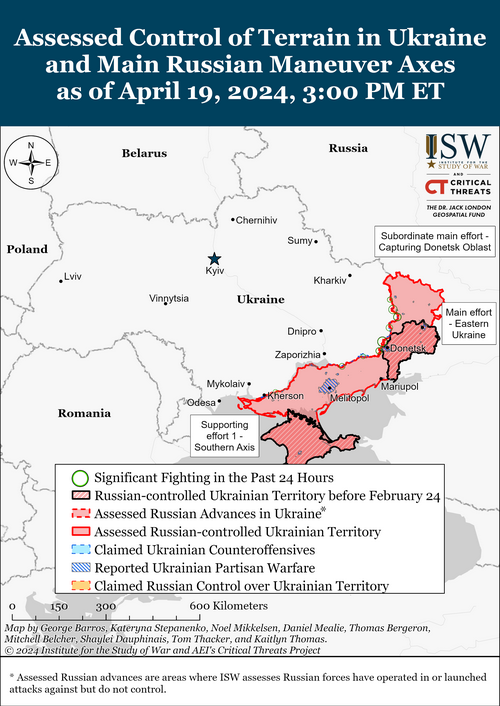
From The Institute for the Study of War:
Russian Offensive Campaign Assessment, April 19, 2024
Angelica Evans, Grace Mappes, Christina Harward, Riley Bailey, and George Barros
April 19, 2024, 6:35pm ET
Click here to see ISW’s interactive map of the Russian invasion of Ukraine. This map is updated daily alongside the static maps present in this report.
Click here to see ISW’s 3D control of terrain topographic map of Ukraine. Use of a computer (not a mobile device) is strongly recommended for using this data-heavy tool.
Click here to access ISW’s archive of interactive time-lapse maps of the Russian invasion of Ukraine. These maps complement the static control-of-terrain map that ISW produces daily by showing a dynamic frontline. ISW will update this time-lapse map archive monthly.
Note: The data cut-off for this product was 1:00pm ET on April 19. ISW will cover subsequent reports in the April 20 Russian Offensive Campaign Assessment.
Russian Foreign Minister Sergei Lavrov signaled Russia’s intent to seize Kharkiv City in a future significant Russian offensive operation, the first senior Kremlin official to outright identify the city as a possible Russian operational objective following recent Ukrainian warnings that Russian forces may attempt to seize the city starting in Summer 2024. Lavrov stated during a radio interview with several prominent Russian state propagandists on April 19 that Kharkiv City “plays an important role” in Russian President Vladimir Putin’s idea of establishing a demilitarized “sanitary zone” in Ukraine to protect Russian border settlements from Ukrainian strikes.[1] Lavrov stated that Putin has very clearly stated that Russian forces must push the frontline far enough into Ukraine – which Lavrov explicitly defines as into Kharkiv Oblast – to place Russian settlements outside of the Ukrainian strike range. This requirement is a very vague definition that could include the entirety of Ukrainian territory as long as an independent Ukrainian state exists and is willing to defend itself. Lavrov stated in response to a question about where Russian forces will go after creating a “sanitary zone” that Russian authorities are “completely convinced” of the need to continue Russia’s war against Ukraine. Lavrov responded in seeming agreement to a comment from one of the interviewers, who suggested that Lavrov’s earlier remarks meant that Russian forces will have to continue to attack further into Ukraine after creating the “sanitary zone” to protect the settlements that would then be within the zone and Ukrainian strike range. Lavrov’s remarks suggest that the Kremlin will likely use the idea of a constantly shifting demilitarized “sanitary zone” to justify Russian offensive operations further and further into Ukraine.
Prominent Russian propagandist and state television host Olga Skabeyeva framed Russia’s drone and missile strikes against Kharkiv Oblast as part of Russia’s efforts to create the “sanitary zone” during a speech on April 19, suggesting that additional prominent Kremlin mouthpieces are also laying the informational groundwork to justify ongoing Russian strikes and a future offensive operation against Kharkiv City under the pretext of defending Russian citizens.[2] Ukrainian officials, including Ukrainian President Volodymyr Zelensky, have recently identified the threat of a possible Russian summer offensive operation aimed at seizing Kharkiv City.[3] ISW continues to assess that a Russian offensive operation to seize Kharkiv City would be an extremely ambitious undertaking that would pose significant challenges to both the Russian forces responsible for the effort and to the wider Russian campaign in Ukraine.[4] ISW also assesses that US military assistance is vital to Ukraine’s ability to defend against any summer Russian offensive operation, including against Kharkiv City.[5]
Ukrainian officials announced that Ukrainian forces downed a Russian aircraft as it conducted missile strikes against Ukraine for the first time overnight on April 18 to 19, demonstrating a capability that may constrain how Russia conducts its strike campaign against Ukraine. Ukrainian Air Force Commander Lieutenant General Mykola Oleshchuk announced on April 19 that Ukrainian forces downed a Russian Tu-22M3 strategic bomber that had launched Kh-22 cruise missiles against Ukraine.[6] The Ukrainian Main Military Intelligence Directorate (GUR) stated that Ukrainian forces shot down the Tu-22M3 at a distance of 300 kilometers from Ukraine with the same means that Ukraine used to down two Russian A-50 long-range radar detection aircraft.[7] Ukrainian outlet RBK-Ukraine reported that Ukrainian security sources stated that Ukrainian forces used S-200 air defense systems to down the Tu-22M3.[8] The GUR reported that the Tu-22M3 crashed in Stavropol Krai, where footage shows the plane losing altitude and crashing.[9] GUR Spokesperson Andriy Yusov stated that the downing of the Tu-23M3 compelled another Russian Tu-22M3 to turn around and noted that it is “practically impossible” for Russia to manufacture new Tu-22M3 bombers.[10] Russian forces reportedly had roughly 60 Tu-22 strategic bombers as of 2023.[11]The Russian Ministry of Defense (MoD) acknowledged the plane crash but attributed it to a technical malfunction rather than Ukrainian forces, and Russian milbloggers largely coalesced around the MoD’s narrative.[12] Stavropol Krai officials reported that the crash killed one Russian pilot and inflicted non-life-threatening injuries on two others and that a fourth crewmember remains missing.[13]
Ukrainian air defense capabilities remain limited and degraded, however, allowing Russian aircraft to operate freely without threat on certain critical areas of the front. Russian milbloggers have recently amplified multiple pieces of video footage, including on April 19, showing Russian Su-25 and Su-34 aircraft operating at low altitudes near Chasiv Yar, Donetsk Oblast and striking Ukrainian positions to support Russian advances in the area, and Russian milbloggers have praised Russian aircraft for enabling relatively quick Russian advances in the area since at least late March 2024.[14] The ability of Russian aircraft to operate over 100 kilometers deep in Ukrainian airspace near the frontline without sustaining significant losses indicates that Ukrainian air defenses in the area are currently insufficient to deter or deny Russian aircraft from operating on the front line. The Ukrainian capability to conduct long-range strikes to down Russian strategic aircraft conducting combat operations may temporarily constrain Russian aviation operations as the previous downing of tactical aircraft has achieved.[15] This Ukrainian strike capability, however, is unable to compensate for Ukraine’s critical air defense shortages across the theater. Ukrainian forces still must husband materiel and prioritize allocating its limited air defense assets to some areas of the theater over others at great expense, allowing Russian aviation to support more consistent and rapid gains on the ground, including near Chasiv Yar.
Ukrainian President Volodymyr Zelensky stressed that Ukraine requires Western provisions of artillery ammunition, air defense materiel, long-range artillery and missile systems, and fighter aircraft as Ukrainian constraints continue due to delays in US military assistance.[16] Zelensky addressed the Ukraine-NATO Council on April 19 and reiterated that Ukraine needs a minimum of seven additional Patriot air defense systems to defend against Russia’s ongoing missile and drone strike campaign and called on Western countries to fulfill their promise to deliver one million artillery shells to Ukraine.[17] Zelensky added that long-range missiles and artillery systems are crucially needed to improve Ukrainian long-range strike capabilities and that Ukraine requires a sufficient number of fighter aircraft to contend with Russian aviation.[18] NATO Secretary General Jens Stoltenberg stated that several unspecified NATO members made unspecified commitments during the Ukraine-NATO Council meeting to provide additional air defense, artillery, deep precision strike, and drone materiel to Ukraine.[19]
Ukrainian artillery shortages are allowing Russian mechanized forces to make marginal tactical gains, and Ukraine’s degraded air defense capabilities are permitting Russian aviation to heavily degrade Ukrainian defenses along the front through glide bomb strikes.[20] Ukrainian officials have highlighted promised F-16 fighter aircraft as a crucial element of a combined air defense system that can intercept more Russian missile and drone strikes and constrain Russian tactical aviation operations.[21] Ukrainian forces have previously leveraged NATO 155mm artillery systems and ammunition capable of striking targets at longer ranges than Soviet equipment to conduct superior counterbattery fire, and more effective long-range artillery systems would support sustained effective Ukrainian counterbattery operations.[22] Ukrainian forces have previously conducted several successful interdiction efforts against Russian forces with Western-provided missile systems and have indicated that they are prepared to resume more regular interdiction efforts should Ukraine receive sufficient provisions of long-range missiles.[23] ISW assesses that continued US delays in security assistance to Ukraine are limiting Ukraine‘s ability to conduct effective defensive operations while offering Russian forces increasing flexibility to conduct offensive operations — a dynamic that can lead to compounding and non-linear opportunities for Russian forces to make operationally significant gains in the future.[24]
Pro-Russian Moldovan actors continue to set conditions to justify possible future Russian aggression in Moldova as Russian Foreign Minister Sergei Lavrov compared Moldova to Ukraine and Armenia. The People’s Assembly of Gagauzia, the pro-Russian autonomous region in Moldova, appealed to the Moldovan Parliament on April 19 to grant the Russian language the special legal status of a language of interethnic communication in Moldova.[25] Kremlin-affiliated Governor of Gagauzia Yevgenia Gutsul claimed in a statement to Kremlin newswire TASS that the Moldovan government is ”Russophobic” and will resist this initiative.[26] The Gagauzian appeal is likely part of Kremlin efforts to set information conditions to blame Moldova for discriminating against Russian speakers and justify future Russian aggression in Moldova as necessary to protect Russia’s ”compatriots abroad.” Lavrov claimed during a radio interview with Russian state media on April 19 that the West made Moldovan President Maia Sandu “openly drag Moldova into NATO, either directly or through unification with Romania” and that the West did the same with Ukrainian President Volodymyr Zelensky.[27] Lavrov criticized both Moldova’s and Armenia’s moves towards the West and urged them to rethink their decisions by claiming that the West will force its citizens to fight in a possible future war against Russia. Russian officials have recently claimed that the West is ”dragging” the South Caucasus region into a ”geopolitical confrontation” between Russia and the West and explicitly threatened Armenia over Armenian outreach to the West.[28] Lavrov’s comparison of the Moldovan government to both the Armenian and Ukrainian governments is likely a tacit threat. ISW continues to assess that the Kremlin is likely trying to destabilize Moldovan society, attack Moldova’s democratic government, and prevent Moldova’s accession to the European Union.[29]
Key Takeaways:
- Russian Foreign Minister Sergei Lavrov signaled Russia’s intent to seize Kharkiv City in a future significant Russian offensive operation, the first senior Kremlin official to outright identify the city as a possible Russian operational objective following recent Ukrainian warnings that Russian forces may attempt to seize the city starting in Summer 2024.
- Ukrainian officials announced that Ukrainian forces downed a Russian aircraft as it conducted missile strikes against Ukraine for the first time overnight on April 18 to 19, demonstrating a capability that may constrain how Russia conducts its strike campaign against Ukraine.
- Ukrainian air defense capabilities remain limited and degraded, however, allowing Russian aircraft to operate freely without threat on certain critical areas of the front.
- Ukrainian President Volodymyr Zelensky stressed that Ukraine requires Western provisions of artillery ammunition, air defense materiel, long-range artillery and missile systems, and fighter aircraft as Ukrainian constraints continue due to delays in US military assistance.
- Pro-Russian Moldovan actors continue to set conditions to justify possible future Russian aggression in Moldova as Russian Foreign Minister Sergei Lavrov compared Moldova to Ukraine and Armenia.
- Russian forces recently made confirmed advances near Bakhmut, Avdiivka, and Donetsk City.
- The Russian Ministry of Defense (MoD) continues to expand the newly reformed Leningrad Military District (LMD) in preparation for an anticipated future large-scale conventional conflict with NATO.
- Russian officials continue to forcibly deport and Russify Ukrainian children as Ukrainian authorities work to return deported children to Ukrainian-controlled territory.
Go here to read the rest.
From Strategy Page:
April 19, 2024: Ukrainian forces have rigged an elaborate network of sensors in parts of the country subject to attacks by Russian armed UAVs (Unmanned Aerial Vehicles) and GPS guided glide bombs launched from Russian aircraft. Ukraine uses truck-mounted large caliber machine guns to bring down the low and slow propeller-driven Shahed UAVs that Russia initially received from Iran but now manufactures itself. The Shaheds cause damage if they reach a target, and often a dozen or more are sent after a single target to do a lot of damage. Ukrainian truck-mounted machine guns use thermal scopes and tablet computers to receive target information that allows the vehicles to get into position to shoot down the Russian Shahed cruise missiles with machine gun fire. These mobile air defense systems currently destroy 40 percent of Russian missile attacks without using an expensive Patriot or IRIS-T air defense missile
This system works because the mobile gun systems receive target information from a large-scale integrated system for tracking sensor networks established around Ukrainian cities using radar, acoustic sensors, and a network of electronic warfare systems that forces Shahed UAVs to fly higher to navigate. At those higher altitudes the Shaheds are easier to spot before they descend to a lower altitude to attack and become vulnerable to machine-gun fire that can destroy them.
Go here to read the rest. How long before drone swarms begin taking out conventional aircraft?


Russian pilot’s nightmare: the seagull scene from Indiana Jones and the Last Crusade. The birds were unarmed!