
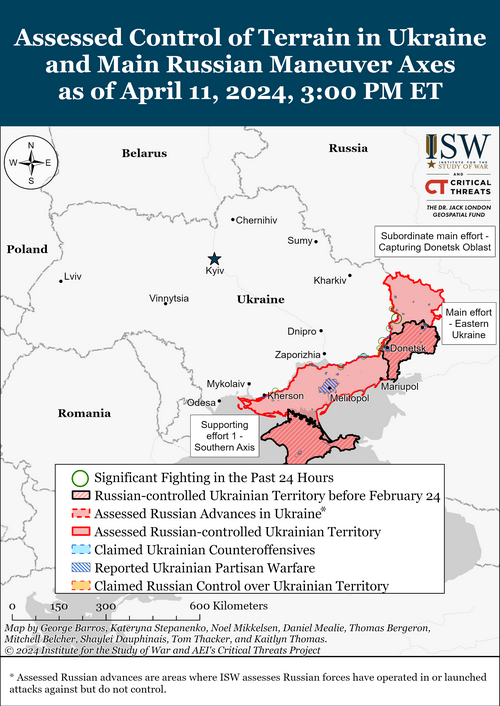
From The Institute for the Study of War:
Russian Offensive Campaign Assessment, April 11, 2024
Christina Harward, Nicole Wolkov, Angelica Evans, Riley Bailey, and Frederick W. Kagan
April 11, 2024, 6:25pm ET
Click here to see ISW’s interactive map of the Russian invasion of Ukraine. This map is updated daily alongside the static maps present in this report.
Click here to see ISW’s 3D control of terrain topographic map of Ukraine. Use of a computer (not a mobile device) is strongly recommended for using this data-heavy tool.
Click here to access ISW’s archive of interactive time-lapse maps of the Russian invasion of Ukraine. These maps complement the static control-of-terrain map that ISW produces daily by showing a dynamic frontline. ISW will update this time-lapse map archive monthly.
Note: The data cut-off for this product was 12:45pm ET on April 11. ISW will cover subsequent reports in the April 12 Russian Offensive Campaign Assessment.
Russian forces conducted another large-scale series of missile and drone strikes against Ukraine on the night of April 10 to 11 that caused notable and likely long-term damage to Ukraine’s energy infrastructure. The Ukrainian Air Force reported that Russian forces launched 82 air targets at Ukraine on the night of April 10 to 11, including 20 Kh-101/555 cruise missiles from Saratov Oblast; six Kinzhal aeroballistic missiles from Tambov Oblast; 12 S-300 anti-aircraft missiles from Belgorod Oblast; four Kh-59 cruise missiles from occupied Zaporizhia Oblast; and 40 Shahed-136/131 drones from Primorsko-Akhtarsk, Krasnodar Krai and occupied Cape Chauda, Crimea.[1] Ukrainian forces reportedly shot down 57 air targets, including 16 Kh-101/555 missiles, two Kh-59 missiles, and 39 Shahed drones.[2] Ukrainian state electricity transmission operator Ukrenergo stated that this strike series was the third large-scale Russian strike on Ukrainian electricity generation in 2024, likely referring to the March 22 and 28 strikes that damaged Ukrainian thermal and hydroelectric power plants (TPPs/HPPs).[3] Ukrainian energy company Centrenergo reported that an unspecified Russian strike destroyed the Trypilska TPP in Kyiv Oblast — the largest supplier of electricity to Kyiv, Cherkasy, and Zhytomyr oblasts.[4] Ukrainian Kharkiv Oblast Military Administration Head Oleh Synehubov stated that Russian forces conducted at least 10 strikes on critical infrastructure in Kharkiv City and Oblast.[5] Lviv Oblast Military Administration Head Maksym Kozytskyi reported that Russian forces struck a gas distribution facility and electric substation in Lviv Oblast with drones and unspecified missiles.[6] Ukraine’s Southern Operational Command reported that Russian forces damaged an energy facility in Zaporizhia Oblast with unspecified missiles, that debris from a downed drone caused a fire at an energy facility in Odesa Oblast, and that Russian forces targeted Odesa City with a Kh-31 anti-radar missile, but that the missile malfunctioned over the Black Sea.[7] Ukrainian officials also reported that an unspecified number of Russian ballistic missiles struck Mykolaiv City and that Russian guided glide bombs struck a power plant in Sumy City during the day of April 11.[8] The Wall Street Journal (WSJ) reported on April 11 that Russian strikes, not including the April 10–11 strike series, have disrupted 80 percent of the generation capacity of DTEK, Ukraine’s largest private energy company, which supplies about 20 percent of Ukraine’s power.[9] The WSJ reported that DTEK’s chief executive, Maksym Timchenko, stated that DTEK spent $110 million repairing damage during the war’s first year and that it will cost more than twice that much to fix the most recent destruction caused by Russian strikes.
Ukrainian Foreign Minister Dmytro Kuleba stated that Ukraine needs more Patriot air defense batteries to protect both Ukraine’s population centers and frontline areas. The Washington Post reported on April 10 that Kuleba is currently focusing on obtaining seven Patriot batteries from other countries as quickly as possible to defend Ukraine’s largest cities.[10] Kuleba reportedly stated that Ukraine would place at least one of these batteries closer to the frontline. Kuleba recently emphasized that Ukraine especially needs Patriot systems to defend against Russian ballistic missiles, such as Kinzhal missiles, as Ukraine’s Soviet-era air defense systems are unable to intercept these missiles.[11] Russian strikes have forced Ukraine to make difficult decisions between providing air defense coverage to large population centers in the rear and active areas on the frontline, and Russia appears to be exploiting Ukraine’s degraded air defense umbrella in an attempt to collapse Ukraine’s energy grid and constrain Ukraine’s defense industrial capacity while Russian ground forces take advantage of their ability to use air strikes on Ukrainian frontline positions to make slow but steady gains.[12] ISW continues to assess that sparse and inconsistent air defense coverage along the front has likely facilitated Russia’s intensification of guided and unguided glide bomb strikes, which Russian forces used to tactical effect in their seizure of Avdiivka in mid-February 2024 and which Russian forces appear to be using again during their current offensive operations near Chasiv Yar.[13]
The Ukrainian Verkhovna Rada adopted a new mobilization law on April 11, a significant step in addressing Ukraine’s manpower challenges amid growing manpower constraints in Ukrainian units defending on the frontline.[14] The Ukrainian General Staff reported that the new mobilization law will come into force after Ukrainian President Volodymyr Zelensky signs the law in May.[15] Ukrainian Joint Forces and “Khortytsia” Group of Forces Commander Lieutenant General Yuriy Sodol addressed the Verkhovna Rada ahead of the vote and reiterated that one of Ukraine’s main problems is its manpower challenges.[16] Sodol stated that some Ukrainian units are severely undermanned and suggested that some Ukrainian detachments are undermanned to the point that the detachment can currently only defend roughly 20 of the 100 meters a detachment at full end strength is typically able to defend. Sodol suggested that the Ukrainian military is currently deploying three partially manned brigades to cover the same area that one fully manned brigade can typically defend, forcing Ukraine to allocate additional units to defensive actions that could otherwise be resting in rear areas or preparing for future counteroffensive actions. ISW continues to assess that Ukraine’s ability to defend against Russian offensive operations and eventually challenge the theater-wide initiative depends heavily on the provision of US military assistance and the continuation of non-US military support as well as on Ukraine’s efforts to restore and reconstitute existing units and create new units.[17]
US European Command (EUCOM) Commander and NATO Supreme Allied Commander Europe (SACEUR) General Christopher Cavoli reported that EUCOM and NATO are strengthening their ability to respond to the “chronic threat” that Russia poses to global stability and European security in hopes of deterring future Russian aggression against NATO. Cavoli stated during a briefing to the US House of Representatives Armed Services Committee on April 10 that Russia poses a “chronic threat” to the world and warned that Russian President Vladimir Putin does not intend to limit or stop his aggression at the borders of Ukraine.[18] Cavoli reported that EUCOM is responding to the Russian threat by enhancing its deterrence posture across Europe, including strengthening EUCOM’s eastern flank with rotational force deployments, expanding EUCOM’s pre-positioned stocks, and modernizing EUCOM’s infrastructure to enable a rapid reception of reinforcing forces. Cavoli stated that EUCOM and NATO are exercising extensively to demonstrate their ability to defend against and deter future Russian aggression against NATO. Cavoli noted that China, Iran, North Korea, and Russia are forming “interlocking, strategic partnerships” that are antithetical to US national security interests and aim to challenge the existing global security framework. Kremlin officials, particularly Putin, are increasingly contextualizing the war in Ukraine as part of a long-term geopolitical confrontation between Russia and the West in order to justify Russia’s long-term war effort in Ukraine and future Russian aggression against other European countries.[19]
Ukraine and Latvia signed a bilateral security agreement on April 11 providing for long-term Latvian assistance and security commitments to Ukraine.[20] Ukrainian President Volodymyr Zelensky stated that the agreement will provide annual aid to Ukraine valued at 0.25 percent of Latvia’s GDP from 2024 through 2026 and confirms Latvia’s 10-year commitment to aid Ukraine in reconstruction, the protection of critical infrastructure, de-mining, unmanned technology, and cyber security.[21] Latvia will also provide about 112 million euros (about $120 million) worth of military aid to Ukraine in 2024.[22]
Russian authorities conducted a counterterrorism operation and reportedly killed two suspected terrorists in the Republic of Kabardino-Balkaria on April 11. The Russian National Anti-Terrorism Committee (NAK) stated that Russian authorities declared a counterterrorism regime in Nalchik and Chereksky Raion, Kabardino-Balkaria and killed two militants who were reportedly planning sabotage and terrorist attacks in Kabardino-Balkaria.[23] The NAK also conducted a counterterrorism operation and reportedly detained three militants in the Republic of Dagestan on March 31.[24] Russian security forces are likely intensifying counterterrorism operations in Russia — particularly in the North Caucasus, which has seen Islamic State-Caucasus Province (Wilayat al Qawqaz) and other jihadist activity over the years — due to heighted fears of terrorism in Russia following the March 22 Crocus City Hall attack. Continued Russian counterterrorism operations in the North Caucasus and intensified measures targeting Central Asian migrants in Russia are further evidence that Russian authorities actually assess that threats emanate from Russia’s Central Asian and Muslim communities instead of Ukraine despite Russian efforts to baselessly tie Ukraine to the Crocus City Hall attack.[25] ISW remains confident that Islamic State (IS) conducted the Crocus City Hall attack and has yet to observe independent reporting or evidence to suggest that an actor other than IS was responsible for or aided the attack.[26]
Key Takeaways:
- Russian forces conducted another large-scale series of missile and drone strikes against Ukraine on the night of April 10 to 11 that caused notable and likely long-term damage to Ukraine’s energy infrastructure.
- Ukrainian Foreign Minister Dmytro Kuleba stated that Ukraine needs more Patriot air defense batteries to protect both Ukraine’s population centers and frontline areas.
- The Ukrainian Verkhovna Rada adopted a new mobilization law on April 11, a significant step in addressing Ukraine’s manpower challenges amid growing manpower constraints in Ukrainian units defending on the frontline.
- US European Command (EUCOM) Commander and NATO Supreme Allied Commander Europe (SACEUR) General Christopher Cavoli reported that EUCOM and NATO are strengthening their ability to respond to the “chronic threat” that Russia poses to global stability and European security in hopes of deterring future Russian aggression against NATO.
- Ukraine and Latvia signed a bilateral security agreement on April 11 providing for long-term Latvian assistance and security commitments to Ukraine.
- Russian authorities conducted a counterterrorism operation and reportedly killed two suspected terrorists in the Republic of Kabardino-Balkaria on April 11.
- Russian forces recently made confirmed advances near Kreminna, in the direction of Chasiv Yar west of Bakhmut, and in the Donetsk-Zaporizhia Oblast border area on April 11.
- Russian exiled opposition outlet Novaya Gazeta Europe reported on April 11 that Russian courts have commuted sentences in over half of all criminal cases against Russian veterans and active-duty servicemen due to military service in Ukraine.
Go here to read the rest. We see in the Ukraine War the wages of European nations letting their militaries and their defense industries go to hell due to the defense shield of Uncle Sam. If Putin does decide to attack the Baltic Republics, all three of which are members of NATO, I think they will be shocked to learn that the Biden administration, in all likelihood, will not be riding to their rescue and going to direct war against Russia. You can have an effective military, or you can have a European st5yle womb to tomb welfare state, but you can’t have both long term.

