
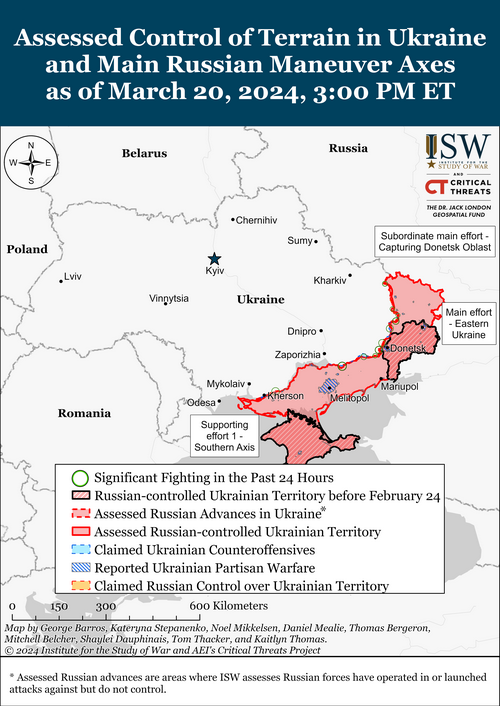
From The Institute for the Study of War:
Russian Offensive Campaign Assessment, March 20, 2024
Nicole Wolkov, Christina Harward, Riley Bailey, Karolina Hird, and Frederick W. Kagan
March 20, 2024, 6:30pm ET
Click here to see ISW’s interactive map of the Russian invasion of Ukraine. This map is updated daily alongside the static maps present in this report.
Click here to see ISW’s 3D control of terrain topographic map of Ukraine. Use of a computer (not a mobile device) is strongly recommended for using this data-heavy tool.
Click here to access ISW’s archive of interactive time-lapse maps of the Russian invasion of Ukraine. These maps complement the static control-of-terrain map that ISW produces daily by showing a dynamic frontline. ISW will update this time-lapse map archive monthly.
Note: The data cut-off for this product was 12:30 pm ET on March 20. ISW will cover subsequent reports in the March 21 Russian Offensive Campaign Assessment.
Several Russian financial, economic, and military indicators suggest that Russia is preparing for a large-scale conventional conflict with NATO, not imminently but likely on a shorter timeline than what some Western analysts have initially posited. Russian President Vladimir Putin met with the leaders of Russian State Duma factions on March 19 and outlined priorities for his fifth presidential term.[1] Putin emphasized the importance of developing the Russian economy and expanding the social programs announced in his February 29 address to the Federation Council.[2] Putin claimed on March 19 that he personally witnessed how corporate interests fueled appointments to legislative bodies while he was working in Leningrad and later St Petersburg, although he himself likely made substantial commissions from illegally endorsed contracts and licenses while serving as St. Petersburg Deputy Mayor and Head of Committee.[3] Putin urged the Russian State Duma faction leaders to act in the interest of the state instead of corporations or parties and emphasized the importance of appointing people based on skill and competence. Putin similarly criticized the Russian “elite” in his February 29 Federation Council address by claiming that the individuals who “lined their pockets” in the 1990s are not the elite, but that the “real elite” are workers and military servicemen who proved their loyalty to Russia.[4]
Putin is likely attempting to set conditions to stabilize Russia’s long-term financial position at a higher level of government expenditure and is signaling that Russia’s long-term financial stability will require imposing at least some pain on some wealthy industrialist siloviki (Russian strongmen with political influence). Putin likely understands that financial crackdowns against industrialist siloviki could risk the political rapport Putin has built with them and is trying to mitigate those consequences. Russia does not appear to be facing imminent financial crisis, and increased military spending has been the most significant change in Russian budgetary policy, so efforts to secure Russia’s financial future are much more likely intended to set long-term conditions than to address immediate financial concerns.[5] Russia continues efforts to circumvent international sanctions, and the International Monetary Fund assessed that Russia’s GDP will grow by 2.6 percent in 2024 and reported that Russia’s GDP grew faster than all Group of Seven (G7) countries’ economies in 2023.[6]
Polish President Andrzej Duda emphasized in a March 20 interview with CNBC that Putin is intensifying efforts to shift Russia to a war economy with the intention of being able to attack NATO as early as 2026 or 2027, citing unspecified German research.[7] Danish Defense Minister Troels Lund Poulsen stated on February 9 that new intelligence indicates that Russia may attempt to attack a NATO country within three to five years, an accelerated timeline from NATO’s reported assessment in 2023.[8] The timeline for the reconstitution of a significant Russian conventional military threat depends heavily on the financial resources Putin is willing to put against military efforts. In the absence of other explanations for Putin’s apparent preparations to risk damaging his relationship with wealthy Russian clients and in the context of continuing announcements of plans to expand the Russian military considered below, Putin’s attempts to set conditions to stabilize Russia’s economy and finances are most likely part of Russian financial and domestic preparations for a potential future large-scale conflict with NATO and not just for a protracted war in Ukraine.
The Russian military continues to undertake structural reforms to simultaneously support the war in Ukraine while expanding Russia’s conventional capabilities in the long term in preparation for a potential future large-scale conflict with NATO. Russian Defense Minister Sergei Shoigu addressed the Russian MoD board on March 20 and discussed ongoing Russian military reforms intended to increase the Russian military’s combat capabilities.[9] Shoigu reported that Russia has formed the “Dnepr River Flotilla” and a “brigade” of boats as part of the flotilla. The Dnepr River Flotilla is the historical name of various special military river units that were active during the Russo-Turkish wars in 1735-1739 and 1787-1792, the Russian Civil War, and World War II, but this is the first time that Russian military officials have confirmed the formation of the Dnepr River Flotilla in relation to the ongoing war in Ukraine.[10] The Dnepr River Flotilla would most likely be deployed along with the Dnepr Grouping of Forces in Kherson Oblast and will likely defend against Ukrainian cross-river raids and counteract Ukrainian efforts to sustain a limited presence in left (east) bank Kherson Oblast. The size and level of equipment of the Dnepr River Flotilla remains unclear, but the Russian military command may also intend to use it to support Russian cross-river raids and attempts to land in Ukrainian-controlled west (right) bank Kherson Oblast. Russian and Ukrainian sources confirmed that Russian forces were able to conduct a limited raid and temporarily land in west bank Kherson Oblast on March 13, and the Dnepr River Flotilla could feasibly support further such cross-river attempts.[11] It is unlikely that the Dnepr River Flotilla has the manpower and equipment necessary to establish an enduring large-scale Russian presence in west bank Kherson Oblast or credibly threaten to re-occupy significant territory in Kherson Oblast at this time, but the presence of a new formation in this area may force Ukraine to commit manpower and scarce materiel to an axis that has been relatively inactive since November 2022. The deployment of the Dnepr River Flotilla may force the Ukrainian command to make challenging decisions about resource attribution as it husbands limited stores of artillery ammunition and other critical military equipment.
Shoigu outlined several ongoing efforts to bolster Russia’s conventional military capabilities, more likely as part of Russia’s long-term effort to prepare for a potential conventional war with NATO than as part of the war against Ukraine. Shoigu stated that Russia has formed an army corps (AC) (likely either in reference to the AC currently forming in Karelia or to the 40th AC, which has deployed to Kherson Oblast) and a motorized rifle division (potentially in reference to the 67th Motorized Rifle Division, which is committed to the Kharkiv-Luhansk Oblast line as part of the new 25th Combined Arms Army).[12] Shoigu also claimed that the Russian military plans to form two combined arms armies (CAAs) and 14 divisions, and 16 brigades by the end of 2024. Russia formed two new CAAs — the 25th and the 18th — in 2023, and it is unclear if Shoigu is suggesting that Russia intends to stand up two additional CAAs over the course of 2024.[13] Shoigu initially announced in January 2023 that Russia would also create three new motorized rifle divisions, two new air assault divisions, and reorganize seven motorized rifle brigades into motorized rifle divisions, and Shoigu’s March 20 speech did not differentiate between air assault and motorized rifle divisions, so it is likely that Shoigu is suggesting that Russia will stand up two new divisions in 2024 in addition to the 12 divisions (air assault and motorized rifle, inclusive) he announced in January 2023. ISW continues to assess that Russia currently lacks the manpower, military infrastructure, and training capacity to properly staff several entirely new divisions to army-level formations to full end strength in the immediate to medium term.[14] Such reforms, however, are more likely intended to build out Russia’s long-term military capabilities vis-a-vis NATO, as opposed to immediately creating and staffing new formations up to the army level.
Ongoing personnel changes within the Russian MoD may be further indicators of Russia’s preparations for a conflict in the long term. Shoigu introduced Lieutenant General Andrei Bulyga as the Deputy Defense Minister for logistics support during the MoD address on March 20, confirming the Russian MoD’s initial announcement of Bulyga’s appointment on March 11.[15] The Russian Armed Forces Headquarters of Logistics Support, which Bulyga now heads, is intended to organize and coordinate logistical support for Russian troops in both peacetime and wartime.[16] Bulyga’s appointment is unlikely to remedy logistics and support issues faced by Russian troops in Ukraine in the immediate term, but Bulyga may spearhead reforms to the logistics headquarters that will have more noticeable impacts in the medium to long term. Bulyga will likely task his department with addressing logistical issues to support the ongoing conventional military reforms, setting conditions for longer-term efforts to build out Russia’s conventional capabilities.
The Ukrainian Main Military Intelligence Directorate (GUR) reportedly conducted a drone strike against a Russian air base in Saratov Oblast on March 20 amid further indications that Ukrainian drone strikes within Russia are achieving limited asymmetric effects against Russian military assets and economic output. Ukrainian and Western media reported that the GUR struck unspecified targets at the Engels air base in Saratov Oblast with Ukrainian-produced drones.[17] Satellite imagery indicates that there were 11 Russian aircraft present at the air base on March 19, although ISW has yet to observe any visual confirmation that Ukrainian forces struck Russian aircraft at Engels-2 Air Base.[18] The Russian MoD claimed that Russian forces destroyed four Ukrainian drones over Saratov Oblast, and Saratov Oblast Governor Roman Busargin claimed that the strikes did not cause any damage.[19] Geolocated footage from Engels includes the sound of loud explosions from nearby but is unclear if the footage depicts strikes against targets in Engels or the sound of Russian air defense striking aerial targets.[20]
Recent Ukrainian drone strikes against oil refineries within Russia may have significantly disrupted Russia’s refining capacity. Bloomberg reported on March 20 that Ukrainian drone strikes may have disabled up to 11 percent of Russia’s total refining capacity.[21] Torbjorn Tornqvist, Chief Executive Officer of multinational energy commodities trading company Guvnor, estimated on March 18 that Ukrainian strikes have taken 600,000 barrels of daily Russian oil refining capacity offline, and American multinational financial institution JPMorgan Chase and Co. estimated that the strikes have taken 900,000 barrels of daily refining capacity offline.[22] The decline in Russia’s refining capacity appears to have prompted a surge in gasoline and diesel prices on the St. Petersburg International Mercantile Exchange, but only a marginal increase in the cost of domestic fuel prices within Russia.[23] Russian Energy Minister Nikolai Shulginov stated on March 20 that the Russian Energy Ministry expects refining volumes to remain roughly the same in 2024 as in 2023, although Russian Deputy Energy Minister Pavel Sorokin stated on March 14 that a possible reduction in primary oil refining in 2024 would likely lead to increases in Russian crude oil exports (since Russia would not be able to refine as much as it usually does).[24] Tornqvist estimated that offline Russian refining capacity will likely immediately impact Russian distillate exports (petroleum products produced in conventional distillation operations).[25] ISW has yet to observe reports of decreased Russian crude oil and petroleum product exports following Ukrainian strikes on Russian oil refineries in recent weeks. Russia relied on oil revenues to buoy federal budgets amid increased spending on its war in Ukraine in 2023, and significant constraints on Russian oil exports could have substantial impacts on Russia’s ability to balance a record level of defense spending in 2024 with its commitments on social spending.[26]
Ukrainian drone strikes against targets within Russia are also likely increasing pressures on available Russian air defense assets. Director of the Russian Energy Ministry’s Department for the Development of the Gas Industry Artem Verkhov stated on March 19 that the Russian Energy Ministry is working with Rosgvardia on proposals to deploy Pantsir-S1 air defense systems to strategic energy facilities within Russia.[27] GUR spokesperson Andriy Yusov stated that Russia has already deployed Pantsir air defense systems at energy facilities, however, and that Russian claims about the planned deployments are meant to reassure the Russian public.[28] Previous Ukrainian drone strikes against strategic targets in Moscow and Leningrad oblasts may have fixed Russian short-range air defenses along expected flight routes, and Russian ultranationalists have recently complained about a lack of available air defense assets in other Russian federal subjects in deep rear areas.[29] The Ukrainian ability to target Russian military infrastructure within Russia, threaten Russian oil refining and exports, and increase pressure on Russia’s air defense umbrella demonstrates that Ukraine can achieve asymmetrical impacts through strikes with limited numbers of mostly domestically produced drones.
Kremlin-affiliated actors in the pro-Russian Moldovan autonomous region of Gagauzia are invoking narratives that mirror previous Russian claims about Ukraine in the years leading up to Russia’s 2022 full-scale invasion of Ukraine, likely as part of the Kremlin’s wider hybrid efforts to destabilize Moldova. Yevgenia Gutsul, the governor of Gagauzia, stated in an interview with Russian outlet Izvestia published on March 20 that she would like Gagauzia to receive “zashchita” (a word that means both “defense” and “protection”) from Russia so that Gagauzian residents can have the right to a prosperous life, Gagauzian farmers can export their products to Russia, and Gagauzia can receive gas at a lower price — points Gutsul recently claimed she spoke about with Russian President Vladimir Putin.[30] Gutsul also claimed that Gagauzia is not considering leaving Moldova but wants the Moldovan government to observe the 1994 law on Gagauzia’s “special legal status” and implied that Gagauzia would consider leaving if this condition was not met.[31] Gutsul has recently drawn increased attention to the fact that Moldovan President Maia Sandu has not signed the decree to confirm Gutsul as a member of the Moldovan government, as required by the 1994 law.[32] Sandu stated in September 2023, however, that she would not sign the decree until the Moldovan Prosecution Service completed its investigation regarding corruption and bribery in the Gagauzia gubernatorial elections that brought Gutsul to power.[33]
Gutsul’s claims that the Moldovan government is not adhering to the law on Gagauzia’s special status parallel the Kremlin’s previous accusations that Ukraine did not adhere to the Minsk Agreements’ stipulations on the “special status” for the Donetsk People’s Republic (DNR) and Luhansk People’s Republic (LNR).[34] Kremlin officials and mouthpieces and Transnistrian authorities have also similarly claimed that Moldova abandoned the 5+2 negotiating process that aimed to resolve the decades-long conflict in Moldova’s other pro-Russian region, the breakaway republic of Transnistria.[35] The Kremlin has notably claimed that Ukraine’s alleged violations of the Minsk Agreements “forced” Russia to launch its full-scale invasion of Ukraine in 2022.[36] The Seventh Congress of Transnistrian Deputies on February 28 formally requested unspecified “zashchita” from Russia in response to alleged increasing pressures from Moldova.[37] ISW previously assessed that the use of a word that means both “defense” and “protection” was likely intended to set conditions for the Kremlin to interpret “defense” in a military sense if it so chooses.[38] Gutsul’s use of “zashchita” and the fact that both Transnistrian and Gagauzian authorities have invoked narratives that mirror those surrounding the Minsk Agreements in a major Russian publication suggest that the Kremlin is orchestrating a wider effort between pro-Russian actors in Gagauzia and Transnistria as part of the Kremlin’s ongoing hybrid operations to destabilize Moldova from within.[39]
Moldovan Interior Minister Adrian Efros stated on March 20 that the recent footage of a single drone allegedly flying from the direction of Odesa Oblast and striking a helicopter on the territory of a military unit in Transnistria is a video “montage” meant to cause panic and fear and that there was actually no explosion.[40] The Transnistrian Ministry of State Security (MGB), which is reportedly a “department” of the Russian Federal Security Service (FSB), responded to Efros’ statement and stated that it will present all available “evidence” of the incident to Interpol for assistance in an investigation.[41] ISW previously assessed that Russia or Russian-linked actors would likely be the beneficiaries of the alleged drone strike in Transnistria.[42] Russia or Russian-linked actors would also likely benefit from the dissemination of fake footage of a drone strike in Transnistria that heightens tensions between Transnistrian and Moldovan authorities and that the Kremlin could use to justify any future Russian activity in Transnistria. ISW cannot independently verify the details of the singular drone strike in Transnistria, but it is consistent with the way that Russia staged provocations in Donbas leading up to the 2022 full-scale invasion.
Key Takeaways:
- Several Russian financial, economic, and military indicators suggest that Russia is preparing for a large-scale conventional conflict with NATO, not imminently but likely on a shorter timeline than what some Western analysts have initially posited.
- The Russian military continues to undertake structural reforms to simultaneously support the war in Ukraine while expanding Russia’s conventional capabilities in the long term in preparation for a potential future large-scale conflict with NATO.
- GUR reportedly conducted a drone strike against a Russian air base in Saratov Oblast on March 20 amid further indications that Ukrainian drone strikes within Russia are achieving limited asymmetric effects against Russian military assets and economic output.
- Kremlin-affiliated actors in the pro-Russian Moldovan autonomous region of Gagauzia are invoking narratives that mirror previous Russian claims about Ukraine in the years leading up to Russia’s 2022 full-scale invasion of Ukraine, likely as part of the Kremlin’s wider hybrid efforts to destabilize Moldova.
- Russian forces recently made confirmed advances near Kreminna and Donetsk City on March 20.
- The Russian military continues to train drone operators for operations in Ukraine.
Go here to read the rest.
From Strategy Page:
March 20, 2024: Hard limits are appearing on Russia’s ability to continue the Ukraine war. It has begun running out of tube artillery (as opposed to rocket artillery) and light armored fighting vehicles (AFVs). The artillery shortage is because tube artillery barrels are wearing out, while the light AFV shortage is because so many have been lost in combat.
Russia’s stocks of self-propelled tube artillery pieces were eliminated by combat losses in the Ukraine, worn-out barrels or exploded from firing with worn-out barrels, and were replaced by towed artillery from its reserve stocks. Now the Russians have lost, worn out or almost worn out everything but their oldest reserve tube artillery, 50+ year-old 122mm towed guns of which they allegedly had about 4,000 in 2021. These are Russia’s last artillery reserve, are being put into service now and, when those are worn out this year, Russia’s tube artillery park will be reduced to their current production of about 200 yearly tube artillery pieces. At that point Russia can no longer continue the war unless their 2024 production increases to at least 2000 a year.
The barrels of tube artillery pieces have a crucial inner sleeve called a barrel “liner” composed of better quality steel than the barrel and coated with special chemicals for greater resistance to super-hot propellant charge gases when fired. Spiral grooves (lands) cut into it engage the rotation bands around artillery shells to rapidly spin them when fired for greater accuracy. Barrel liners are commonly replaced when worn out during peacetime. This makes the more expensive artillery tube last longer.
No country is known to keep spare barrel liners in reserve for wartime, and it takes as long to create new liner manufacturing capability as it does for whole barrels – about two years. If Russia or any other country started developing new liner and barrel manufacturing capability immediately after the Ukraine war started, it will come online sometime this summer. That is unlikely. No one expected a long war. If anyone has done that, they’d more likely have started in late 2022 or early 2023.
Barrel liners incur wear with each shell fired. How much depends on many factors, particularly including how rapidly successive shells are fired, the size of the propellant charge (bigger for longer range), etc. Barrel liners have a useful lifetime of 1000 (for Russia) to 1500-2000 (for NATO countries and South Korea) rounds before needing replacement.
Artillery tubes with liners beyond recommended lifetimes can still be fired with rapidly decreasing range and accuracy such that firing of 5-20 times as many shells is required for the same results as one shell from tubes with useable liners. Worse, erosion of the barrel tube itself, once the liner is gone, produces pitting and eventually defects so bad that shells detonate in the tube producing an “exploding cigar” effect at the end of the barrel, and death or wounds to half or all of the crew. The Russians have consistently done that in the Ukraine war.
The range of the 122mm tube artillery pieces is so low that they will generally be fired with full propellant charges (maximum corrosive effect) at their extreme ranges to increase their survivability against Ukrainian UAV attack. All this means that the average number of shells they can fire before their liners wear out, and the tube steel itself is too corroded for safe firing by even Russian standards, is probably under half the 2,000 rounds the Russians have been firing from their now useless larger caliber towed and self-propelled artillery.
It is highly likely, given Russian corruption and maintenance standards, that only about 3,000 of the nominally available 4,000 pieces of 122mm artillery can be made ready for service. If those can safely fire only about 1000 rounds each, the Russian tube artillery park can only fire three million rounds before becoming useless, which is about their expected three million rounds of shell production for 2024.
The Russians began the war with about 27,000 light armored fighting vehicles in their active army and in reserve stocks. Half of those have been lost so far. New Russian production of those has been only several hundred a year. The number of Russian light AFV in the field is now plunging because they can no longer replace losses from reserve stocks. That is shown by increasing Russian use of imported Chinese farm tractor carts (which look like big golf carts) to transport troops on roads, off roads, and through mud and heavy snow.
Go here to read the rest. Putin has not mobilized Russia, and Russia is not the giant of producing military hardware that the old Soviet Union was during World War II, and when Stalin could lower civilian living standards to just a bit above that of prisoners in the Gulag. Putin lacks the power and the Russians lack the will. Also World War II era technology was simplicity itself compared to most modern weapon systems.


Very troubling: (from ISW assessment above)
“Polish President Andrzej Duda emphasized in a March 20 interview with CNBC that Putin is intensifying efforts to shift Russia to a war economy with the intention of being able to attack NATO as early as 2026 or 2027, citing unspecified German research.[7] Danish Defense Minister Troels Lund Poulsen stated on February 9 that new intelligence indicates that Russia may attempt to attack a NATO country within three to five years, an accelerated timeline from NATO’s reported assessment in 2023.”
Houthis have announced they will no longer target Russian and Chinese ships after a military assistance deal. Demonstrates Russian desire for expansion and previous correct Saudi decision to attack the Houthis.
Alliances are being forged … battle lines are being drawn …
Ever feel like a pawn on a chessboard?
Russian minorities are not much happier with their new czar than with previous ones. Despite recent relative calm, Chechens are always ready to cause problems. Putin has not been taking very good care of the home front.
Let us pray that Putin stays put while Biden is president and that the Democrats do not win in Nov 2024.
Donald Link:
Putin may end up like Justinian, throwing all his resources west and neglecting his east end. I don’t get how a guy who can’t defeat Ukraine can think he could take NATO. He can’t (or won’t) produce enough domestically and has to scrape his prisons and hire foreigners for soldiers. All his immediate neighbors and now France and Britain are fully aware of his intentions, so there would be no surprise. I don’t confuse evil with madness, but is evil finally turning Putin mad?
Unfortunately for 40 Russian civilians, I may have been right. Looks like the East (Chechen terrorism) has struck in Moscow.