
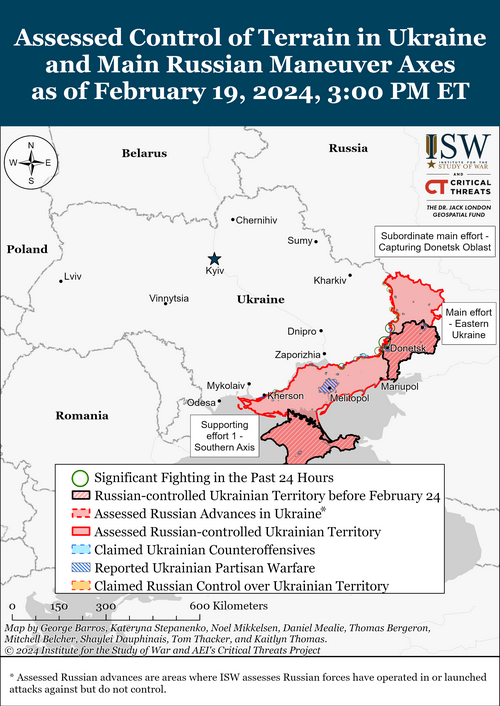
From The Institute for the Study of War:
Russian Offensive Campaign Assessment, February 19, 2024
Angelica Evans, Nicole Wolkov, Christina Harward, Riley Bailey, George Barros, and Frederick W. Kagan
February 19, 2024, 7:15pm ET
Click here to see ISW’s interactive map of the Russian invasion of Ukraine. This map is updated daily alongside the static maps present in this report.
Click here to see ISW’s 3D control of terrain topographic map of Ukraine. Use of a computer (not a mobile device) is strongly recommended for using this data-heavy tool.
Click here to access ISW’s archive of interactive time-lapse maps of the Russian invasion of Ukraine. These maps complement the static control-of-terrain map that ISW produces daily by showing a dynamic frontline. ISW will update this time-lapse map archive monthly.
Note: The data cut-off for this product was 1:30pm ET on February 19. ISW will cover subsequent reports in the February 20 Russian Offensive Campaign Assessment.
Russian actors conducted a cyber operation regarding Russia’s seizure of Avdiivka, likely aimed at generating panic in the Ukrainian information space and weakening Ukrainian morale. Ukraine’s State Special Communication Service reported on February 18 that Russian actors hacked well-known Ukrainian media outlets and posted fake information on their social media channels.[1] Ukrainian outlets Ukrainska Pravda, Apostrophe, Liga.net, and Telegraf reported on February 18 that their social media accounts were hacked and that hackers posted disinformation, specifically about the alleged widespread destruction of Ukrainian forces in Avdiivka.[2] The Russian Ministry of Defense (MoD) issued new claims about the Ukrainian withdrawal from Avdiivka on February 19 aimed at sowing resentment and distrust against the Ukrainian command, and other Russian sources amplified this information operation.[3]
The tempo of Russian offensive operations near Avdiivka has reportedly dramatically slowed following the Russian seizure of Avdiivka. Ukrainian Tavriisk Group of Forces Spokesperson Dmytro Lykhoviy reported on February 19 that the number of Russian attacks in the Avdiivka direction significantly decreased in the past day and that Russian forces are currently regrouping and conducting clearing operations in Avdiivka.[4] Lykhoviy noted that Russian shelling and aviation activity has also significantly decreased in the area.[5] Ukrainian officials reported that Ukrainian forces have withdrawn to a new line of defense, which Ukrainian forces previously prepared in advance and fortified at “several levels.”[6] Russian forces will likely have to conduct an operational pause before resuming significant offensive operations in the Avdiivka direction or will have to transfer additional reinforcements from other sectors of the front to the area to prevent operations near Avdiivka from culminating. Russian forces have reserves available for such reinforcement in other sectors, but ISW has observed no indication that the Russian command is moving those reserves toward Avdiivka at this time. Lykhoviy and Ukrainian Khortytsia Group of Forces Spokesperson Captain Ilya Yevlash, on the contrary, stated that the Russian command will likely transfer Russian forces accumulated around Avdiivka to other, unspecified areas of the frontline in the near future.[7] Yevlash stated that it will likely take Russian forces at least a week to transfer units from Avdiivka into battle in unspecified frontline areas.[8] ISW has not yet observed any indications of how Russian forces will choose to allocate their manpower currently deployed to the Avdiivka area.
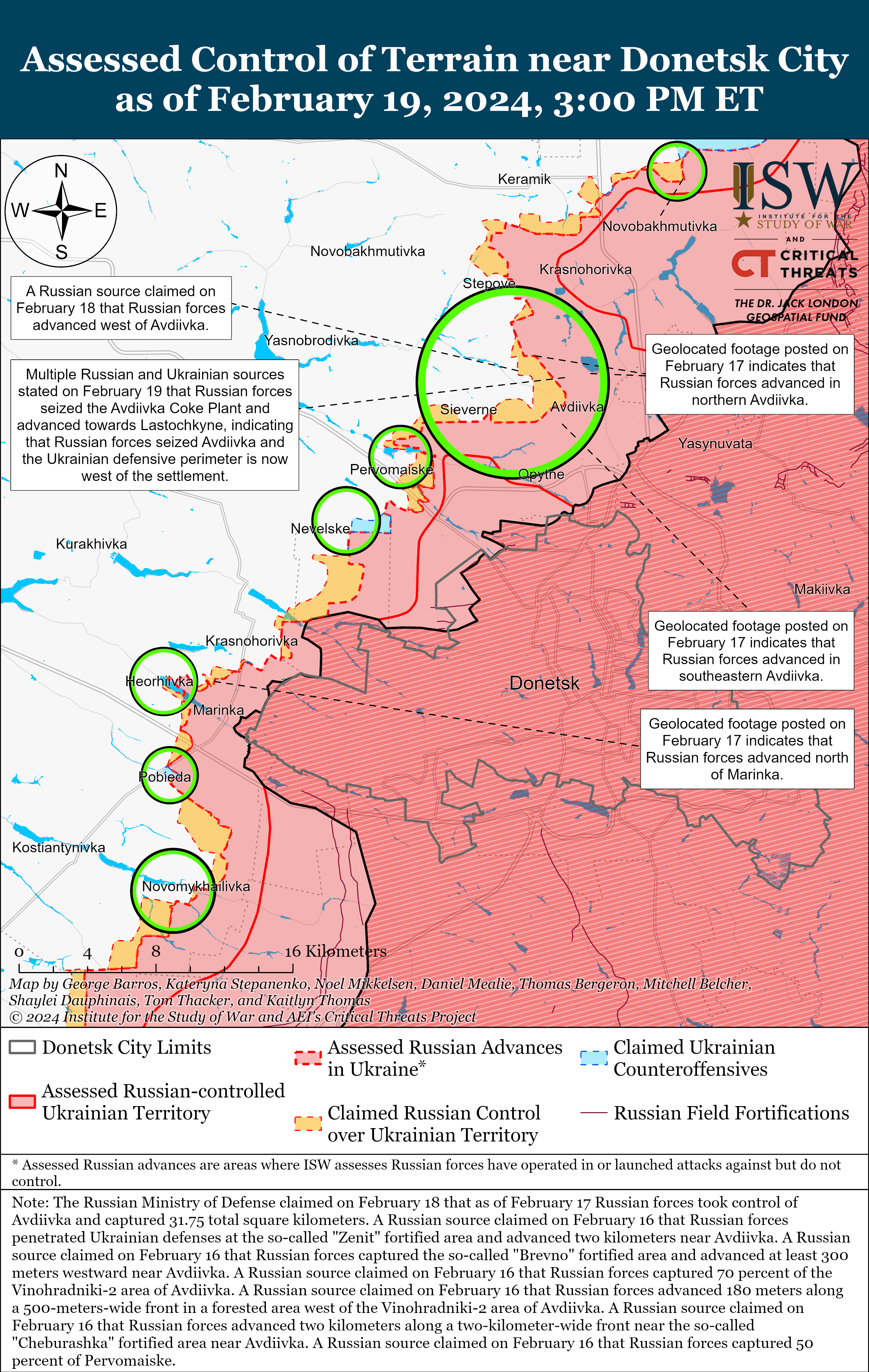
Ukrainian officials reported that Ukrainian forces shot down two more Russian fighter aircraft, a Su-34 and a Su-35S, in eastern Ukraine on the morning of February 19.[9] Ukrainian Commander-in-Chief Colonel General Oleksandr Syrskyi reported that the Russian aircraft were striking Ukrainian positions with glide bombs when Ukrainian air defenses destroyed the planes.[10] Ukrainian forces also shot down two Su-34s and one Su-35 over Donetsk Oblast on February 17 and another Su-34 in eastern Ukraine on February 18.[11] Russian forces appear to have temporarily established limited and localized air superiority during the final days of their offensive operation to seize Avdiivka, but Ukrainian air defenders appear to be challenging Russian air operations in eastern Ukraine once again.[12]
The White House is reportedly considering the provision of long-range ATACMS missiles to Ukraine in the event that Congress passes security assistance for Ukraine. NBC News reported on February 19 that two US officials stated that the White House is working to provide Ukraine with long-range ATACMS missiles in one of the first packages of military aid to Ukraine if Congress approves funding for further security assistance to Ukraine.[13] The US previously provided Ukraine with a limited number of a different type of ATACMS missile that have a shorter range.[14] Ukraine conducted successful ATACMS strikes in October 2023 but did not have enough supplies to sustain a strike campaign with ATACMS that could have presented operational challenges for Russian forces in Ukraine, particularly for Russian aviation operations and for the storage and supply of ammunition.[15] NBC News reported that the US officials also stated that the US has artillery systems and ammunition prepared for immediate transfer to Ukraine if Congress approves funding for US security assistance to Ukraine.[16] Ukrainian long-range strike capabilities allow Ukrainian forces to degrade Russian logistics at depth, and sufficient artillery systems and ammunition are crucial for effective Ukrainian counterbattery fire.
The Russian government eased the requirements for “compatriots” living abroad to apply to resettle in Russia. The Russian government announced on February 17 that it will no longer require “compatriots” abroad to prove their Russian-language proficiency when applying for resettlement in Russia if the individual is a Russian citizen permanently residing abroad; an individual who previously renounced Russian citizenship; an individual who was born or permanently resided in the Soviet Union and had Soviet citizenship; or an individual who has relatives who were born or permanently resided on territory formerly part of the Soviet Union or Russian Empire.[17] The Russian government stated that the changes in the requirements for resettlement in Russia follow a January 1, 2024, Russian presidential decree to “support compatriots from unfriendly countries.” The Kremlin has repeatedly claimed that the Russkiy Mir — purposefully vaguely defined as including ethnic Russians, Russian language-speakers, and any territory and people formerly ruled by the Soviet Union and the Russian Empire — includes Ukrainians and that Russia’s invasions of Ukraine were allegedly in defense of “compatriots abroad” in Ukraine.[18] Russian President Vladimir Putin further expanded the definition of the Russian World in a speech in late November 2023 to include “those who consider themselves carriers of the Russian language, history, and culture regardless of their national or religious affiliation.”[19] Putin’s stated goals of “uniting” and maintaining control over the Russkiy Mir is part of Russia’s larger imperialist ambitions, and Russia may continue to enact measures in accordance with the purposefully broad Russian World framework to manufacture territorial claims against neighboring states, including NATO members.
Emirati banks reportedly began to limit some transactions with Russian entities and close Russian citizens’ accounts in September 2023 due to the risk of Western secondary sanctions. Russian outlet Vedomosti reported on February 19 that three businesspeople working in the UAE and a representative of the Russian “Delovaya Rossiya” organization stated that banks in the UAE are not accepting deposits from or making payments to Russian entities and are closing accounts of companies whose owners are Russian citizens for unclear reasons.[20] Vedomosti reported that one of the sources stated that the “purges” began in September 2023. A source close to the Russian Cabinet of Ministers reportedly stated that the Russian government is aware of the problem but considers it “not critical and solvable.” Vedomosti sources indicated that the problems with the banks can be solved, for example by using local connections and avoiding any connections with entities under Western sanctions. Bloomberg reported in November 2023 that Emirati banks increasingly faced US pressure and began to work to prevent sanctions evasion by rejecting Russian firms.[21] At least two state-owned Chinese banks reportedly ordered reviews of their business with Russian clients in January 2024 and will sever ties with sanctioned Russian entities and entities with ties to the Russian defense industry.[22] Turkish banks have also reportedly started to close Russian companies’ accounts.[23]
Armenian Prime Minister Nikol Pashinyan reiterated that Armenia does not support Russia’s full-scale invasion of Ukraine against the backdrop of deteriorating Russian–Armenian relations. Pashinyan stated on February 19 at the Munich Security Conference that “Armenia is not Russia’s ally in the matter of Ukraine.”[24] Pashinyan highlighted the 1991 Alma-Ata Declaration that founded the Commonwealth of Independent States (CIS) and recognized the territorial integrity of its 11 signatories, including Russia and Ukraine.[25] Kremlin officials and mouthpieces have increasingly promoted narratives about Russia’s alleged continued influence in Armenia and criticized Pashinyan’s policies.[26]
Key Takeaways:
- Russian actors conducted a cyber operation regarding Russia’s seizure of Avdiivka, likely aimed at generating panic in the Ukrainian information space and weakening Ukrainian morale.
- The tempo of Russian offensive operations near Avdiivka has reportedly dramatically slowed following the Russian seizure of Avdiivka.
- Ukrainian officials reported that Ukrainian forces shot down two more Russian fighter aircraft, a Su-34 and a Su-35S, in eastern Ukraine on the morning of February 19.
- The White House is reportedly considering the provision of long-range ATACMS missiles to Ukraine in the event that Congress passes security assistance for Ukraine.
- The Russian government eased the requirements for “compatriots” living abroad to apply to resettle in Russia.
- Emirati banks reportedly began to limit some transactions with Russian entities and close Russian citizens’ accounts in September 2023 due to the risk of Western secondary sanctions.
- Armenian Prime Minister Nikol Pashinyan reiterated that Armenia does not support Russia’s full-scale invasion of Ukraine against the backdrop of deteriorating Russian-Armenian relations.
- Russian forces recently made confirmed advances near Donetsk City and in western Zaporizhia Oblast.
- Russian Security Council Deputy Chairperson Dmitri Medvedev claimed on February 19 that the Russian Ministry of Defense (MoD) has recruited more than 53,000 military personnel since January 1, 2024.
- Russian authorities have reportedly returned Ukrainian children in occupied Ukraine and Russia to relatives in Ukraine.
Go here to read the rest.
From Strategy Page:
February 19, 2024: The invasion of Ukraine led to unexpectedly large Russian casualties. Russia had to conscript more medical personnel to provide their troops with adequate, at least by low Russian standards, medical care. The unexpected conscription of medical personnel caused many Russian medical personnel to leave the country. After recertification, Russian doctors can make a better living in the west. The Russian government tried to deal with the exodus of medical personnel but between the relatively low pay in Russia, government efforts to transfer medical personnel to the many rural provinces with minimal medical services and now the increased medical needs of the military, a growing number of Russian medical personnel are leaving Russia.
Some things never change in Russia and one item is medical care. Russia never was able to establish a nationwide healthcare system or a military health system comparable to those found in the west. This was especially noticeable in the military. Russian medical care in combat units, especially during combat, was never very effective and often not even available.
In the combat zone there was poor or nonexistent medical treatment for the wounded. It was the same for diseases that of the breakout among troops in the combat zone. At one point Russian troops in Ukraine suffered from what was called mouse fever and received little treatment. This meant a growing number of Russian troops were disabled by the mouse fever, which Russian military medical personnel have been slow to deal with. In part that’s because this is a new ailment, and the Russian medical community has not yet found a way to effectively cope.
It’s a different situation with Ukrainian troops, where the army has been quick to adopt western military practices. The traditional Ukrainian military feldsher, or medic with practical but no formal medical training, received more training and better equipment than their Russian counterparts. The results have been dramatic.
About 40 percent of Russian casualties die compared to only 20 percent of Ukrainian casualties because the Russians in this war often get no battlefield medical treatment whatsoever. The Ukrainians eagerly adopted western combat medical practices, which were above average during World War Two and continued to improve after that war. Subsequently western forces have at least minimal battle treatment, largely by getting the wounded off the battlefield to be treated by medics and eventually sent to field hospitals where surgery and other emergency treatment was available. It has long been known that wounded soldiers in freezing conditions died of exposure or shock within about an hour unless they are carried to shelter, but that is not happening for Russian soldiers in this war at all even though it was done somewhat during World War Two. Soviet field medics then were generally women with no medical training whose major job was to crawl out into battlefields with groundsheets, roll wounded soldiers onto those, and then drag them back to an aid station. There are no such Russian female medics in this war so wounded who cannot themselves crawl to a rear aid station generally die. Prospective recruits know this and that’s another reason for avoiding military service.
One of the more amazing, and underreported, aspects of the wars in Iraq and Afghanistan, are the dramatically lower American casualties compared to Vietnam, and previous 20th century wars. The casualty rate in Iraq was a third of what it was in Vietnam. It was even lower in Afghanistan and all subsequent conflicts. Medical care had gotten much better, quicker, and faster. Not only were procedures more effective, but badly wounded soldiers got to the operating table more quickly. Field medics now had capabilities that, during Vietnam, only surgeons had. All this is one reason why the ratio of wounded to killed was 6 in Vietnam, compared to 7.3 for Iraq. In Ukraine, Ukrainian troops benefit from these changes, their Russian adversaries do not.
The fighting in Iraq and Afghanistan has brought about a major change in how the United States handled combat casualties. The result was over 90 percent of the wounded troops survived their wounds. That’s the highest rate in history. There are several reasons for this. The main one is that medics, and the troops themselves, are being trained to deliver more complex and effective first aid more quickly. Military doctors now talk of the platinum 10 minutes, meaning that if you can keep the wounded soldier, especially the ones who are badly hurt, alive for ten minutes, their chances of survival go way up. Before that the goal was the golden hour. That reduced deaths among wounded troops, but the ten minute goal reduced the death rate to a much greater extent.
Medics have been equipped and trained to perform procedures previously done only by physicians, while troops are trained to do some procedures previously handled only by medics. This skill upgrade is made possible by a number of factors.
First, over the last few decades, there has been continuous development in methods and equipment for emergency medicine practiced by ambulance crews and staff in emergency rooms. These practices were initially slow to be adopted by the military. Two decades ago, because of the fighting in Iraq, it had nearly all been adopted by military medical personnel. This was often due to medics in reserve units often having full time jobs as emergency medical personnel.
As much as combat deaths have been reduced in the last decade, by more than half, there are still some types of wounds for which there is no battlefield treatment, meaning the victim will die before more extensive treatment can be obtained. Chief among these are abdominal wounds, where the abdominal aorta is opened. When that happens the victim bleeds to death in minutes. Now there is a solution for this in the form of a belt that is placed on the abdomen and activated. A bladder inflates which puts sufficient pressure on the abdominal aorta to stop the bleeding or reduce it enough to make it possible to get the casualty to a surgeon.
While tourniquets have been around for thousands of years, these devices only work on limbs. Preventing death from most other rapid blood loss situation+ns was achieved in the last decade with the development and widespread use of powders and granules that could quickly stop the bleeding. First came special bandages like the Chitosan Hemostatic Dressing, more commonly called HemCon. This was basically a freeze dried substance that caused rapid clotting of blood and was incorporated into what otherwise looked like a typical battlefield bandage. It greatly reduced bleeding, which had become the most common cause of death among wounded American troops. This device was a major breakthrough in bandage technology. Over 95 percent of the time, the HemCon bandages stopped bleeding, especially in areas where a tourniquet could not be applied. This did not work when the abdominal aorta was involved. HemCon was followed by WoundStat powder to deal with some of the bleeding that HemCon could not handle. While medics and troops prefer the bandage type device, there are situations where WoundStat, a fine granular substance is a better solution, especially in the hands of a medic. Only the medics got packets, usually two of WoundStat powder. That’s because this is only needed for deep wounds and has a theoretical risk of causing fatal clots if it gets into the bloodstream.
WoundStat was but one of many new medical tools for battlefield medicine that greatly increased the effectiveness of the immediate within minutes or seconds, after getting hit, by medical care for troops. This effort consisted of three programs. First, there was the development of new medical tools and treatments that troops could quickly and safely be taught to use. This included stuff like HemCon. Then came the equipping of medics, about one for every 30 or so combat troops with more powerful tools, so that troops were less likely to bleed to death or suffocate from certain types of wounds that are not fatal if treated quickly enough. Finally, there was the Combat Lifesaver program, which more than tripled the number of medics by putting selected soldiers through a 40 hour CLS or Combat Lifesaver course in the most common medical procedures soldiers can perform to deal with the most dangerous types of wounds usually encountered. These CLS trained soldiers are not medics, of course, but they do make available in combat crucial medical treatments. Thus, they are sort of medics lite, which is close enough if you are badly wounded and in need of some prompt medical treatment.

