
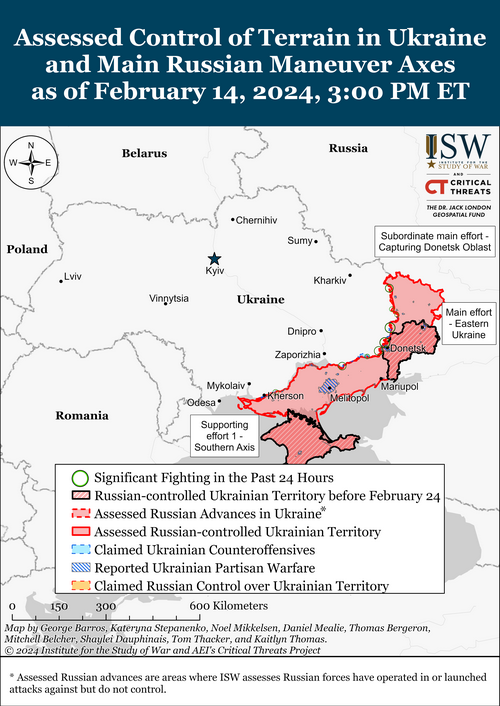
From The Institute for the Study of War:
Russian Offensive Campaign Assessment, February 14, 2024
Angelica Evans, Riley Bailey, Christina Harward, Nicole Wolkov, George Barros, and Frederick W. Kagan
February 14, 2024, 7:50pm ET
Click here to see ISW’s interactive map of the Russian invasion of Ukraine. This map is updated daily alongside the static maps present in this report.
Click here to see ISW’s 3D control of terrain topographic map of Ukraine. Use of a computer (not a mobile device) is strongly recommended for using this data-heavy tool.
Click here to access ISW’s archive of interactive time-lapse maps of the Russian invasion of Ukraine. These maps complement the static control-of-terrain map that ISW produces daily by showing a dynamic frontline. ISW will update this time-lapse map archive monthly.
Note: The data cut-off for this product was 12:30pm ET on February 14. ISW will cover subsequent reports in the February 15 Russian Offensive Campaign Assessment.
Ukrainian forces successfully sank another Russian Black Sea Fleet (BSF) landing ship in the Black Sea off the southern coast of occupied Crimea on the night of February 13 to 14. The Ukrainian Main Military Intelligence Directorate (GUR) published footage on February 14 showing Ukrainian maritime drones striking the Caesar Kunikov Ropucha-class landing ship off the coast of occupied Alupka, Crimea.[1] The GUR reported that maritime drone strikes caused the ship to sink and stated that Russian search and rescue operations were not successful. The GUR stated that the Caesar Kunikov was the largest amphibious landing ship of its project 775 type. Ukrainian forces have destroyed or damaged at least five BSF landing ships since the Russian full-scale invasion of Ukraine in February 2022.[2] Ukrainian Navy Spokesperson Captain Third Rank Dmytro Pletenchuk stated that only five of 13 BSF landing ships that Russia had at the start of the full-scale invasion remain “in service” and that “four ships are under repair, four are destroyed, and five are still in the ranks.”[3] Ukrainian strikes damaging and sinking BSF landing ships further reduce Russia’s ability to conduct amphibious operations, although ISW continues to assess that Russia is unlikely to conduct an amphibious landing operation in Ukraine since Russian naval infantry are deployed across Ukraine and a Ukrainian strike campaign in summer and fall 2023 successfully sequestered the BSF to the eastern part of the Black Sea.[4]
Ukraine reportedly continues efforts to offset Russian advantages in manpower and materiel by using more advanced systems and equipment, although continued delays in Western security assistance will undermine these efforts. Ukrainian Deputy Defense Minister Lieutenant General Ivan Havrylyuk stated in an interview published on February 14 that Ukraine cannot compete with Russia in the number of artillery shells, tanks, and soldiers that Russia can generate but that Ukraine can achieve an advantage on the battlefield by using high-tech weapons.[5] Havrylyuk stated that Ukrainian forces have proven that a well-trained army with more advanced weapons can defeat an enemy with numerical superiority in manpower and equipment.[6] Havrylyuk argued that Ukrainian forces have superior strike capabilities that have previously allowed Ukraine to degrade Russian logistics and combat capabilities.[7] Havrylyuk stressed that Ukraine only has these superior capabilities when it has enough long-range high-precision munitions and enough ammunition for Western-provided artillery systems that have longer ranges and better accuracy than Russian artillery systems.[8] Havrylyuk specifically highlighted Ukrainian efforts to integrate strike drone capabilities throughout the Ukrainian Armed Forces at scale and noted that Ukraine aims to gradually increase the proportion of machines to people on the battlefield.[9]
Havrylyuk acknowledged that Ukrainian progress in expanding drone operations does not replace Ukraine’s need for advanced artillery systems and other long-range capabilities, however. Havrylyuk stated that the war in Ukraine demonstrates that artillery plays a key role on the battlefield and noted that Ukrainian MLRS and artillery units have caused the majority of Russia’s losses in Ukraine.[10] Havrylyuk stated that drones have certain advantages over artillery, specifically in cost, but are more susceptible to external factors such as Russian electronic warfare (EW) systems and natural factors, likely referencing weather.[11] The drones that Ukrainian forces currently possess are not able to generate certain battlefield effects that artillery can achieve, such as the destruction of field fortifications, and most Ukrainian drones cannot reliably destroy Russian armored vehicles as artillery can. Havrylyuk argued that Ukraine needs to focus on combined operations using drones and artillery systems to increase the accuracy of Ukrainian fires and conserve artillery ammunition.[12] Ukraine’s ability to conduct such combined operations currently relies on Western provisions of artillery shells, and Havrylyuk acknowledged that shell shortages continue to affect Ukrainian capabilities and force Ukraine to adjust operational plans.[13]
Russia is similarly pursuing battlefield advantages through technological innovation despite its focus on generating manpower and materiel in greater mass than Ukraine. Russia has gradually expanded its defense industrial base (DIB), sourced critical equipment and ammunition from abroad, and established a crypto-mobilization apparatus that has allowed the Russian military to deploy more personnel and materiel in Ukraine than Ukrainian forces.[14] Havrylyuk stated that Russia is focused on advantages in the quantity of military materiel, although this Russian focus on mass has not precluded Russia from pursuing select technological adaptations.[15] Russian forces have particularly focused on deploying EW systems along the frontline and are likewise attempting to expand the use of drones at scale in Ukraine.[16] Russia has not conducted a general mobilization of manpower and materiel and remains unlikely to do so, currently limiting the mass that the Russian military can bring to bear in Ukraine.[17] It remains unclear how much further Russia can mobilize its DIB and generate new forces without taking significant and possibly unpopular actions given Russia’s persistent economic and human capital constraints.[18] ISW has previously assessed that if the Russians retain the theater-wide initiative in Ukraine for a long time they may prioritize force generation efforts over the requirements of their current offensive efforts, and the Russian command could also use such prioritization to focus more heavily on technological innovation and adaptation at scale.[19] There are no indications that the Russian command intends to adopt such an approach, however.
Havrylyuk’s description of the Ukrainian effort to pursue advantages through the use of more advanced systems echoes former Ukrainian Commander-in-Chief Valerii Zaluzhnyi’s strategy of using technological adaptation and innovation to offset Russian numerical advantages in Ukraine, seize the theater-wide initiative, and restore maneuver to the battlefield.[20] The Russians could in principle also attempt such an approach, but Ukraine appears to be pursuing it in a much more deliberate and concerted effort than Russia. Ukraine is revitalizing its DIB in order to produce and sustain many of these advanced systems on its own or in direct partnership with other countries and to integrate them into Ukrainian tactics, and a premature end to Western security assistance would cede to Russian forces operational advantages before Ukraine could achieve such self-sufficiency.[21] The Ukrainian ability to see such a strategy to fruition is dependent on continued Western support that allows Ukrainian forces to maintain battlefield advantages while providing Ukraine with new advantages over Russian mass.
Russian authorities may be generating enough new forces to sustain losses generated by the current tempo of their offensive operations in Ukraine through 2025. The Royal United Services Institute (RUSI) reported on February 13 that the Russian military continues to grow despite taking significant casualties in Ukraine and that Russian military recruiters are currently meeting almost 85 percent of their quotas for contract recruits.[22] ISW previously assessed that Russian forces may be suffering losses along the frontline in Ukraine at a rate close to Russia’s current force-generation rate.[23] RUSI assessed that Russian forces will likely have the manpower and materiel to be able to maintain a steady tempo of assaults throughout 2024 despite the fact that Russian forces’ quality is unlikely to increase as long as Ukrainian forces can maintain a sufficient level of attrition across the theater.[24] RUSI noted that Ukraine’s ability to defend against Russian assaults and attrit Russian forces is highly dependent on continued Western assistance to Ukraine, which is consistent with ISW‘s ongoing assessment that the collapse of Western aid at this time would eventually lead to the collapse of Ukraine’s ability to defend itself and hold off the Russian military.[25] It is unclear if Russia’s ongoing force-generation campaigns would be able to make up for additional losses that Russian forces would sustain by intensifying offensive operations.
RUSI additionally reported that Russian forces typically engage in localized tactical assaults until they have lost up to 30 percent of their manpower, after which they are rotated out and reconstituted.[26] Losses of 30 percent are extremely high. Most units become combat ineffective after taking much lower losses. The Russians are therefore likely fighting their units past the point at which they have become combat ineffective before rotating them out for reconstitution. Ukrainian Main Military Intelligence Directorate (GUR) Deputy Chief Major General Vadym Skibitskyi stated on January 11 that Russian forces withdraw their units to rear areas when they are at 50 percent or less of their intended end strength and return them to the front following recovery and replenishment.[27] The Russian command’s willingness to allow a unit to be severely degraded to between 50 and 70 percent of the unit’s end strength significantly impacts the unit’s combat effectiveness. This approach to force management likely explains the observable pattern of Russian operations on the ground. Localized assaults continue until they stall out, whereupon offensive operations pause while the command rotates and replenishes degraded units. ISW has observed this pattern in the Kupyansk and Lyman directions since January 2024.[28] Russia can likely sustain this approach for a long time but cannot accelerate its progress as long as Ukraine has the materiel necessary to conduct effective defensive operations. Successful Russian operational-level offensives in Ukraine will likely require the Russian command to commit relatively combat effective and well-equipped units and formations to offensive operations at scale, something the Kremlin has generally been unable or unwilling to do.[29]
The Estonian Foreign Intelligence Service (VLA) stated that the Russian military’s ongoing restructuring and expansion effort aims to intensify Russian military posturing against Finland and the wider NATO alliance. The VLA reported on February 13 that the Russian military is forming the Leningrad Military District (LMD) and Moscow Military District (MMD) in order to posture against Finland and NATO while also attempting to “partially strengthen its units” in the Baltic region as the war in Ukraine continues.[30] Russian formations garrisoned near the Baltics, such as the 6th Combined Arms Army (Western Military District) and 76th Airborne (VDV) Division, are currently heavily committed to combat operations in Ukraine.[31] Russian President Vladimir Putin and Defense Minister Sergei Shoigu have indicated that the Russian military is reforming the LMD to prepare for a potential future conventional war against NATO.[32] The VLA’s assessment that the Russian military may be attempting to use these reforms to strengthen its forces along NATO’s flank is consistent with ISW’s assessment that Russia may be arranging military assets in a way to posture along the border with NATO members in the mid-to-long term.[33] The VLA stated that about 19,000 Russian forces were stationed in the direction of Estonia before Russia’s full-scale invasion of Ukraine in February 2022 and that the Russian military may double the number of personnel and armored vehicles and increase the number of tanks and artillery systems near the Estonian border when Russia begins to feel confident about the outcome of the war in Ukraine. Russia would likely use an increased military presence on NATO’s eastern flank to intensify threats against NATO to further Russia’s long-term goal of weakening and containing the alliance.[34]
The Kremlin is conducting information operations against Moldova very similar to those that the Kremlin used before its invasions of Ukraine in 2014 and 2022, likely to set conditions to justify possible future Russian escalation against Moldova. Russian Foreign Minister Sergei Lavrov answered a question after his speech to the Russian State Duma on February 14 about the Transnistria conflict and falsely alleged that the United States and European Union (EU) control the Moldovan government.[35] Lavrov claimed that the West stopped the 5+2 negotiating process in the Transnistria conflict. The 5+2 process included Russia, Ukraine, Transnistria, Moldova, and the Organization for Security and Cooperation in Europe (OSCE) as mediators and the EU and US as observers. Lavrov claimed that Russia will “do everything” to resume the 5+2 process. Moldovan Deputy Prime Minister Oleg Serebrian stated on January 28 that Moldova would not return to the 5+2 process as long as Russian-Ukrainian relations did not improve and Russia’s war in Ukraine continues.[36] Lavrov claimed that there are about 200,000 Russian citizens in Transnistria and that Russia is “concerned about their fate” and “will not allow them to become victims of another Western adventure.”[37] Lavrov further alleged that Moldova decided not to give state budget subsidies to regions such as Gagauzia that oppose Moldovan integration with the EU. Lavrov compared Moldovan actions concerning Gagauzia to the way the West “refused” to give former Ukrainian President Viktor Yanukovych time to review Ukraine’s Association Agreement with the EU in 2013. Lavrov claimed that the West is issuing similar “ultimatums” to Chisinau about EU integration.
The Kremlin previously accused Ukraine of abandoning and disregarding the Minsk Agreements, which established the post-2014 armistice following the first Russian invasion of Ukraine and involved Ukraine, Russia, and the OSCE with France and Germany as mediators, and Russian President Vladimir Putin has regularly claimed that Ukraine’s alleged violations of the Minsk Agreements “forced” Russia to invade Ukraine in 2022.[38] The Kremlin has also used the idea of protecting its “compatriots abroad” to justify the fact that Russian troops have occupied Transnistria since 1992 as well as Russia’s full-scale invasions of Ukraine in 2014 and 2022.[39] The Kremlin has also accused the US of orchestrating the protests that erupted after Yanukovych’s withdrawal from the Association Agreement with the EU in 2013 and claimed that the alleged subsequent US-backed “coup” forced Russia to invade Crimea and begin military operations in Donbas in 2014 to protect those that “opposed the coup” and Russian “compatriots abroad.”[40]
ISW continues to assess that Kremlin officials and mouthpieces have been attempting to set information conditions to justify possible Russian efforts to destabilize Moldova and prevent its integration into the West, and the fact that Lavrov furthered these narratives — and added additional allegations — suggests that the Kremlin is orchestrating these wider efforts in the information space.[41] Other officials from the Russian Ministry of Foreign Affairs (MFA), including MFA Spokesperson Maria Zakharova, have previously claimed that Moldovan authorities are trying to economically “strangle” Transnistria, are preventing a diplomatic solution to the Transnistria conflict, and face widespread domestic discontent towards Moldovan government policies.[42] A Kremlin-affiliated milblogger has recently seized on the Transnistria issue to consistently promote similar Kremlin narratives as well as claims that Moldova is “militarizing” in order to “forcefully reintegrate” Transnistria into Moldova — an effort for which Russia, the milblogger claimed, must prepare.[43] Moldovan authorities recently accused Russian peacekeepers in Transnistria of conducting exercises and using weapons in the Moldovan security zone in violation of the OSCE Joint Control Commission (JCC) protocols.[44] The timing of a possible Russian hybrid operation in Moldova is unclear, but the Kremlin is setting informational conditions to make it possible soon.
NATO Secretary General Jens Stoltenburg stated on February 14 that NATO does not see any immediate threat of military attacks on a NATO member but noted that there is a “constant risk” of hybrid attacks. Stoltenberg stated that NATO is working to improve intelligence, intelligence sharing, and collaboration with civil society to combat hybrid threats.[45] ISW has recently observed Kremlin actors, including Russian President Vladimir Putin, setting informational conditions to justify possible Russian hybrid attacks on Moldova as well as the Baltic states, Denmark, and Finland.[46]
Kremlin Spokesperson Dmitri Peskov denied recent Western reports that Russia recently proposed freezing the conflict in Ukraine.[47] Peskov called Western reporting on the supposed proposal “untrue” and claimed that US involvement in Ukraine will not change the war’s course and that Russia will continue the war until all its goals are achieved.[48] Reuters reported on February 13, citing unnamed Russian sources, that the US rejected a ceasefire proposal from Russian President Vladimir Putin in late 2023 or early 2024.[49] An unnamed US source denied any official contact with Russia and reiterated that the US will not engage in peace negotiations with Russia that do not involve Ukraine.[50] ISW has yet to observe evidence that Russian officials are interested in good-faith peace negotiations with Ukraine but continues to observe signals that Russia may be open to bilateral discussions leading to the US abandonment of Ukraine.[51] Russian officials recently blamed the US for the absence of constructive peace negotiations to end Russia’s invasion of Ukraine as part of ongoing Kremlin efforts to frame the West as the only meaningful negotiating partner in Ukraine and convince the West to accept the Kremlin’s premise that Ukraine has no independent agency.[52] Estonian Foreign Intelligence Service (VLA) Director General Kaupo Rosin stated on February 14 that the Kremlin is pushing the false narrative that Russia is interested in peace negotiations in the West in order to undermine Western military support for Ukraine.[53] ISW previously assessed that Russian statements suggesting that Russia is or always has been interested in peace negotiations are very likely efforts to feign interest to prompt preemptive Western concessions regarding Ukrainian sovereignty and territorial integrity.[54]
Russia reportedly is developing a space-based anti-satellite weapon. US House Intelligence Committee Chair Michael Turner stated on February 14 that he made information about a “serious national security threat” available to all members of Congress and called on US President Joe Biden to declassify all information relating to the threat.[55] Western media reported that two sources stated that the intelligence concerns Russia’s desire to put an anti-satellite nuclear weapon into space to use against satellites, not to launch a nuclear weapon onto Earth.[56] The New York Times (NYT) reported that US officials said that the new intelligence was serious but that Russia is still developing the capability and has not deployed it yet.[57] NYT reported that the possible Russian capability does not pose an urgent threat to the US, Ukraine, or America’s European allies. The Russian Ministry of Defense announced on February 9 that the Russian Aerospace Forces (VKS) launched a Soyuz-2.1v launch vehicle from the Plesetsk Cosmodrome with an unspecified classified payload “in the interests of the Russian Ministry of Defense.”[58]
Key Takeaways:
- Ukrainian forces successfully sank another Russian Black Sea Fleet (BSF) landing ship in the Black Sea off the southern coast of occupied Crimea on the night of February 13 to 14.
- Ukraine reportedly continues efforts to offset Russian advantages in manpower and materiel by using more advanced systems and equipment, although continued delays in Western security assistance will undermine these efforts.
- Russia is similarly pursuing battlefield advantages through technological innovation despite its focus on generating manpower and materiel in greater mass than Ukraine.
- Russian authorities may be generating enough new forces to sustain losses generated by the current tempo of their offensive operations in Ukraine through 2025.
- The Estonian Foreign Intelligence Service (VLA) stated that the Russian military’s ongoing restructuring and expansion effort aims to intensify Russian military posturing against Finland and the wider NATO alliance.
- The Kremlin is conducting information operations against Moldova very similar to those that the Kremlin used before its invasions of Ukraine in 2014 and 2022, likely to set conditions to justify possible future Russian escalation against Moldova.
- NATO Secretary General Jens Stoltenburg stated on February 14 that NATO does not see any immediate threat of military attacks on a NATO member but noted that there is a “constant risk” of hybrid attacks.
- Kremlin Spokesperson Dmitri Peskov denied recent Western reports that Russia recently proposed freezing the conflict in Ukraine.
- Russia reportedly is developing a space-based anti-satellite weapon.
- Russian forces recently made confirmed advances near Bakhmut, Marinka, and Krynky amid continued positional fighting along the entire line of contact on February 14.
- Russia continues efforts to expand its defense industrial base (DIB).
- Russian authorities continue efforts to militarize and culturally indoctrinate youth and students in occupied Ukraine into Russian identity and ideology.
Go here to read the rest. Lots of news about Russia having launched a satellite which can attack US satellites. Russia has been working on this technology for some time. Considering that there are some 2800 US active satellites, public and private, in orbit, and around another 6000 active satellites by other nations, any Russian anti-satellite would have its work cut out for it. A development to take seriously, but not as alarming as news accounts yesterday at first indicated. All the Western sturm und drang, about this might actually be welcome to Putin, going into March. A fair number of Russians like a tough leader who is feared on the world stage.

