
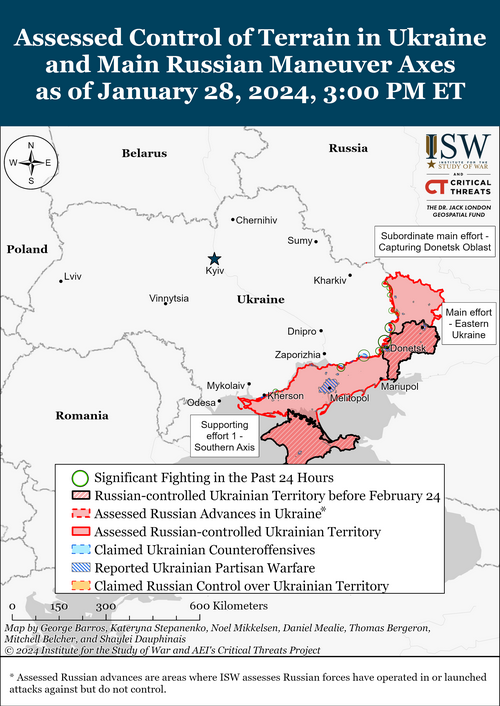
From The Institute for the Study of War:
Russian Offensive Campaign Assessment, January 28, 2024
Angelica Evans, Christina Harward, Nicole Wolkov, Kateryna Stepanenko, and Frederick W. Kagan
January 28, 2024, 8:30pm ET
Click here to see ISW’s interactive map of the Russian invasion of Ukraine. This map is updated daily alongside the static maps present in this report.
Click here to see ISW’s 3D control of terrain topographic map of Ukraine. Use of a computer (not a mobile device) is strongly recommended for using this data-heavy tool.
Click here to access ISW’s archive of interactive time-lapse maps of the Russian invasion of Ukraine. These maps complement the static control-of-terrain map that ISW produces daily by showing a dynamic frontline. ISW will update this time-lapse map archive monthly.
Note: The data cut-off for this product was 1:30pm ET on January 28. ISW will cover subsequent reports in the January 29 Russian Offensive Campaign Assessment.
Note: ISW added a new section on Russian air, missile, and drone campaigns to track Russian efforts to target Ukrainian rear and frontline areas, grow its drone and missile arsenals, and adapt its strike packages.
Kremlin officials and mouthpieces continue to set information conditions to destabilize Moldova, likely as part of efforts to prevent Moldova’s integration into the EU and the West among other objectives. Alexei Polishchuk, the director of the Second Department of the Commonwealth of Independent States (CIS) Countries at the Russian Ministry of Foreign Affairs (MFA), claimed in an interview with Kremlin newswire TASS published on January 28 that Moldova has begun to “destroy its ties” with CIS member states and the Russia-led CIS organization as a whole and that there are rumors that Moldova plans to leave the CIS by the end of 2024.[1] Polishchuk claimed that this decision would not benefit Moldovan interests or citizens and would be unprofitable for the Moldovan economy. Polishchuk also claimed that the settlement of the Transnistria issue in Moldova is in a “deep crisis” and that Moldova’s economic pressure on Transnistria since the beginning of 2024 has “further delayed” any solution.[2] Polishchuk claimed that Russia is ready to fix deteriorating relations between Moldova and Transnistria “as a mediator and guarantor” to the settlement.[3] Moldovan Deputy Prime Minister Oleg Serebrian stated on January 28 that Moldova would not return to the 5+2 Transnistria negotiating process that included Russia as long as Russian-Ukrainian relations do not improve and Russia’s war in Ukraine continues.[4]
A prominent Kremlin-affiliated Russian milblogger, who has recently fixated on the Moldova-Transnistria conflict, continued to highlight alleged discontent in Moldova’s breakaway and autonomous regions. The milblogger claimed that about 50,000 people in Transnistria participated in a rally protesting against Moldovan economic pressure on Transnistria on January 24.[5] The milblogger also stated that Sergei Ibrishim, the Head of the Main Directorate of Agro-Industrial Complex of Gagauzia, sent a request recently to Russian Foreign Minister Sergei Lavrov for Russia to send fertilizer to Gagauzia as humanitarian aid.[6] Ibrishim also reportedly claimed that Gagauzia’s agricultural producers are unable to sell their products to Russia after Moldova’s decision in July 2023 to leave the CIS Interparliamentary Assembly and asked Lavrov to abolish excise taxes and customs duties for Russian imports from Gagauzia.[7] Polishchuk’s and the milblogger’s comments are likely aimed at dissuading Moldova from leaving the CIS and Russia’s wider sphere of influence, setting information conditions to create economic discontent within Moldova, and posturing Russia as an economic and security guarantor in Moldova.
Russia notably accused Ukraine of abandoning and disregarding the Minsk Agreements that had largely frozen the conflict after Russia’s 2014 invasion in the lead up to Russia’s 2022 full-scale invasion of Ukraine, and Russia may be setting information conditions to make similar claims against Moldova.[8] ISW previously assessed that the Kremlin is likely setting information conditions to justify future Russian aggression in Moldova under the guise of protecting its “compatriots abroad” and the “Russian World” (Russkiy Mir) – concepts that are purposely based on vague definitions of ethnic Russians and Russian speakers in foreign countries.[9] Russia may attempt to justify its aggression or destabilization efforts in Moldova by claiming that Transnistrian residents are in danger due to Moldova’s alleged abandonment of the Transnistria settlement process. ISW recently observed suggestions that the Kremlin may be turning to rhetorical narratives that appeal to a wider audience beyond the “Russian World.”[10]
Russian Foreign Intelligence Service (SVR) Director Sergei Naryshkin reiterated that the Kremlin is not interested in any settlements short of the complete destruction and eradication of the Ukrainian state, likely in an ongoing effort to justify the long-term and costly Russian war effort to domestic audiences. Naryshkin told Kremlin journalist Pavel Zarubin during a televised “impromptu” interview on January 28 that the Ukrainian state and government have “a very sad fate” and that “Russia will not stop halfway,” presumably in its efforts to destroy Ukraine’s sovereignty and territorial integrity.[11] Naryshkin made a similar statement on January 27 during the opening of a memorial to the Soviet victims of Nazi genocide in Leningrad Oblast, claiming that “Russia will not stop halfway” in its fight with the current followers of Nazi ideology.[12] The similarity of both statements suggests that Naryshkin may be using pre-approved Kremlin rhetoric to signal to Russian citizens that the Kremlin is not open to negotiating with Ukraine or compromising in any settlement of the war Russia started, despite recent Western reports to the contrary.[13] Russian officials have consistently reiterated Russia‘s commitment to its maximalist objectives in Ukraine – which are tantamount to complete Ukrainian and Western capitulation- and statements by Russian officials suggesting that Russia is or has always been interested in peace negotiations with Ukraine are very likely efforts to feign interest to prompt preemptive Western concessions regarding Ukraine’s sovereignty or territorial integrity.[14]
Naryshkin was notably involved in setting domestic information conditions in the lead-up to the 2022 Russian full-scale invasion of Ukraine, including furthering Russian claims that perceived Ukrainian aggression prompted by Ukraine’s Western ‘puppet masters’ forced Russia to invade Ukraine and claims that the Ukrainian government is comparable to Nazi Germany.[15] Russian President Vladimir Putin ostentatiously humiliated Naryshkin during a televised Russian Security Council meeting on February 22, 2022, demanding that Naryshkin “speak plainly” when Naryshkin declared his support for the independence of occupied Donetsk and Luhansk oblasts.[16] Putin likely humiliated Naryshkin in February 2022 due to Naryshkin‘s failure to set the informational conditions to justify Russia’s invasion of Ukraine in the Russian domestic and international information spaces that Putin desired. Naryshkin’s return to the Russian information space to further the perception of the Kremlin’s commitment to the war in Ukraine could indicate that Putin has given Naryshkin another chance to prove his ability to set informational conditions, this time setting conditions domestically for a long war effort. If this hypothesis is correct, then Naryshkin will presumably be determined not to disappoint Putin again. Zarubin has also previously been involved in a number of Kremlin informational efforts, including filming and conducting interviews wherein Putin threatened Finland and the wider NATO alliance and attempted to portray himself as a gracious leader who cares about the well-being of Russian military personnel and an effective Commander-in-Chief of the Russian armed forces.[17]
The Kremlin also continues to frame and justify a long-term Russian war effort as part of an existential geopolitical confrontation with the West and Nazism. Alexei Polishchuk, the director of the Second Department of the Commonwealth of Independent States (CIS) Countries at the Russian Ministry of Foreign Affairs (MFA), also stated during his interview with TASS that “the West incited neo-Nazi sentiments in Ukraine” and “made [Ukraine] anti-Russia.”[18] Putin, Belarusian President Alexander Lukashenko, Naryshkin, and Russian State Duma Chairman Vyacheslav Volodin during the 80th anniversary of the breaking of the siege of Leningrad on January 27 claimed that Russia is fighting “Nazis” in Ukraine and that a number of Western countries have adopted Nazi ideology.[19] Polishchuk‘s claim that the West incited “neo-Nazi” ideals in Ukraine is likely part of the same coordinated Kremlin informational effort intended to justify geopolitical confrontation with the West and suggests that the Kremlin may increasingly label any perceived adversary and possibly the entire West as “Nazi.”[20] ISW previously assessed that the Kremlin may have decided that the simple narrative that Russia and other states are fighting a geopolitical “Nazi” force is a more effective immediate narrative than Putin’s attempt to appeal to Russian citizens and Russian speakers in the territory of the former Soviet Union and Russian Empire with the ideology of the ”Russian World” (Russkiy Mir), which is based on purposefully amorphous ethnic identities that are not agreed upon and that are at odds with Russia’s multi-ethnic composition.[21] Polishchuk also reiterated long-standing Russian claims that the West controls Ukraine and that Russia has “always remained” open to peace negotiations.[22]
Ukrainian Navy Commander Vice Admiral Oleksiy Neizhpapa emphasized the importance of Ukraine’s ability to technologically adapt and develop as Russian forces continue to adapt to Ukrainian operations in a January 27 Sky News interview.[23] Neizhpapa’s statement is consistent with ISW’s assessment that Russian forces are adapting and learning on certain sectors of the front.[24] Neizhpapa also reiterated the Ukrainian assertion that Ukrainian forces should be able to use Western-provided systems to strike legitimate military targets in Russia.[25] Neizhpapa stated that the Ukrainian Navy would be “very happy” to accept two UK Type 23 frigates that the UK is considering decommissioning due to a shortage of sailors.[26] The Turkish government announced on January 2 that it would not allow the UK to transport two mine hunting ships to Ukraine via the Turkish Straits citing Article 19 of the Montreux Convention Regulating the Regime of the Turkish Straits, which stipulates that “vessels of war belonging to belligerent Powers shall not…pass through the Straits.” Turkey would likely continue to use the Montreux Convention to prevent the UK from potentially transferring these two frigates through the Turkish Straits to Ukraine.[27] Turkey has used the Montreux Convention to deny access to Russian warships wishing to pass through the Bosphorus and Dardanelles straits since February 28, 2022, to Ukraine’s benefit.[28]
The Kremlin will likely use the withdrawals of Mali, Burkina Faso, and Niger from the Economic Community of West African States (ECOWAS) to continue efforts to expand Russian influence in Francophone Africa. The Malian, Burkinabe, and Nigerien juntas announced their immediate withdrawals from ECOWAS in a joint statement on January 28.[29] ECOWAS stated that it had not received “any direct formal notification” from Mali, Burkina Faso, or Niger about their intent to withdraw.[30] Kremlin newswire TASS cited the frustration of these states with ECOWAS’ ”Western influence” as a reason for their withdrawal.[31] Russian milbloggers also celebrated the announcement as evidence of rapidly decreasing French influence in the Sahel.[32] The first contingent of the Russian Ministry of Defense (MoD)-controlled Africa Corps reportedly arrived in Burkina Faso on January 24, and Kremlin officials recently met with Chadian junta officials in Moscow.[33] ISW continues to assess that Russia is attempting to expand its influence in western and central Africa, particularly focusing on Francophone African countries in the Sahel.[34]
Unnamed Indian government sources stated that India wants to distance itself from Russia, its largest arms supplier, because the war in Ukraine has limited Russia’s ability to provide India with munitions.[35] The unnamed Indian government sources told Reuters in a January 28 article that India will act carefully in order to avoid pushing Russia closer to China.[36] Indian think tank Observer Research Foundation’s Russia expert Nandan Unnikrishnan told Reuters that India is unlikely to sign “any major military deal” with Russia because it would cross a red line with the United States.[37] Indian government-run think tank Manohar Parrikar Institute for Defense Studies and Analyses Eurasia expert Svasti Rao stated that the war in Ukraine has caused India to question Russia’s ability to supply India with spare parts.[38] ISW has routinely observed reports that Russia continues to face challenges repairing aircraft and other equipment and has not been able to produce missiles and artillery ammunition at pre-war levels for its own forces to use, making it highly unlikely that Russia will be able to export military equipment to India or its other customers at pre-war levels any time soon.[39] Russian President Vladimir Putin recently highlighted Russian-Indian economic and military-technical cooperation in a meeting with Indian Foreign Minister Subrahmanyam Jaishankar likely in an effort to emphasize positive Russian-Indian relations amid Russian concerns that India is attempting to diversify its defense partners.[40]
Key Takeaways:
- Kremlin officials and mouthpieces continue to set information conditions to destabilize Moldova, likely as part of efforts to prevent Moldova’s integration into the EU and the West among other objectives.
- Russian Foreign Intelligence Service (SVR) Director Sergei Naryshkin reiterated that the Kremlin is not interested in any settlements short of the complete destruction and eradication of the Ukrainian state, likely in an ongoing effort to justify the long-term and costly Russian war effort to domestic audiences.
- The Kremlin also continues to frame and justify a long-term Russian war effort as part of an existential geopolitical confrontation with the West and Nazism.
- Ukrainian Navy Commander Vice Admiral Oleksiy Neizhpapa emphasized the importance of Ukraine’s ability to technologically adapt and develop as Russian forces continue to adapt to Ukrainian operations in a January 27 Sky News interview.
- The Kremlin will likely use the withdrawals of Mali, Burkina Faso, and Niger from the Economic Community of West African States (ECOWAS) to continue efforts to expand Russian influence in Francophone Africa.
- Unnamed Indian government sources stated that India wants to distance itself from Russia, its largest arms supplier, because the war in Ukraine has limited Russia’s ability to provide India with munitions.
- Russian forces recently advanced near Kreminna and Avdiivka amid continued positional fighting throughout the theater.
- A Russian source claimed that Rosgvardia is forming the 1st Volunteer Corps with remaining Wagner Group personnel and newly recruited volunteers (dobrovoltsy) following the Kremlin adoption of the law allowing Rosgvardia to form its own volunteer formations in December 2023.
- Ukrainian Main Military Intelligence Directorate (GUR) Head Lieutenant General Kyrylo Budanov stated on January 28 that Ukraine and Russia will conduct a prisoner of war (POW) exchange in the near future.
Go here to read the rest.
From Strategy Page:
January 28, 2024: Two years of fighting in Ukraine have destroyed the Russian tank force. This was unexpected, as was the Russian inability to replace their tank losses. Ukraine’s success against Russian tanks and armored vehicles revived predictions that tanks were obsolete. Tanks are still relevant, and the Russian losses were the result of poor employment of armored units as well as design features of Russian tanks that make them much more vulnerable than Western tanks like the American M1, German Leopard or Israeli Merkava.
Most Russian armored vehicles were lost while they were on the move, or stationery without adequate infantry support. The first Russian armored units going into Ukraine were told the population would be friendly or neutral. The reality was that the Ukrainians were well armed, hostile, and using tactics the Russians were unaware of and unprepared to deal with. As a result, thousands of Russian vehicles were destroyed in the first month, most of them armored, including some of the most modern Russian tanks plus some ancient models taken from storage facilities for obsolete tanks that might be useful in an emergency. The Ukraine War proved to be that emergency.
Most of the Ukrainian anti-tank weapons were portable and carried into combat by teams of soldiers of whom many were recent volunteers with no military experience at all and only a few days of training, rather like most Russian soldiers since the war started. The few days training they received usually began with carrying ammo, including anti-tank missiles and projectiles, plus instruction in how to obey instructions, take cover, etc. Sometimes volunteers were selected for combat duty because they knew the area where their anti-tank team would be operating. These hastily trained anti-tank teams suffered far fewer casualties than the Russians, even after the Russians became aware of the ambush risk, because the Russians had little if any training against attack by man-carried anti-tank weapons, let alone the ability to actually do it. Additionally most of the Ukrainians’ Western-provided portable anti-tank weapons could accurately hit moving vehicles 300 or more meters away. The Javelin and NLAW guided missiles were fire and forget. That meant once the operator had accurately aimed at a target and launched the missile, the guidance system in the missile would follow the target until the missile hit.
NLAWs have a max range of 600 meters and Javelins are 2,500 meters. The Ukrainians were creative with their ambush tactics and the Russians who survived them noted that the Ukrainian were always better prepared and one or more steps ahead of Russian commanders. The Russians were losing six dead for every Ukrainian fighter and that included soldiers killed by rocket and ballistic missile attacks far from the combat zone.
Russian armored vehicles had some unique vulnerabilities not found on their NATO counterparts. One was the use of an autoloader for the main tank gun, usually a 125mm. The autoloader required there to be a magazine of shells in the crew compartment, which was the turret, where there were also additional shells used by the crew to refill the autoloader magazine. If any anti-tank weapon penetrated into the crew compartment, especially the turret, one or more of the 125mm shells were exposed and likely to explode. If one shell went, all those near the autoloader did as well. This usually meant the turret would literally be blown off the tank and the entire crew killed. Javelin and NLAW were also designed to attack the less protected top of the turret or body of the tank, which at the very least destroyed the engine or wounded some of the three-man crew. And the primary Russian infantry armored vehicle was the BMP, which was poorly protected against any anti-tank weapon.
Trucks carrying supplies, especially fuel, ammo or personnel were even more vulnerable. Machine-gun fire or a hand grenade would destroy or disable a truck. Ukrainian forces concentrated on Russian supply trucks and that meant Russian forces were chronically short of essential supplies.
Even when the Russians knew they were facing well-armed defenders their infantry was not well trained in how to scout for and protect their armored vehicles from ambush. NATO tank units train using infantry who know what to look for and are able to call in heavy fire from the armored vehicles they are escorting. NATO forces also have more small UAVs to do some of the scouting. The Russians had few such UAVs and those that were available were poorly used and often shot down by the Ukrainians.
Ukrainian forces had lots of armored vehicles, most of them Russian models improved by the Ukrainians. Tank tactics used by Ukrainians were more practical and more likely to overcome defenders, plus Ukrainian civilians were everywhere and generally eager to let their troops know what was going on in the area.
After the 2014 initial Russian attack, Ukraine realized they needed new and improved armored vehicles in case the Russian came again in larger numbers. Since 2014 Ukraine has been refurbishing existing equipment with Ukrainian resources. Emphasis is on armored vehicles, which Ukraine had lots of from the defunct Red Army. Most are elderly but were little used in the past and still effective. Initially Ukraine had 250 T-64BMs and 350 T-64BVs. Ukraine also has 1,000 older T-64B tanks in storage. Only the T-64BM and T-64BV are operational and in use with the Ukrainian Army. Since 2007 Ukraine has been upgrading about one of the older T-64Bs to the T-64BM each month. This costs about $600,000 per T-64B. Ukrainian arms factories were also building the T-84 Oplot-M tank with 55 in service by the end of 2015 and 120 more in 2016 at a cost of $3.7 million each. All this is possible because Ukraine contained many Soviet era armored vehicle plants and inherited them when the Soviet Union dissolved in 1991.
Ukraine also began upgrading about 300 T-72B tanks held in reserve. These were modified to become similar to the Polish PT-91. The official reason for this is that Ukraine wants the T-72Bs to meet NATO requirements, but the upgraded tanks would also improve the defensive capabilities of the Ukrainian Army forces fighting in eastern Ukraine. The upgrade idea came as a result of Ukrainian military officials being given an opportunity to test some PT-91s.
Such cooperation between Poland and Ukraine is nothing new because since 2011 defense firms in the two countries have worked together to develop guided 155mm artillery and 120mm mortar shells. Another cooperative effort enabled a Polish firm to develop a less expensive alternative to the Israeli SPIKE ATGM that was based on the Ukrainian RK-3 Corsair ATGM. Ukraine, like Russia, has little choice but to refurbish older vehicles and hope for the best. By the time Russia invaded in 2022, Ukraine was ready.
Go here to read the rest. In World War II, the Soviets produced massive amounts of armor, and most of their tanks could go toe to toe with the German armor. How the mighty have fallen!

