
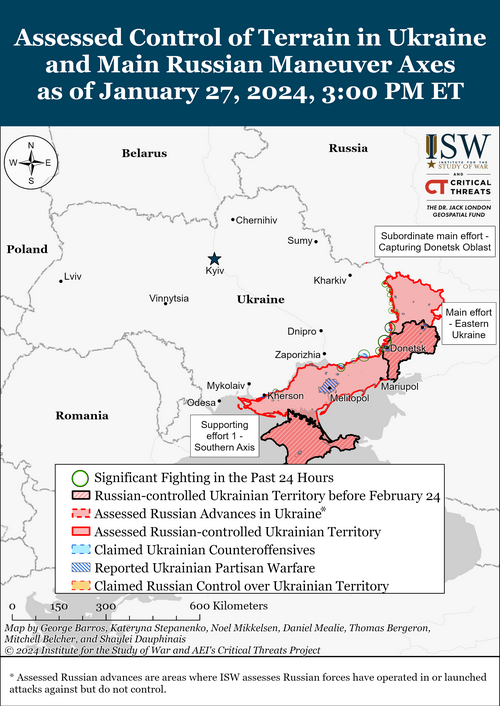
From The Institute for the Study of War:
Russian Offensive Campaign Assessment, January 27, 2024
Riley Bailey, Christina Harward, Nicole Wolkov, Angelica Evans, and Frederick W. Kagan
January 27, 2024, 5:55pm ET
Click here to see ISW’s interactive map of the Russian invasion of Ukraine. This map is updated daily alongside the static maps present in this report.
Click here to see ISW’s 3D control of terrain topographic map of Ukraine. Use of a computer (not a mobile device) is strongly recommended for using this data-heavy tool.
Click here to access ISW’s archive of interactive time-lapse maps of the Russian invasion of Ukraine. These maps complement the static control-of-terrain map that ISW produces daily by showing a dynamic frontline. ISW will update this time-lapse map archive monthly.
Note: The data cut-off for this product was 12:30pm ET on January 27. ISW will cover subsequent reports in the January 28 Russian Offensive Campaign Assessment.
Russian President Vladimir Putin, Belarusian President Alexander Lukashenko, and Kremlin officials claimed that Russia is in an existential geopolitical conflict with an alleged modern Nazi movement that extends beyond Ukraine while marking the 80th anniversary of the breaking of the siege of Leningrad. Putin attended the opening of a memorial to the Soviet victims of Nazi genocide in Leningrad Oblast on January 27 and focused heavily on long-standing claims that Russia is fighting “Nazis” in Ukraine.[1] Putin also asserted that select countries have adopted Nazi ideology and methods and tied this assertion to a number of European states promoting “Russophobia as a state policy.”[2] Putin declared that Russia will ”do everything to suppress and finally exterminate Nazism” and cast Russia as pursuing the ”aspirations of millions of people…all over the planet for true freedom, justice, peace, and security.”[3] Belarusian President Alexander Lukashenko also attended the ceremony and stated that Belarus and Russia ”are again faced with the question of the right to life of our civilization and the preservation of ancestral…[and] cultural values.”[4] Russian Foreign Intelligence Service (SVR) Director Sergei Naryshkin stated that Russia will not stop halfway in its fight against current Nazi followers, and Russian State Duma Chairman Vyacheslav Volodin explicitly stated that “fascist ideology is becoming the norm…for leaders of NATO states” and specifically accused US President Joe Biden, Canadian Prime Minister Justin Trudeau, United Kingdom (UK) Prime Minister Rishi Sunak, French President Emmanuel Macron, and German Chancellor Olaf Scholz of sponsoring genocide in Ukraine.[5] Volodin framed this alleged growing fascist movement as a “dangerous path that could lead to a new world war.”[6]
Nazi Germany besieged Leningrad for over two years during the Second World War, causing the deaths of roughly 1.5 million Soviet citizens. Putin was born in Leningrad in 1952, and his grandfather was seriously wounded while defending the city. Putin likely sought to leverage his known if unstated personal connection with the siege and the emotional appeal of one of the most dramatic moments in the Great Patriotic War (Second World War) to expand his overall ideological framing of the conflict with the West to which he has committed Russia.
Putin has long tried to construct an ideology for Russia that he can use to support a geopolitical confrontation with the West reminiscent of the Cold War, and the Kremlin may increasingly use existing rhetoric about fighting Nazism to support this effort. The Kremlin has called for “denazification” in Ukraine as a thinly veiled demand for regime change and has used information operations about Ukrainian “Nazis” to wrap its unprovoked invasion of Ukraine in the mythos of the Great Patriotic War.[7] Russian officials have previously applied the label of “Nazism” to Western states and actors outside Ukraine, although Putin’s, Lukashenko’s, Naryshkin’s, and Volodin’s likely coordinated rhetoric on January 27 suggest that the Kremlin may increasingly label any perceived adversary and possibly the entire West as “Nazi.”[8] The Kremlin may have decided that the simple narrative that Russia and other states are fighting a geopolitical Nazi force is a more effective immediate narrative line than Putin’s attempt to appeal to Russian citizens and Russian speakers in the territory of the former Soviet Union and Russian Empire with the ideology of the “Russian World” (Russkiy Mir), which is based on purposefully amorphous ethnic identities that are not agreed upon and that are at odds with Russia’s multi-ethnic composition.[9]
Lukashenko’s participation in this rhetorical posturing suggests that the Kremlin and Lukashenko may believe that this narrative is also easier to coordinate than the Kremlin’s appeals to ethnic Russians and the Russkiy Mir. The Kremlin has increasingly sought to cast Russia as a main actor within the “world majority,” which it has defined as “a civilizational and cultural community that objectively opposes” the West (using the word “objectively” in an echo of the Soviet Union’s Communist ideology).[10] The Kremlin’s overtures to non-Western states have yet to acknowledge that these states have cultural, ideological, and political differences and that many of these states are likely unwilling to involve themselves in Russian appeals to the Russkiy Mir. The Kremlin may hope that “fighting fascism” will be an easier rhetorical line to coordinate with desired partners within this fictitious “world majority.”
Putin specifically accused the Baltic states of adopting “Nazism,” likely as part of continued Kremlin efforts to set information conditions for future Russian aggression against NATO members.[11] Putin alleged that the Baltic states have declared thousands of people living there “subhuman,” are “depriving“ them of their “most basic rights,” and are subjecting them to “persecution.”[12] Although Putin did not specifically claim that the Baltic states are “persecuting” Russians or Russian speakers, Kremlin officials have routinely accused Baltic governments of having “neo-Nazi” policies and of oppressing Russians and Russian speakers.[13] The Kremlin has historically used its concept of “compatriots abroad,” which vaguely includes ethnic Russians and Russian speakers of other ethnicities, to justify Russian aggression in neighboring states.[14] ISW continues to assess that Kremlin officials and mouthpieces may be attempting to set information conditions for possible future Russian aggression in the Baltic states – and other NATO members, such as Finland – under the guise of protecting Russia’s “compatriots abroad.”[15] The Kremlin may also use the pretext of protecting people from alleged “Nazi” policies in the future.
Myanmar banks reportedly connected to the Russian System for the Transfer of Financial Messages (SPFS) banking system, a Russian analogue for the Society for Worldwide Interbank Financial Telecommunications (SWIFT) banking system. Russian Minister of Economic Development Maxim Reshetnikov stated on January 27 that Myanmar banks recently connected to SPFS, which will allow Russian and Myanmar businesses to freely buy and sell products.[16] Russia began developing its SPFS banking system in 2014, following US threats to disconnect Russia from SWIFT in response to Russia’s 2014 invasion of Ukraine, and roughly 20 countries have joined SPFS in the past 10 years.[17] The Washington Post reported that internal Russian Security Council documents show that Kremlin officials are working to undermine the dollar’s role as a world reserve currency and hope to work with China to create a new financial system to bypass Western dominance of global financial transactions.[18] Unnamed European security officials told the Washington Post that it is unclear if China has any real interest in this effort.[19]
Russian forces conducted a limited series of drone and missile strikes against Ukraine on January 26 and 27. Ukrainian military officials reported that Russian forces struck civilian infrastructure in Myrnohrad and Novohrodivka in Donetsk Oblast and Antonivka, Kherson Oblast with nine S-300 missiles and in Slovyansk, Donetsk Oblast with an Iskander-M missile on January 26 and 27.[20] The Ukrainian Air Force reported that Ukrainian forces shot down all four Shahed-136/131 drones that Russian forces launched at Ukraine on January 27.[21] Southern Operational Command Spokesperson Colonel Nataliya Humenyuk stated on January 26 that Ukrainian forces are improving and strengthening their ability to counter Russian drone adaptations, including adaptations for Shahed drones.[22]
Russian authorities are likely blocking communications in the Sakha Republic for the fourth consecutive day following January 24 protests in support of a Russian citizen allegedly murdered by a naturalized Russian citizen from Tajikistan. Local Sakha Republic outlets reported on January 27 that disruptions to WhatsApp and Telegram services continue following reported outages on the night of January 24.[23] The local news outlets also noted that Sakha Republic Digital Development Deputy Minister Andrei Suslov stated on January 24 that Russian federal censor Roskomnadzor‘s “preventative work” created communication disruptions, but that no officials have since commented on continued disruptions as of January 27.[24] Former Yakutsk Mayor Sardana Avksenteva and Sakha Party of Business Head Vitaly Obedin stated that all internet connection and communication has slowed, creating difficulties for online commerce and digital document organization.[25] Russian authorities are likely attempting to preemptively stifle a potential resurgence in protests and “strengthen public safety and crime prevention measures” in accordance with Sakha Republic Head Aisen Nikolayev’s orders following the protests.[26] Russian sources notably did not report similar widespread communication outages during or following several days of protest in Bashkortostan.
Key Takeaways:
- Russian President Vladimir Putin, Belarusian President Alexander Lukashenko, and Kremlin officials claimed that Russia is in an existential geopolitical conflict with an alleged modern Nazi movement that extends beyond Ukraine while marking the 80th anniversary of the breaking of the siege of Leningrad.
- Putin has long tried to construct an ideology for Russia that he can use to support a geopolitical confrontation with the West reminiscent of the Cold War, and the Kremlin may increasingly use existing rhetoric about fighting Nazism to support this effort.
- Putin specifically accused the Baltic states of adopting “Nazism,” likely as part of continued Kremlin efforts to set information conditions for future Russian aggression against NATO members.
- Myanmar banks reportedly connected to the Russian System for the Transfer of Financial Messages (SPFS) banking system, a Russian analogue for the Society for Worldwide Interbank Financial Telecommunications (SWIFT) banking system.
- Russian forces conducted a limited series of drone and missile strikes against Ukraine on January 26 and 27.
- Russian authorities are likely blocking communications in the Sakha Republic for the fourth consecutive day following January 24 protests in support of a Russian citizen allegedly murdered by a naturalized Russian citizen from Tajikistan.
- Russian forces made recent confirmed advances near Kupyansk, Kreminna, and Avdiivka amid continued positional engagements along the entire line of contact on January 27.
- UK outlet the Telegraph reported on January 26, citing an unnamed Western official, that Russia is spending roughly 40 percent of its GDP on the war in Ukraine, more than Russian national spending on health and education.
- Russian federal subjects continue to establish patronage networks with occupied areas of Ukraine.
Go here to read the rest. US defense spending is 3.5% of GDP. If, and that is a big if, Russia is spending 40% of its GDP on the War, that would equal in percentage terms what the US spent on defense in 1945, the last year of World War II. In 1985 the Soviet Union spent 17 percent of its gdp on defense and that was ruinous economically for the Soviet Union.

