From The Institute for the Study of War:
Russian Offensive Campaign Assessment, January 22, 2024
Riley Bailey, Christina Harward, Nicole Wolkov, Grace Mappes, Karolina Hird, George Barros, and Frederick W. Kagan
January 22, 2024, 6:45pm ET
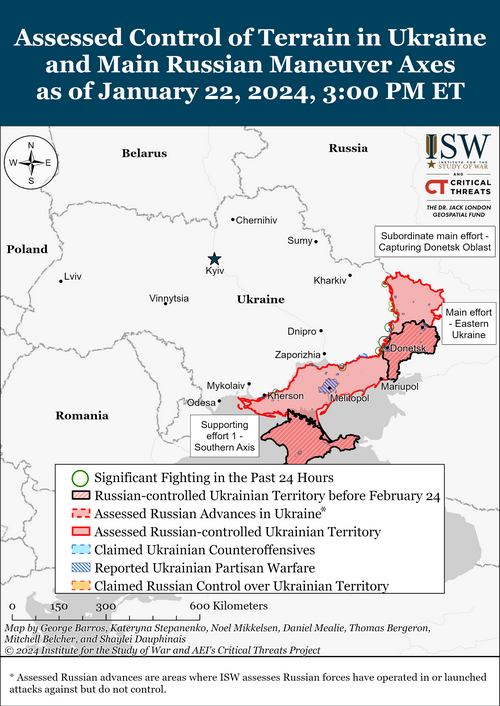
Click here to see ISW’s interactive map of the Russian invasion of Ukraine. This map is updated daily alongside the static maps present in this report.
Click here to see ISW’s 3D control of terrain topographic map of Ukraine. Use of a computer (not a mobile device) is strongly recommended for using this data-heavy tool.
Click here to access ISW’s archive of interactive time-lapse maps of the Russian invasion of Ukraine. These maps complement the static control-of-terrain map that ISW produces daily by showing a dynamic frontline. ISW will update this time-lapse map archive monthly.
Note: The data cut-off for this product was 1:40pm ET on January 22. ISW will cover subsequent reports in the January 23 Russian Offensive Campaign Assessment.
Russia continues to weaponize its position on the United Nations Security Council (UNSC) to propagate several long-standing Russian information operations. Russian Foreign Minister Sergei Lavrov spoke at a UNSC meeting, which Russia convened, on January 22 and blamed the West for the lack of negotiations, claiming that Russia has always been “ready for negotiations.”[1] Lavrov clarified, however, that Russia is only interested in negotiations that result in the removal of the current Ukrainian government from power, confirming that Russia still officially seeks regime change in Ukraine.[2] Lavrov continued to deny Ukraine’s independence and sovereignty, falsely claiming that the Ukrainian people have no interests in the war against Russia and that the West has pushed Ukraine to continue the war.[3] Lavrov advised the West to understand that Ukrainian President Volodymyr Zelensky’s ”peace formula” is a “path to nowhere,” claiming that the “sooner [the West] realizes this, the better it will be for both Ukraine and the West.”[4] Lavrov also claimed that “if Ukraine stops fighting, hundreds of thousands” of Ukrainian lives would be saved.[5] Lavrov previously made similar comments, suggesting that the Kremlin believes that Russia will be able to occupy more territory as the war continues and that this course of the war will increasingly weaken Ukraine’s negotiating position.[6]
Lavrov denied Russia’s responsibility for fears that Russia may attack NATO in the future, ignoring the recent Kremlin official statements that have prompted those fears. Lavrov falsely claimed that the West promotes the idea that Russia will attack the Baltic states, Poland, and Finland in the future as a way to “extort money” from Western states for aid to Ukraine.[7] Kremlin officials, including Russian President Vladimir Putin, however, have sustained consistent threatening rhetoric directed against NATO member states, and Kremlin-affiliated actors appear to be attempting to sow instability and set information conditions for possible future aggressive Russian actions against NATO members and other post-Soviet states.[8] Lavrov also blamed Ukrainian forces for conducting strikes on Russian-occupied territory in Ukraine, which the Kremlin used to support Russian justifications for its war of conquest in Ukraine.[9] Lavrov recently claimed that Ukrainian forces are using Western-supplied weapons to strike civilian targets, including in alleged strikes against occupied Donetsk City on January 21, for example.[10] Russian sources, including the Russian Ministry of Foreign Affairs (MFA), made similar claims on January 21.[11] The New York Times reported on January 21 that it could not independently confirm the actors behind the strike on Donetsk City, and the press service of the Ukrainian Tavriisk Group of Forces stated on January 21 that forces under the control of the Tavriisk Group of Forces did not conduct the strikes.[12] Lavrov also attempted to downplay the various war crimes and crimes against humanity that Russian occupation forces and occupation administrators are conducting in Ukraine, claiming that Ukrainians and Russians “live in peace and harmony” in occupied Crimea and other Russian-occupied Ukrainian territories.[13] Lavrov claimed that “Russians and Ukrainians will live exactly like brothers and good neighbors” after Russia achieves its goals in the war in Ukraine — which ISW continues to assess are tantamount to full Ukrainian and Western surrender.[14] ISW has routinely documented how Russian forces and occupation administrations have been engaging in large-scale and deliberate ethnic cleansing campaigns; forcibly and illegally deport Ukrainians, including children, to Russia; and are systematically working to eliminate the Ukrainian language, culture, history, and ethnicity in areas that Russian forces occupy.[15]
ISW previously assessed that Russia aims to reinforce the primacy of the UN and to link as many international efforts to the UN as possible in order to capitalize on Russia’s permanent UNSC seat and veto power.[16] Russia’s request for the January 22 UNSC meeting to discuss arms supplies to Ukraine and Lavrov’s use of this meeting to promote various Kremlin information operations is likely an attempt to legitimize these Kremlin narratives, promote them on a global stage, and convince Ukraine’s international partners to stop sending weapons to Ukraine.
Polish Prime Minister Donald Tusk visited Kyiv on January 22 and announced a new Polish defense package for Ukraine.[17] Ukrainian President Volodymyr Zelensky thanked Tusk for the new Polish defense package and noted that he and Tusk discussed possibilities for the future production of weapons.[18] Zelensky stated that the package includes a Polish loan for large-scale Ukrainian weapons purchases, but Tusk and Zelensky did not specify additional details about security assistance package provisions or the overall value of the package.[19] Tusk later stated that Poland joined the Group of Seven (G7) declaration of support for Ukraine and noted that Poland will appoint a commissioner to oversee Polish involvement in Ukrainian reconstruction efforts.[20]
Footage purportedly showing an altercation between a Russian soldier and Chechen “Akhmat-Vostok” forces in occupied Melitopol, Zaporizhia Oblast, reignited criticism of Chechen forces for their lack of contributions to Russian military operations in Ukraine. Footage widely circulated on January 22 purportedly shows Chechen “Akhmat-Vostok” Battalion commander Vakha Khambulatov and other “Akhmat-Vostok” Battalion personnel threatening to kill a Russian soldier at a checkpoint in occupied Melitopol after the Russian soldier stated that Khambulatov had invalid identification documents.[21] Russian milbloggers criticized the Chechen personnel for having “too clean uniforms and too clean cars” and complained that these personnel receive the same state salary and social benefits as frontline Russian Airborne (VDV) forces despite contributing less to Russian military operations.[22] A Russian milblogger claimed that this is the fifth altercation between Russian and Chechen military personnel in rear areas.[23] Russian sources have previously criticized Chechen forces for conducting performative actions in Belgorod Oblast after all-Russian pro-Ukrainian forces raided the area, for posturing themselves as a response force during the Wagner Group rebellion in June 2023, and for exaggerating their supposed frontline combat contributions around Bakhmut in July 2023.[24] Chechen Republic Head Ramzan Kadyrov has routinely attempted to curry favor with the Kremlin and promote his domestic power through emphasizing Chechnya’s contributions to the war in Ukraine, and continued criticism against Chechen forces in Ukraine may degrade the influence Kadyrov has gained through this effort.
An investigation by a Russian opposition outlet suggests that Russian elites may have accepted and internalized the domestic consequences of Russia’s war in Ukraine. Russian opposition outlet Verstka, citing unnamed interlocutors amongst Russian elites, reported that Russian elites are increasingly complaining that vacations in Russia and abroad in “friendly countries” are becoming more expensive.[25] Verstka’s interlocutor noted that many Russian elites who work in military and government affairs want a quick end to the war on the condition that Ukraine recognizes Russia’s illegal annexation of Donetsk, Luhansk, Kherson, and Zaporizhia oblasts, and that elites desire Russia to ”finish off” Ukraine so that Russia can go about planning for a new future isolated from Europe. Verstka cited Russian political scientist Ilya Grashchenkov noting that the upcoming March 2024 Russian presidential election is not galvanizing Russian political elites as the Presidential Administration had hoped because most Russian elites view the outcome of the elections as pre-determined, and do not anticipate much change to their status as a result of Russian President Vladimir Putin’s re-election. Grashchenkov noted that “new” elites who came into power as a result of Russia’s invasion of Ukraine have realized that they will be unable to gain more influence and “old” elites understand they have limited political control. Verstka summarized the sentiments of Russian elites as “apathetic,” which suggests that many Russian elites have internalized and accepted the social ramifications of the war. ISW has previously reported on Russian public opinion polls that similarly show a substantial degree of domestic internalization of the war’s consequences and support for the war.[26]
Russian officials and information space actors are attempting to further rhetorically justify Russia’s invasion of Ukraine by misrepresenting a decree that Ukrainian President Volodymyr Zelensky signed on January 22 concerning discrimination against ethnic Ukrainians in Russia. Zelensky signed a decree titled “On the Territories of the Russian Federation Historically Inhabited by Ukrainians,” which accurately stated that Russia has systematically oppressed and continues to oppress Ukrainians living in Russia and eroding their national identity, including on lands historically inhabited by ethnic Ukrainians in modern day Russia’s Krasnodar Krai and Belgorod, Bryansk, Voronezh, Kursk, and Rostov oblasts.[27] The decree instructs the Ukrainian Cabinet of Ministers to develop an action plan for preserving Ukrainian national identity in Russia, documenting the history of Russia’s oppression of its Ukrainian communities, countering disinformation about the history of Ukrainians in Russia, and disseminating materials about Ukrainian national state formations in different historical periods. Zelensky’s decree does not establish any territorial demands upon Russia, as select Russian ultranationalists falsely claimed.[28]
Russian officials purposefully misrepresented the decree to further justify Russia’s full-scale invasion and made further genocidal appeals to the destruction of Ukrainian statehood and ethnic identity. Kursk Oblast Governor Roman Starovoyt called the decree a blatant distortion of history and argued that it shows that Russian President Vladimir Putin was correct to invade Ukraine.[29] Starovoyt’s response suggests that Russian officials and actors may continue to misrepresent the decree as an ex post facto casus belli to falsely assert that Russia’s unprovoked invasion of Ukraine in February 2022 was defensive in nature. Russian Security Council Deputy Chairperson Dmitry Medvedev responded to the decree and reiterated longstanding Kremlin rhetoric that aims to erase Ukrainian ethnic identity by asserting that ethnic Ukrainians are ethnically Russian.[30] Medvedev also stated that “Malorossiya” (Little Russia) is part of Russia — a pseudo-historical Kremlin talking point that Russian officials routinely invoke to deny Ukrainian territorial integrity and sovereignty.[31] The Kremlin has repeatedly used the concept of “compatriots abroad,” which includes ethnic Russian and Russian speakers of other ethnicities, to justify the war in Ukraine and aggression in other neighboring states, and Russian officials and ultranationalists may be primed to view legitimate appeals to protecting compatriots abroad as similar pretexts for aggressive actions.[32]
Russia has historically had a policy to Russify ethnic minorities living within Russian territory, and Zelensky’s decree coincides with wider Russian animus towards non-ethnic Russians within Russia that extends far beyond ethnic Ukrainian communities.[33] The Russian ultranationalist community continues to seize on incidents involving migrants and non-ethnic Russians to express growing hostility towards diaspora communities and non-ethnic Russian minorities within Russia.[34] Russian officials and ultranationalists may attempt to frame states’ legitimate concerns about growing Russian domestic animus towards their diaspora communities and Russia’s history of discriminatory policies as anti-Russian and inherently escalatory.
Key Takeaways:
- Russia continues to weaponize its position on the United Nations Security Council (UNSC) to propagate several long-standing Russian information operations.
- Polish Prime Minister Donald Tusk visited Kyiv on January 22 and announced a new Polish defense package for Ukraine.
- Footage purportedly showing an altercation between a Russian soldier and Chechen “Akhmat-Vostok” forces in occupied Melitopol, Zaporizhia Oblast, reignited criticism of Chechen forces for their lack of contributions to Russian military operations in Ukraine.
- An investigation by a Russian opposition outlet suggests that Russian elites may have accepted and internalized the domestic consequences of Russia’s war in Ukraine.
- Russian officials and information space actors are attempting to further rhetorically justify Russia’s invasion of Ukraine by misrepresenting a decree that Ukrainian President Volodymyr Zelensky signed on January 22 concerning discrimination against ethnic Ukrainians in Russia. Zelensky’s decree does not establish any territorial demands upon Russia, as select Russian ultranationalists falsely claimed.
- Russian forces made confirmed advances south of Avdiivka and west of Donetsk City amid continued positional engagements along the entire frontline.
- Kyrgyzstan issued a statement against Russia’s continued practice of targeting naturalized migrants as part of ongoing crypto-mobilization efforts.
- Russian federal subjects continue to establish ties with areas of occupied Ukraine.
Go here to read the rest. I expect Russia to continue its micro offensives until after the Russian presidential election in March.