
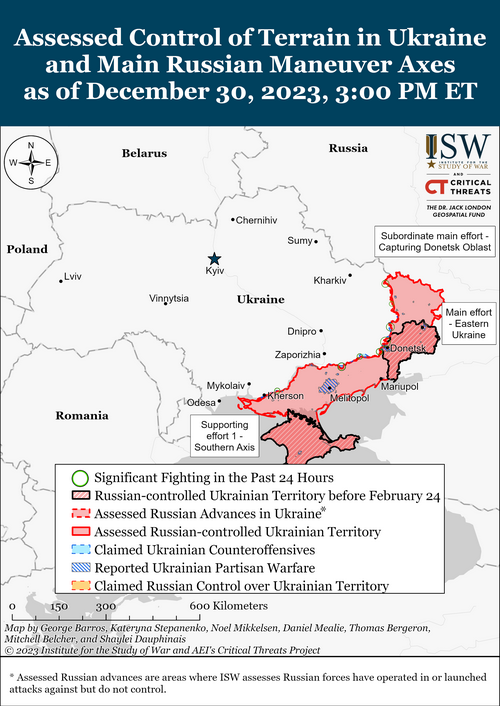
From The Institute for the Study of War:
Russian Offensive Campaign Assessment, December 30, 2023
Nicole Wolkov, Christina Harward, Kateryna Stepanenko, Riley Bailey, and Frederick W. Kagan
December 30, 2023, 6:45pm ET
Click here to see ISW’s interactive map of the Russian invasion of Ukraine. This map is updated daily alongside the static maps present in this report.
Click here to see ISW’s 3D control of terrain topographic map of Ukraine. Use of a computer (not a mobile device) is strongly recommended for using this data-heavy tool.
Click here to access ISW’s archive of interactive time-lapse maps of the Russian invasion of Ukraine. These maps complement the static control-of-terrain map that ISW produces daily by showing a dynamic frontline. ISW will update this time-lapse map archive monthly.
Note: The data cut-off for this product was 1:30pm ET on December 30. ISW will cover subsequent reports in the December 31 Russian Offensive Campaign Assessment.
Ukrainian forces reportedly conducted a large series of strikes against targets in Russia on the night of December 29 to 30 and on December 30. Ukrainian security sources told Western and Ukrainian media that Ukrainian forces launched more than 70 drones on the night of December 29 to 30 at Russian military infrastructure and defense industrial facilities near Moscow, Belgorod, Tula, Tver, and Bryansk cities.[1] The Ukrainian security sources reportedly characterized these strikes as a response to the Russian strikes on December 29, which was the largest series of drone and missile strikes against Ukraine since the start of the full-scale invasion.[2] The Russian Ministry of Defense (MoD) claimed that Russian forces intercepted 32 Ukrainian drones in Bryansk, Orel, Kursk, and Moscow oblasts on the night of December 29 to 30.[3] The discrepancy between these Russian and Ukrainian figures may suggest that Ukrainian forces struck many of their intended targets, as Ukrainian security sources suggested to Western and Ukrainian media.[4] Ukrainian forces reportedly struck the Kreminy El Plant in Bryansk City, which is Russia’s second largest producer of microelectronics, 90 percent of whose manufactured products are reportedly components of Russian military equipment and systems.[5] Geolocated footage published on December 30 shows explosions over Bryansk City.[6] The Russian MoD stated that Russian air defenses shot down 12 Ukrainian MLRS rockets in Belgorod Oblast on December 29 and several more Ukrainian MLRS rockets near Belgorod City during the day on December 30.[7] Ukrainian security sources reportedly told Western and Ukrainian media that the Ukrainian strikes on December 30 targeted Russian military targets near Belgorod City.[8]
Russian forces conducted a lower number of missile and drone strikes against Ukraine on December 30 following the large Russian strike series on December 29. Ukrainian military officials reported that Russian forces launched 10 Shahed-136/-131 drones at targets in southern Ukraine, an Iskander-M missile at Zaporizhzhia City, an unspecified number of Kh-59 missiles at Dnipro and Odesa cities, and six unspecified missiles at Kharkiv City.[9] Ukrainian officials reported that Ukrainian forces intercepted five of the drones, the Iskander-M missile, and one of the Kh-59 missiles.[10] Russian forces reportedly struck civilian infrastructure in Kharkiv City, an enterprise in Odesa City, and the office of the Ukrainian Human Rights Commissioner in Kherson City.[11] Ukrainian President Volodymyr Zelensky stated on December 30 that the December 29 Russian strike series killed 39 people and wounded 159 and impacted hundreds of civilian objects.[12] The Economist reported on December 29 that a source in Ukraine’s defense industry stated that Russian strikes on December 29 predominately targeted defense industrial facilities in Ukraine, including those connected to Ukrainian missile and drone production.[13] Russian strikes against Ukrainian defense industrial facilities likely mean to prevent Ukraine from developing key capacities to sustain operations for a longer war effort and disrupt Ukrainian efforts to seek Western partnerships for joint production in Ukraine.[14]
Russian officials continued to clearly state that Russia is not interested in negotiating with Ukraine or the West in good faith and intends to achieve its maximalist objectives in Ukraine. Russian Deputy Minister of Foreign Affairs Mikhail Galuzin stated in an interview with Russian state outlet RIA Novosti on December 30 that Russia will agree to a settlement when Ukraine is “neutral, non-aligned, and nuclear-free,” “demilitariz[ed],” and “denazi[fied]” — long-standing Russian demands for Ukraine’s exclusion from NATO and EU membership, the removal of Ukraine’s ability to defend its land and its people, and the replacement of the current elected Ukrainian government with a Kremlin-accepted government.[15] Galuzin also reiterated the Kremlin narrative that Ukrainian President Volodymyr Zelensky — and not Russian President Vladimir Putin — is to blame for the absence of negotiations and claimed that Zelensky’s proposed peace plan “has nothing to do with peace” but “justif[ies] the continuation of hostilities.” Galuzin claimed that Russia has never refused to engage in dialogue with Ukraine, but that Russia has “no choice” but to complete all its “assigned tasks” — Russia’s maximalist objectives — in Ukraine.
The Kremlin’s recent public rhetoric about its maximalist objectives and imperial designs in Ukraine are permeating the Russian information space. A prominent Russian milblogger claimed on December 30 that Western media is disseminating “rumors” about negotiations that would end the war in Ukraine by giving Russia unspecified parts of Ukrainian territory.[16] The milblogger stated that Russia is not interested in such “limited proposals,” suggesting that the milblogger believes that Russia’s war objectives extend beyond its currently occupied territory. The milblogger also claimed that Ukraine is not yet sufficiently demoralized and “exhausted” to accept a “catastrophic capitulation,” suggesting that the milblogger believes that Russia should only accept such a “catastrophic [Ukrainian] capitulation” and is calling on Russia to achieve these maximalist objectives in part through psychological means. Russian sources specifically amplified Deputy Chairperson of the Russian Security Council Dmitry Medvedev’s labelling of Odesa, Dnipro, Kharkiv, Mykolaiv, and Kyiv as “Russian cities” on December 28. The prominent milblogger claimed on December 30 that the war will end when Ukraine allows Russia to take Kharkiv, Mykolaiv, Odesa, and other Ukrainian oblasts.[17] Former Donetsk People’s Republic (DNR) People’s Militia Spokesperson Eduard Basurin claimed on December 30 that Russia’s task for the war in Ukraine was previously “blurry” and ”there was no understanding of where [Russian] borders should stop” but Medvedev’s statement makes it clear that Russia has determined that its borders should allow for ”complete [Russian] control“ of the Black Sea and should include Kyiv.[18] Basurin called Kyiv “the capital of [Russia’s] large empire” and the birthplace of Russian Orthodoxy and the word “Rus” (in reference to Kyivan Rus). Basurin’s statements echo those of Putin, who featured similar claims in his July 2021 “Historical Unity of Russians and Ukrainians” essay and who has recently reverted to narratives about Kyivan Rus as part of the “Russian World” (Russkiy Mir) to frame Russia’s invasion of Ukraine as a historically justified imperial reconquest.[19]
Russia continues to set information conditions aimed at destabilizing Moldova by framing Russia as a protector of allegedly threatened Russian-language speakers in Moldova. Russian state news wire TASS reported on December 27 that 19.1 percent of school children in Moldova choose to receive educational instruction in the Russian language.[20] TASS claimed that the Moldovan government’s refusal to recognize Russian as a state language in 1989 led to the war in Transnistria and the conflict with Gagauzia.[21] TASS further claimed that the ruling pro-European Moldovan Party of Action and Solidarity is exacerbating these alleged long-standing language divides by failing to grant Russian language the status of “a language of interethnic communication.”[22] Russian forces have occupied Transnistria since 1992, and Russia has continually supported pro-Russian actors in Moldova to promote political instability and division.[23] Claims that the Party of Action and Solidarity is threating Russian speakers in Moldova allow Russia to frame any potential Russian support for pro-Kremlin actors in Moldova as a humanitarian attempt to protect Russian speakers instead of an attempt to politically destabilize Moldova itself. The Kremlin used exactly this line of argument as one of the bases for its 2022 full-scale invasion of Ukraine.[24] Russia is likely attempting to justify any future actions in Moldova as an attempt to protect its “compatriots abroad,” a term that Russia has broadly defined to mean ethnic Russians and Russian speakers outside of Russia regardless of their citizenship. Russia continues to justify its invasion of Ukraine, in part, by claiming Russia is protecting its “compatriots” in Ukraine and their right to use Russian language and will likely continue to use this narrative when discussing any future Russian attempts at imperial reconquests.[25]
Russia continues attempts to actively shape the Western information space to support Russian positions and undermine support for Ukraine while portraying these efforts as endogenous to the West. The Washington Post reported on December 30 that it obtained Kremlin documents from an unspecified European security service that show that Russian Presidential Administration First Deputy Head Sergei Kiriyenko oversees Kremlin operations to undermine support for Ukraine and NATO in the French information space and through French politicians and activists.[26] The Kremlin documents reportedly listed specific narratives that the Kremlin sought to promote in France including arguments that Western sanctions against Russia have harmed the French economy, that the provision of French weapons supplies to Ukraine has degraded France’s ability to defend itself, that continuous support for Ukraine would lead to World War III, and that France should not fund a foreign war.[27] The Kremlin documents also reportedly show that Kremlin political strategists instructed a Russian troll farm employee to write a “200-character comment by a middle-aged French person” arguing that European support for Ukraine is a “stupid adventure” and that continued support for Ukraine is increasing inflation and lowering living standards.[28]
The Washington Post also reported that a six-month French government inquiry found that “Russia is conducting a long-term disinformation campaign in [France] to defend and promote Russian interests and to polarize [French] democratic society.”[29] The inquiry highlighted French far-right party National Rally’s links to the Kremlin and National Rally Party member and French politician Thierry Mariani’s continued pro-Russian positions.[30] Mariani, previously under investigation for Russia-related corruption, is the Co-Chair of the Russian government-founded French think tank, the Franco-Russian Dialogue Association.[31] Russia reportedly employs similar information tactics in Ukraine, the West, and worldwide. The Atlantic Council’s Digital Forensic Research Laboratory (DFRLab) and the BBC’s Verify project recently found that Russian actors created thousands of fake accounts aimed at defaming former Ukrainian Defense Minister Oleksii Reznikov and connected the effort to a previous Russian information campaign to discredit Commander-in-Chief General Valerii Zaluzhnyi in early 2023.[32] Independent social media monitor Graphika also found that Russian actors generated online content designed to appear as domestically generated to reduce Western support for NATO ahead of the July 2023 NATO summit.[33]
The Russian Ministry Foreign Affairs (MFA) emphasized Russia’s improving diplomatic relations with non-Western countries in way that suggests that the Kremlin is insecure about the possibility of diplomatic isolation against the backdrop of its full-scale invasion of Ukraine. The Russian MFA published a list on December 30 outlining its accomplishments in gaining political and diplomatic support for Russia’s full-scale invasion of Ukraine and expanding cooperation with countries and associations of the “world majority.”[34] Russia has previously defined the “world majority” as “a civilizational and cultural community that objectively opposes” the West and alleged that the world is divided into two camps: countries that support the United States and Ukraine and countries that are neutral or support Russia.[35] The MFA cited several accomplishments, such as improving relations with countries in the Asia-Pacific, Middle East, Africa, and Latin America; having Sino-Russian relations reach an “unprecedented level”; bringing the Russian–North Korean relations to a new level; and developing Russian–Iranian relations. The MFA also claimed that Russia thwarted Western attempts to isolate Russia, responded to NATO’s and the European Union’s expansion, and withdrew from a series of treaties. It notably did not identify the expansion of NATO and the EU as the defeats for Russian diplomacy that they were. The Russian MFA has been trying recently to establish new diplomatic relations with African countries and even reopened its embassy in Burkina Faso for the first time since 1992 on December 28.[36] Russian Prime Minister Mikhail Mishustin signed a bill in August committing Russia to reopen its embassy in Equatorial Guinea.[37] MFA Deputy Minister Yevgeny Ivanov announced on December 25 that Russia is planning to open additional embassies and diplomatic missions and claimed that while Western countries sent hundreds of Russian diplomats home, these diplomats were able to find other jobs within the MFA network.[38]
Key Takeaways:
- Ukrainian forces reportedly conducted a large series of strikes against targets in Russia on the night of December 29 to 30 and on December 30.
- Russian forces conducted a lower number of missile and drone strikes against Ukraine on December 30 following the large Russian strike series on December 29.
- Russian officials continued to clearly state that Russia is not interested in negotiating with Ukraine or the West in good faith and intends to achieve its maximalist objectives in Ukraine.
- The Kremlin’s recent public rhetoric about its maximalist objectives and imperial designs in Ukraine are permeating the Russian information space.
- Russia continues to set information conditions aimed at destabilizing Moldova by framing Russia as a protector of allegedly threatened Russian-language speakers in Moldova.
- Russia continues attempts to actively shape the Western information space to support Russian positions and undermine support for Ukraine while portraying these efforts as endogenous to the West.
- The Russian Ministry Foreign Affairs (MFA) emphasized Russia’s improving diplomatic relations with non-Western countries in way that suggests that the Kremlin is insecure about the possibility of diplomatic isolation against the backdrop of its full-scale invasion of Ukraine.
- Russian forces made confirmed gains near Kreminna, Bakhmut and Avdiivka as positional engagements continued along the entire line of contact.
- The Russian military command reportedly continued the dissolution of the “Kaskad” operational combat tactical formation of the Donetsk People’s Republic’s (DNR) Internal Affairs Ministry (MVD) to support its efforts to formalize control over Russian irregular forces.
- Russia continues efforts to integrate education systems in occupied Ukraine and expand education programs aimed at eliminating Ukrainian identity in occupied territories.
Go here to read the rest.
From Strategy Page:
December 30, 2023: in Ukraine, swarms of FPV (First Person View) UAVs (Unmanned Aerial Vehicles) are revolutionizing how wars are fought. There are few methods to defeat UAV attacks. The primary defensive measure is electronic jamming of the control signal between the UAV operator and the UAV. Jamming is of limited effectiveness because active jammers are easy targets for UAVs programmed to detect, home in on and destroy jammers. Depending on how they are programmed, UAVs will either land if jammed or return to where they were launched.
Despite those defensive measures, and the small explosive payload UAVs carry, about half the armored vehicles damaged or destroyed in Ukraine were done in by armed UAVs. Training of UAV operators is critical as it takes over a hundred hours of operating UAVs to gain a minimal skill level. Female soldiers can excel as UAV operators while mostly avoiding the battlefield risk of death or injury. Unlike pilots of combat aircraft, UAV operators are much less likely to be put out of action by death, injury, or capture. UAV operators are relatively close to the front lines and exposed to some risk, but not nearly as much as pilots. Such reduced casualties shorten the learning curve for UAV operators and make them more dangerous faster compared to infantry whose effective combat “lifetime” is much shorter.
UAV warfare is increasingly common and dominating some combat zones. Tactics and techniques are also evolving as Ukraine and Russia both experiment with new tactics, techniques, and UAV designs. Both nations are also increasing production of UAVs and the number of trained operators. Both Russia and Ukraine realize that UAVs provide unprecedented surveillance of the battlefield, but not all of it. That requires more UAVs and operators. One solution for this shortcoming is operator software that enables one operator to control several UAVs. The number one operator can handle simultaneously depends on operator experience. That cannot be manufactured but must be developed. Whoever can obtain the most trained operators has an advantage.
All these UAV developments make combat more dangerous for the troops on the ground. UAVs not only keep an eye on enemy troops but are always ready to go in and put them out of action, as in dead or wounded. Troops are still fighting each other on the ground, but now they have to worry about constant surveillance and attacks from the growing number of UAVs hovering over the battlefield. In addition to operators there are the UAV maintainers, who repair damaged or otherwise disabled UAVs and service those needing a battery recharge or simply a fresh battery.
Ukraine’s military has established a UAV Academy to train UAV operators in basic and advanced skills. There are courses for commanders on how best to manage and use UAVs. This is essential because now Ukrainian infantry battalions have nearly as many UAVs as troops. The American military likes to call this a force multiplier. That is, a battalion with lots of UAVs is more effective, and lethal, than a battalion without so many UAVs. The Ukrainian military is the first to go so far in this direction and appear to be benefitting from the massive use of UAVs. Other nations are closely following this development and preparing to adopt what works for Ukraine. Russia is more conservative in how they deal with this, even though they are also using massive numbers of UAVs. There are already dozens of Ukrainian companies offering training for UAV operators and the Ukrainian military uses the services of these firms. Ukraine seeks to have more than 10,000 trained operators as quickly as possible. UAV operators specialize. Most learn to operate quadcopters while a large minority learn how to operate FPV UAVs, and a smaller number learn how to operate fixed wing UAVs. Ukraine has found that the most difficult operators to recruit and train are those for FPV UAVs. The Ukrainian military considers UAV operators as a separate military specialty like infantryman, artillerymen, or radar operator.
Earlier in 2023 Ukraine revealed that it planned to spend over half a billion dollars on UAVs but did not reveal the extent of their efforts to add more capabilities to commercial UAVs as well as the growing number of UAVs being manufactured by Ukrainian companies. Ukrainian developers and manufacturers are often small groups of civilian hobbyists that proved capable of creating new features for UAVs, both commercial and hobbyist-created models. The Russian invasion spurred a lot of innovation, mainly among Ukrainian developers. Among the items available to commercial customers are a lot of digital video camera items as well as lighter, miniaturized computer components that can be assembled and programmed by users to perform essential tasks, like using AI apps and data from onboard video cameras of enemy forces, even if they are camouflaged or in underground bunkers. Constant combat use of these systems enables developers to address shortcomings and continually improves the hardware and software carried on these hunter killer UAVs. Earlier in the war two UAVs were needed for this but now all that tech and weapons can be carried and used by one UAV. The Ukrainian military also holds competitions to find the most skilled UAV operators and honor them with promotions and more challenging assignments.
Go here to read the rest. UAV’s are dominating the skies over Ukraine. War in the 21rst century is continuing to evolve and change. I hope the Brass at the Pentagon can take time from their woke games to pay attention.


It appears that Putin will cruise to reelection in the coming Presidential campaign. His opponents have all been disqualified. Sound familiar?