
From The Institute For The Study of War:
Russian Offensive Campaign Assessment, November 14, 2023
Karolina Hird, Christina Harward, Nicole Wolkov, Grace Mappes, George Barros, and Frederick W. Kagan
November 14, 2023, 6:20pm ET
Click here to see ISW’s interactive map of the Russian invasion of Ukraine. This map is updated daily alongside the static maps present in this report.
Click here to see ISW’s 3D control of terrain topographic map of Ukraine. Use of a computer (not a mobile device) is strongly recommended for using this data-heavy tool.
Click here to access ISW’s archive of interactive time-lapse maps of the Russian invasion of Ukraine. These maps complement the static control-of-terrain map that ISW produces daily by showing a dynamic frontline. ISW will update this time-lapse map archive monthly.
Note: The data cut-off for this product was 12:30pm ET on November 14. ISW will cover subsequent reports in the November 15 Russian Offensive Campaign Assessment.
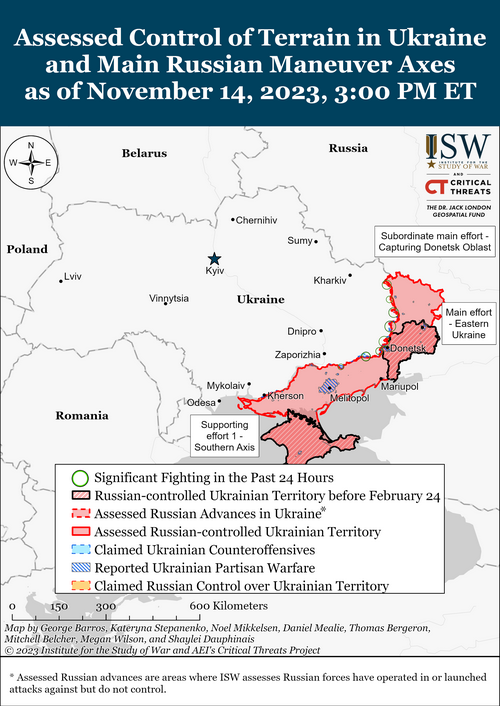
Russian forces are likely trying to regain the theater-level initiative in Ukraine by conducting several simultaneous offensive operations in eastern Ukraine, although it remains unclear if Russian forces will be able to fully regain the initiative as Ukrainian forces maintain pressure on critical areas of the front. Several Ukrainian officials noted that the situation along the frontline is complex but that Ukrainian forces maintain control of the battlespace.[1] Ukrainian Commander-in-Chief General Valerii Zaluzhnyi stated on November 13 during a conversation with US Chairman of the Joint Chiefs of Staff General Charles Brown that the Avdiivka, Kupyansk, and Marinka directions are the most intense but noted that Ukrainian forces are continuing offensive actions in unspecified sectors of the front.[2] Ukrainian Ground Forces Commander Colonel General Oleksandr Syrskyi emphasized that Russian forces are pursuing simultaneous offensive actions in several directions and trying particularly to regain the initiative north and south of Bakhmut.[3] Ukrainian President Volodymyr Zelensky stated that Ukrainian forces are reporting an increase of Russian assaults in the Kupyansk, Avdiivka, and Donetsk directions.[4]
Ukrainian officials’ statements about the current tempo of Russian operations along the frontline are consistent with ISW’s assessment about ongoing Russian offensive operations, particularly in the Kupyansk, Bakhmut, and Avdiivka directions.[5] Russian forces will likely struggle to fully regain the initiative across the theater, however, and Ukrainian forces are continuing their own offensive operations and making tactical-level gains along the front, particularly in western Zaporizhia Oblast and on the east (left) bank of Kherson Oblast.[6] The Russian military command will likely have to decide whether to keep certain Russian elements on certain sectors of the front to defend against ongoing Ukrainian offensive operations or to redeploy them to support offensive operations elsewhere that will likely culminate without reinforcements. These choices will likely hinder Russia’s ability to fully regain the initiative in the coming weeks.
Ukrainian President’s Office Head Andriy Yermak stated on November 13 that Ukrainian forces have established a “foothold” on the east (left) bank of Kherson Oblast.[7] In a speech at the Hudson Institute in Washington, DC, Yermak emphasized that despite the challenging battlefield situation, Ukrainian forces have “gained a foothold on the left bank of the Dnipro” and continue counteroffensive operations in unspecified sectors of the front.[8] ISW continues to assess that Ukrainian forces have been conducting larger-than-usual ground operations on the east bank of Kherson Oblast since mid-October 2023 and that Ukrainian forces appear to be able to maintain and supply their current positions on the Russian-controlled side of Kherson Oblast.[9] Geolocated footage published on November 13 shows that Ukrainian forces recently advanced in Krynky (30km northeast of Kherson Oblast and 2km from the Dnipro River).[10]
Russian President Vladimir Putin approved amendments to the Russian federal election law on November 14 that increase the Kremlin’s control over the conduct of elections and reduce election transparency ahead of the 2024 presidential elections.[11] The amendments allow the Russian Central Election Commission (CEC) to control the specifics and conduct of elections in areas under martial law, which notably includes occupied Donetsk, Luhansk, Zaporizhia, and Kherson oblasts, and stipulates that voting in these areas will only occur following coordination among the regional occupation administrations, the CEC, the Russian Ministry of Defense (MoD), and Federal Security Service (FSB). The amendments also restrict media access to polling places and election commission meetings exclusively to Russian-accredited journalists and media organizations. Russian-accredited journalists who seek access to polling areas in the jurisdiction of Russian military units require the approval of the unit’s commander to visit the areas. The amendments also necessitate that any actor legally designated as a “foreign agent” who speaks during a campaign event must announce that designation at the start of the speech and further prohibits presidential campaigning on blocked online platforms, such as opposition outlets Meduza and Vazhnye Istorii. These amendments allow the Russian federal government to increasingly control election campaigning and coverage of polling in Russian media to set conditions for additional Kremlin controls over Russian elections to help re-elect Putin in 2024. The Russian government may also postpone or cancel presidential elections in occupied Ukraine depending on the frontline situation and their ability to convincingly portray Putin as the winning candidate in these areas.
Russian forces conducted another wave of missile, air, and drone strikes against Ukrainian rear areas on the night of November 13–14. The Ukrainian Air Force reported on November 14 that overnight Russian forces launched nine Shahed-131/-136 drones from the direction of Primorsko-Akhtarsk, Krasnodar Krai; an Iskander-M ballistic missile from the direction of Dzhankoi, occupied Crimea; and Kh-35 cruise missiles from the direction of occupied Zaporizhia Oblast.[12] Ukrainian forces reportedly shot down seven of the nine Shaheds.[13] Ukraine’s Southern Operational Command clarified that a ballistic missile, presumably the Iskander-M, struck an open area near Chornobaiivka, Kherson Oblast, and Russian forces launched Kh-59s at Mykolaiv and Kherson oblasts.[14] Ukrainian Air Force Spokesperson Colonel Yuriy Ihnat noted that Russian forces are using ballistic missiles more frequently because they are more challenging for Ukrainian air defenses to intercept.[15] Russian sources claimed that Russian strikes hit military assets and critical infrastructure in Cherkasy, Vinnytsia, Mykolaiv, Kherson, and Kirovohrad oblasts, as well as the Shebelinsky gas processing plant in Kharkiv Oblast, although ISW has not observed visual evidence for all of these strikes.[16]
Ukraine’s Western partners announced new efforts to continue providing Ukraine with military and financial aid. Germany announced a new aid package to Ukraine on November 13 that includes 10 Leopard tanks, 14 Bandvagn 206 tracked all-terrain vehicles, and 1,020 155-mm shells, and Reuters reported on November 12 that German Chancellor Olaf Scholz’s governing coalition has agreed in principle to double Germany’s military aid to Ukraine next year to €8 billion.[17] Ukrainian President Volodymyr Zelensky stated on November 13 that Ukrainian pilots began training at the F-16 training center in Romania.[18] NATO Secretary General Jens Stoltenberg emphasized on November 14 that sustained NATO support for Ukraine is important as the current situation on the battlefield is difficult.[19] EU Foreign Affairs Representative Josep Borrell stated on November 13 that Ukraine is the EU’s top priority and that the EU’s commitment will not waver.[20] Ukrainian Minister of Foreign Affairs Dmytro Kuleba highlighted the importance of speeding up the EU’s plan to supply Ukraine with one million shells by March 2024 during a meeting with the EU Council of Foreign Ministers on November 13, but Politico reported on November 14 that German Defense Minister Boris Pistorius expressed doubt that the EU would be able to meet this target.[21] Politico also reported that Borrell stated that the European defense industry is exporting about 40 percent of its current production to third countries and urged European countries to shift exports to Ukraine as “priority one.”[22] Borrell stated that the EU’s ability to supply Ukraine with one million shells “will depend on how quickly orders come to the industry and how quickly the industry reacts.”[23] Stoltenberg also reiterated on November 14 that NATO has put in place framework contracts worth €2.4 billion, including €1 billion worth of firm orders, and stated that NATO countries are increasing production in order to reach the target of one million shells by March 2024.[24] Politico reported that Estonian Defense Minister Hanno Pevkur also announced that Estonia offered five European companies a procurement offer for €280 million worth of 155-mm artillery ammunition.[25]
The Russian government is likely attempting to force Google to cease operations in Russia. The Moscow Magistrate’s Court fined Google 15 million rubles (roughly $165,745) on November 14 for the repeated failure to localize the personal data of Russian citizens in Russia.[26] Russian state censor Roskomnadzor requires foreign internet-based services to localize databases of Russian users as of July 1, 2021, and Russian courts previously fined Google 15 million rubles in June 2022 for failing to adhere to this law.[27] The Russian government has previously fined Russian internet giant Yandex for also failing to adhere to Russian laws regarding disclosing users’ personal data to the government, likely forcing Yandex to split its Russian entity from its international entity to adhere to Russian laws and allowing the Russian government to exercise increased control and surveillance over Russians’ usage of Yandex.[28] The Russian government previously banned certain Western social media sites and demanded that Google remove “false information” about the Russian war in Ukraine in early 2022.[29] The Russian government likely aims to force Russians to utilize search engines and other internet services of Russian companies that the government can control better than international entities like Google.
Armenia continues to distance itself from Russia amid deteriorating Russian–Armenian relations. Armenian Prime Minister Nikol Pashinyan informed Belarusian President Alexander Lukashenko on November 14 that he would not participate in the Russian-led Collective Treaty Security Organization (CSTO) meeting in Minsk on November 23.[30] Kremlin Spokesperson Dmitri Peskov responded to Pashinyan’s announcement, stating that the Kremlin understands that heads of state have their own events in their work schedules but that this is regrettable as meetings like the CSTO meeting are a “very good occasion for exchanging opinions” and coordinating ideas.[31] Armenian Deputy Foreign Minister Vahan Kostanyan told journalists on November 9 that Armenia is currently not discussing the legal process of leaving the CSTO.[32]
Deputy Chairperson of the Russian State Duma Pyotr Tolstoy suggested a measure that would restrict work opportunities for migrants from countries that have not designated Russian as a state language, likely as part of an ongoing effort to coerce migrants into Russian military service. Tolstoy proposed restricting migrants from working in service sector jobs if they are not citizens from a country that designates Russian as a state language at a Federation Council meeting on state policy in the field of preservation, protection, and development of Russian language on November 14.[33] Tolstoy claimed that post-Soviet countries are teaching English and “trying to supplant Russian with their national language.”[34] If Tolstoy’s measure is officially proposed and passed, it would allow Russian authorities to limit work opportunities for migrants from Central Asia and the south Caucasus, potentially making it easier for Russian authorities to coerce migrants into serving in the Russian military due to a lack of other labor alternatives. Kazakhstan and Kyrgyzstan designate Russian a state language while the titular languages are their state languages.[35] Tajik law designates Russian as a language of “interethnic communication.”[36] The Russian language does not have a legally designated status in Uzbekistan, Turkmenistan, Azerbaijan, Georgia, or Armenia.[37] Russian authorities may also be attempting to pass laws restricting migrant work in Russia in an effort to placate Russian ultranationalists who are often critical of migrants working in Russia ahead of the Russian presidential elections in 2024.
Key Takeaways:
- Russian forces are likely trying to regain the theater-level initiative in Ukraine by conducting several simultaneous offensive operations in eastern Ukraine, although it remains unclear if Russian forces will be able to fully regain the initiative as Ukrainian forces maintain pressure on critical areas of the front.
- Ukrainian President’s Office Head Andriy Yermak stated on November 13 that Ukrainian forces have established a “foothold” on the east (left) bank of Kherson Oblast.
- Russian President Vladimir Putin approved amendments to the Russian federal election law on November 14 that increase the Kremlin’s control over the conduct of elections and reduce election transparency ahead of the 2024 presidential elections.
- Russian forces conducted another wave of missile, air, and drone strikes against Ukrainian rear areas on the night of November 13–14.
- Ukraine’s western partners announced new efforts to continue providing Ukraine with military and financial aid.
- The Russian government is likely attempting to force Google to cease operations in Russia.
- Armenia continues to distance itself from Russia amid deteriorating Russian-Armenian relations.
- Deputy Chairperson of the Russian State Duma Pyotr Tolstoy suggested a measure that would restrict work opportunities for migrants from countries that have not designated Russian as a state language, likely as part of an ongoing effort to coerce migrants into Russian military service.
- Russian forces conducted offensive operations along the Kupyansk-Svatove-Kreminna line, near Bakhmut, near Avdiivka, west and southwest of Donetsk City, in the Donetsk-Zaporizhia Oblast border area, and in western Zaporizhia Oblast on November 14 and advanced in some areas.
- The Russian government discussed amendments that would more strictly penalize those who evade mobilization as well as volunteer servicemen who “improperly” perform their duties.
- Russian occupation officials are beginning to announce that occupied areas of Ukraine will not hold significant public Christmas and New Years’ celebrations due to security concerns.
Go here to read the rest. Putin is leaving nothing to chance in regard to the February Russian Presidential election next year. I think the current Russian piecemeal offensives are being done to help convince the Russian population that the Ukraine War is not a losing proposition. Even dictators have to be concerned about public opinion.

