

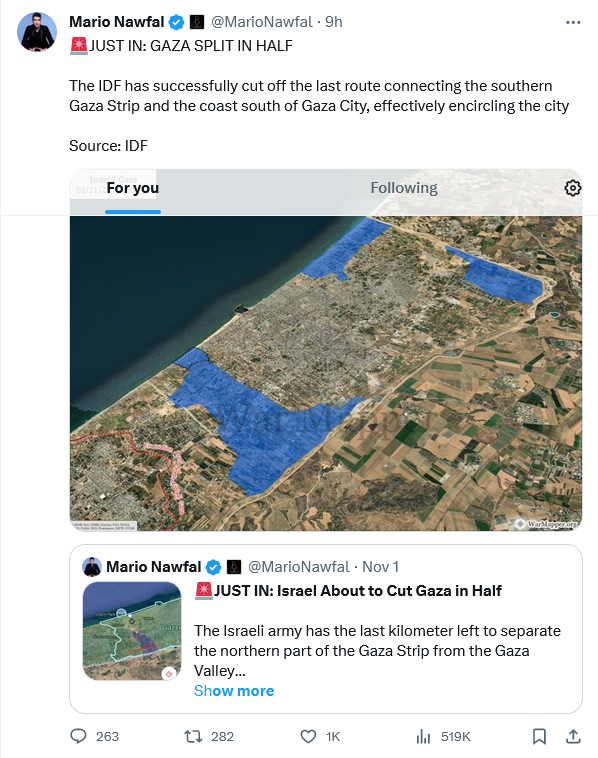
The murderers of Hamas have no idea what they awakened on October 7. The Israelis will take a leaf from the Romans and make a wasteland in the Gaza strip and call it peace. The Gazan civilian population might as well start calling themselves Egyptians. Being ruled by a terrorist gang has consequences.
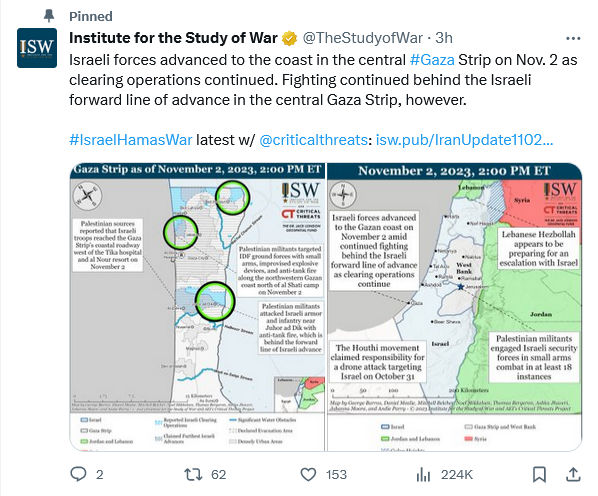
From Strategy Page:
October 30, 2023: The October 7 Palestinian Hamas attack on Israel caused a lot of deaths and quite a bit of destruction in Gaza, where Hamas was, and still is, based. Iran and most Arab nations regarded the attack as a great victory because Hamas was able to kill so many Jews. Some foreigners were killed as well, including Americans.
Israel promptly announced that it was now at war with radical Palestinian faction called Hamas which controls the Gaza Strip, a coastal area south of Israel and north of Egypt. Gaza and the West Bank together constituted the Palestinian state until 2007. Fatah, the Palestinian political party that governed the West Bank, became so corrupt that it lost a 2007 election in the Gaza Strip to Hamas, a more radical but more capable group which administered Gaza after 2007. Hamas also had some presence in the West Bank, which was adjacent to Israel and subject to Israeli army raids if it appeared that someone, like Hamas, was preparing for an attack on Israel. Hamas was preparing for such an attack, but most of the preparations were in Gaza.
Until the recent attack, Israel left Gaza alone as long as there did not appear to be any threat against Israel. Yet there was a growing threat in Gaza, but Hamas managed to conceal it from the Israelis. With the help of Iran, which had long sought to destroy Israel, thousands of missiles and unguided rockets were smuggled into Gaza with the assistance of corrupt Egyptian border guards eager to take bribes to ignore the movement of these weapons into Gaza. Iran also provided technical advisors to show Hamas operatives how to quietly obtain information about Israeli settlements and military bases between Gaza and Israel. Hamas also had a lot of equipment, like bulldozers and trucks, that were needed for the attack on Israel but had legitimate uses inside Gaza.
All the missiles and rockets were concealed in a network of tunnels underneath Gaza. Israel knew of some of these tunnels but had not been able to monitor their current status or use. Hamas prepared tunnel exits that allowed rockets and missiles to be quickly brought to the surface and launched. They practiced getting the missiles and rockets to the surface, but obviously did not fire any. Hamas wanted to convince Israel that nothing unusual or threatening was going on in Gaza. Israel had great opportunities to establish effective informant networks in Gaza but obviously failed to do so. Hamas made it appear that there was no threat in Gaza. This was a major intelligence failure for Israel, and an expensive one.
The Hamas attack plan was thorough and there were numerous small groups of Hamas attackers, each with specific objectives during the offensive. The bulldozers were used to quickly create breeches in the wall Israel built between Gaza and Israel. Through those gaps came Hamas members in trucks or on foot. They were told to kill anyone, civilian or military they encountered as they advanced towards Israel. By killing as many Israelis as they could, Hamas expected to make Israel look weak. That may have been the intention, but Israel responded by declaring war on Hamas and Hezbollah, their Iran-backed counterpart in southern Lebanon.
The Hamas offensive faltered as it approached the Israeli border and this was visible by the growing number, about 1,500, Hamas men who were killed. Having killed 1,400 Israelis and a few foreigners, most of them civilians and taken several hundred hostages, Hamas retreated to Gaza with their hostages. Hamas still had plenty of rockets and prepared to continue fighting by launching more rockets and missiles and deploying gunmen and placing explosives in areas to be defended and detonating the explosives if the invading Israelis got that far. Hamas planned to use the hostages to delay an Israeli attack The Israelis did not cooperate. First the Israelis used airstrikes on known Hamas targets in Gaza. At the same time Israeli tank and infantry units maneuvered to attack Gaza from several directions. Worse, for Hamas, the Israeli ground attack did not come as a massive assault, but small raids with infantry, or even tanks, hitting a specific target and then withdrawing.
In the north, Iran-backed Hezbollah attacked Israel with some of its 100,000 – 150,000 rockets and missiles but made no large-scale attacks and refused to try and enter Israel. There were a lot of Israeli troops in the north and Hezbollah had to worry about the Lebanese army attacking them if Hezbollah forces tried to advance into Israel. Hezbollah has no allies in Lebanon and is considered an Iran-backed group that is hostile to the Lebanese government. The feeling was mutual.
The battle for Gaza continued, with Israel declaring it would eliminate the Hamas presence and take control of Gaza. Israel might eventually find some locals who can run Gaza and do so without threatening Israel or anyone else. Until then, Gaza will be under Israeli military occupation. That’s not a perfect solution but it’s better than having Palestinians in charge. Any solutions seem to have eluded the Palestinians. It wasn’t always like that. The original UN plan for the area included separate Israeli and Palestinian states. The Palestinians were not satisfied and instead sought to destroy Israel and make the entire area Palestinian. The plan failed.
Currently fighting continues in Gaza, where 2.3 million Palestinians are dependent on foreign aid to survive. By the end of October, more than 7,000 Palestinians in Gaza have died while Israeli troops are only beginning their conquest of the Gaza Strip. Hamas has a network of 500 kilometers of tunnels underneath Gaza and Hamas calls it their metro (subway). In some places Hamas even used narrow gauge railroad tracks to speed the movement of weapons and supplies. Israel has dealt with these tunnels before, and their latest tactic is to block tunnel entrances. Some of these entrances are designed to allow some of the hundreds of rockets and missiles still stored in the metro to launch into Israel.
With Gaza again under Israeli occupation, the only Palestinian-controlled area left will be the West Bank. Some Hamas men fled to the West Bank, where Iran has tried to smuggle in weapons, including rockets. That has not been successful because the West Bank doesn’t have corrupt Egyptian border guards due to being landlocked with Jordan on its eastern border and Israel on the western border.
Since 1967, most of the West Bank has been under Israeli military occupation. Some portions are under Palestinian control but are surrounded by Israeli troops and 23o Israeli civilian settlements. The settlers are armed. Jordan cooperates with Israel in keeping things quiet in the West Bank, especially on the Jordanian border. There is some anti-Israel violence in the West Bank, but the Palestinians have not been able to sustain that because they are generally hostile to groups like Hamas. Most Palestinians do not approve of Hamas and its violence. This gets a lot of Palestinian civilians killed along with destruction in Palestinian communities and, more importantly, interferes with jobs.
During the last six months there has been more violence in the West Bank that required Israel forces to deal with. At first it was armed Palestinian groups fighting each other for dominance (Hamas vs. Fatah) while organizing attacks on Israelis or in Israel itself. This led to a degree of fighting in the West Bank not seen since 2021, and might be the start of a new Palestinian offensive or “intifada”. This would be the third one. The first lasted from 1987 to 1993 while the second one was from 2000 to 2005.
Israel defeated the 2000 Intifada(uprising) terror campaign by 2005. But as long as Palestinians had free access to Israel, Palestinian government (Fatah) urged and encouraged Palestinians to attempt attacks inside Israel. The Israelis responded with tighter border controls which kept the terrorist threat low in Israel. Fatah insisted they had a right to keep trying to kill Israelis and, for over a decade, Arab and Western nations kept providing aid to the West Bank and Gaza despite the fact that more and more of it was used to support and encourage more terrorism against Israel. Some Palestinian leaders tried to describe the violence as an effort to defend Islam. The Palestinians were not very religious and their violence against Israelis was justified by their belief that Israel must be destroyed, and Israelis driven from the region.
There were other problems, mainly involving corruption. This has led more donor states, Moslem and non-Moslem, to openly complain of Fatah misuse of aid money. Fatah denied it and continued their corrupt ways. The donors cut their aid, often to nothing. It was not just the Fatah support of terrorism but the growing Fatah corruption which meant a lot of the aid was stolen to enrich Fatah leaders. Palestinians also opposed the Fatah policy and Fatah was forced to tolerate more and more Palestinians renouncing terror to pass the background check and work in Israel. West Bank Palestinian jobs in Israel have become a crucial part of the West Bank economy even more so than they were back in 2000.
The post-2000 ban on Palestinian workers was unpopular with many Israeli employers, but the threat was so great that Israeli employers had to pay more to import and hire non-Moslem foreigners for as long as there was a threat that Palestinian workers were likely to try and kill Israelis. Both Israel and the former or potential Palestinian workers knew that a growing number of those Palestinian workers could be trusted to work in Israel. Those who violated that trust faced prison or worse if they played any part in an attack. Anyone associated with these untrustworthy Palestinians had a more difficult time getting permits to work in Israel. The growth in the number of trustworthy Palestinian workers was something neither Israel nor Fatah wanted to publicize lest the Islamic radicals declare war on Palestinians working or seeking to work in Israel. This might trigger a civil war in the West Bank, something Fatah did not want but the radicals were less opposed to. There are Palestinian factions that believe chaos in the West Bank would spread to Israel and weaken Israeli power. This is a minority belief that ignores the Israeli ability to organize effective responses to Palestinian violence. Life inside Israel is peaceful, most Palestinians wish they had a similar situation, and they would be correct if not for the endless supply of radical factions insisting violence is the solution.
For example, Hamas does not care about any form of collateral damage from forcing Palestinians working in Israel to cooperate with terrorists. Most Palestinians recognize that Hamas is hard-core about attacking Israel, which is why Hamas has had a hard time gaining political traction in the West Bank. Palestinians know that Hamas policies produce more poverty and casualties for Palestinians. The only thing that got Hamas control of Gaza during the last Palestinian elections in 2007 was the belief that Hamas would be less corrupt than Fatah. That was true in 2007 but has become less so ever since. Hamas forbids working in Israel and punishes anyone who protests about Hamas corruption.
West Bank violence between Palestinians and Israelis living in the many Jewish settlements has been on the increase for over a decade. The upsurge in violence is the result of the Palestinian leadership calling for another intifada in 2013. This was a side-effect of the rebellion in Syria and the “Arab Spring” in general. While some Palestinian leaders call for another uprising (intifada), most Palestinians, especially the older ones (over 30), fear the economic consequences of that and warn the pro-intifada radicals that there is not a lot of popular support for another round of violence. Israel has shown they know how to handle this at little cost to themselves and great cost to the Palestinians.
All this is complicated by persistent American efforts to achieve a negotiated peace between Israel and the Palestinians. The Palestinian peace talks never made much progress. The talks were held at the insistence of the U.S., which threatened to cut aid if the talks did not happen. American leaders are aware of Palestinian attitudes on peace with Israel, but the U.S. still assumes that a peace deal is possible if you keep trying. That’s one definition of insanity, continuing to try the same failed policies over and over again. For years Palestinian leaders have agreed with the “give peace talks a chance” approach when speaking to Western leaders and reporters but they then turn around and tell their followers that, of course, Israel must be destroyed and that there is no other solution.
For most Western leaders the disunity, corruption and general chaos within the Palestinian community is seen as a larger problem than a peace deal. That may be true, but without a positive attitude towards a peace deal, there won’t be any peace. Despite all this, for over a decade many Palestinians have been talking about a “Third Intifada” as if more civil disorder will change anything. Peace is not on the agenda. Most Israelis and Americans agree. Even without a new intifada, casual violence in the West Bank kept increasing. This usually takes the form of young men throwing stones at Israeli soldiers or civilians. Israeli women and children are the preferred targets because they are the least likely to shoot back if the rocks begin to inflict injuries. Palestinian propaganda praises those who kill children just as much as those who killed soldiers or police. All are heroes of the Palestinian struggle to destroy Israel. This is becoming embarrassing for some Western nations when it was pointed out that their aid money was being used directly for some of this propaganda.
The recent West Bank violence was the result of Israeli security forces shutting down a major Palestinian effort to recruit, train and arm hundreds of Palestinians to carry out attacks against Israelis living in the West Bank as well as in Jerusalem and Israel in general. The Palestinian terrorism operation was real as Israeli troops encountered armed resistance when they approached locations where weapons and munitions were stored, and newly recruited Palestinians were trained and armed. These operations were shut down, but only after fighting between Israeli troops and armed Palestinians. Once the fighting is over the weapons and munitions are disposed of and the Israeli troops withdraw, taking Palestinian suspects with them. Israeli troops are wounded and at least one has been killed in these operations. This sort of thing had not been seen in the West Bank since 2002. Until recently Fatah security forces kept the peace in the West Bank. The current growth of terrorist activity in the West Bank can be attributed to Gaza-based and Iran-supported terror group Hamas. There have been increasing Hamas efforts to establish operations in the West Bank. Most West Bank Palestinians want no part of this because similar activity in Gaza has brought nothing but poverty and trouble to the Palestinians living there.
The disruptive impact of small groups of radicals is a long tradition in the Middle East, especially after Islam was introduced over a thousand years ago. Islam is the only major religion whose scripture mandates continuous violence against infidels (non-believers). The Islamic scriptures make it clear that the mere existence of infidels is a threat to Islam and these infidels must be attacked, no matter what the cost. Most Moslems ignore this aspect of their religion, at the risk of being declared a heretic if conservative Moslems near them decide to get violent and go jihad (war on) against any Infidels within reach. Many Moslems, including Gulf oil state Arab governments are openly seeking a way to reform Islam and eliminate this flaw which has been crippling Islam and killing Moslems for over a thousand years. This is a serious effort and one reason for making peace with Israel. The Islamic militants in Gaza and the West Bank oppose efforts to give peace a chance.
Up north, the leaders of Hezbollah are less eager to attack Israelis. This is the result of a Hezbollah raid in 2006 that backfired in a big way, Hezbollah leaders later publicly admitted that they would not have staged that raid into Israel if they believed the Israeli response would have been so massive. Nevertheless, Hezbollah headers also believed they could prevent the UN peacekeeping force from disarming them and work out a prisoner exchange for the two Israeli soldiers that they held. However, Hezbollah is also aware that Lebanese public opinion has turned on them, and many Lebanese do want the UN peacekeeping force to disarm Hezbollah and return control of southern Lebanon to the Lebanese government. For over a decade, Hezbollah has resisted that by threatening a revival of civil war, with Hezbollah leading the Shia minority, which is about 35 percent of the population, against all comers. This made more sense when there were 30,000 Syrian troops in the country. The Syrians were now gone, and not coming back. All Lebanese could see what Hezbollah control of southern Lebanon had brought them. Lebanese blame Israel for the damage, but they blame Hezbollah for setting the Israelis off. The Lebanese can’t make the Israelis pay, but Hezbollah is a different matter.
Meanwhile in mid-2006 Israeli troops moved back into northern Gaza, and warplanes continued making missile attacks on suspected terrorist leaders and key personnel. Israeli troops brought in large bulldozers, which are apparently being used to make it more difficult to launch rockets from the area, into southern Israel. Two recently kidnapped Western journalists were released. Their captors were not just a bunch of local guys grabbing some foreigners as a ploy to get a handout or a job, but a group of al Qaeda wannabes. The kidnappers demanded the release of all Moslem prisoners in the U.S., a typical al Qaeda demand. But with the chaotic conditions in Gaza, the last thing the Palestinian leadership (such as it is) needed was more foreign enemies. The kidnappers were found and persuaded to give up their Westerners. But not before the captives were forced, at gunpoint, to make a video where they pretended to convert to Islam.
European nations agreed to provide about half the 15,000 troops needed for the UN peacekeeping force in Lebanon. However, Moslem nations have been slow to supply the rest of the troops. Still up in the air was the issue of the peacekeepers being allowed to disarm Hezbollah. This would involve force, as Hezbollah has said it would not comply with any disarmament demands. In the past, UN peacekeepers have backed away from Hezbollah threats. During the recent fighting, UN peacekeepers even provided Hezbollah with daily updates of Israeli military operations, as observed by UN personnel who stayed in place.
A year after Israel withdrew from Gaza, some 3,500 Palestinians were killed and injured in the resulting violence. Most of the casualties were caused by other Palestinians. Radical groups insisted on continuing attacks on Israel. These only produced a few dozen deaths and injuries, less than one percent of the hurt the Palestinians were inflicting on themselves. It also brought Israeli retaliation, which was far less damaging than what Palestinian factions were doing to each other. Many Palestinians are now urging that their leaders get their acts together and stop all the posturing. The residents of Gaza are acutely aware of the fact that they were much better off under Israeli occupation, and that electing Hamas to run the place was not such a great idea.
Go here to read the rest.





HAMAS is incompetent, insane and malevolent. It is impossible to deal with such on rational terms as the US administration keeps attempting to do. Probably time for some one to remind them of Einstein’s definition of insanity.
Virtue-signaling politicians and ‘elites’— people who needn’t worry about the downsides of the policies they call for— are already pushing for the US, Canada and Europe to take in hundreds of thousands of Palestinians. It should tell us something that Gaza’s neighboring nations and fellow Muslims categorically refuse to accept these people into their population.
They would have us ignore the fact that these are the same people who danced in the streets over the ‘success’ of Hamas’ butchery on October 7. Those same people overwhelmingly support the extermination of Jews and applaud random bombings of civilians. For them, decapitating babies is a valid political act.
Take a long, hard look at those politicians, pundits, clerics and celebrities lobbying for the importation of Palestinians into the West. What you’ll see are fools insulated from the consequences of their bad decisions, people who do not give a damn about the people of their nations nor the culture that sustains them.