
“For generations to come, all will be told of the miracle of the immense planes from the United States bringing in the materiel that meant life to our people.”
Golda Meir, Prime Minister of Israel during the Yom Kippur War
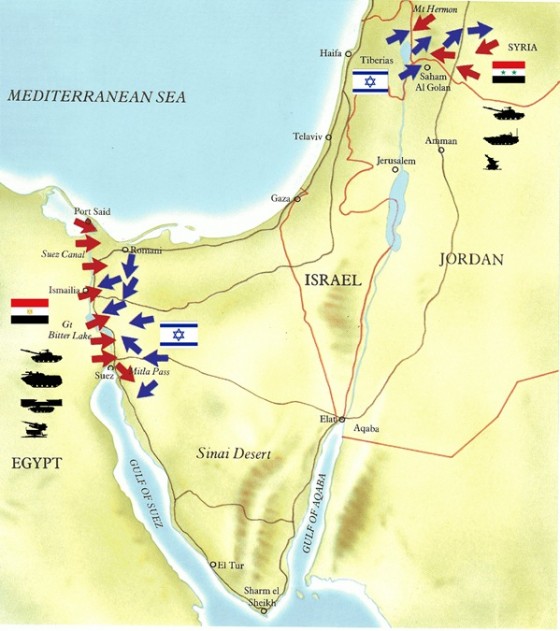
Hard to believe that half a century has passed since 16 year old me followed the Yom Kippur War developments with rapt attention. Launching a sneak attack on the holiest days for Jews, the Egyptians implemented a good set piece attack on the Bar Lev forts set up by the Israelis after their conquest of the Sinai in 67. As usual, such fortifications gave the illusion rather than the reality of security, and posed little obstacles to the Egyptians. In the meantime the Syrians launched a huge armor attack against the north of Israel
The Israelis were caught completely flat footed, and quickly found that their blitzkrieg tactics of small armor columns no longer worked in the face of Sagger wire guided missiles, and surface to air missiles helped lessen Israeli air superiority. The rate of ammunition usage and the destruction of some of their best weaponry brought the Israelis to the brink of defeat with Prime Minister Meir privately considering the nuclear option. Then the deux ex machina arrived in the form of an apostate Quaker US President:
Richard Nixon who resigned in disgrace was known for making anti-Semitic remarks in private, but here is how he acted during the Yom Kippur War crisis for Israel per Front Page:
Nixon’s Day of Judgment
If two-thirds of American Jewish voters had had their way, the man sitting in the White House at that critical moment would have been George McGovern. Though Nixon in 1972 doubled his share of the Jewish vote from the paltry 17 percent he received four years earlier, his Democratic opponent – an isolationist who spoke of drastic military cutbacks, had stated that Israel should not be allowed to use U.S.-supplied planes over Arab territory, and whose closest political allies were not exactly known for holding staunchly pro-Israel views – received the support of 65 percent of Jewish voters.
Fortunately for Israel, Nixon crushed McGovern among non-Jewish voters and easily won a second term. Now, a year after the election, Israel’s fate was very much in Nixon’s hands.
Precise details of what transpired in Washington during the first week of the Yom Kippur War are hard to come by, due mainly to conflicting accounts given by Kissinger and Secretary of Defense James Schlesinger regarding their respective roles.
What is clear, from the preponderance of information provided by those who witnessed or were involved with the unfolding events, is that Nixon – overriding inter-administration objections and bureaucratic inertia – implemented a breathtaking transfer of arms. During a 32-day period beginning October 14, jumbo U.S. military aircraft touched down in Israel 567 times, delivering some 22,300 tons of material. This enabled Israel to reverse its earlier setbacks, surround the Egyptians in the Sinai, and advance deep into Syrian territory.
This was accomplished, as Walter J. Boyne noted in an article in the December 1998 issue of Air Force Magazine, while “Washington was in the throes of not only post-Vietnam moralizing on Capitol Hill but also the agony of Watergate, both of which impaired the leadership of Richard M. Nixon. Four days into the war, Washington was blindsided again by another political disaster – the forced resignation of Vice President Spiro Agnew.”
According to those with firsthand knowledge, it was Nixon’s stubborn insistence that propelled the massive arms transfer, code-named Operation Nickel Grass.
“Both Kissinger and Nixon wanted to do [the airlift],” said former CIA deputy director Vernon Walters, “but Nixon gave it the greater sense of urgency. He said, ‘You get the stuff to Israel. Now. Now.'”
Boyne, in his book The Two O`Clock War, describes a high-level White House meeting on October 9:
As preoccupied as he was with Watergate, Nixon came straight to the point, announcing that Israel must not lose the war. He ordered that the deliveries of supplies, including aircraft, be sped up and that Israel be told that it could freely expend all of its consumables – ammunition, spare parts, fuel, and so forth – in the certain knowledge that these would be completely replenished by the United States without any delay.
Alexander Haig, who at the time was White House chief of staff, writes in his memoir Inner Circles:
As soon as the scope and pattern of Israeli battle losses emerged, Nixon ordered that all destroyed equipment be made up out of U.S. stockpiles, using the very best weapons America possessed….Whatever it takes, he told Kissinger…save Israel.
Leonard Garment recalled:
It was Nixon who did it. I was there. As [bureaucratic bickering between the State and Defense departments] was going back and forth, Nixon said, This is insane….He just ordered Kissinger, Get your [behind] out of here and tell those people to move. “
When Schlesinger initially wanted to send just three transports to Israel because he feared anything more would alarm the Arabs and the Soviets, Nixon snapped: “We are going to get blamed just as much for three as for 300…Get them in the air, now.”
Haig recalls that Nixon, frustrated with the initial delays in implementing the airlift and aware that the Soviets had begun airlifting supplies to Egypt and Syria, summoned Kissinger and Schlesinger to the Oval Office on October 12 and “banished all excuses.” The president asked Kissinger for a precise accounting of Israel`s military needs, and Kissinger proceeded to read aloud from an itemized list.
“Double it,” Nixon ordered. “Now get the hell out of here and get the job done.”
Go here to read the rest. We live in a time of deep mendacity when words substitute for deeds. Words can be as empty as the hot air that propels them, but our deeds, usually, remain behind after we are gone as our true legacy.
Did his (Nixon’s) personal attitudes have any effect on his dealing with Israel and with Jews? None. He supplied arms and unflinching support when our very existence would have been in danger without them. Let his comments be set against his actions. And I`ll choose actions over words any day of the week.
Chaim Herzog, President of Israel
General Ariel Sharon came up with the war winning strategy on the Sinai front of crossing the Suez and surrounding the Egyptian Third Army. Israeli restraint, counseled by the US, in allowing food and supplies into the Third Army, helped lay the ground work of the Camp David Accords in 1979 and a thus far lasting peace between Egypt and Israel.
On the Golan Front the Israelis armor, reinforced by reservists, smashed the Syrian armor, in addition to Iraqi and Jordanian forces, and the IDF was knocking at the suburbs of Damascus when the cease fire went into effect.


A good reminder of Nixon’s pragmatic real world approach in most of his foreign policy actions. A lot of Democrats and still too many Republicans look at foreign relations as some sort of board game. The fecklessness of the current administration stands out as a consummate example.
Donald:
It doesn’t help that popular attention to affairs abroad seems to follow a frustrating pattern of “sleep followed by flailing”. Something in US culture seems to discourage consistent sober monitoring of things outside the US. It would help a lot if the press reported foreign news more thoroughly (and honestly) and we the people actually took time to read it.
“the deus ex machina arrived in the form of an apostate Quaker US President”
I am reminded of last Sunday’s Gospel, which was the parable of the two sons whose father asked them to go work in his vineyard, one who said “yes” but never went and the other who said “no” but did go after all. In this particular case, Nixon was in the latter category — he may have said he didn’t like Jews, but he stood up for Israel when they needed it most.
And one day later…