
From Strategy Page:
October 3, 2023: The war in Ukraine has led to massive losses for Russian forces. So far, over 270,000 Russian troops have died in Ukraine and most of their modern tanks have been destroyed as well as many other armed vehicles and artillery systems. Aircraft losses have also been heavy, even though Russia sent few warplanes or helicopters into Ukraine because of the formidable Ukrainian air defense systems. The Ukrainian Russian era air defense systems have been augmented by more reliable and effective Western systems. Another reminder of this was the recent Russian friendly fire incident where one of their S-300 systems shot down a Su-35 fighter, one of the most modern jet fighters Russia has. The more reliable and capable Western aid defense systems made it clear how backward the older Russian systems are. The S-300 was designed in the 1980s and hasn’t been updated much by the Russians. The short range S-125 system was designed in the 1960s and performs poorly against aircraft with modern electronic and decoy defenses against Russian SAMs (Surface to Air Missiles). Russian air defense forces have found it difficult to obtain replacement parts for older missiles used by the S-300 system. Without that kind of maintenance, S-300 missiles are less reliable and accurate. Ukrainian forces still have some of these S-300 systems in use and they find the more recently deigned and better maintained Western systems far superior. Russian allies like North Korea and Iran are eager to receive S-300 systems as these are an upgrade compared to the even older Russian SAMs they currently have. Ukraine has taken better care of its S-300 and S-125 systems and made them more reliable and effective than the ones the Russians use. The Ukrainians are more enthusiastic about doing this because it protects their homeland. The Russians lack that motivation and it shows up when their S-300 systems are not as effective as the Ukrainian ones.
Russia is also losing tanks faster than Ukraine and unable to replace their tank losses as efficiently as the Ukrainians. Russia has limited tank production capability while Ukraine is receiving more tanks from NATO countries than Russia can match in numbers of capabilities. Ukraine also has its own tank production and repair facilities. These have been subject to Russian missile attacks but have been repaired and again producing and repairing tanks, including some sent by NATO countries. Those nations are also involved in the operation of the Ukrainian tank repair operations. Russian tank losses since early 2022 have been much heavier than Ukrainian losses. This means that currently Russia and Ukraine each have about the same number of tanks. A growing number of Ukraine tanks are Western models like the M1, Leopard 1 and 3 and British Challengers. Russia has T-72s, T-90s and T-80s. Ukraine also has some T-72s and T-80s but has found the Western tanks much more effective in combat. The portable anti-tank missiles supplied by NATO are also superior to similar Russian weapons and have accounted for about half the Russian tanks losses in Ukraine.
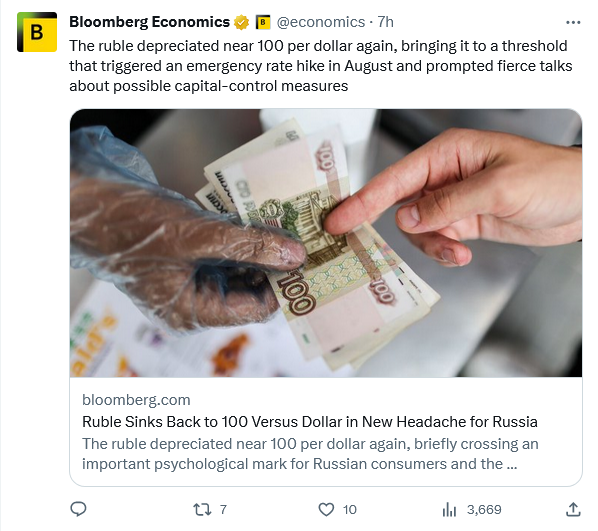
One of the economic impacts of the war in Ukraine is the decline in the value of the Russian versus the dollar. Recently the value of the ruble reached a record low of 100 rubles per dollar. After the Soviet Union dissolved most of the 1990s were spent with the new Russian economy getting used to the real world. By the late 1990s the Russian currency had reached a realistic value versus the dollar (about 30 rubles per). In 2017 it was 60 rubles per dollar. In 2016 it hit 80 rubles to buy a dollar and in 2023 hit 100 rubles. All of these declines are because of low oil prices and sanctions. More sanctions were imposed in 2018 as the U.S. unilaterally sanctioned about a hundred Russian business and government officials for their role in various illegal activities. While the travel and banking sanctions applied to these people is a minor inconvenience, being named and having your misdeeds explained is embarrassing and could cause long-term problems. After the 2022 Russian invasion began in early 2022, the sanctions multiplied and remained a problem for the ruble, which briefly hit 134 rubles per dollar. After a few months that came down to 65 rules. Since then, the ruble has continually lost its value versus the dollar. This causes problems for Russian oil exports because the primary currency for international trade is the dollar. China has been trying to change that, but without much success. This is partially due to the current problems the Chinese economy is suffering from. Russia wanted to help itself and China by building pipelines for its natural gas and oil exports that used to go to Europe. These stopped when Russia invaded Ukraine. Europe coped with the loss of Russian oil and gas, something Russia did not believe possible. The Chinese pipelines may be equally improbable because of the cost and time required to make it happen. Meanwhile the value of Russian oil and natural gas exports declined from $49 billion a month just before the 2022 Ukraine invasion to about $31 billion now.
Go here to read the rest. War is an expensive business and Russia has managed that part of the Ukrainian War as well as they have the War on the battlefield.


A little more concerted push by the West and Russia (Putin) might rethink this adventure.
The high point for the ruble v the dollar was the late 19th century, when (on a gold-based standard) it ran as high as $0.75. In the run-up to WWI it rated $0.50-0.54. Some historians say the rapid improvement in the Russian industrial economy triggered a nervous Germany to start the war.
Putin will keep throwing people at the front until it starts raining. He knows if he can keep the Ukrainians from advancing for another 5-6 weeks the counteroffensive will be over.