

From The Institute For The Study of War:
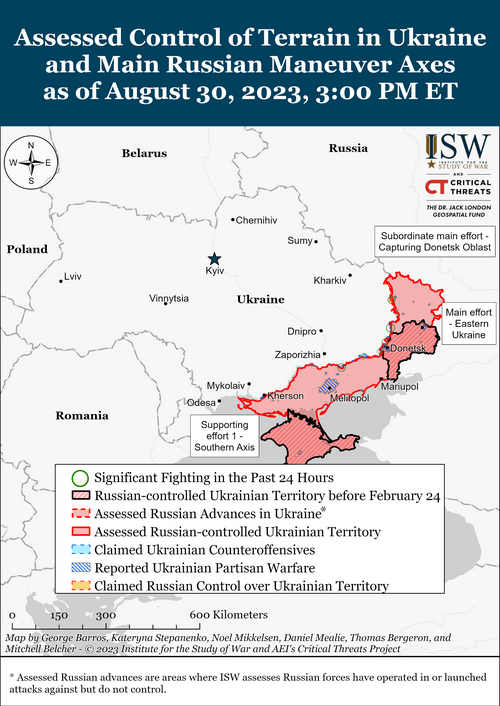
Russian Offensive Campaign Assessment, August 30, 2023
Angelica Evans, Kateryna Stepanenko, Grace Mappes, Christina Harward, and Frederick W. Kagan
August 30, 2023, 7:30 pm ET
Click here to see ISW’s interactive map of the Russian invasion of Ukraine. This map is updated daily alongside the static maps present in this report.
Click here to access ISW’s archive of interactive time-lapse maps of the Russian invasion of Ukraine. These maps complement the static control-of-terrain map that ISW produces daily by showing a dynamic frontline. ISW will update this time-lapse map archive monthly.
Note: The data cut-off for this product was 2:30pm ET on August 30. ISW will cover subsequent reports in the August 31 Russian Offensive Campaign Assessment.
Ukrainian forces reportedly destroyed four Russian Il-76 planes during a drone strike on a Russian airfield in Pskov Oblast on the night of August 29 to 30. Ukrainian Main Military Intelligence Directorate (GUR) Representative Andriy Yusov stated that the drone strike destroyed four Russian Il-76 planes and possibly damaged two other planes at the Pskov airfield but did not comment on the nature of the strike or claim responsibility for it.[1] Geolocated footage and Russian sources confirmed the strike and the destruction of at least two Russian Il-76 planes.[2] Russian milbloggers claimed that over 21 Ukrainian drones struck the Pskov airfield.[3] Russian sources, including the Russian Ministry of Defense (MoD), claimed that Russian air defenses and electronic warfare (EW) systems also downed Ukrainian drones over Oryol, Tula, Voronezh, Ryazan, Kaluga, Bryansk, and Moscow oblasts.[4] Moscow Mayor Sergey Sobyanin stated that Russian air defenses repelled a massive Ukrainian drone strike on the Central Federal Okrug (a large administrative area including Moscow but not Pskov) and that at least one of the drones was headed toward Moscow, possibly suggesting that Russian authorities may have initially believed that Ukrainian forces intended to strike Moscow or the region around it.[5] Russian forces may have focused their air defenses on covering Moscow and somehow missed the unusually large number of Ukrainian drones that reportedly struck the Pskov airfield. The Ukrainian drones that Russian air defenses downed over the six other oblasts were likely en route to Moscow or Pskov Oblast and likely were not part of a Ukrainian effort to strike targets in the other oblasts.
Russian propagandists and milbloggers criticized Russian forces for their inability to defend Russian territory and military facilities, while simultaneously criticizing recent Russian MoD censorship efforts. A Kremlin-affiliated Russian milblogger claimed that the Ukrainian strike on the Peskov airfield indicates that Russian air defenses have not adapted to defend against repeated Ukrainian drone strikes, in contrast with how Russian air defenses in Crimea have adapted.[6] The milblogger also criticized Russian authorities for not keeping expensive military aircraft in hangars.[7] Another prominent Russian milblogger expressed concern that there will be no safe places in western Russia due to Ukraine’s growing technical capabilities and suggested that Russian forces need to take this into account when securing military and strategic facilities.[8] Still, another milblogger noted that the requirement for Russian authorities to secure and defend Russian airfields is at a “qualitatively different level” from what it had been.[9] Russian sources also challenged the Russian MoD’s recent censorship efforts by noting the need for truth and honesty in reporting about Ukrainian strikes on Russian territory, including one Russian milblogger who criticized official Russian television channels for not reporting the Ukrainian strikes.[10] Prominent Kremlin propagandist Vladimir Solovyov expressed his outrage in response to the drone strike and criticized Russian elites who are calling on the Kremlin to freeze the war in Ukraine and negotiate to save Russia’s economy.[11]
Russian forces conducted a large-scale missile and drone strike predominantly targeting Kyiv on the night of August 29-30, likely in retaliation for the Ukrainian strikes earlier on Moscow and Pskov oblasts. Ukrainian officials reported that Russian forces launched 28 Kh-101, Kh-555, and Kh-55 air-launched cruise missiles from aircraft operating out of Engels airbase in Saratov Oblast and the Caspian Sea, and 16 Shahed-136/131 drones from Krasnodar Krai and Kursk Oblast.[12] Ukrainian officials reported that Ukrainian air defenses shot down all 28 cruise missiles and 15 drones over Kyiv, Odesa, Cherkasy, and Mykolaiv oblasts.[13] The Kyiv City Military Administration reported that Ukrainian forces shot down over 20 air targets over Kyiv.[14] This Russian strike was considerably larger than other Russian strikes in recent weeks and was likely in retaliation for the Ukrainian strikes on Moscow and Pskov Oblasts earlier in the night.
Ukrainian light infantry – likely reconnaissance elements – infiltrated east of Russian field fortifications near Verbove as of August 30. Geolocated footage published on August 30 shows Ukrainian infantry on the northwestern outskirts of Verbove, indicating that Russian control over the outskirts of the settlement is degraded.[15] The footage, however, does not indicate that Ukrainian forces established control over the area at this time, and Russian milbloggers claimed that Ukrainian forces have not yet breached the defensive line around Verbove.[16] The Ukrainian General Staff reported that Ukrainian forces were successful in the Novodanylivka-Novopokropivka (4-15km south of Orikhiv) and Mala Tokmachka-Verbove (7-18km southeast of Orikhiv) directions.[17] Ukrainian officials reported that Ukrainian forces continue offensive operations south of Bakhmut, and geolocated footage published on August 28 shows that Ukrainian forces marginally advanced south of Klishchiivka (6km southwest of Bakhmut).[18] A Kremlin-affiliated milblogger claimed that Ukrainian forces advanced in the direction of Volodyne (13km south of Velyka Novosilka) on the Donetsk-Zaporizhia Oblast border and that Russian forces had to retreat from several heights in the area.[19]
The Kremlin has reportedly undertaken several efforts to silence or confuse reports about Wagner Group financier Yevgeny Prigozhin’s funeral, which likely indicates that the Kremlin remains worried about Prigozhin’s appeal in Russia and among Wagner forces even after his death. Two acting Russian officials told The Moscow Times that the Russian Presidential Administration and Federal Security Service (FSB) deliberately made Prigozhin’s funeral a secret to avoid further making him a martyr.[20] The officials noted that Russian Presidential Administration’s First Deputy Chief of Staff Sergei Kiriyenko, officers from several intelligence agencies, and FSB officials met to develop a plan that would prevent any chance of public outcry or protest and mislead the public about the location of Prigozhin’s burial. The Moscow Times added that there were many conflicting reports about the location of Prigozhin’s funeral on August 29. Some Russian Telegram channels noted that Russian federal channels largely ignored Prigozhin’s funeral, likely also as part of the Kremlin’s planned “coverage” of the funeral.[21] ISW continued to observe some Russian Telegram channels baselessly speculating that Prigozhin survived the crash, which may have also been an information operation to overwhelm the Russian information space with misleading reports and deflect from Prigozhin’s funeral.[22]
Some Russian officials may be probing the views of milbloggers about Prigozhin and his death to identify and censor Russian ultranationalists not clearly connected with Prigozhin or Wagner. A Russian milblogger claimed that he received a visit from “aggressive” Telegram channel advertisers who had asked him to promote several Telegram channels that exaggerated the topic of the Wagner leadership’s death in “almost an abusive manner.”[23] The milblogger noted that this request was strange because the Kremlin and the Russian state media had “already closed this topic” and he refused to promote these channels. The refusal reportedly prompted one advertiser to accuse him of supporting the rebellion and opposing Russian President Vladimir Putin and the Russian Constitution.[24] The milblogger noted that division within Russian society would not benefit the Russian war effort. The milblogger has been consistently critical of the Russian military leadership and supportive of Russian Airborne Forces Commander Colonel General Mikhail Teplinsky – who had previous links to the Prigozhin but who survived the armed rebellion apparently unscathed and still in power.[25] The incident, at the very least, suggests that prominent milbloggers are self-censoring their discussions about Prigozhin’s death and have modeled their coverage of this subject on the Kremlin. The incident may also support the above outlined hypothesis that certain Russian social media actors may be attempting to overwhelm the Russian information space, or it could indicate that Russian officials are trying to identify other prominent ultranationalist voices who may be promoting insubordination of the regime or the military and tie them in some way to Prigozhin.
Chechen Republic Head Ramzan Kadyrov reiterated his loyalty to Russian President Vladimir Putin on August 30 in continued attempts to distance himself from Wagner Group financier Yevgeny Prigozhin. Kadyrov posted a picture of himself with Putin and proclaimed that he is “an infantryman of the Supreme Commander-in-Chief” and is “ready to fulfill any order” from Putin.[26] Kadyrov has repeatedly attempted to align himself with Putin and the Russian MoD and away from Prigozhin following Prigozhin’s fall from grace.[27]
Key Takeaways:
- Ukrainian forces reportedly destroyed four Russian Il-76 planes during a drone strike on a Russian airfield in Pskov Oblast on the night of August 29 to 30.
- Russian propagandists and milbloggers criticized Russian forces for their inability to defend Russian territory and military facilities, while simultaneously criticizing recent Russian MoD censorship efforts.
- Russian forces conducted a large-scale missile and drone strike predominantly targeting Kyiv on the night of August 29-30, likely in retaliation for the Ukrainian strikes earlier on Moscow and Pskov oblasts.
- Ukrainian light infantry – likely reconnaissance elements – infiltrated east of Russian field fortifications near Verbove as of August 30.
- The Kremlin has reportedly undertaken several efforts to silence or confuse reports about Wagner Group financier Yevgeny Prigozhin’s funeral, which likely indicates that the Kremlin remains worried about Prigozhin’s appeal in Russia and among Wagner forces even after his death.
- Some Russian officials may be probing the views of milbloggers about Prigozhin and his death to identify and censor Russian ultranationalists not clearly connected with Prigozhin or Wagner.
- Chechen Republic Head Ramzan Kadyrov reiterated his loyalty to Russian President Vladimir Putin on August 30 in continued attempts to distance himself from Wagner Group financier Yevgeny Prigozhin.
- Russian forces conducted offensive operations along the Kupyansk-Svatove-Kreminna line, near Bakhmut, on the Avdiivka-Donetsk City line, in the Donetsk-Zaporizhia Oblast border area, and in western Zaporizhia Oblast on August 30 and reportedly advanced.
- Ukrainian forces conducted offensive operations along at least two sectors of the front on August 30 and advanced near Bakhmut, in the Donetsk-Zaporizhia Oblast border area, and in western Zaporizhia Oblast.
- The Russian Ministry of Defense (MoD) is reportedly banning Wagner Group soldiers from fighting in Ukraine.
- The Ukrainian Crimean-based “Atesh” partisan group claimed that its partisans successfully detonated an explosive at the campaign headquarters of the United Russia party in occupied Nova Kakhovka, Kherson Oblast on August 29.
Go here to read the rest.
From Strategy Page:
August 30, 2023: Russia has suffered heavy personnel losses in Ukraine and is considering mobilizing about 450,000 more civilians into the military. This is needed to prevent front line units from wasting because of casualties, desertions and illness. Russia has had to establish additional military hospitals to cope with the larger number of wounded and sick. The exact number of dead and wounded in Ukraine is a military secret but the growing number of dead, wounded and missing soldiers is noticed by the families and they discuss their losses on encrypted Internet apps. This data often finds its way to Ukrainian and other foreign journalists. Russia is reluctant to increase the number of mobilized civilians because that is increasingly unpopular because of the growing number of combat losses.
What is more obvious, at least to Ukrainian troops, is that Russian units are not receiving enough replacements to make up for combat losses. Captured Russian soldiers confirm the growing lack of replacements and the extremely long periods Russian units stay in the combat zone without any relief by fresh units. To maintain morale and combat capabilities it is customary for both sides to withdraw infantry units from the fighting for some rest, home leave, retraining and integrating new recruits into the unit. Without this downtime, which can last a few weeks to more than a month, combat units decline in per capita effectiveness. This happens despite increasing combat experience because too much time in the combat zone creates exhaustion and hurts morale, always to the point of sharply reducing combat effectiveness. The troops refer to the latter as combat fatigue or burnout. Most troops begin to suffer from combat fatigue after various periods, with generally an irrecoverable breakdown after 200-300 days total in combat. Taking troops out of a combat zone for rest and then putting them back into a less active combat area for a period (rotation) is the only way to deal with this. The United States developed other methods to keep career combat non-commissioned officers (NCOs) effective after the 200-300 day limits during the war on terror, involving more frequent and longer periods of time off, and with special treatment when off.
Both sides are suffering from combat fatigue but it is worse for the Russians, most of whose combat personnel have not been rotated (ever), and who suffer from corruption in the military, especially among combat officers who cannot pass up opportunities or enrich themselves at the expense of the troops as Russian officers commonly do. The degree of such corruption varies from country to country and Russia was always one of the worst examples. During World War II there was a lot less corruption because Russian troops were defending the motherland from foreign invaders. That’s why Russian propaganda inside Russia depicts the fighting in Ukraine as a defensive war against NATO pro-NATO Ukrainians who are hostile to Russian claims that Ukraine is part Russia and not an independent country. Most Ukrainians disagree with this interpretation and are willing to fight to defend Ukrainian independence. Many Russians agree with the “Ukraine is part of Russia” claim and consider Ukrainians who disagree as traitors. NATO countries are accused of encouraging these treasonous beliefs among Ukrainians. Before the Russian invasions most Ukrainians did not want to join NATO because Ukraine already had treaties with Russia that recognized and guaranteed independence. Violating that agreement turned Russia into an untrustworthy and dangerous neighbor. Now Ukrainians want to join NATO but have to defeat the Russians first. The enormous military aid from NATO countries confirms to Ukrainians that NATO membership is preferable to trusting the Russians. Older Ukrainians who lived in Ukraine during the Cold War agree that the Russians cannot be trusted and that the Russian invasion is another example of that.
The War in Ukraine has had an impact on other wars that Russia is involved in. For example, Russian influence in Libya has diminished since Russia invaded Ukraine and failed to achieve a quick victory. Libyans note that Russians in Ukraine are now stuck in a morass of its own making. The Russians are losing ground and the situation in Ukraine takes priority over what Russia had going on in Libya. There are still enough Russian troops in Libya to prevent Turkey, Libyans or Egyptians from taking control of whatever they want. In this case the Russians have a lot of local support. Libyans see the Russians as a foreign occupier that doesn’t want to be there while the Turks are former imperial occupiers that have ambitious plans for a continued presence in Libya.
In Russian cities the impact on civilians is more obvious. Prices of retail goods are way up and many popular Western goods are no longer available. Higher interest rates and inflation have reduced living standards while the war in Ukraine takes more money away from civilian needs. The official government attitude is that everything is normal and open criticism of government policies is a crime. Government spending on the war, while Russian casualties increase and a Ukrainian counter offensive is succeeding against weakened, by low morale, high losses and less government support, Russian forces.
Go here to read the rest. Russia is losing the war of attrition.





There are reports that Putin is trying to take over Prigozhin’s mercenaries to avoid more discontent among the civilians and military. The last guy to try a private army started with a gang wearing brown shirts and when that didn’t work went black shirts and a skull and bones on the hat. It did not end well.