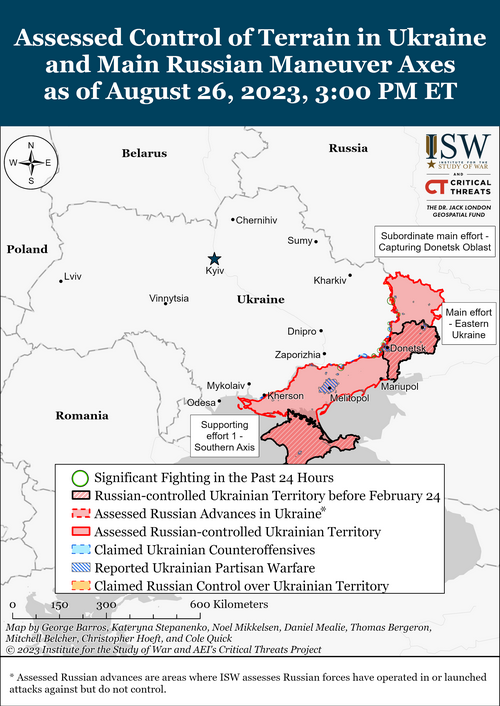
From The Institute For The Study of War:
Russian Offensive Campaign Assessment, August 26, 2023
Riley Bailey, Nicole Wolkov, Grace Mappes, Christina Harward, and Mason Clark
August 26, 2023, 6:45pm ET
Click here to see ISW’s interactive map of the Russian invasion of Ukraine. This map is updated daily alongside the static maps present in this report.
Click here to access ISW’s archive of interactive time-lapse maps of the Russian invasion of Ukraine. These maps complement the static control-of-terrain map that ISW produces daily by showing a dynamic frontline. ISW will update this time-lapse map archive monthly.
Note: The data cut-off for this product was 12:15pm ET on August 26. ISW will cover subsequent reports in the August 26 Russian Offensive Campaign Assessment.
Ukrainian forces have made further tactically significant gains in western Zaporizhia Oblast, and several Ukrainian and Russian sources reported that Ukrainian forces are advancing through what Ukrainian and US sources suggested may be the most challenging series of prepared Russian defensive positions. Geolocated footage published on August 25 indicates that Ukrainian forces advanced 1.5km southward northeast of Novoprokopivka (13km south of Orikhiv).[1] US Chairman of the Joint Chiefs of Staff General Mark Milley stated on August 25 that Ukrainian forces are currently attacking through the main set of Russian defensive preparations along the axis of Ukrainian advance.[2] Reuters reported on August 26 that a Ukrainian commander fighting in southern Ukraine stated that Ukrainian forces believe they have broken through the most difficult line of Russian defenses in the area and will now be able to advance more quickly.[3] The Ukrainian commander reportedly stated that Ukrainian forces have entered areas where they encountered only Russian ”logistics groups” and that he expects that further Ukrainian breakthroughs in these areas will be easier.[4] A Russian milblogger claimed on August 25 that Ukrainian forces were attacking in the direction of rear defensive lines near Verbove (18km southwest of Orikhiv), suggesting that Ukrainian forces may be near tactical rear areas within the series of Russian defensive positions that they are currently penetrating – though these reports should not be misinterpreted to indicate Ukrainian forces have entered Russian rear areas at the operational level.
Ukrainian forces now appear within striking distance of the next series of prepared Russian defensive positions, which may be weaker than the previous set of Russian defenses but still pose a significant challenge. The series of defensive positions that Ukrainian forces are currently advancing through were comprised of dense layers of minefields and fortifications to which Russian forces committed considerable manpower, materiel, and effort to hold.[5] The series of Russian defensive positions now ahead of Ukrainian forces likely consists of a relatively more contiguous array of anti-tank ditches; dragon’s teeth anti-tank obstacles; and additional minefields – with Russian fighting positions behind these obstacles – much like the first Russian line of defense. However, the extent of the minefields in the area of this series of prepared defensive positions is unclear, although they may be less heavily mined to give Russian forces operating north of these positions the ability to retreat.[6] ISW additionally recently assessed that this series of prepared defensive positions may be less heavily defended than the positions Ukrainian forces already penetrated to the north, although this remains unclear.[7]
Each of these Russian “lines” are layered defensive positions with their own forward and rear area positions, and it is important to differentiate between the rear areas of individual Russian defensive positions and of Russian defenses in southern Ukraine as a whole. Russian defensive “lines” are additionally notional in the sense that Russian prepared positions are not uniform across the front in southern Ukraine, and are not fully manned. There are additional series of prepared Russian defensive positions further south of the current Ukrainian advance, although Russian forces will only be able to fully leverage these positions if they have the available personnel and materiel to incorporate them into cohesive defensive operations.
A Ukrainian source indicated that Russian forces have laterally redeployed elements of a relatively elite formation from the Kreminna area in Luhansk Oblast to the Robotyne area in western Zaporizhia Oblast. A Ukrainian reserve officer reported on August 26 that Russian forces transferred elements of the 76th Guards Air Assault (VDV) Division to the Robotyne area from the Kreminna area.[8] ISW has observed elements of the 76th VDV Division operating in the Kreminna area but cannot confirm if all elements of the 76th VDV Division were deployed in the area or what elements remain near Kreminna.[9] ISW has now observed elements of almost every Russian VDV formation operating in areas where Ukrainian forces are conducting offensive operations, including elements of the 7th Guards Mountain VDV Division operating in southern Ukraine; and elements of the 98th Guards VDV Division, 106th Guards VDV Division, 11th Guards VDV Brigade, and 83rd Guards VDV Brigade operating near Bakhmut.[10] A Russian source has claimed that elements of the 31st Guards VDV Brigade are also defending in the Bakhmut area, although ISW has not observed further indicators that these elements are present.[11] Lateral redeployments of elements of the 7th Guards Mountain VDV Division from Kherson Oblast to the frontline in Zaporizhia Oblast and elements of the 76th VDV Division from the Kreminna area to the Robotyne area suggest that Russian forces may be using relatively elite units to reinforce critical sectors of the front. This additional lateral redeployment, if true, further supports ISW’s assessment that a lack of sizeable operational reserves would force the Russian command to conduct further lateral redeployments and make decisions about what sectors of the front to prioritize.[12] Elements of these VDV formations may be more heavily committed in certain sectors of the front than others and each formation is unlikely to be operating as a cohesive brigade or division-level asset, and all reports should be understood as referring to elements of the relevant formation.
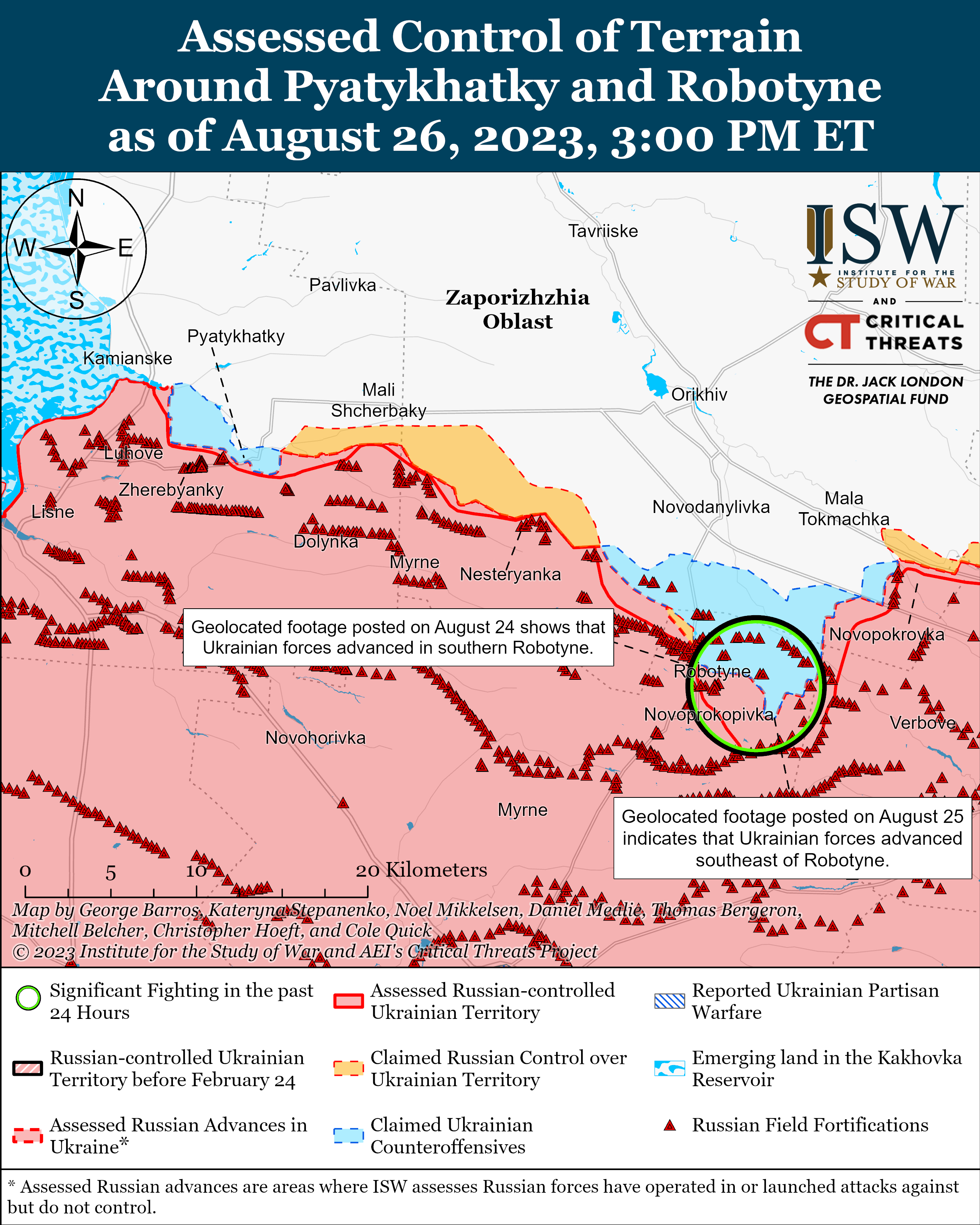
Russian irregular formations remain willing to threaten to withdraw from combat unilaterally despite recent efforts by Russian military command to purge and suppress insubordination. The “Rusich” Sabotage and Reconnaissance Group, a far-right Russian irregular paramilitary unit, announced on August 25 that the group will refuse to conduct combat missions in Ukraine until the Russian government secures the release of Rusich commander and founding member Yan Petrovsky, who is currently in Finnish custody.[13] Ukrainian authorities requested the extradition of Petrovsky from Finland to Ukraine, where he is suspected of various charges related to terrorism.[14] The Rusich Group accused the Russian government of not meeting its obligations to protect Russians abroad by not securing Petrovsky’s release earlier, and asked why Rusich personnel should protect Russia if the Russian government will not protect Russians.[15] The Rusich Group indicated that it is likely operating on the Robotyne-Verbove line in western Zaporizhia Oblast, a critical area of the frontline where the Russian military command likely cannot afford for any units to rebel and refuse to conduct combat missions.[16] The Russian MoD has notably previously struggled with insubordination and threats of desertion from other Russian units in western Zaporizhia Oblast.[17]
The Russian Ministry of Defense (MoD) is reportedly prosecuting the junior officers and soldiers of a Russian unit that complained about senior commanders’ inattention to frontline issues, following a MoD pattern of deflecting blame away from senior officers. Russian milbloggers claimed on August 26 that an assistant to an unspecified Russian deputy defense minister arrived in Kherson Oblast to investigate complaints associated with the 205th Motorized Rifle Brigade (49th Combined Arms Army, Southern Military District) that sparked outrage within the Russian information space on August 25.[18] These milbloggers claimed that the Russian MoD official is protecting the 205th Brigade’s commander and punishing protesting company commanders.[19] These Russian milbloggers expressed continued anger at this deflection of responsibility and at the broader Russian officer system that does not allow for officers with new command styles.[20] These claims are unconfirmed, but the speed at which the Russian military command is reportedly responding likely demonstrates their deep concern about insubordination in the military, as well as of public criticism of the Russian military command. The Russian MoD has previously shown a propensity for deflecting blame away from senior officers and holding lower-level soldiers responsible for problems.[21] The Russian military has recently suffered from multiple public instances of insubordination, and ISW has previously assessed that the Russian military chain of command is deteriorating.[22]
No prominent channels known to be directly affiliated with Wagner have shared additional information on the future of the group despite speculation from nominally pro-Wagner channels, while the majority of Russian sources have focused their attention on kinetic activity on the frontline. Insider sources have continued to report details about the flight crew killed in the crash as well as the ongoing Russian government investigation into the crash.[23] Russian sources that are not aligned with Wagner have largely stopped speculating about Prigozhin’s death and the future of the Wagner Group and have focused their reporting on operations on the frontline.
Key Takeaways:
- Ukrainian forces have made further tactically significant gains in western Zaporizhia Oblast, and several Ukrainian and Russian sources reported that Ukrainian forces are advancing through what Ukrainian and US sources suggested may be the most challenging series of prepared Russian defensive positions.
- Ukrainian forces now appear within striking distance of the next series of prepared Russian defensive positions, which may be weaker than the previous set of Russian defenses but still pose a significant challenge.
- A Ukrainian source indicated that Russian forces have laterally redeployed elements of a relatively elite formation from the Kreminna area in Luhansk Oblast to the Robotyne area in western Zaporizhia Oblast.
- Russian irregular formations remain willing to threaten to withdraw from combat unilaterally despite recent efforts by Russian military command to purge and suppress insubordination.
- The Russian Ministry of Defense (MoD) is reportedly prosecuting the junior officers and soldiers of a Russian unit that complained about senior commanders’ inattention to frontline issues.
- No prominent channels known to be directly affiliated with Wagner shared additional information on the future of the group, while the majority of Russian sources have focused their attention on kinetic activity on the frontline.
- Russian forces conducted offensive operations along the Kupyansk-Svatove-Kreminna line, near Bakhmut, along the Avdiivka-Donetsk City line, and in western Donetsk Oblast but did not make any confirmed advances.
- Russian regional governments continue to facilitate the forced deportation of Ukrainian children from occupied Ukraine to occupied Crimea.
Go here to read the rest. Through the mud and the blood to the green fields beyond.