
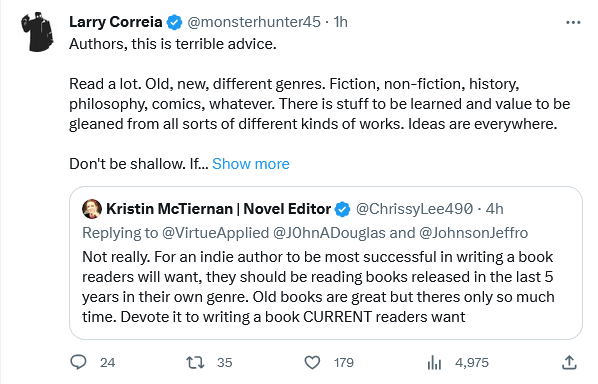
Don’t be shallow. If you focus only on what’s new and hot, and you’re just trying to mimic that in your own work, you’re going to produce books that feel stale and repetitive. I like how CURRENT readers is in caps there, for SUPER EMPHASIS. 😀 But that’s trite nonsense, as readers are a really broad and diverse bunch, and you will never make all of them happy. You need to produce work that enough people will love that you can make a living at it. If you are just chasing trends, then you’ll never invent the hot new thing. What is going to be the next hot new thing? Nobody knows until it exists and the fans go wild for it. The only way you’re gonna discover this new thing is by creating a new thing. Trend chasing is the opposite of that. I don’t even really read books in my own genre hardly ever, just because my brain goes into editing mode, and it feels like work instead of relaxation. Yet, I’ve gotten great ideas and picked up all sorts of neat tricks by reading other genres. My Saga of the Forgotten Warrior is a really popular epic fantasy series right now. The biggest influence on it was from an author who has been dead since 1936 (Robert E. Howard). My Grimnoir trilogy did great. The biggest influence on that was from an author who died in 1959 (Raymond Chandler). And the big dog series that pays all my bills, Monster Hunter International, wouldn’t exist at all if it wasn’t for Louis L’Amour novels written mostly in the 50s and 60s and he’s in an entirely different genre! Oh, and everything from Mary Shelly and Bram Stoker to Repairman Jack and Sluggy Freelance! I even had influences in there from books I didn’t like, where I purposefully did the opposite of techniques I saw in other books.
Go here to read the rest. Good literature never goes out of style. If a current generation does not appreciate, future generations will.


We indie authors know the struggle is real. But I’m determined to write according to my vision and Catholic world view, not to chase the ever-changing whims of the modern audience.
Are CURRENT readers like MODERN audiences?
Some people would rather make a few bucks writing stuff that gets sold now and forgotten next week than be famous forever but poor during their life. When all you care about is the present world, the second choice doesn’t make as much sense.
I can give some context to the quoted tweet. The overall conversation is in reference to a vein of the indie writing scene which goes by a variety of different names, though “The Iron Age” is probably most common. This is an offshoot of the “Pulp Revolution” which was an attempt to write new stories along the lines of the works of ER Burroughs, A Merritt, RE Howard, WB Gibson, HP Lovecraft etc. The “Iron Age” movement distinguished itself mainly by focusing on the new, rather than revisiting the classics. I don’t think that there was any objection to this from the Pulp Revolution authors, whose works were often full of new ideas (just with pulp sensibilities.) However, some Iron Age authors did come into things with an obvious lack of familiarity with classic fiction.
This has led to a bit of a back and forth between those stressing the importance of reading the classics and those saying that what matters is getting new readers. I don’t know that there is actually that much disagreement among the core players. For example, Kristian McTiernen has since repeatedly claimed that she meant that you shouldn’t SOLELY read old works. This is probably in reference to Jeffro Johnson’s (who she tagged) slogan “Never read anything published after 1980.” But it’s obvious that this is rhetoric and not a serious claim since Johnson consistently advertises new indie books.
Though this is also one of the things where it is easy for a person to pretend that a position is less objectionable than it really is. For example, in the responses McTiernan seems to be completely unfamiliar with the authors that I list above, which I think does show a real lack of cultural background for an author.
I will also say that even if we do take McTiernan’s comments as charitably as possible, she’s still wrong. She’s focusing the conversation on the fact that if you only read old books you won’t have time for new ones, and you should read new ones. Fine, I agree with that. But the problem with her statement is the idea that the desires of new readers are different than the desires of old readers. On a superficial level that is true, in that new readers expect modern technology and so on to inform a story. But new readers still want stories with adventure, romance, friendship, chilling horror, triumphant morals, etc. just like the pulp audiences.
If you read the works of Robert E. Howard and think “oh, I need to have a barbarian in my stories” but don’t go further than that, then yeah you won’t get far since the savage barbarian is less popular now than back then. (Though it’s not like they’ll reject them wholesale, as the success of Primal showed.) But if you read Howard and study his characterization, techniques to increase tension, satisfying story resolutions, etc. and you will have a lot to offer audiences of any time period.
The biggest problem with focusing on modern entertainment is that modern entertainment rarely rises above “adequate” in terms of storytelling, meaning that you will focus on superficial trends like superheroes or zombies as being key to success or failure.