
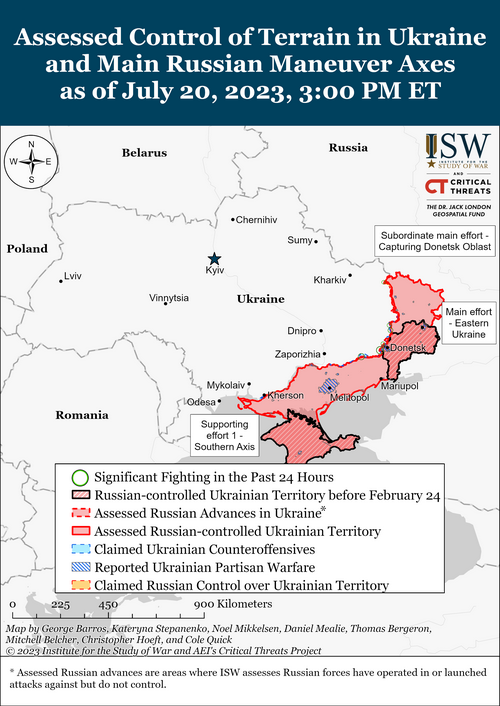
From The Institute For The Study of War:
Russian Offensive Campaign Assessment, July 20, 2023
Riley Bailey, Kateryna Stepanenko, Grace Mappes, Angelica Evans, George Barros, Christina Harward, and Frederick W. Kagan
July 20, 2023, 7:50pm ET
Click here to see ISW’s interactive map of the Russian invasion of Ukraine. This map is updated daily alongside the static maps present in this report.
Click here to access ISW’s archive of interactive time-lapse maps of the Russian invasion of Ukraine. These maps complement the static control-of-terrain map that ISW produces daily by showing a dynamic frontline. ISW will update this time-lapse map archive monthly.
Note: The data cutoff for this product was 12:30pm ET on July 20. ISW will cover subsequent reports in the July 21 Russian Offensive Campaign Assessment.
Russian forces launched a third night of missile and drone strikes against port and grain infrastructure in southern Ukraine on July 20 following Russia’s withdrawal from the Black Sea Grain Initiative on July 17. The Ukrainian General Staff reported that Russian forces launched seven Onyx cruise missiles, four Kh-22 anti-ship missiles, three Kalibr sea-based cruise missiles, five Iskander ballistic missiles, and 19 Iranian-made Shahed drones.[1] The Ukrainian General Staff reported that Ukrainian air defenses destroyed 18 targets, including two Kalibrs, three Iskanders, and 13 Shaheds.[2] Spokesperson of the Ukrainian Southern Operational Command Captain First Rank Nataliya Humenyuk stated that Russian forces targeted port infrastructure in Mykolaiv and Odesa oblasts and noted that the strikes mainly affected warehouses and logistics facilities.[3] Humenyuk noted that Russian “blackmail and sabotage” of Ukrainian ports started shortly after Russian began its rhetoric about its conditions for the expansion of the grain deal.[4] The Russian Ministry of Defense (MoD) claimed that Russian forces struck Ukrainian manufacturing and storage facilities in Odesa City and Chornomorske in Odesa Oblast, and fuel infrastructure facilities and ammo depots in Mykolaiv City.[5] Ukrainian military officials reported that Russian forces destroyed the Odesa Seaport Administration building in the center of Odesa City and noted that residential buildings were damaged by the blast wave.[6] Ukrainian sources reported that Russian missile strikes also damaged a Chinese consulate building in Odesa City.[7]
Ukrainian military officials outlined the challenge of defending against Onyx missiles and Russia’s shortage of Kh-22 missiles. Ukrainian Air Force Spokesperson Colonel Yuriy Ihnat stated that Onyx missiles fly at a speed of more than 3,000 kilometers per hour at a high altitude and then quickly change altitude to 10–15 meters above the surface when striking a target, making it difficult to detect and destroy.[8] Ihnat noted on July 19 that Russian forces are using Onyx cruise missiles that are designed to destroy targets located directly on the coastline along the sea.[9] Ihnat also stated on July 20 that Russia does not have the same ability to manufacture Kh-22 missiles that it does to produce other types of high-precision long-range missiles.[10] Ihnat noted that Russia had approximately 250 Kh-22 missiles at the beginning of the war in February of 2022 and has already used approximately 150 missiles against Ukraine.[11]
The Russian military announced that it may consider civilian ships in the Black Sea en route to Ukrainian ports legitimate military targets. The Russian Ministry of Defense (MoD) stated on July 19 that as of midnight Moscow time on July 20 Russian forces will consider all ships en route to Ukrainian ports as potential carriers of military cargo and will consider the flag countries of such vessels as “involved in the Ukrainian conflict on the side of the Kyiv regime.”[12] The Russian MoD declared a number of sea areas in the northern and southern parts of the Black Sea “temporarily dangerous for navigation” and claimed that it issued relevant warnings to sailors in the Black Sea about the withdrawal of safety guarantees.[13] The Russian MoD specified that these naval measures are connected to the termination of the Black Sea Grain Initiative and the curtailment of the maritime humanitarian corridor in the Black Sea.[14] The announcement prompted the Ukrainian Ministry of Defense (MoD) to announce on July 20 that as of midnight Kyiv time Ukrainian forces may treat all ships in the Black Sea heading to ports in Russia and occupied Ukrainian territories as military cargo vessels.[15] The Ukrainian MoD similarly stated that Ukrainian officials released relevant navigation information to seafarers.[16] US National Security Council Spokesperson Adam Hodge stated on July 20 that US intelligence indicates that Russian forces have laid additional sea mines in the approaches to Ukrainian ports.[17] Hodge added that the White House believes that Russia is engaging in a coordinated effort to justify possible attacks against civilian ships in the Black Sea and blame Ukrainian forces for the attacks.[18]
The Russian military’s intensifying strikes against Ukrainian port and grain infrastructure and threats of maritime escalation are likely a part of a Kremlin effort to leverage Russia’s exit from the Black Sea Grain Initiative and exact extensive concessions from the West. Russian President Vladimir Putin stated on July 19 that Russia is ready to return to the grain deal immediately if all previously agreed-upon conditions for Russia’s participation in the initiative are fulfilled and the parties restore the deal’s “original humanitarian essence.”[19] Putin accused Western countries of exploiting the grain deal so that European enterprises could profit at the expense of Russian businesses.[20] Putin claimed that elements of the grain deal led to a 30 to 40 percent discount on Russian grain on global markets, which caused Russian farmers to lose $1.2 billion and Russian fertilizer producers to suffer $1.6 billion in losses.[21] Putin stated that returning to the deal in its current form is pointless and called for the lifting of sanctions on Russian grain and fertilizer deliveries and the removal of obstacles for Russian banks servicing food supplies to the global market, including their connection to the Society for Worldwide Interbank Financial Telecommunication (SWIFT) banking system.[22] Putin also called for the resumption of deliveries of components and spare parts for Russian agricultural machinery and fertilizer production, the resolution of issues with Russia ship chartering and insurance of Russian food exports, the renewal of operations for the Togliatti-Odesa ammonia pipeline, and the removal of blocks on Russian agricultural assets.[23]
The Kremlin likely views the Black Sea Grain Initiative as one of its few remaining avenues of leverage against the West and has withdrawn from the deal to secure these concessions. The Kremlin now appears to be attempting to create a sense of urgency around its return to the Black Sea Grain Initiative by conducting intensifying strikes against Ukrainian port and grain infrastructure and threatening to strike civilian ships in the Black Sea. Ukraine harvests most of it grain between July and August, and Russia’s strikes on Ukrainian port and agricultural infrastructure can further complicate Ukraine’s ability to free up space for newly harvested grains.[24] Prolonged disruptions to grain logistics in Ukraine will likely have increasingly cascading effects on grain supplies, adding to the sense of urgency that the Kremlin hopes to create.
The Kremlin routinely engages in escalatory rhetoric surrounding the West’s support for Ukraine in an effort to shape Western behavior, although Russia appears notably to be conducting these shaping efforts concerning the grain deal with kinetic operations instead of rhetoric. It is unclear to what extent Russian forces intend to strike civilian ships in the Black Sea, although the Kremlin likely believes the announcement will have a chilling effect on maritime activity in the Black Sea and create conditions reminiscent of the complete blockade of Ukrainian ports at the start of the full-scale invasion.[25] This attempt to achieve economic concessions from the West may undermine the Kremlin’s international outreach efforts by threatening the food supplies of several countries that are the intended targets of the Kremlin’s outreach.[26] Russian strikes against Ukrainian port and grain infrastructure and naval posturing also continue to illustrate that the Kremlin is willing to use naval and precision strike assets to prioritize immediate economic concerns instead of operations in Ukraine that pursue the Kremlin‘s overall campaign objectives.
The Kremlin may be destroying Ukrainian port and grain infrastructure before renegotiating the Black Sea grain deal to set conditions for the export of stolen Ukrainian grain from Russian-occupied territories that could disproportionately benefit the Russian economy. Ukrainian Minister for Agrarian Policy Mykola Solskyi stated that it would take Ukraine no less than one year to restore the Chornomorsk port in Odesa Oblast, which was used for export of grain.[27] The destruction of Ukrainian port infrastructure in government-controlled Odesa and Mykolaiv oblasts may restrict Ukraine’s ability to export grain by sea even if the grain deal is renegotiated, while allowing Russia to offer grain from occupied Ukraine or Russia to fulfil the deal in the meantime.
Russia is also likely attempting to intensify divisions between Ukrainian and Central European governments as Ukraine and the West search for a way to re-route the grain exports. Senior European officials stated that the European Union (EU) is seeking to transport more Ukrainian grain via road and rail to help make up for Russia’s withdrawal from the Black Sea grain deal.[28] Five Central European countries — Poland, Hungary, Romania, Slovakia, and Bulgaria — called on the EU to extend the ban on grain imports from Ukraine until at least the end of the year on July 19.[29] Polish Prime Minister Mateusz Morawiecki also announced on July 19 that Poland will retain its ban on Ukrainian grain exports on September 15 even if the EU does not agree to the extension.[30] Polish Agriculture Minister Robert Telus stated on July 18 that Poland is willing to facilitate Ukrainian grain transit through Poland but said that the EU will need to help to establish necessary infrastructure.[31] Telus added that Poland had only begun its harvest and noted that it cannot facilitate the extra transit immediately. Ukrainian Prime Minister Denys Shmyhal condemned Poland’s decision to extend the ban as an “unfriendly and populist move that will severely impact global food security and Ukraine’s economy.”[32] Exports through Poland and other EU countries bordering Ukraine had previously sparked resistance from local farmers after the EU lifted tariffs and quotas on food exports from Ukraine in June 2022 as Russia blocked Ukraine from transporting grain and other goods by sea.[33] Poland, Slovakia, and Hungary announced in April 2023 bans on grain and other food exports from Ukraine to protect their agricultural sectors.[34] The European Commission later announced restrictions on the imports of Ukrainian wheat, maize, rapeseed, and sunflower seeds in Poland, Hungary, Romania, Slovakia, and Bulgaria until June 5 as a result of farmers’ concerns in Central European countries.[35] The Kremlin may be attempting to disrupt Ukraine’s future prospects for maritime exports in an effort to sour Ukrainian relations with its Western neighbors.[36]
Ukrainian forces continued counteroffensive operations on at least three sectors of the front and reportedly advanced on July 20. A Ukrainian commander operating in the Bakhmut area reported on July 19 that Ukrainian forces advanced 1.8km likely on the southern flank of Bakhmut, and Russian milbloggers claimed that Ukrainian forces also advanced on Bakhmut’s northern flank on July 20.[37] Ukrainian Ground Forces Commander Colonel General Oleksandr Syrskyi stated that Ukrainian forces cannot rapidly advance near Bakhmut due to heavy Russian force concentrations in the area.[38] The Russian military command concentrated a high density of forces in the Bakhmut area to defend against Ukrainian attacks in the area, likely an intended effect of those attacks, though Syrskyi and other Ukrainian officials have repeatedly restated their intent to retake Bakhmut.[39] Ukrainian military officials reported that Ukrainian forces continued advancing in the Berdyansk (Donetsk-Zaporizhia oblasts border area) and Melitopol (western Zaporizhia Oblast) directions and are continuing to advance by roughly 100 meters per day south and southeast of Orikhiv.[40] Ukrainian Presidential Advisor Mykhailo Podolyak reiterated that the Ukrainian counteroffensive will be slow and difficult but will prevent Russian forces from retaking the battlefield initiative.[41] The Washington Post reported that Ukrainian forces have begun using Western-provided cluster munitions in southeastern Ukraine and assessed that Ukrainian forces will likely use them near Bakhmut soon.[42] The Washington Post, citing an anonymous Ukrainian military official, reported that Ukrainian forces are using the cluster munitions to “break up [Russian] trenches slowing down Ukrainian forces.”
The United States and European Union (EU) reiterated their long-term security commitments to Ukraine via security assistance packages and proposals on July 19 and 20. The Pentagon announced on July 19 a new $1.3 billion security package for Ukraine that includes four National Advanced Surface-to-Air Missile Systems (NASAMS), 152mm artillery rounds, mine-clearing equipment, and other munitions and vehicles.[43] The US package also includes electronic warfare, communications, and other security equipment. EU Foreign Affairs Representative Josep Borrell proposed a plan to EU ministers on July 20 to provide Ukraine with security assistance worth up to 20 billion euros ($22.4 billion), including weapons, ammunition, and other military aid, over the next four years.[44]
Wagner Group personnel are training Belarusian special forces on modern tactics at the Brest Training Ground in Brest, Belarus. The Belarusian Ministry of Defense and Wagner-linked sources reported on July 20 that Wagner forces began training unspecified Belarusian special forces elements at the Brest Training Ground in Brest, Belarus, and that the training will last until July 24.[45] The Wagner trainers are teaching Belarusian forces modern combined arms techniques and tactics, including using drones for tactical reconnaissance, tactical maneuvers, movement under fire, camouflage, and command and control.[46] Wagner-linked sources praised the Belarusian military and Belarusian trainees for their adeptness, agility, and flexibility in training while complaining that the Russian Ministry of Defense did not appreciate the Wagner Group due to Russian command staff’s “rigidity of thinking and bureaucratic barriers.”[47] A Wagner-linked source specifically praised Belarusian President Alexander Lukashenko’s “old school” style and how Lukashenko managed to preserve the Soviet military’s “best traditions.”[48]
The Wagner Group may open another base in Belarus in Gomel Oblast near Belarus’ international border with Ukraine. The Ukrainian Resistance Center reported on July 20 that construction for another Wagner Group base in Belarus began near Naroulia Raion and that Wagner personnel surveyed land near Dyatlik, Naroulia Raion, Gomel Oblast, approximately 2km from Belarus’ border with Ukraine on July 19.[49] ISW has not observed visual confirmation of construction in this area as of this publication.
Approximately 400 Wagner convict fighters are reportedly awaiting their criminal pardon paperwork to clear in Anapa, occupied Crimea. Independent Russian investigative outlet Vazhnye Istorii reported on July 19 that about 400 Wagner convict fighters are waiting in hotels in Anapa until the Russian government approves their pardons.[50] The report states that the Wagner Group suspended its effort to recruit Russian convicts (codenamed “Project K”) and that Wagner seeks to release these convicts no later than July 29.[51] The report states that the former convicts will have the option to extend their contracts with Wagner to serve in Belarus or Africa.[52]
The Wagner Group reportedly suffered an 80 percent casualty rate and a 28 percent killed-in-action rate in Ukraine. A Wagner-linked source reportedly quoted a senior Wagner commander with the callsign “Marx,” who stated that 78,000 Wagner fighters fought in Ukraine (49,000 of whom were convicts), and that Wagner had suffered 22,000 killed-in-action and 40,000 wounded-in-action as of Wagner’s capture of Bakhmut on May 20.[53] These figures — if accurate — indicate that the Wagner Group was likely combat ineffective after fighting in Bakhmut and that the force suffered a 79.5 percent overall casualty rate and a 28.2 percent death rate. Marx reportedly stated that 25,000 Wagner fighters are currently alive and that 10,000 of them are in Belarus and the remaining 15,000 are resting, presumably in Russia.[54]
Key Takeaways:
- Russian forces launched a third night of missile and drone strikes against port and grain infrastructure in southern Ukraine on July 20 following Russia’s withdrawal from the Black Sea Grain Initiative on July 17.
- The Russian military announced that it may consider civilian ships in the Black Sea en route to Ukrainian ports legitimate military targets.
- The Russian military’s intensifying strikes against Ukrainian port and grain infrastructure and threats of maritime escalation are likely a part of a Kremlin effort to leverage Russia’s exit from the Black Sea Grain Initiative and exact extensive concessions from the West.
- The Kremlin likely views the Black Sea Grain Initiative as one of its few remaining avenues of leverage against the West and has withdrawn from the deal to secure these concessions.
- Ukrainian forces continued counteroffensive operations on at least three sectors of the front and reportedly advanced on July 20.
- The United States and European Union (EU) reiterated their long-term security commitments to Ukraine via security assistance packages and proposals on July 19 and 20.
- Wagner Group personnel are training Belarusian special forces on modern tactics at the Brest Training Ground in Brest, Belarus.
- The Wagner Group may open another base in Belarus in Gomel Oblast near Belarus’ international border with Ukraine.
- The Wagner Group reportedly suffered an 80 percent casualty rate and a 28 percent killed-in-action rate in Ukraine.
- Russian forces continued limited ground attacks on the Kupyansk-Svatove-Kreminna line, around Bakhmut and along the Avdiivka–Donetsk City line and advanced on the Kupyansk-Svatove-Kreminna line as of July 20.
- Ukrainian forces continued limited offensive operations east of Kupyansk, near Kreminna, near Bakhmut, and along the Avdiivka–Donetsk City line and made gains near Bakhmut on July 20.
- Ukrainian forces continued offensive operations near Vuhledar, on the administrative border between western Donetsk and eastern Zaporizhia oblasts, and south of Orikhiv and made limited territorial gains in western Donetsk and eastern Zaporizhia oblasts and western Zaporizhia Oblast on July 20.
- Russian forces continued to unsuccessfully counterattack Ukrainian positions on the Donetsk-Zaporizhia Oblast administrative border on July 20.
- The Russian State Duma approved amendments increasing penalties for draft dodging and for officials and legal entities that fail to assist Russian force generation efforts on July 20.
- Russian authorities continue persecution of non-Russian Orthodox churches in occupied Ukraine.
Go here to read the rest. The eighty percent casualty rate of Wagner forces that fought in Ukraine, if accurate, a big if, would indicate Russian casualties that are impossible to sustain long term for an unpopular war. The major caveat is that in war everything about the other side tends to be guesswork and rarely should be relied upon. Having said that, the Russians have traditionally been heedless of casualties in their wars and often run up a very high butcher’s bill by Western standards.

