
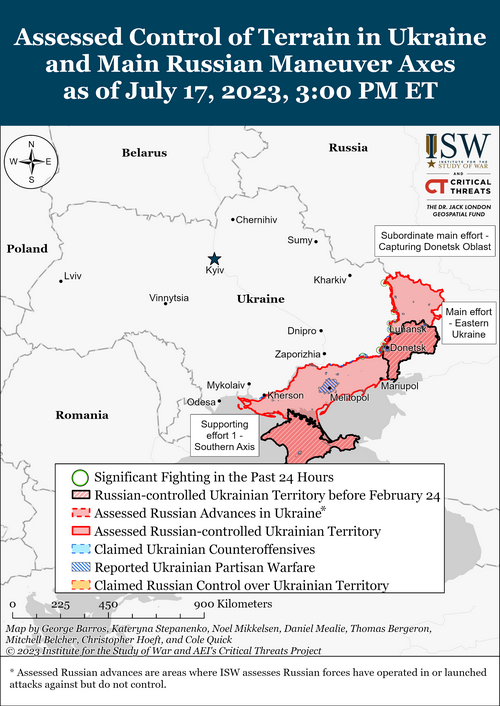
From The Institute For The Study of War:
Russian Offensive Campaign Assessment, July 17, 2023
Grace Mappes, Karolina Hird, Nicole Wolkov, Christina Harward, and Frederick W. Kagan
July 17, 2023, 8:30pm ET
Click here to see ISW’s interactive map of the Russian invasion of Ukraine. This map is updated daily alongside the static maps present in this report.
Click here to access ISW’s archive of interactive time-lapse maps of the Russian invasion of Ukraine. These maps complement the static control-of-terrain map that ISW produces daily by showing a dynamic frontline. ISW will update this time-lapse map archive monthly.
Note: The data cutoff for this product was 2:30pm ET on July 17. ISW will cover subsequent reports in the July 18 Russian Offensive Campaign Assessment.
The July 17 attack on the Kerch Strait Bridge will likely have continuing ramifications on Russian logistics in southern Ukraine. Russian authorities accused Ukrainian special services of conducting an unmanned surface vehicle strike against the Kerch Strait Bridge between Russia and occupied Crimea on the morning of July 17.[1] Footage of the aftermath shows that one Kerch Strait Bridge road span had collapsed and another span suffered damage but remains intact.[2] The Russian Ministry of Transport claimed that the strikes did not damage the rail bridge or supports of the road bridge, and rail traffic across the Kerch Strait Bridge resumed several hours after the strike.[3] Russian occupation authorities rerouted heavy civilian traffic from occupied Crimea to Russia through occupied southern Ukraine, and Russian sources reported extensive traffic jams in Crimea’s Dzhankoy Raion and occupied Kherson Oblast towards Melitopol.[4] Russian tourists fleeing occupied Crimea likely exacerbated traffic and likely impeded Russian logistics from Crimea to rear areas in Zaporizhia and Kherson oblasts. Occupation authorities asked civilians to consider alternate evacuation routes to mitigate the immediate traffic issues.[5] Ukrainian Main Military Intelligence Directorate (GUR) Spokesperson Andrii Yusov declined to comment on Ukrainian involvement in the incident.[6] The Kerch Strait Bridge and military areas in occupied Crimea are legitimate military targets for Ukrainian forces in their defense against the full-scale Russian invasion and occupation of Ukraine, as ISW and Ukrainian officials have previously reported.[7]
The Russian government’s continued failure to put Russian society on a war-time footing will have significant impacts on Russian logistics as traffic from Russian tourism to occupied Crimea jams Russian logistics to southern Ukraine in the midst of the ongoing Ukrainian counteroffensive in the south. The Kerch Strait Bridge is along one of two ground lines of communication (GLOCs) supporting Russia’s southern force grouping, with the other route passing through occupied Donetsk, Zaporizhia, and Kherson Oblasts. This sole remaining logistics route is now a single point of failure for the supply of the large numbers of mechanized Russian forces in southern Ukraine needed to resist Ukrainian counteroffensives. Russian and occupation officials have nevertheless continued to promote occupied Crimea as a tourist destination, however, urging Russian civilians to drive through and to a warzone rather than advising them to avoid it as a responsible government would.[8] Russian occupation authorities recently struggled to mitigate traffic issues just from increased Russian tourism across the Kerch Strait Bridge, as ISW has previously reported.[9] Russian President Vladimir Putin even ordered the use of Russian military assets to ferry tourists across the Kerch Strait.[10] Some Russian milbloggers also suggested that the attack against the Kerch Strait Bridge should not reduce continued tourist flows.[11]
Russian logistics to southern Ukraine will likely suffer in the short and medium-term, likely exacerbating recent and significant complaints about inadequate Russian supplies in southern Ukraine. Former Russian 58th Combined Arms Army (Southern Military District) Commander Major General Ivan Popov’s recent complaints about the Russian military command’s mistreatment of Russian forces defending against the Ukrainian counteroffensive in southern Ukraine sparked great ire in the Russian information space.[12] Many of Popov’s complaints indicated that the 58th Combined Arms Army, and likely other Russian formations deployed in Zaporizhia Oblast, suffer from supply shortages that will further worsen if tourist and other civilian traffic slow down logistics routes supporting Russian forces in southern Ukraine.[13] Further issues with support for this grouping, and further resulting complaints that emerge in the Russian information space, are likely to draw further outrage from the Russian ultranationalist community and undermine confidence in the Russian Ministry of Defense (MoD).[14]
Russian and occupation authorities appear to be consumed with mitigating the consequences of the attack rather than leveraging the incident to levy heavy informational attacks with rhetorical inflections. Russian President Vladimir Putin held a meeting instructing Russian Deputy Prime Minister Marat Khusnullin to lead a headquarters and develop solutions to mitigate traffic issues across the bridge.[15] Khusnullin and other occupation authorities decided to lift curfews and passport checks along major highways to Russia in occupied territories, which are under Russian martial law, in order to mitigate some of these traffic issues.[16] Putin’s and other senior Russian officials’ statements were largely straightforward; the officials accused Ukraine of conducting a “terrorist attack” and promised retaliation, which is consistent with prior official reactions to claimed Ukrainian provocations.[17] The Russian Foreign Ministry accused Ukraine of conducting the strike in conjunction with American and British intelligence, forwarding a consistent Russian narrative aimed at falsely portraying Russia as at war with the West rather than Ukraine.[18] Some Russian officials connected the Kerch Strait Bridge attack to the Black Sea Grain Initiative, which expired today.[19] Senior Russian officials, including Putin, had signaled before the bridge was attacked that Russia was unwilling to renew the grain deal without significant additional concessions, however.[20] Russia was very unlikely to have engaged in negotiations around the continuation of the grain deal or any other negotiations with Ukraine in good faith, as ISW has previously assessed.[21]
The Russian milblogger response to the Kerch Strait Bridge attack largely criticized Russian authorities for failing to secure the bridge. Some milbloggers, including former Russian officer and critical pro-war nationalist Igor Girkin, offered the critique that Russian authorities have focused too heavily on road security and not enough on maritime security, thereby allowing the most recent attack on the bridge to occur.[22] Girkin complained that the Russian border officials have devoted too much time to checking civilian cars entering the bridge and not enough time investing in infrastructure that could protect against attacks launched by sea.[23] Another prominent milblogger and Kremlin-appointed member of the Russian Human Rights Council blamed Russian authorities for focusing too much on security on the land bridge and neglecting to take into account any maritime threats.[24] One milblogger emphasized that the strike was caused by poor internal Russian decision making and posed a threat to the stability of Russian domestic peace.[25] Many Russian sources erroneously claimed that the strike will not impact Russian logistics in occupied Ukraine and called the attack a “terrorist act” to minimize the fact that the Kerch Strait Bridge is a legitimate military target in the rear of an active war zone.[26] Some Russian sources additionally advocated for retributive and retaliatory actions against Ukraine in the wake of the attack, but this brand of milblogger response closely resembles outcry following previous such events.
The Wagner Group continues to prepare to establish a permanent presence in Belarus. Independent Belarusian monitoring group “The Hajun Project” reported on July 17 that another Wagner vehicle convoy traveled towards the Tsel village tent camp near Asipovichy, Mogilev Oblast, Belarus, and that two other Wagner columns had traveled along this same route between July 11 and July 17.[27] Wagner-affiliated Telegram channels relatedly posted footage on July 17 of a Wagner column moving between Voronezh and Oryel oblasts before arriving at the training ground near Asipovichy.[28] The Ukrainian Resistance Center reported that over 700 Wagner fighters have recently settled in the Tsel-Asipovichy area and that Belarusian authorities have formed three Belarusian special-purpose units to train under Wagner leadership in these training areas.[29] Several Wagner-affiliated milbloggers additionally claimed that Wagner’s training ground in Molkino, Krasnodar Krai, will cease operations by July 30 and that Wagner will deploy elsewhere and they posted footage of Wagner fighters ceremoniously lowering Russian and Wagner flags at Molkino.[30] Wagner fighters will likely continue to redeploy to Belarus from training areas in Molkino and staging grounds elsewhere in Russia over the coming month.
Russia continues efforts to reorganize its domestic security apparatus in the wake of the Wagner Group’s armed rebellion. Russian State Duma Deputy Alexander Khinshtein stated on July 17 that the “Grom” special units of the Russian Federal Drug Control Service (of the Russian Ministry of Internal Affairs) were officially transferred to the control of the Rosgvardia (Russian National Guard).[31] Khinshtein emphasized that the decision was made to capitalize on Rosgvadia’s key role in protecting Russia’s internal security.[32] ISW previously reported on July 4 that the decision to transfer “Grom” to Rosgvardia emphasizes the Kremlin’s desire to consolidate an effective anti-rebellion force under Rosgvardia command.[33] The Russian Duma additionally announced on July 17 that it is considering a bill to allow Rosgvardia to field heavy weapons by amending the federal law “On the National Guard Troops of the Russian Federation,” which will allow the Rosgvardia to be armed with transport aircraft, combat, transport, and multi-purpose helicopters, infantry fighting vehicles, armored personnel carriers, communications complexes, boats, engineering equipment, and other military and paramilitary kit.[34] The transfer of “Grom” units to Rosgvardia, as well as the decision to provide Rosgvardia with heavy combat equipment, supports ISW’s previous assessment that the Kremlin is continuing efforts to consolidate its internal security apparatus around Rosgvardia’s structures. However, several actors within the Russian internal security sphere have voiced their concern and dissatisfaction over the “Grom” transfer, and the reorganization of domestic security organs may cause more tension within Russia.[35]
Ukrainian forces continued counteroffensive operations on at least three sectors of the front over the backdrop of increased Russian offensive operations along the Kharkiv-Luhansk Oblast border on July 17. Russian and Ukrainian sources reported that Russian forces have launched active offensive operations and advanced in the Kupyansk area (between northeastern Kharkiv Oblast and northwestern Luhansk Oblast) in the past several days.[36] Russian forces likely are engaging in offensive operations in this area of the front in an effort to exploit Ukrainian operational focus on other sectors of the front and draw Ukrainian reserves away from critical areas of the theater, namely the Bakhmut and western Donetsk, and western Zaporizhia Oblast areas, where Ukrainian forces are pursuing counteroffensive operations. The poor quality and composition of Russian troops currently deployed on this line, however, will likely hinder Russia’s ability to achieve more than tactically significant gains or make an operationally significant breakthrough. Ukrainian and Russian sources have both reported the deployment of convict-formed “Storm-Z” assault units to the Kupyansk direction, and ISW has previously assessed that “Storm-Z” units have low operational effectiveness due to poor morale and discipline.[37] Ukrainian forces also continued counteroffensive operations near Bakhmut, south of Velyka Novosilka, and near Orikhiv in western Zaporizhia Oblast throughout July 17.[38]
Key Takeaways:
- The July 17 attack on the Kerch Strait Bridge will likely have significant and sustained impacts on Russian logistics as traffic from tourism to occupied Crimea jams Russian logistics to southern Ukraine in the midst of the ongoing Ukrainian counteroffensive in the south.
- Russian and occupation authorities appear to be consumed with mitigating the consequences of the attack rather than leveraging the incident to levy heavy informational attacks with rhetorical inflections.
- The Russian milblogger response to the Kerch Strait Bridge attack largely criticized Russian authorities for failing to secure the bridge.
- The Wagner Group continues to prepare to establish a permanent presence in Belarus.
- Russia continues efforts to reorganize its domestic security apparatus in the wake of the Wagner Group’s armed rebellion.
- Ukrainian forces continued counteroffensive operations on at least three sectors of the front over the backdrop of increased Russian offensive operations along the Kharkiv-Luhansk Oblast border on July 17.
- Russian forces conducted active offensive operations along the Kupyansk-Svatove line and have likely made marginal tactical gains in this direction.
- Russian forces continued limited ground attacks southwest and south of Kreminna, around Bakhmut, and along the Avdiivka-Donetsk City line.
- Ukrainian forces continued counteroffensive operations in the Bakhmut area and advanced near the Donetsk-Zaporizhia administrative border.
- Russian forces conducted limited counterattacks in western Donetsk Oblast.
- Russian sources claimed that Ukrainian forces continued unsuccessful ground attacks in the Orikhiv area in western Zaporizhia Oblast.
- Russian opposition outlet Verstka reported that Russian authorities have removed at least eight Russian military commanders without reappointing them to new positions since the start of the war, which is largely consistent with ISW’s previous assessments.
- Russian occupation authorities continue to artificially increase the number of Russian citizens in occupied Ukraine ahead of the September regional elections.
Go here to read the rest. The attack on the Kerch Strait Bridge was spectacular but will have little impact on the war unless it is followed up.

