
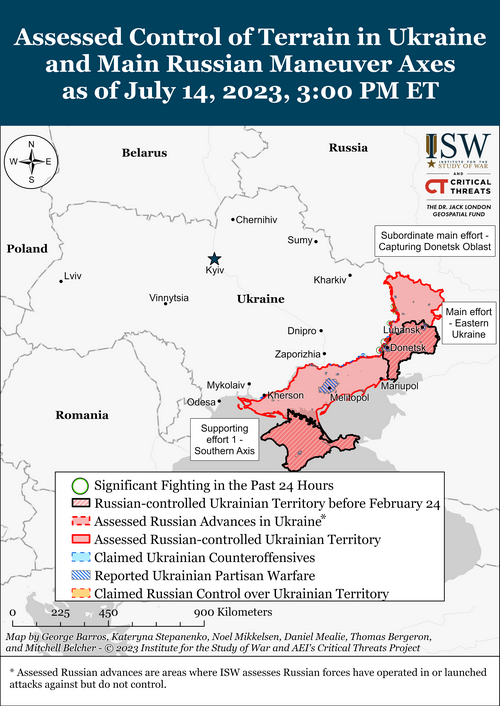
From The Institute For The Study of War:
Russian Offensive Campaign Assessment, July 14, 2023
Riley Bailey, Karolina Hird, Grace Mappes, Nicole Wolkov, Angelica Evans, Christina Harward, and Mason Clark
July 14, 2023, 4:45pm ET
Click here to see ISW’s interactive map of the Russian invasion of Ukraine. This map is updated daily alongside the static maps present in this report.
Click here to access ISW’s archive of interactive time-lapse maps of the Russian invasion of Ukraine. These maps complement the static control-of-terrain map that ISW produces daily by showing a dynamic frontline. ISW will update this time-lapse map archive monthly.
Note: The data cutoff for this product was 12:00pm ET on July 14. ISW will cover subsequent reports in the July 15 Russian Offensive Campaign Assessment.
Russian President Vladimir Putin further indicated he intends to maintain the Wagner Group as a cohesive fighting force rather than breaking it up but seeks to separate Wagner Financier Yevgeny Prigozhin from Wagner leadership and forces. Putin confirmed to Russian news outlet Kommersant in an interview published on July 13 that he met with Prigozhin and 35 Wagner commanders on June 29.[1] Putin claimed that he offered Wagner fighters the option to serve under a Wagner commander (callsign “Seda”) who has commanded Wagner forces for the last 16 months, further confirming ISW’s previous assessment that the Kremlin seeks to retain Wagner as a cohesive fighting force while separating it from Prigozhin.[2] Putin claimed that “many [Wagner commanders] nodded” in response to his offer, but that Prigozhin, “who was sitting in front of his personnel and did not see them nodding,” said that the Wagner commanders did not agree with the decision. Putin likely emphasized Prigozhin’s differing response to frame Prigozhin as a problem in contrast to loyal Wagner commanders. Former Russian officer and ardent nationalist Igor Girkin noted that Putin’s retelling of the July 29 meeting portrays Putin as succumbing to Prigozhin’s demands, but the final outcome of the July 29 meeting is unclear.[3] When asked directly by Kommersant about Wagner’s future as a combat unit, Putin continued to maintain the absurd notion that private military companies (PMCs) do not exist in Russia. Pentagon Press Secretary Air Force Brigadier General Pat Ryder stated on July 14 that Wagner forces are not participating in military operations in Ukraine in any significant support or combat roles.[4] ISW has previously observed Russian sources reporting that Wagner forces are not involved in combat operations in Ukraine.[5]
Belarusian government and independent sources confirmed on July 14 that Wagner Group instructors previously deployed in Africa previously arrived at training grounds in Belarus. The Belarusian Ministry of Defense (MoD) posted footage on July 14 showing Wagner instructors training Belarusian territorial troops near Asipovichy, Mogilev Oblast.[6] A Belarusian insider source claimed that the Wagner instructors from Wagner‘s African contingent (which the source described as the “Wagner Africa Corps,“ though it is unknown if that is a formal designation) arrived in Belarus on July 11 via a convoy from occupied Luhansk Oblast.[7] The Belarusian insider source suggested that Wagner seeks to rotate troops of their African contingent and that the arrival of some instructors to Belarus is part of a wider troop rotation effort.[8] A Russian milblogger claimed that only a part of Wagner’s Africa contingent has left Africa and that sufficient troops remain in African host nations to perform assigned tasks.[9] Wagner’s internationally deployed commanders are likely arriving in Belarus to prepare training infrastructure and set conditions for the arrival of regular Wagner forces, who are reportedly slated to deploy to Belarus in early August after taking leave and undergoing reorganization following Wagner‘s June 24 armed rebellion.[10] Russian milbloggers additionally amplified an image on July 14 reportedly showing Prigozhin himself either in Belarus or en route to Belarus from occupied Luhansk Oblast, but one milblogger noted that Prigozhin’s current role in Wagner remains unclear.[11]
Former 58th Combined Arms Army Commander Major General Ivan Popov’s dismissal continues to generate pronounced ire against the Russian military command and the Russian civilian leadership. Russian milbloggers argued that Popov’s dismissal shows that the Russian military command is detrimentally suppressing the opinions of commanders about the situation at the front and that Russian command has forgotten that their main priority is preserving their personnel.[12] A Russian military correspondent argued that Popov’s dismissal illustrates a dire issue with both the Russian military leadership as well as Russia’s civilian leadership.[13] The military correspondent accused the civilian leadership of routinely suppressing and ignoring reports from the frontline and of failing to properly mobilize Russia’s defense industrial base (DIB) for the war effort.[14] The military correspondent claimed that Russian elites and businessmen have agreements with the Russian military command constraining Russian military action on the ground to avoid damaging economic interests – providing the hypothetical example of Russian forces being denied permission to attack a town to preserve an industrial plant owned by a Russian businessman.[15] Prigozhin previously accused Russia’s oligarchs of deceiving Putin and the Russian public to launch the invasion of Ukraine in order to divide the assets of occupied Ukrainian territories between themselves.[16] The military correspondent also warned that the Russian chain of command in Ukraine is further degrading and that the situation is “beginning to boil.”[17] Popov’s dismissal has exposed a new level of concern about factional dynamics and degraded command structures in the Russian military following Prigozhin’s June 24 rebellion, and will likely serve as a point of neuralgia in the Russian information space for the foreseeable future.[18]
Ukrainian forces continued counteroffensive operations on at least three sectors of the frontline on July 14 and reportedly made gains in some areas. The Ukrainian General Staff reported that Ukrainian forces continued offensive operations in the Bakhmut, Melitopol (western Zaporizhia Oblast), and Berdyansk (Donetsk-Zaporizhia Oblast border area) directions.[19] The Ukrainian General Staff reported that Ukrainian forces achieved partial success in the Bila Hora-Andriivka direction (9-15km southwest of Bakhmut).[20] Ukrainian Deputy Director of the Department of Application Planning of the Main Directorate of the Ukrainian National Guard Colonel Mykola Urshalovych stated that Ukrainian forces have advanced over 1,700 meters in unspecified places in the Melitopol direction.[21] Russian milbloggers claimed that Ukrainian forces achieved a localized breakthrough of Russian defensive lines north of Pryyutne (15km southwest of Velyka Novosilka).[22]
Russian forces conducted another series of Shahed drone strikes across Ukraine on July 14. The Ukrainian General Staff reported that Russian forces launched 17 Shahed-131/136 drones from Krasnodar Krai and an S-300 missile at targets in Ukraine and that Ukrainian air defenses shot down 16 of the launched drones.[23] Ukrainian sources reported that Russian forces targeted Odesa, Mykolaiv, and Dnipropetrovsk oblasts.[24] Russian sources claimed that an unspecified number of Russian Shahed-131/136 drones struck Ukrainian military infrastructure in Kryvyi Rih, Dnipropetrovsk Oblast.[25]
Russian authorities detained former Russian Federal Security Service (FSB) officer Mikhail Polyakov, who reportedly is the administrator of several popular telegram channels covering internal Kremlin politics. Moscow City police detained Polyakov on accusations that he extorted unspecified Russian politicians and businessmen.[26] Russian sources claimed that Polyakov runs the “Kremlin Laundress” channel and is either affiliated with or an administrator of the telegram channels “Brief” and “Siloviki.”[27] “Brief” and “Siloviki” denied that Polyakov is affiliated with their channels, however.[28] These three telegram channels routinely speculate on internal Kremlin politics and dynamics between Russian political factions and have promoted notable rumors within the Russian information space. Channels that speculate about internal Kremlin politics represent a specific niche of the Russian information space, and Polyakov’s detention suggests that the Kremlin may intend to suppress speculations about internal politics following Wagner’s rebellion.
Ukrainian Commander-in-Chief General Valerii Zaluzhnyi acknowledged that Ukrainian forces are waging an interdiction campaign against Russian military targets in Russia. The Washington Post quoted Zaluzhnyi as saying that Ukraine uses domestically produced weapons to strike Russian military targets in Russia due to Western concerns about Ukrainian forces using Western-provided weapons against Russian territory.[29] Zaluzhnyi also stressed the importance of Ukrainian strikes across the theater in Ukraine. The Washington Post reported that Zaluzhnyi also stated that increased Ukrainian indirect fire can pin down Russian forces and minimize Ukrainian casualties, but that Ukraine is currently dependent on munitions from other countries for this aim. Zaluzhnyi also reiterated Ukraine’s intent to liberate Crimea.
Key Takeaways:
- Russian President Vladimir Putin further indicated he intends to maintain the Wagner Group as a cohesive fighting force rather than breaking it up but seeks to separate Wagner Financier Yevgeny Prigozhin from Wagner leadership and forces.
- Belarusian government and independent sources confirmed on July 14 that Wagner Group instructors previously deployed in Africa previously arrived at training grounds in Belarus.
- Former 58th Combined Arms Army Commander Major General Ivan Popov’s dismissal continues to generate pronounced ire against the Russian military command and the Russian civilian leadership.
- Ukrainian forces continued counteroffensive operations on at least three sectors of the frontline on July 14 and reportedly made gains in some areas.
- Russian forces conducted another series of Shahed drone strikes across Ukraine on July 14.
- Russian authorities detained former Russian Federal Security Service (FSB) officer Mikhail Polyakov, who reportedly is the administrator of several popular telegram channels covering internal Kremlin politics.
- Ukrainian Commander-in-Chief General Valerii Zaluzhnyi acknowledged that Ukrainian forces are waging an interdiction campaign against Russian military targets in Russia.
- Russian and Ukrainian forces continued limited ground attacks along the Svatove-Kreminna line.
- Ukrainian forces continued ground attacks and reportedly advanced around Bakhmut.
- Ukrainian and Russian forces conducted limited ground attacks along the Avdiivka-Donetsk City line.
- Ukrainian forces continued counteroffensive operations along the western Donetsk-eastern Zaporizha Oblast border and reportedly made limited gains.
- Ukrainian forces continued counteroffensive operations in western Zaporizhia Oblast and reportedly advanced in this direction.
- Russia continues efforts likely aimed at keeping high ranking officers in their positions without needing special exemptions to retirement age limits.
- Russian occupation authorities continue efforts to consolidate administrative control of occupied territories by manipulating residence requirements and forcibly passportizing occupied populations.
Go here to read the rest. The situation with Major General Popov continues to be interesting. Ordinary Russians have long complained that there government is not telling them the truth regarding the war in Ukraine. Now Popov has confirmed this. There is all the difference between suspecting something and knowing something. Putin has always feared that he would be toppled by a military coup. His fears may be prophetic.

