
From The Institute For The Study of War:
Russian Offensive Campaign Assessment, July 10, 2023
Riley Bailey, Kateryna Stepanenko, Karolina Hird, Nicole Wolkov, and Frederick W. Kagan
July 10, 2023, 7pm ET
Click here to see ISW’s interactive map of the Russian invasion of Ukraine. This map is updated daily alongside the static maps present in this report.
Click here to access ISW’s archive of interactive time-lapse maps of the Russian invasion of Ukraine. These maps complement the static control-of-terrain map that ISW produces daily by showing a dynamic frontline. ISW will update this time-lapse map archive monthly.
Note: The data cutoff for this product was 12:30pm ET on July 10. ISW will cover subsequent reports in the July 11 Russian Offensive Campaign Assessment.
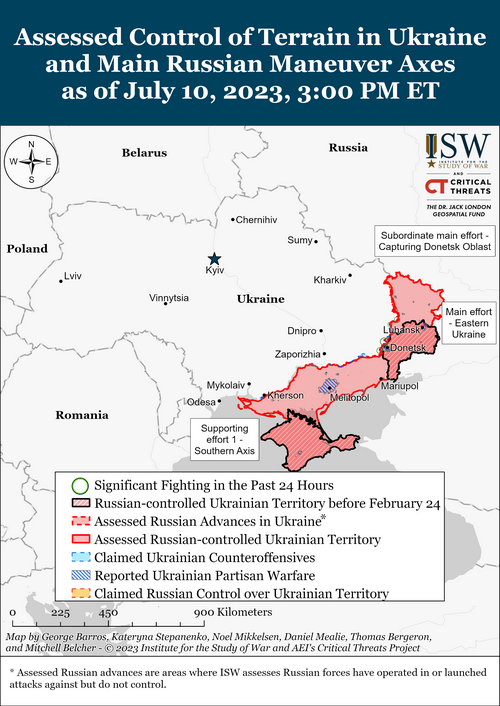
Ukrainian officials stated on July 10 that Ukrainian forces have fire control over Bakhmut and Russian ground lines of communication (GLOCs) around the city.[1] Ukrainian Deputy Defense Minister Hanna Malyar stated that Ukrainian forces have taken control of unspecified heights around Bakhmut, allowing Ukrainian forces to establish fire control over Bakhmut itself.[2] Ukrainian officials have recently signaled that Ukraine seeks to trap Russian forces within the city, and it appears that Ukrainian operations in the Bakhmut area in recent days have been intended to slowly envelop Russian troops in Bakhmut and on its flanks.[3] ISW was previously conservative when assessing claims of Russian fire control and general interdiction of Ukrainian lines of communication in and around Bakhmut as Russian forces gradually took control of the settlement, but Ukrainian claims of establishing fire control may be more credible. [4] Both Ukrainian and Russian sources have indicated in recent days that Ukraine is gaining ground in the Bakhmut area and on its southwestern flanks including specific terrain features that can give Ukrainian forces fire advantage. The fear of Ukrainian fire control and imminent threats to Bakhmut is also permeating the Russian information space, and Russian milbloggers have repeatedly expressed fear over Ukrainian forces encircling Russian forces in Bakhmut.[5] Russian sources claimed at least since February that Russian forces maintained fire control over critical Ukrainian GLOCs around Bakhmut, while Ukrainian officials and sources did not express concern over these Russian claims, in contrast, and withdrew their forces in good order in the face of the Wagner Group‘s expensive frontal assaults.[6] The persistent signaling of Ukrainian officials about Ukrainian operational intent in Bakhmut, alongside the clear concern of milbloggers over exactly what this intent may be, suggests that Ukrainian counteroffensive actions in this direction may be credibly threatening the Russian hold on Bakhmut, although it is far too early to forecast the liberation of the city.
Ukrainian forces conducted counteroffensive operations on at least three sectors of the front on July 10. Ukrainian military officials stated that Ukrainian troops continued offensive actions in the Bakhmut, Berdyansk (western Donetsk-eastern Zaporizhia oblasts), and Melitopol (western Zaporizhia Oblast) directions.[7] The Ukrainian General Staff reported that Ukrainian forces have liberated four square kilometers of territory in the Bakhmut direction over the past week, and a total of 24 square kilometers since starting counteroffensive operations in the Bakhmut direction (likely around early June).[8] The Ukrainian General Staff also reported that Ukrainian troops advanced up to one kilometer in the Berdyansk and Melitopol directions, and a total of 8.6 kilometers since Ukrainian troops initiated counteroffensive operations in these directions.[9] Since the beginning of the Ukrainian counteroffensive on June 4, ISW has calculated based on its own control of terrain data that Ukrainian forces recaptured approximately 253 square kilometers of territory. (Ukrainian official accounts of the area liberated differ from ISW’s, almost certainly because Ukraine calculated its initial control of terrain differently. ISW is presenting its own figure of liberated land to make an apples-to-apples comparison of Russian and Ukrainian gains.) Russian forces have captured a total of 282 square kilometers in the entire theater since January 1. In five weeks, Ukrainian forces have liberated nearly the same amount of territory that Russian forces captured in over six months.
Russian Chief of the General Staff and overall theater commander Army General Valery Gerasimov’s first public appearance since Wagner’s rebellion supports ISW’s previous assessment that he will likely retain his official position within the Russian military. The Russian Ministry of Defense (MoD) published footage on July 10 showing Gerasimov receiving reports about alleged Ukrainian attempts to strike Russian military targets in occupied Crimea and Rostov and Kaluga oblasts.[10] ISW previously assessed that Gerasimov’s past long periods of public absence have not been indicators of his official position within the Russian military leadership and that Putin will likely not remove Gerasimov as the overall theater commander or Chief of the General Staff, as doing so would be too damaging to the Kremlin’s and the MoD’s reputation.[11] The Kremlin has previously responded to speculations about Gerasimov’s public absences by affirming his role as Chief of the General Staff and appears to be currently publicizing Gerasimov’s presence at the meeting to respond to a new bout of rumors about his absence following Wagner’s rebellion on June 24.[12] ISW has previously observed Russian speculations that Russian Airborne Forces (VDV) Commander Colonel General Mikhail Teplinsky has recently assumed Gerasimov’s responsibilities for Russian operations in Ukraine, although there continues to be no confirmation of these speculations.[13] Gerasimov’s first public appearance since the rebellion was notably focused on alleged Russian internal security issues and not necessarily on Russian operations in Ukraine that the overall theater commander oversees.
The Kremlin and Western intelligence officials reported that Russian President Vladimir Putin met with Wagner Group financier Yevgeny Prigozhin on June 29 (and/or July 1) following Wagner’s armed rebellion on June 24.[14] Kremlin Spokesperson Dmitry Peskov stated that Putin met with Prigozhin and all of the Wagner commanders (35 people in total) in a three-hour meeting in the Kremlin. Peskov claimed that Putin gave an assessment of Wagner’s actions during the “special military operation,” gave his assessment of the armed rebellion, and listened to commanders’ explanations.[15] Putin also reportedly offered Wagner commanders “further employment options,” while the Wagner commanders assured Putin that they are loyal supporters and soldiers of the state and Putin. Peskov refused to answer a question about whether Russian MoD officials were present at the meeting. French outlet Liberation previously reported on July 7, citing Western intelligence officials that Prigozhin and Wagner’s top commanders met with Putin, Head of the Russian National Guard (Rosgvardia) Viktor Zolotov, and Head of the Russian Foreign Intelligence Service Sergei Naryshkin on July 1.[16] It is unclear if Liberation is referring to the claimed June 29 meeting or an additional meeting in the Kremlin.
Putin’s decision to meet with Prigozhin is inconsistent with the Kremlin’s prior rhetoric about Prigozhin and his role within the Wagner private military company (PMC). Peskov stated on June 29 that he did not have information about Prigozhin’s whereabouts.[17] Putin had also claimed in his speech on June 27 that “the owner of Concord company” (the Concord company is the parent company of Prigozhin’s catering company) provided catering services for the Russian army, while the Russian state fully funded and supplied Wagner forces.[18] Putin was clearly referring to Prigozhin in this statement given that Prigozhin is the owner of the Concord company and previously served as Putin’s caterer in an effort to deliberately deprive Prigozhin of the title of Wagner financier and undermine his role in the Wagner PMC. Putin’s meeting with Prigozhin and the later acknowledgment erodes these efforts and contradicts Putin’s condemnation of the rebellion’s organizers.[19] The Kremlin may have sought to publicize the meeting to address the number of questions arising regarding Prigozhin’s ability to freely move around Russia without facing legal action.
A Kremlin-affiliated war correspondent characterized the Putin-Prigozhin meeting as the Kremlin’s attempt to “gently” replace Prigozhin and restructure Wagner.[20] The milblogger claimed that the Kremlin is very dependent on Prigozhin’s structures within Wagner and that their destruction would seriously damage the Wagner PMC, confirming ISW’s previous assessment that the Kremlin is gradually attempting to separate the Wagner PMC from Prigozhin.[21] ISW also previously assessed that the Kremlin relied on irregular armed formations and their patrons to outsource reservist recruitment and crowdfunding efforts, which may be one of many forms of the Kremlin’s structural dependencies on Prigozhin-lead Wagner PMC.[22] The milblogger noted that the meeting aimed to close out any issues that were not discussed during the negotiations between Belarusian President Aleksandr Lukashenko and Director of the Russian Federal Security Service (FSB) Alexander Bortnikov that ensured security guarantees for Prigozhin. The milblogger noted that some of these issues included the fate of Wagner PMC as well as Prigozhin’s businesses and personal affairs. The milblogger added that Prigozhin is still allowed to operate his businesses and not face charges in Russia but had lost access to his media companies and faces a smear campaign in the state media, as ISW has also assessed.[23]
Gerasimov’s public reemergence and the acknowledgment of the Putin-Prigozhin meeting is likely a part of the Kremlin’s wider narrative effort to portray itself as fully in control following Wagner’s rebellion while also reaching out to those who lean toward loyalty toward Wagner and especially Prigozhin himself. The MoD published the footage of Gerasimov on the same day that the Kremlin acknowledged Putin’s June 29 meeting with Prigozhin, likely signaling a rejection, at least officially, of the rebellion’s call to replace senior Russian military leadership. A notable Russian milblogger argued that Gerasimov and Russian Defense Minister Sergei Shoigu’s media appearances show that there will be no command reshuffles and observed that Putin never fires people under external pressure.[24] Acquiescence to Prigozhin’s demands to remove Shoigu and Gerasimov would have likely damaged Putin’s regime security by creating a precedent that resistance and outright rebellion are legitimate means to achieve desired goals. The public backing of Shoigu and Gerasimov and the acknowledgment of Putin’s meeting with Prigozhin indicates that the Kremlin likely aims to portray the rebellion, its potential fallout, and the calls to replace disdained MoD establishment figures as a settled affair. The Kremlin may have chosen to portray itself as solving this issue now because of Lukashenko’s apparent attempt on July 6 to distance himself from the deal he mediated between the Kremlin and Prigozhin.[25] The meeting and the publicized support for Shoigu and Gerasimov are in line with what ISW continues to assess to be the Kremlin’s attempt to balance a desire to mitigate the widespread disdain for MoD establishment figures that fueled Wagner’s rebellion while also trying to disempower those who sympathized or supported the rebellion.[26]
It is unclear whether any agreements between the Kremlin and Prigozhin will prompt significant numbers of Wagner personnel to agree to sign contracts with the MoD. A Russian milblogger interviewed a Wagner assault group commander on July 10 and claimed that the commander stated that no personnel in his unit have signed the contract with the MoD.[27] The Wagner commander reportedly stated that Wagner is united around Prigozhin and a common ideology of fighting for the motherland instead of a military contract.[28] The commander reportedly stated that he will either continue serving with Wagner or demobilize.[29] It is unclear what proportion of Wagner fighters has this deep ideological loyalty to Prigozhin and Wagner as an independent organization, although such an ideological commitment will likely prove a significant obstacle for MoD efforts to subordinate Wagner. Prigozhin ramped up efforts to disseminate Wagner’s militarism and ideology throughout Russia in March, and Prigozhin may have similarly intensified internal ideological messaging within Wagner itself at the time.[30]
Chechen Republic Head Ramzan Kadyrov claimed that Chechen Akhmat Special Forces have deployed to the Bakhmut direction, but a local Ukrainian commander denied having encountered Chechen forces, suggesting that these Chechen elements are not making significant frontline contributions to Russian operations in Ukraine. Kadyrov claimed on July 9 that Akhmat Special Forces (Spetsnaz) Commander Apty Alaudinov recently visited Akhmat Spetsnaz near Klishchiivka (7km southwest of Bakhmut) and that Russian forces recently decided to transfer Akhmat Spetsnaz to the Bakhmut direction, allegedly reflective of the Russian General Staff’s trust in Akhmat’s combat capabilities.[31] A Ukrainian battalion commander operating in the Bakhmut direction stated on July 10 that Ukrainian personnel have yet to encounter any Akhmat units near Bakhmut, however.[32] A Russian source claimed on July 6 that “bearded mountain men” were taking pictures at the Bakhmut Raion welcome sign, likely hinting that Chechen forces were coming to the Bakhmut area for propaganda purposes.[33]
Kadyrov recently claimed on May 31 that Akhmat Spetsnaz assumed responsibility for the Russian offensive to capture Marinka southwest of Donetsk City.[34] Kadyrov also reportedly deployed Akhmat Spetsnaz to border areas in Belgorod Oblast to defend against limited all Russian pro-Ukrainian cross-border raids.[35] ISW has observed Akhmat Spetsnaz elements fighting near Bilohorivka south of Kreminna and operating in Zaporizhia Oblast.[36] Kadyrov has previously claimed that 7,000 Chechen servicemen are operating in Ukraine but that there are 70,000 active Chechen personnel in the entire Russian military.[37] If Akhmat forces are deployed across five different sectors of the front, it is likely that each grouping lacks significant manpower and provides limited combat capabilities to ongoing Russian operations in each sector. Akhmat forces have allegedly been fighting in Marinka for over a month and have yet to produce the significant breakthroughs that they promised. Akhmat forces have been engaged in Russian offensives south of Kreminna since at least February 2023 with a similar lack of Russian advances in the area.[38] Akhmat Spetsnaz thus appears unlikely to make even a tactically significant impact in their alleged deployment to the Bakhmut area. Kadyrov is likely promoting Akhmat as a heavily involved force in Ukraine in order to curry favor with the MoD and with Putin. It is unclear how involved Akhmat forces are in Russian operations in each sector that they are reportedly deployed to, and Kadyrov may be intentionally shielding these forces from combat and degradation in a bid to retain the influence these paramilitary structures provide.
Former Russian officer and prominent critical nationalist milblogger Igor Girkin claimed on July 10 that he managed to deliver a speech in St. Petersburg despite efforts by law enforcement to censor him and prevent the speech from happening. Girkin previously accused the Russian Federal Security Service (FSB) of fabricating a bomb threat at the Listva bookstore in St. Petersburg to prevent him from speaking about the Wagner Group rebellion.[39] On July 10, Girkin posted an update claiming that he still delivered the lecture in St. Petersburg, and the Listva bookstore reported that Girkin spoke in a pre-prepared spare room while the law enforcement raid was ongoing.[40] Girkin stated that the only thing that law enforcement accomplished during the raid was making a stronger point against itself and its resort to censorship than even he could.[41] Girkin went on to complain that he is preparing to leave St. Petersburg for Moscow as it is clear he is no longer welcome in the city.[42] ISW previously assessed that the FSB-fabricated bomb threat at Girkin’s event is likely part of a long-standing feud between the FSB and Girkin and the larger ultranationalist community, and the fact that Girkin supposedly went ahead with his speech despite the censorship attempts is likely to exacerbate the feud.[43]
Key Takeaways:
- Ukrainian officials stated on July 10 that Ukrainian forces have fire control over Bakhmut and Russian ground lines of communication (GLOCs) around the city.
- Ukrainian forces conducted counteroffensive operations on at least three sectors of the front on July 10.
- Russian Chief of the General Staff and overall theater commander Army General Valery Gerasimov’s first public appearance since Wagner’s rebellion supports ISW’s previous assessment that he will likely retain his official position within the Russian military.
- The Kremlin and Western intelligence officials reported that Russian President Vladimir Putin met with Wagner Group financier Yevgeny Prigozhin on June 29 (and/or July 1) following Wagner’s armed rebellion on June 24.
- Putin’s decision to meet with Prigozhin is inconsistent with the Kremlin’s prior rhetoric about Prigozhin and his role within the Wagner private military company (PMC).
- A Kremlin-affiliated war correspondent characterized the Putin-Prigozhin meeting as the Kremlin’s attempt to “gently” replace Prigozhin and restructure Wagner.
- Gerasimov’s public reemergence and the acknowledgment of the Putin-Prigozhin meeting is likely a part of the Kremlin’s wider narrative effort to portray itself as fully in control following Wagner’s rebellion while also reaching out to those who lean toward loyalty toward Wagner and especially Prigozhin himself.
- It is unclear whether any agreements between the Kremlin and Prigozhin will prompt significant numbers of Wagner personnel to agree to sign contracts with the MoD.
- Chechen Republic Head Ramzan Kadyrov claimed that Chechen Akhmat Special Forces have deployed to the Bakhmut direction, but a local Ukrainian commander denied having encountered Chechen forces, suggesting that these Chechen elements are not making significant frontline contributions to Russian operations in Ukraine.
- Former Russian officer and prominent critical nationalist milblogger Igor Girkin claimed on July 10 that he managed to deliver a speech in St. Petersburg despite efforts by law enforcement to censor him and prevent the speech from happening
- Russian and Ukrainian forces conducted ground attacks along the Kupyansk-Svatove-Kreminna line and in the Bakhmut direction.
- Russian forces conducted ground attacks along the Avdiivka-Donetsk City line.
- Ukrainian forces conducted counteroffensive operations south of Orikhiv in western Zaporizhia Oblast on July 10.
- Russian forces are continuing to suffer significant casualties on the battlefield.
- Russian occupation officials acknowledged widespread utility service disruptions in occupied Donetsk Oblast.
Go here to read the rest. The Ukrainians appear to be winning the battle of Bakhmut. We will see if the Russians can afford to withdraw or if they are afraid that might start a rout of their forces in that sector of the front. The capture of Bakhmut by the Russians was accomplished largely by the Wagner forces, and those forces are now unawailabe to the Russians.

