
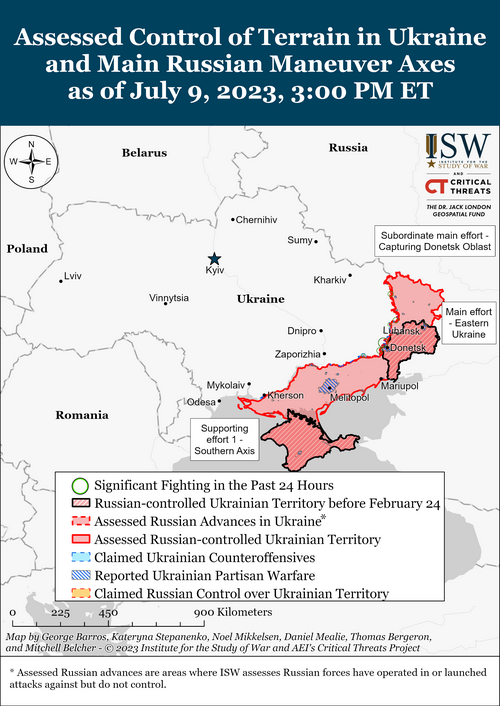
From The Institute For The Study of War:
Russian Offensive Campaign Assessment, July 9, 2023
Kateryna Stepanenko, Grace Mappes, George Barros, Nicole Wolkov, and Frederick W. Kagan
July 9, 2023, 7pm ET
Click here to see ISW’s interactive map of the Russian invasion of Ukraine. This map is updated daily alongside the static maps present in this report.
Click here to access ISW’s archive of interactive time-lapse maps of the Russian invasion of Ukraine. These maps complement the static control-of-terrain map that ISW produces daily by showing a dynamic frontline. ISW will update this time-lapse map archive monthly.
Note: The data cutoff for this product was 1:00pm ET on July 9. ISW will cover subsequent reports in the July 10 Russian Offensive Campaign Assessment.
Ukrainian forces conducted counteroffensive operations on at least three sectors of the front on July 9. Ukrainian Ground Forces Commander Colonel General Oleksandr Syrskyi stated that Ukrainian forces successfully continue to advance in the Bakhmut direction.[1] Ukrainian officials reported that Ukrainian forces continued to conduct counteroffensive operations in the Berdyansk and Melitopol directions.[2] The Russian Ministry of Defense (MoD) and Kremlin-affiliated milbloggers claimed that Ukrainian forces conducted attacks in western Zaporizhia Oblast.[3] A Russian milblogger claimed that Ukrainian forces are attacking Russian positions in small groups and are targeting Russian rear positions, warehouses, and infrastructure.[4] Ukrainian military officials also reiterated that Ukrainian forces are continuing their interdiction campaigns in southern and eastern Ukraine.[5]
The Wall Street Journal (WSJ) reported that Ukrainian forces are attempting to soften Russian defenses before liberating territory, accepting a slower pace of advance.[6] The WSJ also reported that Ukrainian forces are focusing on dislodging Russian forces from fortifications and minefields, which are over 24km deep in some areas of Russian occupied territory.[7] Lieutenant Colonel Oleksiy Telehin of Ukraine’s 108th Territorial Defense Brigade told the WSJ that Russian forces are continually able to bring in replacements even if Ukrainian forces destroy entire units.[8] ISW has assessed that Russian forces lack operational reserves. Telehin’s statement likely refers to locally available tactical reserves. Another unit commander in the 108th Territorial Defense Brigade stated that the shortage of armored vehicles makes it difficult for Ukrainian forces to advance on well-prepared positions. WSJ sources also cited the lack of Ukrainian air superiority as one of the factors slowing down Ukrainian counteroffensives. ISW continues to assess that the current pace of the Ukrainian counteroffensive is reflective of a deliberate effort to conserve Ukrainian combat power and attrit Russian manpower and equipment at the cost of slower territorial advances.[9]
US President Joe Biden stated that Ukraine cannot join NATO until Russia’s war in Ukraine is over. Biden told CNN on July 9 that it is premature to vote on Ukraine’s NATO membership and that the alliance should “lay out a rational path for Ukraine to be able to qualify to be able to get into NATO.”[10] Biden’s statement follows Turkish President Recep Tayyip Erdogan’s July 7 statement that Ukraine “deserves NATO membership” and precedes the NATO summit in Vilnius on July 11 and July 12.[11]
Russian Foreign Minister Sergei Lavrov discussed Turkey’s decision to allow the release of five Ukrainian commanders involved in the defense of the Azovstal Metallurgical Combine in Mariupol, Donetsk Oblast with his Turkish counterpart Hakan Fidan on July 9.[12] Ukraine, Russia, and Turkey previously agreed in September 2022 that Azovstal commanders would remain in Turkey for the duration of the war after Russia freed some Azovstal defenders in an Ankara-brokered prisoner exchange.[13] Ukrainian President Volodymyr Zelensky brought five Azovstal commanders home to Ukraine on July 8.[14] The Russian Ministry of Foreign Affairs (MFA) announced that Lavrov and Fidan discussed the situation regarding the release of Azovstal defenders in a phone call initiated by the Turkish side but did not provide additional details regarding the discussion.[15] Lavrov reportedly emphasized to Fidan that further deliveries of military aid to Ukraine are “destructive” and “can lead to negative consequences,” likely in an effort to discourage further military support for Ukraine. The Turkish MFA also noted that Fidan and Lavrov discussed the United Nations-brokered grain export deal, while the Russian MFA predictably blamed the West for its “inability to take necessary steps” to implement the agreement.[16] The grain deal expires on July 17, and it is likely that the Kremlin will threaten to not extend the deal to advance its objectives.[17]
The Russian ultranationalist community continued to blame the Kremlin for trusting Turkey to uphold the deal and to keep Azovstal defenders in Turkey. Russian ultranationalists have been consistently criticizing the Kremlin’s decisions to free Azovstal defenders in other prisoner exchanges because the Kremlin had portrayed these Ukrainian fighters as “Nazis” during the Battle of Mariupol.[18] One Russian milblogger observed that the release of Azovstal defenders undermines Russia’s aim to ”denazify” Ukraine, while another milblogger implied that Russia should not have trusted Turkey to uphold the deal given that Turkey is Russia’s ”historical enemy.”[19] A Kremlin-affiliated milblogger claimed that Russia could have avoided this release by not organizing the initial prisoner of war (POW) exchange in 2022, and another Russian milblogger stated that Russia was once again misled because Russian officials irresponsibly prioritized the release of Kremlin-affiliated former Ukrainian MP Viktor Medvedchuk – who is a godfather to one of Putin’s children – from Ukrainian captivity.[20] Another milblogger stated that the news of the Azovstal commanders’ release had upset Russian military personnel on the frontlines and urged people to reevaluate the reasons for Wagner Group’s armed rebellion – implying that the rebellion’s goals of changes within the Russian military command and information space are still needed in Russia.[21] The milblogger added that this incident is one of many incidents since the start of Russia’s full-scale invasion of Ukraine that are dividing Russian society.[22]
Former Russian officer and ardent nationalist Igor Girkin claimed that the Russian Federal Security Service’s (FSB) Service for the Protection of the Constitutional Order (UZKS) is deliberately censoring him. Girkin reported that his talk about the Wagner Group armed rebellion was canceled at the Listva bookstore in St. Petersburg on July 9 after St. Petersburg law enforcement responded to a claimed bomb threat at the bookstore.[23] Girkin and Listva complained on July 8 that St. Petersburg police warned Listva not to host the event, but Listva claimed it would host the event despite the warning.[24] Russian police routinely cancel events under the premise of bomb threats to censor public figures.[25] Girkin claimed that someone attempted to censor his event and discussed three potential culprits.[26] Girkin sarcastically hypothesized that the government perceives him as a greater threat than Wagner Group financier Yevgeny Prigozhin and 15,000 Wagner military personnel. Girkin also noted that Prigozhin may own and fully control the Listva bookstore.[27] Listva has notably promoted Girkin and hosted many prior events with him, and it is unclear why a Prigozhin-owned bookstore would first try to host such an event and then cancel it.[28] Girkin also suggested that UZKS Head Lieutenant General Aleksey Zhalo may have censored his event, either because he had gone crazy or because he is under Prigozhin’s influence.[29] Girkin’s mention of Zhalo stands out as the only serious theory Girkin offered.
The FSB’s possible soft censorship of Girkin may be part of a longstanding feud between Girkin and Zhalo. Zhalo previously orchestrated FSB crackdowns on Russian ultranationalist groups and charged their leaders with terrorism and fraud.[30] Girkin, who led an ultranationalist movement, publicly criticized Zhalo and the FSB in 2018 for further arrests of individuals in the ultranationalist pro-separatist movement and for failing to combat the Ukrainian Azov Regiment’s recruitment measures.[31] Girkin claimed in 2018 that he personally knew Zhalo, criticized Zhalo as a ”thief” and a ”hypocrite,” and claimed that Zhalo is one of multiple Russian officials who stand against him.[32]
Central African Republic (CAR) Presidential Spokesperson Albert Yaloke Mokpem stated on July 8 that Wagner Group personnel leaving CAR are conducting rotations and are not withdrawing.[33] Reuters reported that a CAR military source claimed that several hundred Wagner forces recently left CAR, and ISW observed footage published on July 6 purportedly showing 600 Wagner personnel departing from an airport in Bangui, CAR.[34] ISW previously assessed that some Wagner personnel in CAR may be leaving after refusing to sign contracts with the Russian MoD given similar reports of Wagner personnel departing Syria.[35] Wagner personnel may be attempting to remain in CAR to maintain control over Wagner-owned natural resource extraction operations in CAR.[36]
Unknown persons leaked an image of what appears to be the Wagner Group’s founding charter on July 9, possibly to present the Wagner Group as a professional organization. The document, dated May 1, 2014, commits Wagner Group financier Yevgeny Prigozhin and Wagner Group commander Dmitry Utkin to follow a set of rules for their new private military company’s participation for combat in eastern Ukraine.[37] Prigozhin’s duties as “director” include the responsibility to provide weapons and funding; provide guarantees for the killed and wounded; provide permanent work; protect personnel against criminal charges for mercenaryism (article 359 of Russia’s Criminal Code); resolve all issues “collegially”; participate in person; and not go against the Russian nation.[38] Utkin’s responsibilities as “commander” were to select and train personnel; get rid of deserters; prohibit alcohol and drugs; resolve issues “collegially”; implement lessons learned and complete tasks to the end; not go against “VVP” (Vladimir Vladimirovich Putin); and not lie or deceive and always tell the truth as it is.[39] It is unclear who leaked this document or why. Russian law enforcement, which raided Prigozhin’s home, and pro-Prigozhin actors likely had access to the document.[40] The leak may be part of an effort to rehabilitate Wagner’s image following Prigozhin’s June 24 rebellion. The document reiterates that Wagner’s founding principles are to fight Russia’s war in Ukraine in loyal service to Russian President Vladimir Putin and “the Russian nation.”
Russian President Vladimir Putin’s decision to not rapidly dispose of the Wagner Group and prosecute rebellion participants is placing himself and his subordinates in an awkward position. It remains unclear who benefits from the leak of Wagner’s alleged founding document as the document makes the Wagner Group look professional and appealing in comparison with the regular Russian military. Wagner is still reportedly recruiting within Russia while the Russian MoD is reportedly conducting a competing effort to recruit Wagner fighters to sign contracts with the MoD.[41] Putin’s decision to not dispose of the Wagner Group – previously Russia’s most combat capable force – is making it difficult for Putin and other Russian power players to know how to interact with the Wagner Group and its leaders and fighters.
Key Takeaways:
- Ukrainian forces conducted counteroffensive operations on at least three sectors of the front on July 9.
- The Wall Street Journal (WSJ) reported that Ukrainian forces are attempting to soften Russian defenses before liberating territory, accepting a slower pace of advance.
- US President Joe Biden stated that Ukraine cannot join NATO until Russia’s war in Ukraine is over.
- Russian Foreign Minister Sergei Lavrov discussed Turkey’s decision to allow the release of five Ukrainian commanders involved in the defense of the Azovstal Metallurgical Combine in Mariupol, Donetsk Oblast with his Turkish counterpart Hakan Fidan on July 9.
- The Russian ultranationalist community continued to blame the Kremlin for trusting Turkey to uphold the deal and to keep Azovstal defenders in Turkey.
- Former Russian officer and ardent nationalist Igor Girkin claimed that the Russian Federal Security Service’s (FSB) Service for the Protection of the Constitutional Order (UZKS) is deliberately censoring him.
- Central African Republic (CAR) Presidental Spokesperson Albert Yaloke Mokpem stated on July 8 that Wagner Group personnel leaving CAR are conducting rotations and are not withdrawing.
- Unknown persons leaked an image of what appears to be the Wagner Group’s founding charter on July 9, possibly to present the Wagner Group as a professional organization.
- Russian President Vladimir Putin’s decision to not rapidly dispose of the Wagner Group and prosecute rebellion participants is placing himself and his subordinates in an awkward position.
- Russian forces conducted limited ground attacks north of Svatove and south of Kreminna.
- Ukrainian and Russian forces continued counteroffensive operations in the Bakhmut area.
- Russian and Ukrainian forces continued ground attacks on the Avdiivka-Donetsk City line, and Russian forces advanced as of July 9.
- Ukrainian forces continued to advance in the Donetsk-Zaporizhia oblasts administrative border area, and continued counteroffensive operations in western Zaporizhia Oblast.
- Russian forces reportedly continued to reestablish previously flooded positions on the east (left) bank of the Dnipro River in Kherson Oblast.
- Russian sources accused Ukrainian forces of targeting the Kerch Strait Bridge.
- The Russian Ministry of Defense (MoD) is reportedly accepting Wagner Group mercenaries for contract service with the Russian MoD in Molkino, Krasnodar Krai.
Go here to read the rest. Traditionally the Russian response to an enemy offensive is to quickly launch a counteroffensive. The Russians have not done that currently, presumably because they lack the military resources to do so.

