
From The Institute For The Study of War:
Russian Offensive Campaign Assessment, July 2, 2023
Kateryna Stepanenko, Riley Bailey, Grace Mappes, Nicole Wolkov, George Barros, and Frederick W. Kagan
July 2, 2023, 5pm ET
Click here to see ISW’s interactive map of the Russian invasion of Ukraine. This map is updated daily alongside the static maps present in this report.
Click here to access ISW’s archive of interactive time-lapse maps of the Russian invasion of Ukraine. These maps complement the static control-of-terrain map that ISW produces daily by showing a dynamic frontline. ISW will update this time-lapse map archive monthly.
Note: The data cutoff for this product was 12:30pm ET on July 2. ISW will cover subsequent reports in the July 3 Russian Offensive Campaign Assessment.
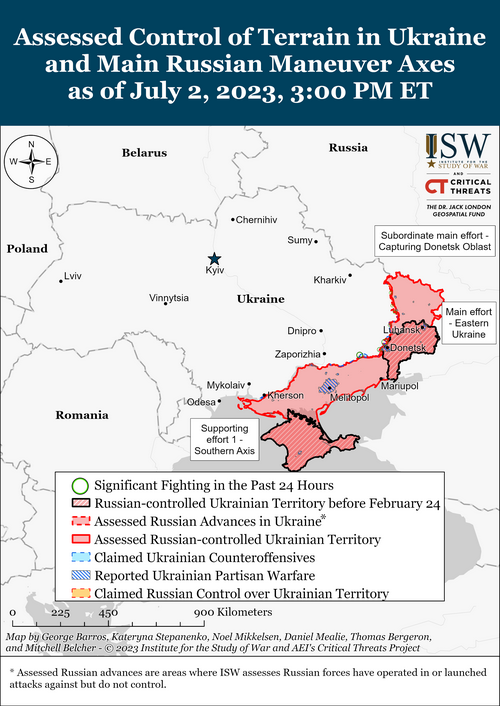
Ukrainian forces reportedly conducted counteroffensive operations in six sectors of the front on July 2 and made gains in some of these areas. The Russian Ministry of Defense and other Russian sources claimed that Ukrainian forces conducted offensive operations in the Lyman direction, in the Bakhmut area, along the Avdiivka-Donetsk City front, in western Donetsk Oblast, on the administrative border between Zaporizhia and Donetsk oblasts, and in western Zaporizhia Oblast.[1] Ukrainian Eastern Group of Forces Spokesperson Colonel Serhiy Cherevaty reported on July 2 that Ukrainian forces are continuing to make unspecified advances on the flanks around Bakhmut.[2] A Russian milblogger claimed that Ukrainian forces made unspecified gains southwest of Klishchiivka (7km southwest of Bakhmut).[3] Geolocated footage published on July 1 indicates that Ukrainian forces advanced northeast of Volodymyrivka (12km southeast of Vuhledar) in western Donetsk Oblast.[4] Russian sources claimed that Ukrainian forces continued counteroffensive operations south and southwest of Orikhiv in western Zaporizhia Oblast.[5] Zaporizhia Oblast occupation deputy Vladimir Rogov claimed that Ukrainian forces advanced towards Russian trench positions near Robotyne (12km south of Orikhiv) and that there is ongoing close combat in these trenches.[6] Some Russian sources continue to describe these Ukrainian counteroffensive operations as smaller tactical operations than earlier Ukrainian counteroffensive operations.[7]
Russian forces conducted another series of drone and missile strikes targeting southern Ukraine and Kyiv on July 2. The Ukrainian General Staff reported that Russian forces launched 11 missiles and eight Shahed drones at Ukraine, including three Kalibr missiles at Odesa and Mykolaiv oblasts.[8] The Ukrainian General Staff reported that Ukrainian forces intercepted all three Kalibr cruise missiles and eight Shahed drones.[9] The Kyiv City Military Administration reported that Ukrainian air defenses shot down all Russian Shahed drones targeting Kyiv, and Ukraine‘s Southern Operational Command reported that Ukrainian forces shot down two drones over Mykolaiv Oblast.[10]
The Russian Ministry of Defense (MoD) is attempting to consolidate control over the Russian information space by undermining select Russian milbloggers who did not repeat the MoD’s desired framing regarding the claimed defeat of a Ukrainian presence on the east (left) bank Kherson Oblast on July 1. The Russian MoD claimed on July 1 and July 2 that Russian forces successfully repelled Ukrainian landings near the Antonivsky Bridge and disproportionally celebrated defeating a small Ukrainian landing on the eastern (left) bank of the Dnipro River.[11] Some Russian milbloggers, however, contrary to the MoD‘s reports noted that fighting is still ongoing and that Ukrainian forces maintained some positions near Antonivsky Bridge as of July 2.[12] A prominent Russian milblogger amplified a post on July 1 from an unspecified Telegram channel, which criticized several prominent Kremlin and Wagner-affiliated Telegram channels for contradicting the Russian MoD’s official narrative.[13] The post accused select milbloggers of spreading false information about the situation around the Antonivsky Bridge and other Russian MoD claims – ultimately accusing these channels of assisting Ukrainian “psychological operations.”[14] Russian milbloggers who contradicted the MoD’s report responded in turn by accusing the Russian General Staff of launching an attack on the Russian milblogger community.[15] These defiant milbloggers claimed that the Russian General Staff and the MoD previously attempted to open a criminal case against milbloggers in 2022 and claimed that milbloggers’ accurate coverage of frontline realities greatly undermines defense officials’ efforts to exaggerate Russia’s successes.[16] Some of these defiant milbloggers directly interact with Russian President Vladimir Putin, and it is likely that the Russian MoD seeks to censor some Kremlin-affiliated milbloggers out of a concern that these ultranationalists may expose Russian military failures to Putin during their monthly ”special military operations” milblogger working groups within the Kremlin.[17]
The Russian MoD’s conflict with the milblogger community over a trivial combat operation may indicate that the Russian military command does not think it has any other successes to report to Putin amidst the ongoing Ukrainian counteroffensive. One milblogger noted that Russian defense officials worry that milbloggers’ coverage of the war endangers their official positions and implied that the Russian MoD may be attempting to recover from the Wagner Group’s rebellion on June 24.[18] ISW previously reported that the Russian MoD may have exaggerated its victory in east Kherson Oblast to repair the reputation of the Russian ”Dnepr” Group of Forces and the Southern Military District (SMD), whose headquarters in Rostov-on-Don the Wagner Group surrounded a week before.[19] The Russian MoD has consistently exaggerated Ukrainian losses since the beginning of the full-scale invasion and may not be confident that such tired narratives are sufficiently offsetting the lack of any Russian progress on the battlefield as Ukrainian forces continue to make limited but steady advances in eastern and southern Ukraine.
The Russian MoD’s attempt to overstate a potential tactical Russian victory near the Antonivsky Bridge and its efforts to restrict opposing information has backfired. Russian milbloggers began to blame Russia’s military command for failing to provide Russian servicemen in east bank Kherson Oblast with boats and other supplies and generally accused the Russian MoD of lying about the situation on the frontlines for its own self-interested reasons.[20] One milblogger observed that the Russian MoD failed to provide Russian forces with more boats despite the fact that an acute and persistent Russian lack of patrol boats for littoral security has been widely known since at least April 2023, while another milblogger claimed that Russia should authorize the Russian Federal Security Service (FSB) to create a parallel control system over the Russian MoD to resolve bureaucratic problems.[21] The Russian pro-war community thus continues to criticize the Russian MoD even after Wagner’s failed rebellion and even as Prigozhin losses his platform in Russia.
Putin continues to face the choice of either siding with the Russian MoD to defend its weakened reputation or maintaining his support among pro-war ultranationalist milbloggers and their patronage networks. The Russian MoD had launched similar organized attacks against hostile milbloggers in July and October 2022 that did not result in milbloggers’ arrests or punishments for their criticism of the Russian military command.[22] ISW assessed that Putin was not interested in restricting the milblogger community as he valued its support for the invasion of Ukraine and instead increasingly co-opted select milbloggers by bringing them into the pro-Kremlin fold – likely in part to check the Russian MoD.[23] Wagner financier Yevgeny Prigozhin had extensively used Russian milbloggers to promote his efforts to replace Russian MoD leadership with Wagner-affiliated officials prior to his rebellion, and Putin now faces the choice of censoring or appeasing Russian milbloggers in the aftermath of the rebellion.[24] Putin will need to restrict Russian milbloggers from criticizing the Russian MoD if he seeks to reestablish and reinforce the MoD’s credibility, but the MoD’s failures, struggles, and apparent pervasive dishonesty may make that task infeasible. Putin may thus instead decide to continue appeasing the milblogger community and scapegoating the Russian MoD for military failures in Ukraine, a far easier undertaking. That course of action could let Putin retain support for the war among the Russian ultranationalist camp at the expense of the Russian MoD. But that course of action also carries risk for Putin: the continued erosion of the MoD’s credibility could enable other ambitious Russian figures to promote their interests at its expense, as Prigozhin tried to do.
Key Takeaways:
- Ukrainian forces reportedly conducted counteroffensive operations in six sectors of the front on July 2 and made gains in some of these areas.
- Russian forces conducted another series of drone and missile strikes targeting southern Ukraine and Kyiv on July 2.
- The Russian MoD’s conflict with the milblogger community over a trivial combat operation may indicate that the Russian military command does not think it has any other successes to report to Putin amidst the ongoing Ukrainian counteroffensive.
- The Russian MoD’s attempt to overstate a potential tactical Russian victory near the Antonivsky Bridge and its efforts to restrict opposing information has backfired.
- Putin continues to face the choice of either siding with the Russian MoD to defend its weakened reputation or maintaining his support among pro-war ultranationalist milbloggers and their patronage networks.
- Russian and Ukrainian forces continued to engage in positional battles along the Kupyansk-Svatove-Kreminna frontline.
- Ukrainian and Russian forces continued to conduct limited ground attacks around Bakhmut and along the Avdiivka-Donetsk City line.
- Ukrainian forces reportedly conducted limited offensive operations in western Donetsk Oblast and have advanced as of July 2.
- Russian sources claimed that Russian and Ukrainian forces conducted limited offensive operations in the western Donetsk-eastern Zaporizhia oblasts border area.
- Russian sources claimed that Ukrainian forces maintain limited positions in east (left) bank Kherson Oblast near the Antonivsky Bridge as of July 2.
- Kremlin Spokesperson Dmitry Peskov stated that Russian officials plan to create regional centers for the development of drones in Nizhny Novgorod as well as in occupied Sevastopol, Crimea, and Mariupol, Donetsk Oblast.
- Ukrainian and Belarusian sources reported that Belarusian President Alexander Lukashenko and other Belarusian officials and citizens are actively involved in the deportation of Ukrainian children from occupied territories to Belarus.
Go here to read the rest. The Ukrainians are continuing their effort to attack the Russian lines over a broad area to force the Russians to spread out their reserves.

