
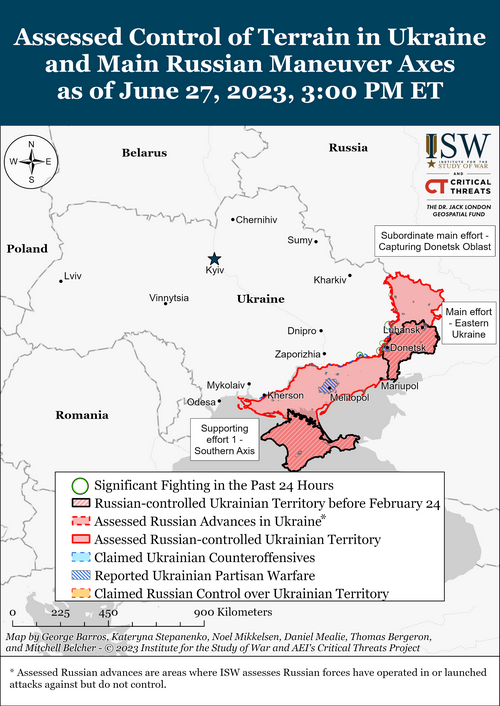
Russian Offensive Campaign Assessment, June 27, 2023
George Barros, Kateryna Stepanenko, Grace Mappes, Nicole Wolkov, Angelica Evans, and Frederick W. Kagan
June 27, 2023, 8:50 pm ET
Click here to see ISW’s interactive map of the Russian invasion of Ukraine. This map is updated daily alongside the static maps present in this report.
Click here to access ISW’s archive of interactive time-lapse maps of the Russian invasion of Ukraine. These maps complement the static control-of-terrain map that ISW produces daily by showing a dynamic frontline. ISW will update this time-lapse map archive monthly.
Note: The data cutoff for this product was 1pm ET on June 27. ISW will cover subsequent reports in the June 28 Russian Offensive Campaign Assessment.
Russian President Vladimir Putin is trying to present Wagner Group financier Yevgeny Prigozhin as corrupt and a liar to destroy his reputation among Wagner personnel and within Russian society. Putin implied on June 27 that “the owner of Concord company” (the Concord company is the parent company of Prigozhin’s catering company) lied about the Wagner Group private military company’s (PMC) independence from the Kremlin and the lack of state compensation for Wagner personnel.[1]Putin publicly claimed for the first time since Wagner’s founding that the Kremlin “fully funds” and “fully supplies” the Wagner PMC and claimed that the Kremlin made various payments to Wagner personnel and their families from Russia’s federal budget. Putin added that “the owner of the Concord Company” received 80 billion rubles (about $936 million) between May 2022 and May 2023 for delivering and catering food to the Russian military, and that the Kremlin will investigate whether the company stole anything during its work for the Kremlin. Putin was clearly referring to Prigozhin, who is the owner of the Concord Company Group and previously worked as Putin’s personal caterer, but Putin continues to refuse to say Prigozhin’s name.[2] Putin’s insinuation that the Kremlin will investigate the Concord Company may be preparation to justify the Kremlin’s confiscation of Prigozhin’s assets via corruption charges.
Putin is rhetorically separating Prigozhin from the Wagner PMC and is deliberately depriving Prigozhin of the title of Wagner financier to undermine his role in the Wagner PMC. The Kremlin launched an ongoing domestic information campaign in Russia to forgive Wagner fighters and commanders in an effort to lure Wagner personnel to sign contacts with the Russian Ministry of Defense (MoD).[3] The deliberate effort to separate Prigozhin from the Wagner Group is likely intended to set informational conditions so that the Kremlin can accuse Prigozhin of corruption or conspiring with Ukraine or the West and alienate Prigozhin from Wagner personnel whom the Kremlin seeks to retain to fight in Ukraine as part of the regular Russian military.[4] Prigozhin had built his personal brand on criticizing the Russian military command and bureaucrats for corruption and ties to Western countries, and Putin is likely attempting to shatter Prigozhin’s populist appeal by accusing him of the same sins.
Putin has likely decided that he cannot directly eliminate Prigozhin without making him a martyr at this time. Prigozhin still retains some support within Russian society and the Russian regular forces, and the Kremlin will need to ensure that these groups become disillusioned with Prigozhin to effectively deprive him of his popular support in Russia. Prigozhin campaigned for military command changes by accusing the Russian MoD of mistreating regular Russian military personnel in combat – a message that likely appealed to many servicemen and their families disillusioned with mobilization, casualties, supply shortages, and great loss of life with little to show for it. The Kremlin needs to separate Prigozhin’s cause from his persona, lest an attack on Prigozhin be perceived as a Kremlin attack on his popular narrative and his stated objectives of punishing the criminally incompetent Russian MoD leadership. The Kremlin will likely continue to attack Prigozhin’s character to break Prigozhin’s popular support, discourage Wagner personnel from following him to Belarus, and destroy his financial power.
Belarusian President Alexander Lukashenko’s account of his mediation between Putin and Prigozhin on June 24-25 in tandem with Putin’s June 26 speech indicates that Putin promised Lukashenko and Prigozhin that Prigozhin and the Wagner Group would have “security guarantees” in Belarus. Lukashenko indicated on June 27 that Putin “promised” both Lukashenko and Prigozhin that Prigozhin and the Wagner Group would enjoy unspecified “security guarantees” in Belarus.[5] The Russian Federal Security Service (FSB) officially dropped charges against Prigozhin on June 27.[6] Lukashenko has thus likely managed to secure a degree of safe haven for Prigozhin in Belarus at this time. This is a change in ISW’s June 26 assessment that the offer of safe haven in Belarus was likely a trap.[7] ISW has altered its assessment based on the pattern created by Putin’s and Lukashenko’s speeches.
It is unclear whether Prigozhin’s safety will survive Putin’s effort to destroy Prigozhin’s reputation, however, especially since the threat of corruption investigations against Prigozhin opens the possibility of new charges against Prigozhin that Putin’s promise presumably does not cover. Putin thus likely decided to destroy Prigozhin’s reputation and possibly strip him of his financial resources for offenses technically independent of the armed rebellion while abstaining from punishing Prigozhin directly for the rebellion.
Lukashenko likely seeks to use the Wagner Group in Belarus to buy maneuvering space to balance against the Kremlin campaign to absorb Belarus via the Union State. Lukashenko described at length how he inserted himself into the Putin-Prigozhin conflict in a way that – if Lukashenko’s account is true – demonstrates that Lukashenko is a politically savvy actor capable of exercising influence within the upper echelons of Russian politics. Lukashenko described how he managed to broker the deal between Putin and a livid Prigozhin, who refused to answer Putin’s phone calls, by skillfully engaging both parties directly and through Russian Deputy Defense Minister Yunus-Bek Yevkurov and Russian FSB Director Alexander Bortnikov.[8] Lukashenko’s elaborate account suggests that Lukashenko successfully mediated a crisis within Putin‘s own inner circle that Putin could not.[9] Lukashenko intervened to mediate likely in part to signal to Putin and other senior Kremlin officials that Moscow should not trifle with Lukashenko and that Lukashenko has the ability to operate successfully and independently within Russian politics. Lukashenko’s boasting about his ability to manipulate power brokers within Putin’s innermost circle is humiliating for Putin, whether or not it is true. The fact that Putin has not challenged Lukashenko’s presentation of events and has in fact publicly thanked Lukashenko is even more humiliating.
Lukashenko likely seeks to closely control any Wagner Group forces that move into Belarus. Lukashenko stressed that the Wagner Group will not open recruitment centers in Belarus as it did in Russia but that Belarusians – and presumably other nationals- will be allowed to join the Wagner Group in Belarus.[10] Lukashenko’s description suggests that the Wagner Group will primarily act as a training and advisory partner for the Belarusian military. Lukashenko stated that Wagner forces have more training than the Belarusian military and that the Belarusian military could benefit from the Wagner Group’s extensive combat experience.[11] Lukashenko denied claims that Belarusian authorities have already begun establishing field camps for Wagner Group fighters but said Belarus would create camps if Wagner requested them.[12]
Lukashenko may seek to use the Wagner Group in Belarus to reduce the Belarusian military’s accumulated structural dependency on the Russian military for higher operational functions. Lukashenko may seek to use the Wagner Group to help rebuild lost capability within the Belarusian military that the Belarusian military largely delegated to the Russian Western Military District. The Belarusian military’s dissolution of its unified ground command in 2011 effectively subordinated Belarus’ military to the Western Military District.[13] Belarus has no recent experience in conducting large-scale operations or organizing exercises above the battalion level. Belarus’ main source of knowledge and experience for higher operational activity is from Russian-organized exercises, such as the recurring Zapad, Union Shield, and Unbreakable Brotherhood exercises.[14] The Wagner Group has experience conducting combined arms operations with formations larger than the combat services of the Belarusian military.[15] It is unclear how successful this assessed effort may be, however. The Belarusian military’s operational subordination to the Russian General Staff has been a de facto reality for many years, and reversing such deep institutional linkages will be difficult, if even possible. Russia’s new regime stability crisis may provide novel opportunities for Minsk, nonetheless.
Lukashenko also announced on June 27 that Belarus had received an unspecified number of Russian nuclear weapons on a previous date – a development that Lukashenko may also use to balance against the Kremlin’s campaign to absorb Belarus via the Union State. Belarusian opposition railway workers claimed on June 27 that Russian nuclear weapons will be delivered to the base of the 2631st Missile and Air Ammunition Storage Base in Prudok, Vitebsk Oblast.[16] Lukashenko observed on June 27 that nobody has gone to war with a nuclear power and insinuated that Belarus will use nuclear weapons if a hostile state attacks Belarus.[17] This development is more interesting for how Lukashenko may use the deployment of nuclear weapons in Belarus to posture against Russia than because of any threat nuclear weapons in Belarus pose to NATO or Ukraine. Lukashenko may use the deployment of Russian tactical nuclear weapons in Belarus in tandem with a new Wagner Group presence in Belarus to argue that Belarus has a new capacity to defend itself independent of Russia and that additional Russian basing in Belarus is therefore unnecessary. An indicator of this course of action will be whether Lukashenko allows more Russian military personnel to train at Belarusian training grounds. Ukrainian officials stated that there were approximately 1,000 Russian military personnel in Belarus as of early June 2023 – a sharp decrease from spring 2023 when Ukrainian officials reported that about 9,000-10,000 Russian troops were in Belarus as of March 30.[18] Another indicator would be an explicit promise or rejection of permanent Russian ground forces bases in Belarus.
The ongoing Putin-Lukashenko-Prigozhin powerplay is not yet over and will continue to have short-term and long-term consequences that may benefit Ukraine. Director of the Russian National Guard (Rosgvardia) Viktor Zolotov announced on June 27 that Rosgvardia will receive heavy weapons and tanks.[19] The announcement indicates that the Kremlin is attempting to address regime security issues that transpired during Prigozhin’s armed rebellion on June 24 – such as Russia’s security forces’ inability or unwillingness to repel a mechanized drive on Moscow. The transfer of heavy military equipment to Rosgvardia for internal security will tie up weapons that could otherwise be used in Ukraine. The Russian MoD also announced on June 27 preparations to transfer the Wagner Group’s heavy military equipment to unspecified elements of the Russian Armed Forces.[20] This transfer will deprive Wagner forces of organic heavy mechanized equipment and suggests that the Russian MoD seeks to dissolve previously separate Wagner units, atomize Wagner Group fighters, and integrate them into regular Russian units to minimize the risk of any repeated Wagner-driven mutiny attempts. The announced transfer of Wagner’s equipment to MoD elements also suggests that Wagner forces are unlikely to imminently deploy to reinforce frontlines in Ukraine before undergoing reorganization.
It remains unclear whether the Russian MoD will dissolve Wagner detachments and reassign Wagner personnel to pre-existing regular units. Such a drastic reorganization would be tantamount to the dissolution of the Wagner Group in Ukraine as a distinct organizational entity and would eliminate the unique combat power that the Wagner Group developed for itself in Ukraine. A Russian MoD decision to maintain separate Wagner units within the MoD structure would pose stability risks when subordinating previously independent and overindulged Wagner forces under the MoD highly bureaucratic military command. Separate Wagner forces would likely continue to pose an internal threat to Russia due to their dissatisfaction with the Russian military command – the reason why Wagner forces followed Prigozhin into the armed rebellion in the first place.
The Kremlin campaign to destroy Prigozhin’s reputation and possibly dissolve the Wagner Group’s Ukraine force decreases the probability of Putin announcing a new round of reserve mobilization in the near term. The Russian MoD will be preoccupied with subordinating Wagner forces if many of them elect to sign contracts with the MoD. Putin, who is a cautious decisionmaker and has clearly signaled his concern for his regime, is also unlikely to aggravate Russian society with a highly unpopular mobilization announcement on the heels of the armed rebellion. The Kremlin’s response to the aftermath of Prigozhin’s armed rebellion points to more advantageous conditions for Ukraine compared with the pre-June 24 situation.
Ukrainian forces conducted counteroffensive operations on at least four sectors of the front and reportedly made gains on June 27. Ukrainian President Volodymyr Zelensky reported that Ukrainian forces advanced in all active sectors of the front from Donetsk to Zaporizhia oblasts.[21] Russian sources, including the Russian Ministry of Defense (MoD), claimed that Ukrainian forces continued limited ground attacks near and south of Kreminna.[22] Ukrainian and Russian sources reported that Ukrainian forces continued counteroffensive operations on the northern and southern flanks of Bakhmut.[23] Ukrainian General Staff Spokesperson Andriy Kovalev stated that Ukrainian forces conducted successful offensive operations south of Velyka Novosilka near the Donetsk-Zaporizhia oblasts administrative border and south of Orikhiv in western Zaporizhia Oblast.[24] Russian sources claimed that Ukrainian forces conducted ground attacks south and southeast of Velyka Novosilka, and one prominent milblogger claimed that Ukrainian forces made further gains south of Rivnopil (10km southwest of Velyka Novosilka) after capturing the settlement on June 26.[25] Zaporizhia Oblast occupation official Vladimir Rogov claimed that Ukrainian forces conducted counterattacks south of Orikhiv to regain lost positions.[26]
Russian President Vladimir Putin identified the Ukrainian main counteroffensive effort on June 27, possibly signaling his own defensive priority. Putin claimed that Ukraine considers the Orikhiv direction in western Zaporizhia Oblast as “the main direction of attack.”[27] ISW offers no assessment of the accuracy of Putin’s statement or of which sector Ukraine has prioritized or plans to prioritize as the main counteroffensive effort. Putin may have instead identified the sector of the front that he perceives as most critical to hold, however. ISW has observed the most extensive Russian defensive fortifications erected in the western Zaporizhia Oblast south of Orikhiv.
Key Takeaways
- Russian President Vladimir Putin is trying to present Wagner Group financier Yevgeny Prigozhin as corrupt and a liar to destroy his reputation among Wagner personnel and within Russian society.
- Belarusian President Alexander Lukashenko’s account of his mediation between Putin and Prigozhin on June 24-25 in tandem with Putin’s June 26 speech indicates that Putin promised Lukashenko and Prigozhin that Prigozhin and the Wagner Group would have “security guarantees” in Belarus.
- Lukashenko likely seeks to use the Wagner Group in Belarus to buy maneuvering space to balance against the Kremlin campaign to absorb Belarus via the Union State and likely seeks to closely control any Wagner Group forces that move into Belarus.
- Lukashenko also announced on June 27 that Belarus had received an unspecified number of Russian nuclear weapons on a previous date – a development that Lukashenko may also use to balance against the Kremlin’s campaign to absorb Belarus via the Union State.
- The ongoing Putin-Lukashenko-Prigozhin powerplay is not yet over and will continue to have short-term and long-term consequences that may benefit Ukraine.
- The Kremlin campaign to destroy Prigozhin’s reputation and possibly dissolve the Wagner Group’s Ukraine force decreases the probability of Putin announcing a new round of reserve mobilization in the near term.
- Ukrainian forces conducted counteroffensive operations on at least four sectors of the front and reportedly made gains on June 27.
- Russian President Vladimir Putin identified the Ukrainian main counteroffensive effort on June 27, possibly signaling his own defensive priority.
- Russian and Ukrainian forces continued limited ground attacks northwest of Svatove and south of Kreminna.
- Ukrainian officials are signaling that Ukrainian forces are capitalizing on the armed rebellion in Russia and intensifying counteroffensive operations in the Bakhmut area as of June 27.
- Ukrainian forces continued counteroffensive operations in the Donetsk-Zaporizhia oblasts’ administrative border area.
- Russian milbloggers expressed concern at Ukrainian attempts to advance south of Kherson City.
- Russian officials expressed varied opinions on the future of private military companies (PMCs) in response to the armed rebellion.
- The UN reported that Russia has detained hundreds of Ukrainian civilians since the start of the war in Ukraine.
Go here to read the rest. The Ukrainians are attacking on a broad front to thin the Russian forces opposing them. I think the Russians are missing the Wagner forces to use as “fire brigades” to hold their line. The situation inside Russia and between Russia and Belarus remain quite unstable. Putin may be longing for the good old days when he only had the war in Ukraine to worry about.

