
From The Institute For The Study of War:
Russian Offensive Campaign Assessment, May 31, 2023
Grace Mappes, Kateryna Stepanenko, Nicole Wolkov, Layne Philipson, and Fredrick W. Kagan
May 31, 2023, 7:30pm ET
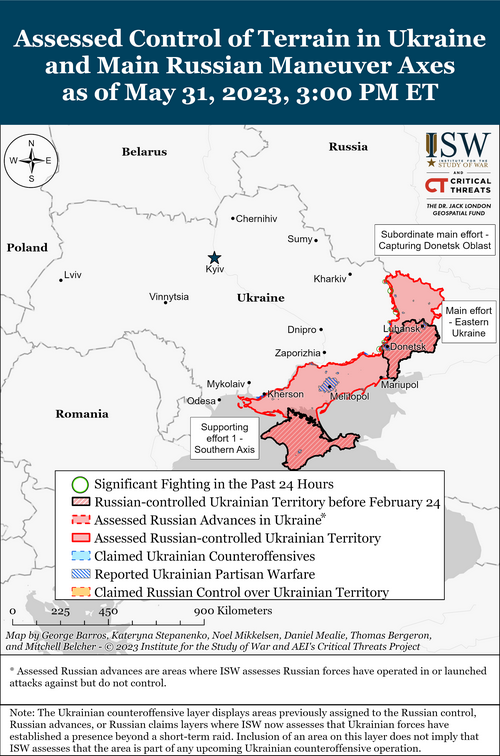
Click here to see ISW’s interactive map of the Russian invasion of Ukraine. This map is updated daily alongside the static maps present in this report.
Click here to access ISW’s archive of interactive time-lapse maps of the Russian invasion of Ukraine. These maps complement the static control-of-terrain map that ISW produces daily by showing a dynamic frontline. ISW will update this time-lapse map archive monthly.
Note: The data cutoff for this product was 1pm ET on May 31. ISW will cover subsequent reports in the June 1 Russian Offensive Campaign Assessment.
The Russian military command has likely ordered Chechen Republic Head Ramzan Kadyrov’s forces to begin offensive operations in Ukraine following the withdrawal of Wagner Group forces from Bakhmut. Kadyrov claimed on May 31 that Chechen forces received a new order and assumed responsibility over the Donetsk Oblast frontline.[1] Kadyrov claimed that Chechen units need to start “active combat activities” and “liberate a series of settlements.” Kadyrov added that Chechen “Akhmat” Special Forces (Spetsnaz) and the “Sever-Akhmat” Special Purpose Regiment transferred to the Marinka direction southwest of Donetsk City. The Russian Ministry of Defense (MoD) also claimed that assault detachments of the 5th Separate Motorized Rifle Brigade of the 1st Army Corps and Akhmat Spetsnaz conducted offensive operations in the Marinka direction.[2] Kadyrov noted that the Russian military command ordered Russian, Rosgvardia (Russian National Guard), and Chechen Akhmat forces to begin offensive actions along the frontline in Zaporizhia and Kherson oblasts as well.[3] Kadyrov claimed that these units have already begun tactical preparations for these offensive actions and claimed that “Akhmat” units’ offensive operations began before Ukrainian forces launched a counteroffensive. ISW has observed no indications of Chechen offensive operations in Zaporizhia or Kherson as of this writing.
The claimed return of Chechen forces to offensive operations would break Kadyrovites from a nearly yearlong hiatus from participating in high-intensity combat operations. Chechen forces have been largely operating in the rear after participating in the battles for Mariupol, Severodonetsk, and Lysychansk – with the exception of some offensive activities around Bilohorivka, Luhansk Oblast.[4] ISW also observed Kadyrov’s forces operating as a police force in the rear in southern Ukraine and performing localized reconnaissance-in-force operations in Zaporizhia Oblast.[5] Kadyrov also claimed that 3,300 personnel of the “Sever-Akhmat” Regiment were in Chechnya as of May 8, and ISW assessed that Kadyrov may have been conserving his forces instead sending them to the frontlines.[6] Chechen units’ limited participation on the frontlines alongside Kadyrov’s heavy emphasis on recruitment may suggest that Kadyrov is hesitant to commit his forces to grinding offensive operations in Ukraine despite his ultranationalist narratives.[7]
The Kremlin may be attempting to reintroduce Kadyrovites as the main offensive force following the culmination of Wagner forces and their withdrawal from the frontlines. ISW had previously assessed that Russian President Vladimir Putin had been attempting to pressure Kadyrov into increasing the role of Chechen fighters in combat operations since at least Putin’s public meeting with Kadyrov on March 13.[8] Kadyrov also claimed on May 20 to have met with Putin in Pyatigorsk, Stavropol Krai, around the time of Wagner Group’s claimed victory in Bakhmut.[9] The Kremlin did not publish a readout from this meeting, and Kadyrov claimed that he boasted to Putin that there are seven Chechen regiments and four battalions operating in Ukraine.[10] Kadyrov later clarified on May 26 that there are 7,000 Chechen personnel in Ukraine.[11] The Russian MoD’s mention of “Akhmat” operations in the Marinka direction a day prior to Wagner’s initial claimed withdrawal date on June 1 indicates that Putin may have coerced Kadyrov into assuming an offensive role in the war to compensate for Wagner’s likely culmination.[12] The Kremlin may perceive Chechen units as an untapped assault force that can restore Russia’s ability to sustain simultaneous offensive efforts on multiple axes of advance. If Kadyrov’s claims that he has 7,000 troops in Ukraine are close to accurate his forces will not be able to mount multiple significant offensive operations successfully.
The Kremlin may also be attempting to sever Kadyrov’s relationship with Wagner Group financier Yevgeny Prigozhin and re-emphasize federal authority over Chechen forces. Prigozhin responded on May 31 to reports of Chechen forces transferring to occupied Donetsk Oblast, stating that he is confident that Kadyrov’s forces will be successful in capturing some settlements in the region but emphasized that Kadyrov was not tasked with capturing the entirety of Donetsk Oblast.[13] Prigozhin also noted that he is not aware of Chechen units’ new positions as this information is secret. Kadyrov participated in Prigozhin’s blackmail attempt in early May aimed at coercing the Russian MoD to allocate additional military supplies to Wagner in Bakhmut.[14] Kadyrov claimed that his forces would relieve Wagner forces on May 6 and even directly asked Putin to authorize the transfer of Chechen forces from other directions to Bakhmut.[15] Putin may have perceived Kadyrov’s behavior as a threat to his control given that Kadyrov and Prigozhin had conducted a successful joint information campaign in early October 2022 to facilitate military command changes.[16] Putin or the Russian military command may have ordered Kadyrov to increase the presence of his units on the battlefield in retaliation for Kadyrov’s blackmail attempt.
The official Russian responses to recent attacks against Russia remain likely insufficient to satisfy the Russian ultranationalist information space’s desire for escalation in the war. Belgorod Oblast Governor Vyacheslav Gladkov called on Russian forces on May 29 to capture Kharkiv City and Kharkiv Oblast to create a barrier between Belgorod Oblast and Ukraine.[17] Gladkov later announced on May 31 the evacuation of children from the border areas of Shebekino and Grayvoron raions — including 300 children relocated to Voronezh Oblast — in response to the “deteriorating” border situation.[18] Kremlin Spokesperson Dmitry Peskov refused to comment on Gladkov’s statements on May 29, igniting some ire in the Russian information space.[19] Former Russian officer and ardent nationalist Igor Girkin criticized Peskov, Russian President Vladimir Putin, and Russian Defense Minister Sergei Shoigu for their reluctance to address attacks against Russian territory.[20] Russian milbloggers have complained about the lack of Russian military escalation to secure border areas in Belgorod and Kursk oblasts since at least September 2022, often criticizing the Kremlin for underreacting to attacks against Russian territory and failing to fully dedicate itself to the war effort.[21] The evacuations and Peskov’s comments are largely consistent with Putin’s unwillingness and inability to meaningfully escalate the war short of full-scale general and economic mobilization, as ISW has previously assessed.[22]
Key Takeaways
- The Russian military command has likely ordered Chechen Republic Head Ramzan Kadyrov’s forces to begin offensive operations in Ukraine following the withdrawal of Wagner Group forces from Bakhmut.
- The claimed return of Chechen forces to offensive operations would break Kadyrovites from a nearly yearlong hiatus from participating in high-intensity combat operations.
- The Kremlin may be attempting to reintroduce Kadyrovites as the main offensive force following the culmination of Wagner forces and their withdrawal from the frontlines.
- The Kremlin may also be attempting to sever Kadyrov’s relationship with Wagner financier Yevgeny Prigozhin and re-emphasize federal authority over Chechen forces.
- The official Russian responses to recent attacks against Russia remain likely insufficient to satisfy the Russian ultranationalist information space’s desire for escalation in the war.
- Russian forces conducted ground attacks northwest of Svatove and south of Kreminna.
- Russian forces conducted limited ground attacks around Bakhmut and along the Avdiivka-Donetsk City line.
- Russian forces continue to concentrate in southern Ukraine.
- The Russian State Duma appears to be considering measures to legalize the military recruitment of current or formerly incarcerated Russian men.
- Ukrainian Verkhovna Rada Human Rights Commissioner Dmytro Lyubinets announced that Ukraine has a new avenue to repatriate Ukrainian children abducted to Russia.
Go here to read the rest. I suspect that the Ukrainian air attack on Moscow was a deliberate provocation to draw out Russian forces in Ukraine just prior to the Ukrainian offensive.

