

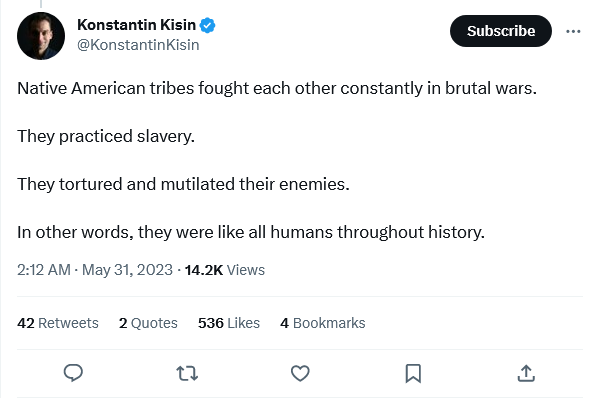
Studying the history of Indian tribes is a fascinating and complicated undertaking. They were stone age cultures, except for the great meso-American empires and the Incas in South America, who suddenly found themselves confronting much more highly advanced cultures from beyond the great Eastern sea. Under these bizarre circumstances they did their best to adapt and to learn and hold on to their ways of life as long as they could. It is no surprise that their efforts largely failed, but rather the surprise is that they held out as long as they did, and that they often succeeded in passing down their history and ways to their descendants. Painting them as merely noble victims, sticks to belabor Western Civilization by 21rst century activists, is an insult to history and to them.





The study of the Indian tribes is largely a subject within anthropology, not history. The historical portion thereof prior to a certain date was derived from their interaction with non-Indians.
Discussion of the Indians, like discussion of the blacks, is an instrument of a certain type of bourgeois whose angle is trashing the 12 generations who built this country and built Canada. See the work of Keith Windschuttle on what sort of fabrications their counterparts in Australia have been up to. By and large, our chattering classes are bad people.
The study of the Indian tribes is largely a subject within anthropology, not history.
Which I avoid like the plague since anthropology is often poorly conducted. Margaret Mead is a prime example of this. For the tribes that inhabited the US, the studies of their histories becomes possible mostly over the last three or so centuries, dependent upon when they came into steady contact with Europeans.
Speaking of Margaret Meade, my favorite observation of hers was pretty much this: “Never let women go into war, they are far too vicious.”
Which I avoid like the plague since anthropology is often poorly conducted. Margaret Mead is a prime example of this.
Don’t think Mead ever did much in the realm of archaeology or physical anthropology. A cultural anthropologist of my acquaintance told me Mead acknowledged that her work in Samoa in the 1920s was largely bollocks, but she did this in professional meetings and her ackowledgement was implicit rather than explicit. Derek Freeman was eventually able to inspect her raw field notes in archives and concluded she was on the level but insufficiently skilled to be doing what she was attempting to do in Samoa. (One element of Freeman’s thesis is that her informants were amusing themselves conning her).
Mead’s acolyte was Colin Turnbull (who savaged Freeman in print in 1983). There’s a satisfactory thesis that large swaths of his writing were nonsense and self-conscious nonsense.
As far as I can tell, cultural anthropology has responded to the decline in the number of appropriate research subjects by raiding the territory of sociology. Also, both sociology and cultural anthropology are so monochromatic they’re functionally apologetical disciplines.
Back in 1976, two years before her death, I attended a lecture by Mead at the U of I. She rightfully began yelling at students for taking the seats at the end of rows and forcing late comers to crawl over them. She said it was enough to make her lose hope in humanity. 47 years later that is all I can recall of her lecture, but it made a good impression on me.
Would that Mead’s admonitions to her audience were read before every Mass! Been a gripe of mine for years.
Cannibalism and enslavement may be a culture but it is not civilization. There is proof of human sacrifice in the Andes mountains of Chile. Civilization is respect for all persons’ civil rights
Many decades ago, I attended an exhibition at the National Gallery of Art which displayed European, Eastern, and tribal American art from about 1492. It was almost an insult presenting the three collections next to each other. The West was finishing the greatest century in history, and the East has never lacked beautiful and detailed artwork. The tribal art was comparable to any other tribe. More ingenuity and better stonework than I could ever do, but…think who you were competing against in Europe at the time.
Mary:
Civilization means organized urban life and writing. Nothing to do with morals (until the Victorians).
See the work of Keith Windschuttle well yes. But what else would you expect the left to use to distract from their lack of government policy except to constantly bemoan the nations so-called inadequacy and perpetual grovelling to the “crimes” we as a nation committed against the indigenous peoples? And now they are forcing a push to support a referendum on the Australian people for an Indigenous Voice to parliament. The left are jumping on anyone opposing it in the media- especially the Indigenous critics of the Voice. See what Warren Mundine (an Aboriginal leader has to say):
https://amp.smh.com.au/national/the-voice-as-proposed-is-flawed-and-insulting-to-first-nations-20230418-p5d1g3.html
The same personalities that loudly proclaimed “all darker persons are bad”, are alive and well today with the same ugly motivations.
(Only “white is bad”; power over others is still their goal.)
Funny, in high school and college (1980s), a common theme in various social studies courses I took was ‘sure the West was a net positive for the world, but in the end we were as capable of doing bad as everyone else.’ Now we see it said ‘sure, but they were sometimes as bad as us.’ Lots of big changes in thinking in that little switch around.
What really gets me is, even after 1492 when everyone knew America wasn’t India nobody said: “Chris, we really need to stop calling these people, Indians.”