
From The Institute For The Study of War:
Russian Offensive Campaign Assessment, May 20, 2023
Kateryna Stepanenko, Riley Bailey, Grace Mappes, George Barros, and Frederick W. Kagan
May 20, 2023, 5:45pm ET
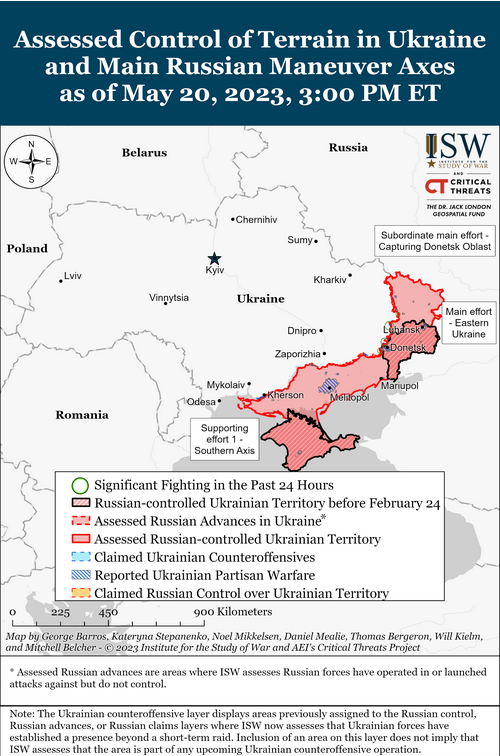
Click here to see ISW’s interactive map of the Russian invasion of Ukraine. This map is updated daily alongside the static maps present in this report.
Click here to access ISW’s archive of interactive time-lapse maps of the Russian invasion of Ukraine. These maps complement the static control-of-terrain map that ISW produces daily by showing a dynamic frontline. ISW will update this time-lapse map archive monthly.
Note: The data cutoff for this product was 12pm ET on May 20. ISW will cover subsequent reports in the May 21 Russian Offensive Campaign Assessment.
Wagner Group financier Yevgeny Prigozhin declared victory in Bakhmut City on May 20 and announced his intent to withdraw from the city on May 25.[1] Prigozhin claimed that Wagner Group forces completely captured Bakhmut City on May 20, seizing the last multi-story apartment building in southwestern Bakhmut near the MiG-17 monument. Prigozhin announced that Wagner forces will establish defensive positions before transferring responsibility for the city to Russian conventional forces on May 25. Prigozhin effectively stated that Wagner forces will conduct an operational pause by resting and restoring combat power at field training camps in unspecified areas, presumably far from the frontline. ISW has not observed geolocated footage confirming Prigozhin’s claims as of this publication. Ukrainian officials reported that Ukrainian forces are still fighting in a small section of southwest Bakhmut as of May 20. Ukrainian Deputy Defense Minister Hanna Malyar stated that Ukrainian forces continue to hold positions near the MiG-17 monument as of May 20.[2] The Russian Ministry of Defense (MoD) has not commented on Prigozhin’s claims as of this publication.
Prigozhin’s claimed victory over the remaining areas in Bakhmut is purely symbolic even if true. The last few urban blocks of eastern Bakhmut that Prigozhin claimed that Wagner Group forces captured are not tactically or operationally significant. Their capture does not grant Russian forces operationally significant terrain to continue conducting offensive operations or any particularly strong position from which to defend against possible Ukrainian counterattacks.
Ukrainian forces continue pressuring Bakhmut’s northern and southern flanks. Ukrainian and Russian sources reported that fighting is ongoing on Bakhmut’s northern and southern flanks in the directions of Ivanivske (6km west of Bakhmut), Stupochky (13km southwest of Bakhmut), and Bila Hora (12km southwest of Bakhmut).[3] Ukrainian forces reported on May 19 that they have recaptured approximately four square kilometers of additional territory near Bakhmut, and Russian sources claimed that Ukrainian forces continue conducting localized attacks near Klishchiivka (6km southwest of Bakhmut).[4] Prigozhin’s claimed capture of the remaining blocks in Bakhmut is not strategically significant as it will not allow exhausted Wagner or conventional Russian forces to establish a meaningful springboard for further offensive operations. Ukrainian ongoing counterattacks north, west, and southwest of Bakhmut will complicate any further Russian advances beyond Bakhmut in the near term. Prigozhin’s withdrawal announcement, whether Wagner withdraws from the city or not, indicates that Prigozhin does not intend to continue an offensive effort to push directly west of Bakhmut.
Wagner forces are unlikely to successfully conduct a controlled withdrawal from Bakhmut while in contact with Ukrainian forces within five days without disrupting the Russian MoD’s efforts to prepare for planned Ukrainian counteroffensives. Wagner forces are unlikely to establish adequate defenses or consolidate recent gains in Bakhmut sufficient to forestall Ukrainian counterattacks by May 25 even if Prigozhin’s announcement of Wagner’s withdrawal is true. Ukrainian forces are still in Khromove and Ivanivske and are engaging Russian forces in and near Bakhmut. Ukrainian artillery can still target Russian forces in and around Bakhmut. Withdrawal in contact with the enemy is an exceedingly difficult task that the Wagner Group’s forces are unlikely to perform well within Prigozhin’s five-day time frame. Conducting a relief-in-place while in contact is also an extremely challenging maneuver that Russian forces would likely struggle to conduct even if the Russian MoD agrees to undertake it. Wagner units have shown poor coordination with Russian conventional forces, other irregular formations subordinated to the Russian MoD, and the Russian military command—factors that would hinder a smooth relief-in-place operation.[5] The Russian military command is unlikely to generate sufficient forces to relieve Wagner in Bakhmut and hold its flanks within the window Prigozhin has announced without redeploying Russian forces from other areas. Prigozhin’s statement of his intent to withdraw could be a crude attempt to mislead Ukrainian forces into conducting a counterattack through Bakhmut City.
Russian conventional forces likely will still need to transfer additional forces to the Bakhmut direction even if Wagner mercenaries remain in Bakhmut. Ukrainian Eastern Group of Forces Spokesperson Colonel Serhiy Cherevaty stated that Russian forces continue to transfer airborne, motorized rifle, and special forces elements to reinforce the Bakhmut flanks even as Wagner forces remain in Bakhmut City.[6] The UK MoD also reported that the Russian military command likely redeployed several battalions in the last few days to reinforce Bakhmut despite only having few uncommitted combat units and that this redeployment suggests a substantial commitment to the Bakhmut effort by the Russian leadership.[7] These additional forces could in principle be meant to participate in the relief-in-place of Wagner forces that Prigozhin has just announced, reducing but not eliminating some of the challenges considered above, but it is more likely that they are intended to secure Bakhmut’s threatened flanks.
Russian forces targeted Kyiv Oblast with Iranian-made Shahed drones on the night of May 19 to 20. The Ukrainian General Staff reported that Russian forces launched 18 Shahed-136/131 drones at Kyiv Oblast, and that Ukrainian air defenses shot down all 18 of the drones.[8] The Ukrainian General Staff also reported that Ukrainian forces destroyed two Russian Shahed drones in eastern Ukraine.[9] Russian forces have targeted Kyiv heavily in the past month, likely to produce informational affects with both Russian and Ukrainian audiences. This hyperfocus on targeting Kyiv is at odds with the new limited Russian air campaign’s other target: alleged Ukrainian rear logistics.[10] These conflicting target sets likely further limit the campaign’s ability to degrade Ukrainian counteroffensive capabilities in the near term.[11]
US National Security Advisor Jake Sullivan stated on May 20 that the United States may agree to transfer modern combat aircraft to Ukraine, including the F-16, on the condition that Ukraine does not use them to strike Russian territory. Sullivan stated the war in Ukraine has “evolved” and that F-16 fourth-generation fighter aircraft have now become “part of that mix” of weapons that Ukraine will need as part of a “future force to be able to deter and defend against Russian aggression as we go forward.”[12] Sullivan stated that any F-16s given to Ukraine – like other Western weapons provided to Ukraine – will be provided under the condition that they do not strike Russian territory.[13] Sullivan also stated that training Ukrainian pilots to use F-16s is the “obvious first step” and that the next steps are to “determine how to do the actual provision of planes.”[14] US President Joe Biden informed G7 leaders on May 19 that Washington will support a joint effort to train Ukrainian pilots on F-16s and other fourth generation aircraft but did not pledge that the US will send Ukraine the F-16s.[15]
Ukrainian Deputy Defense Minister Hanna Malyar reported that Russian sources are falsely alleging that high-ranking Ukrainian military commanders have recently died, likely to demoralize the Ukrainian forces and to portray Russian forces as constraining Ukrainian counteroffensive capabilities. Malyar stated that these information operations allege that Russian strikes have recently killed Ukrainian Territorial Defense Forces Commander General Ihor Tantsyura, Ukrainian Eastern Grouping of Forces Commander Colonel General Oleksandr Syrskyi, and Ukrainian Commander in Chief General Valeriy Zaluzhnyi.[16] Prigozhin also amplified the information operation alleging that Zaluzhnyi might be dead on May 20.[17] These information operations are particularly absurd given that Zaluzhnyi spoke with US Chairman of the Joint Chiefs of Staff General Mark Milley on May 19 and that Syrskyi appeared on Ukrainian television on May 16.[18] Ukrainian officials have denied previous Russian claims that a May 10 strike on a Ukrainian command post in the Bakhmut area killed several high-ranking Ukrainian military officials and that Wagner forces killed Tantsyura while he was en route to Bakhmut on May 2.[19] ISW has previously assessed that Russian ultranationalists are increasingly seeking to frame any Russian operations as delaying potential Ukrainian counteroffensive actions.[20]
Key Takeaways
- Wagner Group financier Yevgeny Prigozhin declared victory in Bakhmut City on May 20 and announced his intent to withdraw from the city on May 25.
- Prigozhin’s claimed victory over the remaining areas in Bakhmut is purely symbolic even if true.
- Ukrainian forces continue pressuring Bakhmut’s northern and southern flanks.
- Wagner forces are unlikely to successfully conduct a controlled withdrawal from Bakhmut while in contact with Ukrainian forces within five days without disrupting the Russian MoD’s efforts to prepare for planned Ukrainian counteroffensives.
- Russian conventional forces likely will still need to transfer additional forces to the Bakhmut direction even if Wagner mercenaries remain in Bakhmut.
- Russian forces targeted Kyiv Oblast with Iranian-made Shahed drones on the night of May 19 to 20.
- US National Security Advisor Jake Sullivan stated on May 20 that the United States may agree to transfer modern combat aircraft to Ukraine, including the F-16, on the condition that Ukraine does not use them to strike Russian territory.
- Ukrainian Deputy Defense Minister Hanna Malyar reported that Russian sources are falsely alleging that high-ranking Ukrainian military commanders have recently died, likely to demoralize Ukrainian forces and to portray Russian forces as constraining Ukrainian counteroffensive capabilities.
- Russian forces continued limited ground attacks in the Kreminna area.
- Russian forces continued to conduct ground attacks on the Avdiivka-Donetsk City line.
- The Washington Post reported on May 19 that a Ukrainian commander stated that Ukrainian Special Operations forces conduct raids in east (left) bank Kherson Oblast but that Ukrainian forces do not hold stable positions there.
- The Russian Ministry of Defense (MoD) is incorporating mobilized and conscripted personnel into its own “Veterany” private military company (PMC), leading to discrimination and conflict.
- A Lithuanian official publicly accused Russia of attempting to hold international children hostage in occupied Crimea as “human shields” against a future Ukrainian counteroffensive.
Go here to read the rest. Now we will see if the Russians attempt to hold Bakhmut and be encircled, or if they begin a rapid withdrawal. I am betting on the latter.

