
From The Institute For The Study of War:
Russian Offensive Campaign Assessment, May 18, 2023
Grace Mappes, Kateryna Stepanenko, Nicole Wolkov, Layne Philipson, and Frederick W. Kagan
May 18, 2023, 7:30pm ET
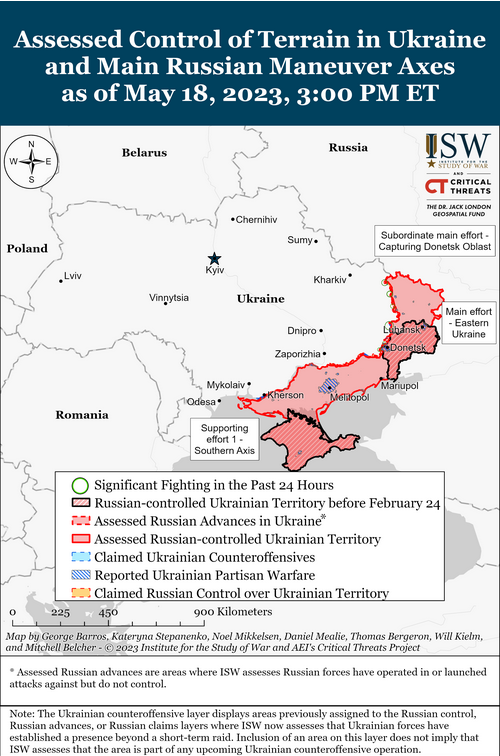
Click here to see ISW’s interactive map of the Russian invasion of Ukraine. This map is updated daily alongside the static maps present in this report.
Click here to access ISW’s archive of interactive time-lapse maps of the Russian invasion of Ukraine. These maps complement the static control-of-terrain map that ISW produces daily by showing a dynamic frontline. ISW will update this time-lapse map archive monthly.
Note: The data cutoff for this product was 3pm ET on May 18. ISW will cover subsequent reports in the May 19 Russian Offensive Campaign Assessment.
Ukrainian forces have seized the tactical initiative and made tactically significant gains around Bakhmut in counter-attack operations on May 18. These operations are a continuation of the localized counter-attacks Ukrainian forces have been conducting for some days and do not reflect the start of a major new operation. Multiple Russian milbloggers claimed that Ukrainian forces drove through the Russian defensive lines south and southwest of Ivanivske (6km west of Bakhmut) and northwest of Klishchiivka (6km southwest of Bakhmut) from the northwest.[1] The milbloggers also claimed that Russian forces retreated from positions north of Sakko i Vantsetti (15km north of Bakhmut) to positions south of the settlement, but that Ukrainian forces have not yet entered the settlement. Wagner Group financier Yevgeny Prigozhin claimed that Russian forces yielded 570 meters of territory north of Bakhmut, which is consistent with Ukrainian Deputy Defense Minister Hanna Malyar’s statement that Ukrainian forces had advanced 500 meters north of Bakhmut and 1,000 meters south of Bakhmut.[2] Ukrainian Eastern Forces Spokesperson Colonel Serhiy Cherevaty stated that Ukrainian forces advanced up to 1,700 meters in the past day, and the Ukrainian 3rd Separate Assault Brigade stated that the brigade’s counterattacks expanded the Ukrainian salient in the Bakhmut area to 2,000 meters wide by 700 meters deep.[3]
Ukrainian officials indicated that Ukrainian forces have seized the battlefield initiative in the Bakhmut area. Cherevaty stated on May 18 that Ukrainian forces regained the battlefield initiative and are forcing Russian forces to respond to Ukrainian actions, including by transferring Russian Airborne (VDV) elements to Bakhmut’s flanks to defend against the Ukrainian advances.[4] Malyar stated that Russian forces have deployed most of their reserves to the Bakhmut area, very likely to the detriment of other areas of the frontline.[5] ISW recently assessed that the Russian military command is reallocating military assets to the Bakhmut area in order to augment Wagner’s offensive capabilities and to gain a tactical victory ahead of a Ukrainian counteroffensive.[6] The limited nature of Wagner’s offensive operations in Bakhmut compared to the localized Ukrainian counterattacks underscores the loss of Russian initiative in the area. Russian milbloggers claimed that Wagner forces began assaulting one of the final Ukrainian fortified areas in western Bakhmut.[7] Zaporizhia Oblast occupation official and prominent Russian information space voice Vladimir Rogov claimed that Wagner forces cut the Bakhmut-Chasiv Yar road in western Bakhmut on May 17, although ISW is unable to confirm this claim.[8] Prigozhin claimed that Wagner forces advanced 260 meters in Bakhmut and that Ukrainian forces only control 1.28 square kilometers of the city.[9] One milblogger optimistically claimed that Wagner forces increased their pace of advance following Russian ammunition deliveries to Wagner, though Prigozhin’s claimed daily rate of advance has remained largely consistent.[10]
Wagner Group financier Yevgeny Prigozhin admitted on May 18 that Wagner mercenaries are unable to encircle the Ukrainian forces in Bakhmut due to the loss of stable flanks north and south of Bakhmut. Prigozhin accused the Russian Ministry of Defense (MoD) of losing advantageous positions after MoD-subordinated units retreated from their positions on Bakhmut’s flanks necessary for an encirclement.[11] Prigozhin and Wagner sources have long indicated Wagner’s intent to encircle Bakhmut and trap Ukrainian forces but proved unable to do so after the Ukrainian military command decided to defend the city. ISW had previously assessed that Russian forces were unlikely to encircle Bakhmut after Wagner forces made several rapid breakthroughs north, south, and east of the city in winter-spring 2023.[12] Prigozhin likely anticipated that Ukrainian forces would entirely withdraw from Bakhmut out of fear of imminent encirclement and even offered to allow President Volodymyr Zelensky to withdraw Ukrainian forces from the city on March 3.[13] The Ukrainian defensive operation, however, prioritized the defense of the Ukrainian ground lines of communication (GLOCs) west of Bakhmut, which forced Wagner forces into urban warfare and grinding directly through the city itself. Prigozhin’s admission further supports Ukrainian officials’ statements that Wagner is losing the initiative on the battlefield.
Prigozhin and Wagner-affiliated milbloggers are blaming Russian conventional forces for military failures in and around Bakhmut. Prigozhin directly appealed to Russian Defense Minister Sergei Shoigu and Chief of the Russian General Staff Army General Valery Gerasimov to hold Sakko i Vantsetti for at least few more days.[14] Prigozhin also blamed Gerasimov for the retreats of Russian conventional forces from Bakhmut‘s flanks.[15] A prominent Wagner-affiliated milblogger stated on May 18 that Russian forces lack the organization, fire support, coordination, and training necessary to defend the Bakhmut’s flanks.[16] The milblogger complained that Russian forces allow Ukrainian forces to “drive a BMP [infantry fighting vehicle] for 15 minutes” into the Russian rear without destroying it, with the Ukrainian assault lasting only 16 minutes.[17] The milblogger claimed that Russian forces would not be able to drive an infantry fighting vehicle into the Ukrainian rear without Ukrainian forces destroying it.[18] The milblogger also claimed that Russian airborne forces attempted to occupy territory in the “grey zone” and Ukrainian forces immediately interdicted their efforts with artillery fire, making it impossible for Russian forces to move and gain a foothold in the targeted location.[19] A non-Wagner-affiliated milblogger noted the lack of coordination between Wagner and conventional Russian forces and claimed that the Russian Ministry of Defense (MoD) needs ”competent command and control” to strengthen interactions between Russian forces and Wagner fighters for operations after Bakhmut.[20]
Prigozhin’s efforts to blame the Russian military for failures around Bakhmut are causing some ultranationalists to accuse him of using the Battle for Bakhmut to satisfy his personal ambitions. Russian serviceman and prominent ultranationalist Andrey Morozov (known under the alias Murz) criticized a Wagner-affiliated Telegram channel for wrongfully attributing successful artillery fire of the 4th Separate Motorized Rifle Brigade of the 2nd Army Corps to Wagner mercenaries.[21] Morozov argued that Prigozhin’s claims that Russian conventional forces are abandoning the flanks is another part of Prigozhin’s narratives aimed at saving his forces at the expense of other units that deployed to reinforce Wagner forces. Morozov accused Prigozhin of improving his financial standing at the expense of the war while setting up reinforcement units for failure and claimed that elements of 4th Separate Motorized Rifle Brigade nearly all died when attempting to secure the flanks southwest of Bakhmut near Klishchiivka. Morozov also claimed that Prigozhin is blaming conventional units in order to promote himself. ISW assessed on May 17 that Russian strongmen (siloviki) are attempting to discredit Prigozhin by accusing him of attempting to use victory in Bakhmut to further his political aspirations in Russia.[22] Morozov’s criticism is notable as it may indicate a shift in ultranationalists’ perception of Prigozhin.
Russian forces conducted another large-scale missile strike across Ukraine on the night of May 17 to 18, targeting Kyiv for the ninth time since the beginning of May.[23] Ukrainian officials reported that Russian forces launched 22 Kh-101/555 air-launched cruise missiles, six Kalibr sea-launched cruise missiles from Black Sea vessels, and two Iskander-K ground-launched cruise missiles at Kyiv, Odesa, and Mykolaiv cities.[24] Ukrainian Commander in Chief General Valeriy Zaluzhnyi reported that Ukrainian forces destroyed 29 cruise missiles, two Shahed-136/131 drones, and two reconnaissance drones.[25] Russian forces are likely attempting to use reconnaissance drones after launching missile strikes to locate Patriot air defense systems.
The Kremlin continues to strengthen domestic repression measures likely to encourage self-censorship and prepare Russian society for a prolonged war. Russian President Vladimir Putin signed a decree on May 17 amending the Russian Federal Security Service (FSB) Regulations to expand the responsibility and reach of the FSB.[26] The amendment explicitly states that the FSB is responsible for state security issues within its powers, strengthens the FSB and its director’s powers in matters of information security. This allows the FSB head to determine the conditions for FSB personnel combining FSB work and military service. These amendments are likely part of a prolonged effort to expand the FSB’s domestic power, and ISW has previously reported on the FSB expanding its powers and involvement in the war in Ukraine.[27] Russian opposition news outlet Meduza reported on May 18 that Russian authorities conducted mass searches of residences of individuals allegedly associated with the Congress of People’s Deputies and former Russian State Duma Deputy Ilya Ponomarev under the accusation of spreading false information about the Russian military.[28] Russian opposition outlet Verstka reported on May 18 that the Liberal Democratic Party (LDPR) Russian State Duma deputies are preparing a bill to punish “Russophobia” with fines of 100,000 to 300,000 rubles (about $1,250 to $3,730), and up to five years in prison, or service in a forced labor colony.[29] ISW previously reported on Russian efforts to criminalize “Russophobia” as another method of domestic repression and censorship.[30]
NATO Secretary General Jens Stoltenberg stated that NATO may discuss the possible provision of Western fighter jets to Ukraine at the June Defense Ministers meeting.[31] Stoltenberg told German outlet Der Spiegel on May 18 that NATO members are “constantly discussing whether modern Western fighters are needed in both Europe and Ukraine,” adding that the provision of fighter jets to Ukraine will also require ammunition, spare parts, and “round-the-clock” aircraft maintenance.[32]
Key Takeaways
- Ukrainian forces have seized the tactical initiative and made tactically significant gains around Bakhmut in counter-attack operations on May 18.
- Ukrainian officials indicated that Ukrainian forces have seized the battlefield initiative in the Bakhmut area.
- Wagner Group financier Yevgeny Prigozhin admitted on May 18 that Wagner mercenaries are unable to encircle the Ukrainian forces in Bakhmut due to the loss of stable flanks north and south of Bakhmut.
- Prigozhin and Wagner-affiliated milbloggers are blaming Russian conventional forces for military failures in and around Bakhmut.
- Prigozhin’s efforts to blame the Russian military for failures around Bakhmut are causing some ultranationalists to accuse him of using the Battle for Bakhmut to satisfy his personal ambitions.
- Russian forces conducted another large-scale missile strike across Ukraine on the night of May 17 to 18, targeting Kyiv for the ninth time since the beginning of May.
- The Kremlin continues to strengthen domestic repression measures likely to encourage self-censorship and prepare Russian society for a prolonged war.
- NATO Secretary General Jens Stoltenberg stated that NATO may discuss the possible provision of Western fighter jets to Ukraine at the June Defense Ministers meeting.
- Russian forces conducted limited ground attacks northeast of Kupyansk and along the Svatove-Kreminna line.
- Russian forces conducted limited ground attacks on the Avdiivka-Donetsk City line.
- Unknown actors, possibly Ukrainian partisans, attacked a Russian rail line in Crimea.
- The Russian Supreme Court ruled on May 18 that Russian military personnel who voluntarily surrender on the battlefield will be prosecuted under treason charges.
- Russian occupation authorities continue to announce patronage programs with Russian federal subjects to support infrastructure projects in occupied territories.
Go here to read the rest. The fact that the Ukrainians have seized the initiative around Bakhmut, where the Russians have been massing units, is bad news for the Russians to hold ground against the Ukrainian offensive.

