
From The Institute For The Study of War:
Russian Offensive Campaign Assessment, April 28, 2023
Karolina Hird, Riley Bailey, Grace Mappes, George Barros, Layne Philipson, and Frederick W. Kagan
April 28, 5pm ET
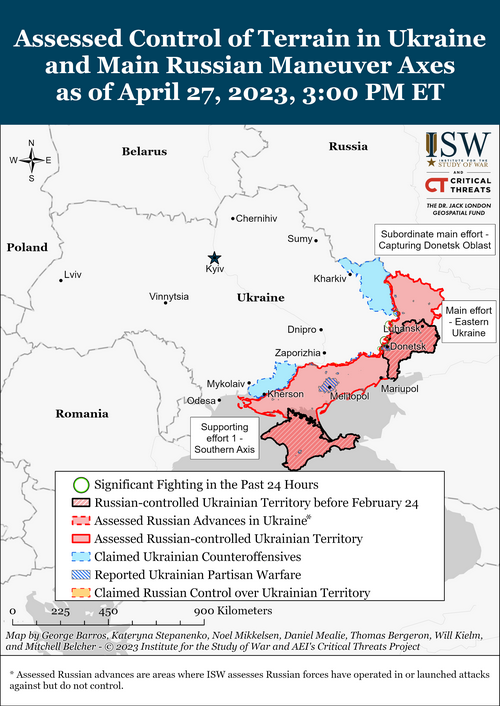
Click here to see ISW’s interactive map of the Russian invasion of Ukraine. This map is updated daily alongside the static maps present in this report.
Click here to access ISW’s archive of interactive time-lapse maps of the Russian invasion of Ukraine. These maps complement the static control-of-terrain map that ISW produces daily by showing a dynamic frontline. ISW will update this time-lapse map archive monthly.
Russian forces launched a series of missile strikes against rear areas of Ukraine on the night of April 27. Ukrainian military sources confirmed that Russian forces launched 23 Kh-101/Kh-555 missiles from Tu-95 aircraft over the Caspian Sea and struck civilian infrastructure in Uman, Cherkasy Oblast; Dnipro City; and Ukrainka, Kyiv Oblast.[1] The Ukrainian Air Force reported that Ukrainian air defense shot down 21 of 23 missiles and two UAVs.[2] The Russian Ministry of Defense (MoD) acknowledged the strike and claimed that the Russian aerospace forces conducted a coordinated missile strike against Ukrainian reserve deployment points and struck all intended targets.[3] Geolocated footage shows large-scale damage to a residential building in Uman, with the death toll reaching 20 civilians, including children, as of 1700 local time on April 28.[4]
The Russian Ministry of Defense (MoD) confirmed the appointment of Vice Admiral Vladimir Vorobyov as the new commander of the Baltic Fleet on April 28 following the transfer of former Baltic Fleet Commander Admiral Viktor Liina to the Pacific Fleet. Russian state media reported that the Russian MoD introduced Vorobyov as the new Baltic Fleet commander thereby confirming that Liina replaced Admiral Sergei Avakyants as Pacific Fleet command.[5] ISW had previously reported that Liina may have been replacing Avakyants because of Pacific Fleet failures exposed during recent combat readiness exercises, and Russian officials claimed that Avakyants was moved to a new position as head of Russian military sports training and patriotic education centers after aging out of military service.[6] Vorobyov has previously served as Chief of Staff and First Deputy Commander of both the Baltic and Northern Fleets.[7]
Russian President Vladimir Putin signed a decree on April 27 codifying conditions for the further large-scale deportation to Russia of residents of occupied areas of Ukraine. Putin signed a decree entitled “On the Peculiarities of the Legal Status of Certain Categories of Foreign Citizens and Stateless Persons in the Russian Federation” that defines those who are living in Russian-occupied territories who have declared their desire to retain their current citizenship and refuse to accept Russian passports as “foreign citizens and stateless persons currently residing in the Russian Federation.”[8] The decree holds that such individuals may continue to reside in occupied territories until July 1, 2024, suggesting that these individuals may be subject to deportation following this date.[9] This decree codifies coercive methods to encourage residents of occupied areas to receive Russian passports and also sets conditions for the deportation of Ukrainians who do not agree to become Russian citizens. Russian authorities are also continuing other efforts to deport Ukrainians, particularly children, to Russia under various schemes.[10] ISW continues to assess that all lines of effort aimed at deporting Ukrainians to Russia may constitute a violation of the Geneva Convention on the Prevention and Punishment of the Crime of Genocide, as well as a potential deliberate ethnic cleansing campaign.
Russian Defense Minister Army General Sergei Shoigu promoted the Kremlin’s efforts to form a potential anti-Western coalition during a meeting of the defense ministers of Shanghai Cooperation Organization (SCO) member states in New Delhi, India. Shoigu stated on April 28 that the SCO meeting occurred against the backdrop of the establishment of a new multipolar world order, which the collective West is actively opposing.[11] Shoigu argued that the US and its allies are provoking conflicts with Russia and China and that the West is attempting to defeat Russia and threaten China through the war in Ukraine.[12] Shoigu invited SCO member states to participate in the 11th Moscow Conference of International Security and called on the SCO to develop a framework for exchanging military information, cooperation in joint military exercises, and the development of partnerships between the SCO and Russian-favored multilateral organizations such as the Commonwealth of Independent States (CIS) and the Collective Security Treaty Organization (CSTO).[13]
The Kremlin has previously identified multilateral organizations without significant Western participation as its preferred bodies for international decision making and will likely continue to use such bodies to promote Russian President Vladimir Putin’s envisioned geopolitical conflict with the West.[14] ISW assessed that Putin tried to use Chinese President Xi Jinping’s visit to Moscow from March 20 to 22 to promote the idea of an anti-Western Russian-Chinese-based geopolitical bloc, but that Xi rebuffed Putin’s rhetorical overtures.[15] The Kremlin is likely aware that the attractiveness of such a bloc lies more with China’s economic and political power than with Russia’s increasingly isolated economy and degraded military capacity, which is why it likely chose the Chinese-favored SCO to promote the idea of a potential anti-Western coalition. The Kremlin is also likely attempting to secure through multilateral engagement with China desired benefits of a Chinese-Russian bilateral relationship that Putin was unable to obtain in his meeting with Xi. The Kremlin’s attempts to use the SCO to support these efforts are unlikely to be more successful than its previous efforts to rally the rest of the world against the West and convince China that Russia is a reliable and equal security partner.
Head of the Kremlin-controlled Russian Orthodox Church Patriarch Kirill of Moscow defrocked a Russian Orthodox Church protodeacon who did not support Russia’s invasion of Ukraine. Russian Orthodox Protodeacon Andrei Kuraev posted an order dated April 28 defrocking him for “anti-church activities” signed by Patriarch Kirill.[16] The Russian Orthodox Church had previously defrocked Kuraev in December 2020, but Patriarch Kirill imposed a moratorium on the execution of this decision to give Kuraev time to “rethink his position.”[17] Kuraev reportedly does not support Russia’s invasion of Ukraine or the Russian Orthodox Church’s support for the invasion.[18] Russian authorities fined Kuraev 30,000 rubles for discrediting the Russian military in August 2022 after Kuraev wrote a blog post about the current war in Ukraine.[19] Radio Free Europe/Radio Liberty additionally reported that Kuraev has criticized the Russian Orthodox Church’s structures and Patriarch Kirill, accusing the Russian Orthodox Church of being distant from its parishioners, bureaucratic, and inert.[20] Kuraev’s defrocking supports ISW’s assessment that the Russian Orthodox Church is not an independent religious organization but rather an extension of the Russian state and an instrument of Russian state power.[21] Russian forces in Ukraine have reportedly gone out of their way to punish individual Russian Orthodox priests in Ukraine who were not fully cooperative with Russian military forces.[22]
Key Takeaways
- Russian forces launched a series of missile strikes against rear areas of Ukraine on the night of April 27.
- The Russian Ministry of Defense (MoD) confirmed the appointment of Vice Admiral Vladimir Vorobyov as the new commander of the Baltic Fleet following the transfer of former Baltic Fleet commander Admiral Viktor Liina to the Pacific Fleet.
- Russian President Vladimir Putin signed a decree codifying conditions for the further large-scale deportation of residents of occupied areas of Ukraine to Russia.
- Russian Defense Minister Army General Sergei Shoigu promoted the Kremlin’s efforts to form a potential anti-Western coalition during a meeting of the defense ministers of Shanghai Cooperation Organization (SCO) member states in New Delhi, India.
- Head of the Kremlin-controlled Russian Orthodox Church Patriarch Kirill of Moscow defrocked a Russian Orthodox Church protodeacon who did not support Russia’s invasion of Ukraine.
- Russian forces continued ground attacks near Kreminna and have made an incremental advance northwest of Kreminna as of April 28.
- Russian forces are increasing pressure against the T0504 Kostyantynivka-Chasiv Yar-Bakhmut highway.
- Russian forces continued routine indirect fire and defensive operations in southern Ukraine.
- Russian President Vladimir Putin tasked Russian officials with developing Russia’s domestic drone industry likely as part of the Kremlin’s effort to gradually mobilize Russia’s defense industrial base (DIB).
- Russian occupation authorities continue to announce patronage programs with Russian federal subjects.
From Strategy Page:
April 28, 2023: The Russian economy has not collapsed because of Western sanctions, but those have crippled production of tanks, war planes and all weapons and munitions in general. Russian GDP shrank by about five percent while the number of Russians living below the poverty line reached 60 percent. The government is managing this decline mostly by ensuring that no one starves to death and concentrating military mobilization efforts in regions with the largest number of military age men who are unemployed. These growing economic problems are accompanied by more corruption, especially by officials who distribute emergency aid and manage military mobilization efforts. Russia’s economic situation will grow worse if the Ukrainian offensive is successful and Russian forces have to be reinforced to avoid losing territory. While Putin has declared that Russia will never stop fighting to assert its claim on Ukraine, he has to pay attention to Russian public opinion towards the war. While it’s now a crime to criticize the war effort, there are no restrictions on complaining about unemployment, inflation, shortages and higher taxes (to pay for the war). Russian can no longer borrow money abroad and Russian banks already have too many outstanding loans to the government. While foreign banks will no longer provide loans, Russia is considering money offering Russian government debt to the commercial markets in friendly South American and Asian countries. The problem here is that local bankers will warn, or at least confirm to the public that these Russian bonds are very risky. Chinese banks, usually eager to invest in Russia, now consider Russia a toxic investment environment.
Russia has little economic support from anyone while Ukraine is backed by the NATO nations, which account for about half the world GDP. Putin is more frequently resorting to psychological warfare, trying to come up with something that will scare NATO into backing off on their support for Ukraine. Nothing seems to work for Putin and the sanctions have forced him to export oil via smuggling that led to huge discounts. For the second year in a row the Russian economy (GDP) is shrinking. At the same time Russian arms manufacturers are unable to fill many orders because sanctions have halted imports of key components. What can be delivered is more than the government can afford. There is a similar situation with paying the troops and providing needed bonuses to get volunteers and keep veterans in. Despite all this, Putin believes time is on his side and that NATO nations will tire of supporting Ukraine and Ukrainians will become less willing to fight if Putin waits long enough.
Russian Reality in Ukraine
Most recent Russian losses occurred in Donetsk province where Russian attacks on Bakhmut (for eight months) and Vuhledar (five months) have cost Russia 30,000 dead, hundreds of combat vehicles and several hundred thousand 152mm artillery shells. Most of the fighting and losses were in Bakhmut. Ukrainian losses were far less at about 5,000 dead. These heavy Russian losses and little territorial gain have further demoralized Russian troops so a growing number are refusing to go to Ukraine or fight if they do end up there. In past wars, soldiers who refused to fight could be killed by their officers to encourage the others. That doesn’t work anymore because the Russian troops are armed and see themselves trapped between two groups (Ukrainians and Russian officers) trying to kill them. Few veteran, pre-invasion Russian troops are in Ukraine. Most have been killed, disabled by wounds or quit the military. The “quit” option was recently outlawed and is applied to men “mobilized”, rather than conscripted, in the last year to serve a set term (six months or longer) in Ukraine. This process has now been automated using an electronic registry of all military age men. Mobilization notices are sent via the Internet and failure to comply is a criminal offense. This encouraged so many young Russians to get out of the country that Russian officials claim the economy is doing so well that there is a labor shortage.
Russian media is banned from reporting the heavy losses but Ukraine is not, and the interviews with Ukrainian troops or Russian soldiers captured in Ukraine are available to many Russians via the Internet or video recordings. To make matters worth, Ukrainian forces have prepared for another major offensive, which apparently has already started. This offensive is much larger than the one in mid-2022 that cleared the Russian out of Kharkiv, where Ukraine had four brigades attacking. The current one involves nine brigades and is in the southeast. These brigades are in much better shape than any of the Russian units they will face. Russia has no comparable forces and is using a lot of smaller units that have suffered losses and not had any time to rebuild and train. Most Russian troops have been recently mobilized and have less training and equipment. Morale is low and most men do not want to be in Ukraine. In contrast, the Ukrainian troops are better prepared and confident that they will prevail.
Ukrainian tactics avoid attacks on heavily defended urban areas and instead surround Russian forces and cut their access to resupply or reinforcements. The reality is that Russia has fewer troops in Ukraine and these have far fewer tanks and other combat vehicles. The Ukrainian troops are better trained, armed, led and motivated than their Russian adversaries. Russian state-controlled media now discusses “freezing” military efforts in Ukraine. In other words, going on the defensive and concentrating on holding onto Russian-occupied territory in Ukraine. Russian leader Vladimir Putin is seriously considering the “freeze” option and prolonging the war until Western support for Ukraine diminishes along with Ukrainian morale. To avoid that, Ukraine is on the offensive against demoralized Russian troops.
Previous to this Russia was desperate for some kind of victory in Ukraine and this led to the Battle for Bakhmut, a town in Donetsk province. Using frontal assaults, often without artillery or armor support, against entrenched Ukrainian defenders, the Russians suffered horrific losses. Most of the Russian dead were untrained and poorly led recent recruits. Many of these are convicts, promised a pardon if they agree to fight in Ukraine for six months. This has changed the Russian goals in Ukraine. A year ago, it was to conquer all of Ukraine, now it is to hang onto the remaining Ukrainian territory they occupy and perhaps grab some more if an opportunity presents itself.
Go here to read the rest. So the boys at Strategy Page believe the Ukrainian offensive has opened in the south east? That carries a fair amount of weight with me, but I am still not entirely convinced.


The war has had serious negative effects on the civilian part of the economy. Putin seems to have forgotten that the Soviet Union fell in large part because its ideological economy could not keep up with both military and civilian needs. Some lessons never seem to be learned.
Donald:
According to Paul Johnson, the Soviets realized that in Khrushchev’s time (early 1960s), and gave up on prioritizing civilian needs, after a few genuine advances in the 1950s.. It took a generation for that mistake to catch them up, however.