

Shane: Yeah, you’ve lived too long. Your kind of days are over.
Ryker: My days! What about yours, gunfighter?
Shane: The difference is I know it.
Ryker: All right. So we’ll all turn in our six-guns to the bartender. We’ll all start hoeing spuds. Is that it?
Shane: Not quite yet. [to Wilson] We haven’t heard from your friend here.
Wilson: I wouldn’t push too far if I were you. Our fight ain’t with you.
Shane: It ain’t with me, Wilson?
Wilson: No it ain’t, Shane.
Ryker: I wouldn’t pull on Wilson, Shane. [to Will Atkey} Will, you’re a witness to this.
Shane: So you’re Jack Wilson.
Wilson: What’s that mean to you, Shane?
Shane: I’ve heard about you.
Wilson: And what’ve you heard, Shane?
Shane: I’ve heard that you’re a low-down Yankee liar.
Shane, 1953
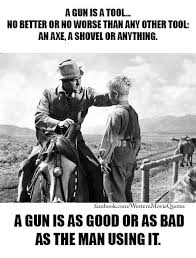
Perhaps the greatest Western ever made, Shane is a snapshot of the West as the old West of cattle barons and gunfighters is coming to an end. Alan Ladd as the gunfighter Shane realizes his day is done, even as he comes to understand that his attempt to change his life is futile, just as his adversary, cattle baron Rufus Ryker, does not:
Right? You in the right! Look, Starrett. When I come to this country, you weren’t much older than your boy there. We had rough times, me and other men that are mostly dead now. I got a bad shoulder yet from a Cheyenne arrowhead. We made this country. Found it and we made it. We worked with blood and empty bellies. The cattle we brought in were hazed off by Indians and rustlers. They don’t bother you much anymore because we handled ’em. We made a safe range out of this. Some of us died doin’ it but we made it. And then people move in who’ve never had to rawhide it through the old days. They fence off my range, and fence me off from water. Some of ’em like you plow ditches, take out irrigation water. And so the creek runs dry sometimes and I’ve got to move my stock because of it. And you say we have no right to the range. The men that did the work and ran the risks have no rights? I take you for a fair man, Starrett.
Clashes of right and wrong are morally simple, while clashes of competing rights are more morally complex and Shane does a good job showing this, just as it illustrates that we can do a lot with time in this Vale of Tears, but we can’t freeze it.
Jack Palance as hired killer Jack Wilson had his breakthrough role in this film which was populated with flawless performances, many of the actors and actresses involved giving the best work of their careers to this masterpiece. If you haven’t seen this film, please remedy this omission as soon as possible.
Bonus:





I saw this a couple weeks ago. I like westerns in general, but based on Don’s recommendations we watched it. I only missed the first 5 to 10 minutes. It was very good! A classic.
The western movies lost all luster in the late 60s and into the 70s. I think if you look up the directors for that time period, they are all Democrats and their policial and moral failings are clearly shown in their movies.
My grandfather’s brother moved to Wyoming in 1898 from Germany. Ryker was correct. Much of the hard work had already been done. As a matter of interest, his son, my cousin, wound up raising both cattle and sheep on the ranch in the post WW I years, largely thanks to the efforts of those like Ryker.
Never quite understood the expression “damm Yankee”, seems an early projection attempt by Democrats towards Republicans in the North that ended that “particular institution”. Of course things are flipped now, there are too many damm democrats in the blue north, former yankee republican states.
https://www.youtube.com/watch?v=PopJZmGjSRg
At 8.00
The phrase predates the Civil War and was originally applied to dishonest peddlers from New England.