
From The Institute For The Study of War:
Russian Offensive Campaign Assessment, March 30, 2023
Kateryna Stepanenko, Riley Bailey, George Barros, Nicole Wolkov, Layne Philipson, and Frederick W. Kagan
March 30, 7:30pm ET
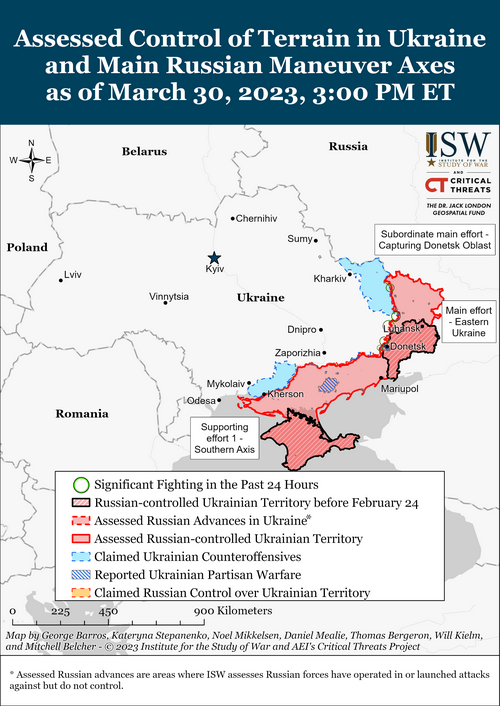
Click here to see ISW’s interactive map of the Russian invasion of Ukraine. This map is updated daily alongside the static maps present in this report.
Click here to access ISW’s archive of interactive time-lapse maps of the Russian invasion of Ukraine. These maps complement the static control-of-terrain maps that ISW produces daily by showing a dynamic frontline. ISW will update this time-lapse map archive monthly.
Russian President Vladimir Putin signed a decree on March 30 authorizing Russia’s semiannual spring conscription which will induct 147,000 Russians between April 1 and July 15.[1] Russia conducts two conscription cycles per year with the spring conscription cycle usually conscripting 134,000 Russian men.[2] Russia may use Belarus’ training capacity to support the increase of 13,000 conscripts from previous years. A Ukrainian military official reported on March 4 that Russian personnel training in Belarus do not exceed 9,000 to 10,000 at a time, and ISW previously observed Russian forces training up to 12,000 troops in Belarus.[3] Satellite imagery indicates that Russian forces training in Belarus at the Obuz-Lesnovsky Training Ground recently redeployed to Russia in mid-March, freeing up space for new Russian trainees.[4] The new conscripts will not increase Russian combat power in the short term, as Russian conscripts must undergo months of training and service before they see combat.
Putin remains unlikely to deploy newly conscripted troops to participate in combat in Ukraine due to concerns for the stability of his regime. Chairman of the Russian State Duma Defense Committee Andrey Kartapolov stated on March 30 that spring conscripts will not deploy to Russian-occupied territories in Ukraine during the spring 2023 conscription cycle.[5] Kartapolov also noted that Russian forces will not conscript men from occupied territories. Kartapolov‘s statements may be true given that ISW has not observed the Russian military use conscripts on any significant scale on the frontlines since the first months of the war and especially since the sinking of the Russian Black Sea Fleet’s flagship, the Moskva, which had some conscripted sailors aboard.[6] Putin’s use of conscripts during the winter-spring period of 2022 sparked social tensions in Russia, and Putin is unlikely to risk his regime’s stability by deploying newly conscripted servicemen to the frontlines.[7] The Russian Ministry of Defense (MoD) and Putin even publicly instructed Russian authorities to investigate alleged incidents of Russian conscript deployments to Ukraine on March 9, 2022 (which were technically illegal at that time).[8] Putin likely perceives the political cost of deploying conscripts to the frontlines as being higher than that of Russia’s September 2022 mobilization. Putin did not deploy conscripts from the spring 2022 conscription cycles in response to Ukraine’s September 2022 counteroffensive in Kharkiv Oblast but instead mobilized reservists to stabilize collapsing frontlines. This decision indicated Putin’s policy preference for mobilizing reservists rather than committing conscripts to battle — likely for political reasons — even though conscripts entering the final months of their annual service obligation might fight more effectively than civilian reservists. A prominent Russian news aggregator criticized the Russian conscription system, noting that Russia’s current staffing levels for contract servicemen are insufficient even though Russia has 250,000 available conscripts.[9] The aggregator added that it is “unacceptable” that “half of the Russian army is fighting with all its strength, while the other part is sitting in the barracks.”
The start of the new conscription period, even with a slightly increased number of conscripts, may actually reduce Russian training capacity for reservists and other personnel recruited via crypto-mobilization campaigns. Russia has limited training capacity and allocating it to training conscripts who will not fight in 2023 deprives the Kremlin of the opportunity to train reservists and volunteers who would. The Kremlin may seek to increase its combat personnel in Ukraine by coercing spring 2022 conscripts who are finishing their one-year service into signing military contracts, since these freshly discharged conscriptions would need less additional training before deploying to Ukraine. It is far from clear how successful such an effort will be.
Russian President Vladimir Putin appointed a prominent milblogger and Russian proxy battalion commander as a regional Russian National Guard (Rosgvardia) official for occupied Donetsk Oblast, advancing several Kremlin efforts. Multiple Russian milbloggers reported on March 30 that Putin signed a decree appointing former Donetsk People’s Republic (DNR) Security Minister and current Vostok Battalion commander Alexander Khodakovsky as deputy head of the Main Directorate of Rosgvardia in occupied Donetsk Oblast, making him responsible for Rosgvardia’s special rapid response and riot police (OMON and SOBR) in the region.[10] Khodakovsky announced on March 30 that he received this appointment in early February 2023 and posted a public recruiting ad for Rosgvardia OMON and SOBR units now under his command.[11] Khodakovsky publicly praises Putin and has been a loyal pro-Russian Ukrainian separatist since March 2014.[12] (Khodorkovsky was a Ukrainian SPETSNAZ commander for the Donetsk Oblast Alpha Group under the Ukrainian State Security Service before participating in Russia’s hybrid war against Ukraine in 2014.[13]) Khodakovsky’s appointment is analytically significant for several of ISW’s running assessments:
- Khodakovsky’s appointment indicates a Russian effort to generate more forces from occupied Donetsk Oblast. Putin passed a bill on March 27 removing the upper age limit and other barriers to entry for Rosgvardia recruits from occupied Ukraine.[14] Khodakovsky — a native of Donetsk City — is well connected with Donetsk People‘s Republic militia fighters, veterans, and pro-Russian patriot groups in Donbas, and can help facilitate recruitment drives.[15]
- The appointment advances a Kremlin effort to formalize legacy irregular Russian proxy forces in Donetsk and Luhansk oblasts and subordinate them to Kremlin-controlled structures.[16]
- Putin may use Khodakovsky’s appointment to ensure that Putin maintains reliable control over new Rosgvardia elements in Donetsk Oblast. ISW assessed that Russian authorities may be conducting a sweeping corruption probe within Rosgvardia, possibly to weed out actors who are perceived to be unreliable to Putin.[17]
- The appointment could help Putin divide and conquer influential communities that the Kremlin does not fully control. Mixed reactions to Khodakovsky’s appointment from various Russian milbloggers’ — notably among Russian military veterans — indicate a significant fracture within the Russian nationalist veteran community.[18] ISW has previously assessed the Russian nationalist veteran community within the blogosphere to be more or less unified.
Khodakovsky’s appointment also indicates that Putin continues to prioritize loyalty over competence in his subordinates. One Russian milblogger criticized Khodakovsky’s appointment and stated that Khodakovsky’s incompetence as the Vostok Battalion commander in 2014 resulted in an especially bad friendly fire incident in which Khodakovsky’s troops destroyed a Russian volunteer detachment, killing 42.[19] Former Russian officer and convicted war criminal Igor Girkin accused Khodakovsky of being a swindler and a “corrupt slug-traitor” and stated that the Kremlin’s “failed personnel policy” of advancing ”traitors, scum, and mediocrity” will lead Russia to ruin.[20] Putin has appointed loyalists ahead of competent people before. Putin replaced relatively competent Army General Sergey Surovikin, who effectively conducted a politically unpopular but militarily necessary withdrawal from upper Kherson in fall 2022, with Putin loyalist and Chief of the Russian General Staff Valery Gerasimov — who green-lit the disastrous campaign plan for the initial full-scale invasion of Ukraine — as theater commander for the Russian invasion of Ukraine in January 2023.[21]
Western officials reported that Wagner Group and conventional Russian forces have likely lost a substantial amount of manpower in the Bakhmut area, which will further constrain Russia’s offensive on Bakhmut. US Chairman of the Joint Chief of Staff General Mark Milley reported on March 29 that the Wagner Group has around 6,000 professional personnel and 20,000 to 30,000 recruits, mostly convicts, fighting in the Bakhmut area.[22] US National Security Council Spokesperson John Kirby reported in late December 2022 that the Wagner Group had 50,000 personnel in Ukraine including 10,000 contractors and 40,000 convict recruits.[23] The Wagner Group has deployed the vast majority of its force to support the offensive to capture Bakhmut, and it is likely that the difference between Kirby’s 50,000 figure in Ukraine and Milley’s 26,000 to 36,000 figure in the Bakhmut area is the result of casualties from Wagner’s attritional offensive on Bakhmut. Kirby reported on February 17 that the Wagner Group had suffered 30,000 casualties, with 9,000 dead, in operations in Ukraine.[24] The Wagner Group may lose thousands more convict recruits in the upcoming weeks as convicts finish their six-month military contracts, and the Wagner leadership appears for now to be allowing pre-pardoned convicts to return from the frontlines to Russia at the conclusion of those contracts.[25]
The senior military advisor to the United Kingdom’s mission to the Organization for Security and Co-operation in Europe (OSCE), Ian Stubbs, reported on March 30 that 30,000 Russian military and Wagner personnel have died or been injured in the Bakhmut area since the Battle of Bakhmut began in July 2022.[26] Stubbs stated that Russian and Wagner forces have particularly suffered significant losses in and around Bakhmut in recent weeks and that they urgently need to replenish their personnel.[27] These losses in manpower will continue to constrain Russian offensive operations in the Bakhmut area as well as the wider theater, and Wagner’s significant losses will likely threaten its ability to maintain its influential role among Russian forces fighting in Ukraine.
The Russian Federal Security Service (FSB) arrested Wall Street Journal correspondent Evan Gershkovich in Yekaterinburg, Sverdlovsk Oblast on charges of espionage on March 30. The FSB claimed that Gershkovich collected information constituting a state secret about the activities of a Russian military-industrial complex enterprise on behalf of the US, and Kremlin spokesperson Dmitry Peskov claimed that FSB officers caught Gershkovich “red-handed.”[28] Russian authorities may have arrested Gershkovich as a retaliatory response to the US arrest of Russian national Sergey Vladimirovich Cherkasov on March 24 on charges of acting as an agent of a foreign power.[29] The Kremlin will likely use Gershkovich’s detention to attempt to extract some type of concession from the United States and possibly may seek to replicate a prisoner exchange similar to the December 2022 exchange of US basketball player Brittney Griner for Russian illegal arms dealer Viktor Bout.[30]
The reported site of Gershkovich’s arrest is noteworthy. Yekaterinburg hosts 12 Russian defense enterprises that specifically produce anti-aircraft rocket systems, long-range anti-aircraft missiles, radio systems, ground support equipment for missiles and aircraft, electronic control systems for missile complexes, missile-related guidance systems and radars, self-propelled artillery systems, highly enriched uranium, rare earth metal alloys, heavy machinery, and optical systems for military aircraft.[31] These enterprises include Russia’s primary producer of self-propelled artillery systems, Uraltransmash; one of Russia’s leading optical enterprises, Urals Optical-Mechanical Plant; and Uralmash, which mass produced tanks during and after the Second World War.[32] It is not evident which military industrial enterprise is associated with the FSB’s claims about Gershkovich’s arrest, but many of them produce systems and equipment that Russian forces have lost or used in significant quantities in Ukraine. Others use microchips, which are in critically short supply in Russia and the object of intense smuggling and sanctions-evasion efforts. ISW assesses that significant equipment shortages are likely constraining the Russian military’s ability to conduct mechanized maneuver warfare in Ukraine and that the Kremlin is trying to gradually mobilize Russia’s Defense Industrial Base (DIB) to meet the Russian military’s needs without conducting full economic mobilization.[33] ISW also previously assessed that the FSB may be trying to penetrate the Russian DIB in a way that is reminiscent of the KGB’s involvement and surveillance of the Soviet military establishment.[34]
Ukrainian National Security Defense Council Secretary Oleksii Danilov stated on March 30 that Ukrainian authorities do not intend to expel the Kremlin-affiliated Ukrainian Orthodox Church of the Moscow Patriarchate (UOC MP) from the Kyiv-Pechersk Lavra by force.[35] Independent Russian news outlet Meduza reported that parishioners of the UOC MP prevented a Ukrainian Ministry of Culture commission from entering the Lavra to conduct an inventory of the property.[36] Meduza reported that Ukrainian officials ordered the UOC MP to leave the Lavra on March 10 by March 29, and the UOC MP stated that it did not intend to comply.[37]
Key Takeaways
- Russian President Vladimir Putin signed a decree on March 30 launching the semiannual spring conscription cycle, which will conscript 147,000 Russians between April 1 and July 15.
- Russian President Vladimir Putin appointed a prominent milblogger and Russian proxy battalion commander as a regional Russian National Guard (Rosgvardia) official for Donetsk Oblast.
- Western officials reported that Wagner Group and conventional Russian forces have likely lost a substantial amount of manpower in the Bakhmut area.
- The Russian Federal Security Service (FSB) arrested Wall Street Journal correspondent Evan Gershkovich in Yekaterinburg, Sverdlovsk Oblast on charges of espionage.
- Ukrainian National Security Defense Council Secretary Oleksii Danilov stated that Ukrainian authorities do not intend to expel the Ukrainian Orthodox Church of the Moscow Patriarchate (UOC MP) from the Kyiv-Pechersk Lavra by force.
- Russian authorities arrested Bryansk Oblast Acting Deputy Head Elena Egorova and Second Deputy Governor Tatyana Kuleshova for reportedly receiving bribes.
- Russian forces conducted limited ground attacks north of Kupyansk and along the Svatove-Kreminna line.
- Russian forces continued offensive operations in and around Bakhmut as well as along the Avdiivka-Donetsk City front.
- International Atomic Energy Agency Director (IAEA) Rafael Grossi stated that plans to ensure the safety of the Zaporizhzhia Nuclear Power Plant (ZNPP) have evolved.
- Pardoned Wagner Group convicts are continuing to commit crimes in Russia following the end of their contract service with Wagner.
- Russian occupation authorities continue efforts to set conditions for September 2023 elections by further integrating occupied territories into the Russian legal apparatus.
Go here to read the rest. Events marking time until the Ukrainian offensive. If Putin was smart he would try to enter into peace negotiations, but if were smart he would not have embarked on this madness to begin with.

