
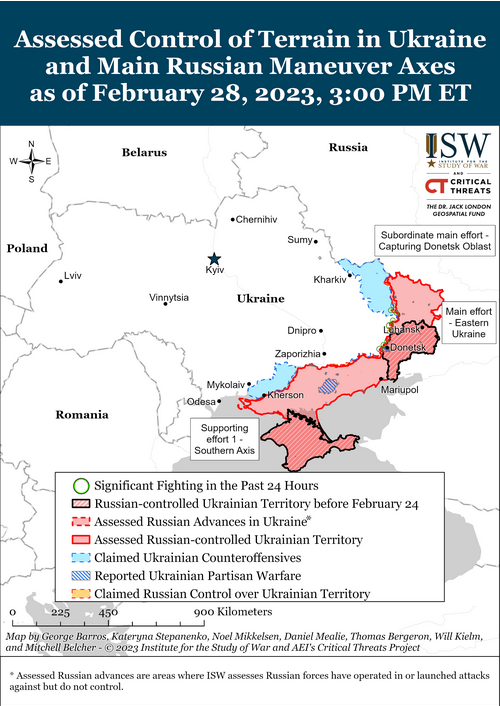
From The Institute For The Study of War:
Russian Offensive Campaign Assessment, February 28, 2023
Karolina Hird, Riley Bailey, George Barros, Nicole Wolkov, Angela Howard, and Frederick W. Kagan
February 28, 6:30pm ET
Click here to see ISW’s interactive map of the Russian invasion of Ukraine. This map is updated daily alongside the static maps present in this report.
Russian authorities appear to be escalating their promotion of false flag information operations to distract from their lack of tangible battlefield gains and slow down the provision of Western tanks and other aid in advance of expected Ukrainian counter-offensives. The Russian Ministry of Defense (MoD) accused the “US and its accomplices” on February 28 of planning to carry out a provocation in Ukraine using toxic chemicals.[1] The Russian MoD relatedly claimed on February 19 that Ukrainian officials are planning false-flag attacks at hazardous radiation facilities in Ukraine to accuse Russian forces of indiscriminately striking such sites.[2] The apparent uptick in fallacious biochemical and nuclear false flag warnings accompanies a concerted Russian false flag information operation accusing Ukraine of preparing for an invasion of Russian-occupied Transnistria, Moldova.[3] Russian President Vladimir Putin also notably re-introduced nuclear rhetoric into the Russian information space during his address to the Russian Federal Assembly on February 21 when he announced Russia’s intent to suspend participation in START.[4] The recent resurgence of several standard Russian information operations in the form of false flag warnings and tired nuclear threats suggests that Russian officials are increasingly trying to mitigate the informational impacts of a continued lack of Russian battlefield successes as well as to slow down the provision of Western tanks and other equipment in advance of expected Ukrainian counter-offensives. ISW has previously reported on the correlation between Russian information operations and battlefield realities, particularly when Russian forces are failing to take significant ground in offensive operations in Ukraine.[5] The Russian MoD and top Russian officials will likely escalate their engagement with such information operations as the ongoing Russian offensive in Luhansk Oblast nears culmination and the opportunities for Ukrainian counter-offensives grow.
A top US defense official supported ISW’s continued assessment that Russia is extraordinarily unlikely to use nuclear weapons in Ukraine. Undersecretary of Defense for Policy Colin Kahl stated that the US does not assess that Russia will use nuclear weapons during a House Armed Service Committee hearing on American military support for Ukraine on February 28.[6] ISW has assessed that Russian invocations of nuclear threats and nuclear doctrine are part of an information operation meant to discourage Ukraine and the West but do not represent any material Russian intent to employ nuclear weapons.[7]
Russian President Vladimir Putin addressed the Federal Security Service (FSB) board on February 28 and emphasized the role of the FSB in supporting the war in Ukraine in a law enforcement and counterterrorism capacity. Putin lauded the FSB for its direct participation in the war in “non-standard field tasks” such as protection of the Russian border and cracking down on terrorist activities, organized crime, corruption, and extremism.[8] Putin also emphasized that the FSB’s primary purpose is to support the Russian Armed Forces and Rosgvardia in their efforts to accomplish the objectives of the “special military operation” and noted the FSB’s role in preventing incursions of Ukrainian sabotage groups onto Russian territory.[9] Putin has frequently invoked mentions of domestic security, law enforcement, and counterterrorism efforts when speaking about the war in Ukraine in order to portray the war as a threat to Russian internal security and to bring the war closer to his domestic constituency as ISW has previously reported.[10] Putin’s address to the FSB similarly aligns the FSB and its traditional domestic law enforcement and counterterrorism role with Russian military efforts in Ukraine in order to frame Russian victory in the war as necessary for Russia’s domestic security.
The Kremlin is likely attempting to reintroduce a Russian information operation aimed at falsely portraying Russia as being open to negotiations while the collective West refuses to negotiate. Kremlin spokesperson Dmitry Peskov stated on February 28 that Russian officials are open to negotiations to end the war in Ukraine but that Ukraine and the West must recognize new “territorial realities” associated with Russia’s illegal annexation of occupied territories in Ukraine.[11] Peskov added that Ukraine also needs to consider Russia’s specific goals in the war in Ukraine to reach a negotiated settlement.[12] These goals include regime change of the Ukrainian government under the rubric of “denazification“ and the elimination of Ukraine’s ability to defend itself against future Russian attacks under the rubric of “demilitarization.”[13] Peskov also stated that Russia made serious preparations for security talks before launching the invasion of Ukraine but accused the West of being unreceptive to such talks.[14] Russia’s suggested pre-invasion security talks called for the West to acknowledge a list of “security guarantees” demanding a moratorium on NATO expansion, a ban on the deployment of Western strike weapons near Russia, and the de facto withdrawal of NATO forces to their 1997 posture.[15]
The Kremlin appears to be using Belarusian President Alexander Lukashenko as a conduit to reengage with this information operation, likely in pursuit of negotiations on favorable terms to Russia and further delays in the West’s provision of critical weapons systems to Ukraine. Lukashenko stated during his official trip to China that Russia is ready to take steps towards a peaceful settlement and that there is a unique opportunity to end the war in Ukraine before Russia puts its economy on a stronger war footing.[16] Lukashenko also blamed the West and the US for coercing Ukrainian officials into rejecting negotiations with Russia.[17] The Kremlin and Lukashenko are likely seizing on China’s release of a 12-point peace plan to reintroduce an existing Russian information operation that the Kremlin used in December 2022. That information campaign centering on Russia’s openness to negotiations aimed to prompt Western officials to offer preemptive concessions and coerce Ukraine to negotiate on Russian terms and likely contributed to the delay in the provision of Western tanks and other equipment essential for the continuation of Ukrainian mechanized counteroffensives.[18] The Kremlin may be reintroducing the negotiations information operation to reduce the effectiveness of future Ukrainian counteroffensives by delaying the provision of essential Western aid and to seek to gain concessions before potential further setbacks in Ukraine.
Belarusian President Alexander Lukashenko may facilitate sanctions evasion schemes between Russia and China during his official trip to Beijing, China from February 28 – March 2. Deutsche Welle reported that Lukashenko will sign a large package of agreements on developing joint projects, trade, economic, investment, humanitarian cooperation, and political cooperation with China during his three-day visit.[19] Lukashenko previously stated that the Belarusian defense industry can produce weapons since Belarus has access to microelectronics, optics, and other component imports from other states.[20] Ukrainian intelligence officials stated that Belarus supplied Russia with artillery ammunition from Belarusian warehouses to support operations in Ukraine.[21] US Central Intelligence Agency (CIA) Director William Burns stated on February 25 that the CIA is confident that Chinese leadership is considering the provision of lethal equipment to Russia.[22] China may clandestinely transfer equipment to Russia via Belarus.
Key Takeaways
- Russian authorities appear to be escalating their promotion of false flag information operations in an effort to distract from their lack of tangible battlefield gains and slow down the provision of Western tanks and other aid in advance of expected Ukrainian counter-offensives.
- US Undersecretary of Defense for Policy Colin Kahl stated that the US has no indication that Russian forces will use nuclear weapons in Ukraine.
- Russian President Vladimir Putin emphasized the role of the Russian Federal Security Service (FSB) in supporting the war in Ukraine during an address to the FSB board.
- The Kremlin and Belarusian President Alexander Lukashenko are likely attempting to intensify efforts to falsely portray Russia as open to negotiations to end its war in Ukraine.
- Lukashenko may facilitate Sino-Russian sanctions evasion schemes during his official trip to Beijing, China from February 28 to March 2.
- Russian forces conducted limited ground attacks near Svatove and Kreminna and likely made limited advances north of Kreminna.
- Russian forces made tactical gains in northern Bakhmut and continued ground attacks around Bakhmut and in the Avdiivka-Donetsk City area.
- Ukrainian officials continue to report potential Russian preparations for renewed offensive operations in Zaporizhia and Kherson oblasts, though ISW has not observed indicators that Russian forces plan to renew offensive operations in these directions.
- Armenian authorities detained a Russian citizen in Yerevan for an act of protest against the war in Ukraine committed in Moscow in July 2022.
- Ukrainian President Volodymyr Zelensky enacted a Ukrainian National Security and Defense Council decision to sanction 109 Russian citizens involved in the forced deportation of Ukrainian children.
Go here to read the rest.
From Strategy Page:
February 28, 2023: It’s been a year since Russia invaded Ukraine and the Ukrainians are seen as the unexpected victor against the theoretically more powerful Russians. The Russian effort was poorly planned and carried out by poorly trained and often reluctant Russian troops. The Ukrainians were prepared and determined to defend their independence. This was the largest war Russia has been involved in since 1945 and Russian commanders and troops were not ready for what they faced in Ukraine. It’s common for Russian forces to perform poorly in the early stages of a war, especially when they are the attacker. The Russian government thought they had solved all these problems. That was not the case and in some respects Russian reform efforts made matter worse
From the start of the invasion the Russians under-performed. Initially this was seen as the Ukrainians getting lucky. After a few weeks it was clear that Russian and Ukrainian forces were using very different tactics. The Ukrainians have been winning from the beginning by using better tactics and having better leadership in general. These differences led to Russia suffering more combat deaths in the last year than they suffered in all the wars and conflicts their troops were involved in since the end of World War II in 1945.
The original plan was to make a massive attack from many directions on an unprepared Ukraine. That failed in a spectacular fashion because the Russians overly dispersed their attacks and the Ukrainians were far more prepared than the invaders. Ukrainian war preparations were no secret and Russian intel (FSB and GRU) had lots of people inside Ukraine observing and reporting back to Russia. These reports were accurate but, by the time they reached senior leaders, especially Vladimir Putin, they had been modified to tell Putin what he wanted to hear. Putin believed the Ukrainians were incapable of organizing an effective resistance against his planned massive land and air attack that would paralyze and demoralize them. Russia expected to take control of the country in a matter of days. A year later Russian military operations are still crippled by similar delusions which probably only Putin believes, with any senior dissenters being retired or reported as a victim of a fatal accident.
Russia had a hard time accepting the fact that the Ukrainians were better trained, armed and led. To an outside observer Russia has two major problems with their armed forces. The most obvious one is continued use of outdated (pre-1991) Soviet-style planning and command techniques. Plans are still created to be followed precisely by subordinates who make no deviations without orders from above. This works if you use overwhelming force against a foe who does not react in an unanticipated fashion. During World War II German dictator Hitler often ordered troops to not retreat and that is one of the reasons for this Russian military style. Many major Russian World War II victories were due to frequent German “stand fast” orders. This did not work against the more flexible Ukrainians, who were using planning methods and tactics developed in the West during the last century and tested and found effective many times during and after World War II. The standard Russian tactics don’t work against a more flexible defender and the Ukrainians were yet another demonstration of that.
Another Russian problem is a lot more corruption than in Ukraine. This makes it difficult for Russia to recruit or even conscript more troops. In contrast Ukraine had about a million regular and reserve troops a year after the invasion began. In Russia, corruption in the recruitment and training process is common and discourages new soldiers from fighting. Desertion in the combat zone is common. Those who don’t desert face almost certain death or injury making suicidal frontal attacks on well prepared and determined Ukrainian defenders. In response to this the Russian plan is to keep the war going for as long as it takes to wear the Ukrainians and their NATO supporters d0wn. The Russian people are suffering most from all this and Putin believes the Russian people will put up with this because this is what Russians have done in the past. Currently most Russians still support the war. At the same time there are also a growing number of Russians trying to get out of Russia to avoid military service or staying and subverting or sabotaging the war effort.
Russia is trying to produce some victories, no matter how minor, by carrying out dozens of small offensive operations. Some of these do gain minor amounts of territory and are declared as great victories even though they usually have no value at all and were gained at the cost of thousands of Russian casualties.
Captured documents indicate Russia has developed a new solution to the problems revealed a year ago when the BTG (Battalion Task Group) system that Russia expanded since the 1980s was a major failure in combat. The new combined arms units contain fewer than a hundred troops and about a dozen tanks and other armored vehicles. The BTGs had as many as 800 troops and Russian officers (there are few NCOs) were unable to handle the many different weapons and other systems found in a BTG. The new, smaller task groups are more the size of an infantry company and could be called CTGs (Company Task Groups). As simplified as they are, the key problem is the lack of small unit officers in general and combat experienced officers in particular.
The BTG concept was based on the success Western armies had with task forces. The Russian BTGs missed that point that a successful task force required trained, and preferably combat experienced officers and NCOs to work. Russia didn’t have sufficient small unit leaders for the 170 BTGs they had before the invasion and lost a lot of combat officers in the first months of the Ukraine war. It is believed that Russia will form far fewer CTGs and use only as many as it can find competent junior officers who are able to command them in combat. In Ukraine Russia sought to replace heavy losses of junior combat officers by offering competent soldiers officer rank and command of small units. Historically, officers given battlefield promotions to officer rank are not reluctant to point out problems to their superiors. This apparently led to the CTGs. Russia is desperate for some battlefield victories, no matter how small and the few CTGs in action so far seem capable of delivering some wins.
Before the invasion the BTGs became the standard for Russian divisions, which now consisted of two or three brigades. Each of these usually had just two BTGs. The division had fewer support units because most of these troops were now assigned to BTGs or brigades. BTG combat elements consisted of one tank company, two or three infantry companies and one or two batteries of artillery. These contained contract (volunteer) troops while most of the rest of the BTG depended on conscripts. The conscripts had several shortcomings. They could not be used in a combat zone outside Russia. The Conscript’s term of service was only one year and they were not as well trained or trained at all compared to the contract troops. Many newly formed BTGs were sent to the Ukrainian border in late 2021 to threaten Ukraine and if that did not work, to invade. Most of the troops in BTGs were not aware of the invasion option.
The flaw in the BTGs was not obvious until they encountered well-armed and motivated opponents. That happened soon after they crossed the border into Ukraine. The leadership in these BTGs could not handle the complex composition of BTGs. Senior Russian leaders knew this from the performance of BTG leaders during military exercises. This was not a surprise as the quality of officers had declined in the last decade and there were still not enough experienced NCOs.
The lack of competent leadership meant the troops in the BTGs were poorly used during combat and troops increasingly abandoned their vehicles and fled if they encountered Ukrainian troops, who concentrated on hitting the very vulnerable tanks and light armored vehicles. BTG commanders failed to carry out effective reconnaissance or get the infantry out of their armored vehicles and protect their tanks from Ukrainian infantry armed with modern Western anti-tank weapons. Worse, the Ukrainians concentrated on attacking the BTG supply trucks and vehicles transporting maintenance personnel. The Ukrainian attacks on these trucks meant that the combat units could not refuel and had to stop before they reached their objectives. The Ukrainians now had stationary Russian armored vehicles to attack. The few competent or determined BTG officers were soon killed as they tried to get their troops to put up an effective fight. These young officers had no experience and many had little or no training for combat. An example was a weather officer forced to serve as an armored reconnaissance officer. Senior Russian officers (colonels and generals) who did have experience were under tremendous pressure from their military and political commanders to get the problem fixed. Many went to the front line BTGs to show the junior officers how it was done, often by example. Many of these senior officers were killed or wounded. This further weakened the leadership of the brigades and divisions that went into Ukraine dependent on their BTGs.
It remains to be seen if the CTGs can be turned into a success. The BTGs were a major embarrassment; the CTGs appear more the result of practical necessity than damage control by embarrassed Russian generals. Ukraine is the first major war Russia has fought since World War II and after two years of heavy losses in 1942-2, the surviving Russian officers and troops had become practical and effective in how they fought, and eventually defeated the Germans. In Ukraine the Russians are the invaders and the Ukrainian defenders have been far more innovative and effective at defending themselves and killing Russians. For Russia, this is not World War II and the Russians are the bad guys in Ukraine.
Ammunition Supply Problems
Russia is also running out of ammunition and weapons because its defense industries are not large enough to build the needed replacements. Economic sanctions also limit defense production and war-related spending in general. Few countries were willing to sell to Russia. The solution was to find countries willing to barter instead. Russia found two suppliers. Iran offered Russian ammunition as well as more UAVs. Iran manufactures a wide range of artillery and infantry weapon ammunition, and some UAVs. Many of the Iranian made mortars, assault rifles and machine-guns are compatible with Russian weapons. In return Iran wanted modern Russian military aircraft, including recent jet trainers and electronic warfare systems. Russia is apparently reluctant to provide Iran with assistance in developing nuclear weapons. North Korea was willing to provide artillery munitions in return for food and fuel.
Atrocity Blues
Another cost of the war for Russia is legal and international. Ukraine has assembled a large quantity of evidence, including recorded cell phone conversions, captured cellphones and testimony from Russian prisoners as part of an effort to bring charges of war crimes against Russian troops in Ukraine, especially those in Russian occupied territory. There the Russians have been particularly brutal against Ukrainian civilians who refuse to accept Russian rule. Food and access to utilities (electricity and water) is limited for those who refuse to accept Russian identification documents or use Russian currency.
Russia continues to send kidnapped Ukrainian children to Russia where they are adopted by Russian couples and raised as Russian. Details of these war crimes have been smuggled out or Russian occupied territory and formal war crimes charges have been brought for more 65,000 separate incidents including mass murder, deliberate attacks on civilians, rape and kidnapping. Many of these continue to occur in Ukrainian territory or were discovered when the Russians are driven out of Ukrainian territory. Many of these crimes have no Ukrainian witnesses, just a lot of dead bodies. Ukraine is accused of killing Russian troops seeking to surrender and sometimes firing artillery shells at civilian occupied areas. Russia is way ahead of Ukraine when it comes to bad behavior in or out of combat.
February 27, 2023: Russia continues to face problems with its neighbor and sometimes ally Belarus. Efforts to persuade Belarus to join Russian forces inside Ukraine continue to be turned down. The main obstacle to that happening is that Russia wants to annex Belarus as well as Ukraine. This was confirmed recently when a classified Russian document describing how Russia planned to absorb Belarus without a war. This was not news. Before 2022, Belarus was seen as the next former Soviet territory to be annexed by Russia. The response of Ukrainians to the Russian invasion changed attitudes towards annexation of Belorussia. This is despite the fact that the longtime (27 years so far) Belarus president-for-life Alexander Lukashenko has ruled Belarus as a loyal ally of Russia. That has not helped the Belarussian economy or improved the lives of Belarus voters. A new post-Soviet Union generation of voters has seen how life is better in democracies, especially other former victims of Russian rule like neighboring Poland, Lithuania, Latvia, Estonia, and Ukraine. They blame Lukashenko for the poverty and mismanaged economy in Belarus, as well as an incompetent response to covid19. Since 2020 Lukashenko has faced growing popular protest against government incompetence and decades of rigged elections, corrupt rule, and inability to do much of anything effectively. Since the late 1990s Lukashenko has won reelection with 80-90 percent of the vote in visibly fraudulent elections. Lukashenko is a Soviet era official, who runs Belarus using the Soviet Union as a model. Belarus is a police state, where elections, and everything else, is manipulated to keep the same politicians in power. It’s a tricky business, but so far Lukashenko has kept the security forces up to snuff, and on his side. He bribes or bullies key officials to keep the country running. Lukashenko has maintained good relations with Russia, getting him cheap fuel supplies and other aid. Belarus is small (9.5 million people) compared to neighbors Russia (146 million) and Ukraine (42 million) and Russia wants to absorb Belarus and Ukraine to rebuild the centuries old Russian empire that the czars created and the communists lost. Lukashenko, like most Belarussians, opposes annexation by Russia. So far Russia is not actively seeking to annex Belarus or send in security forces to help suppress what has turned into a rebellion against Lukashenko. Lukashenko is becoming more of a liability for Russia but is currently still a “favored ally.” Russia would like to be rid of Lukashenko but there is no one in Belarus with his skills, experience and pro-Russia attitude. Russia has created a major problem for itself in Belarus. Not as bad as the mess in Ukraine, but still another setback in the Russian effort to rebuild the Soviet-era Russian empire. Lukashenko noted what happened to pro-Russia Ukrainian politicians after the Russians invaded and most Ukrainians joined or supported the fight against Russian domination and any pro-Russia Ukrainians. Currently Lukashenko is on his way to China for a three day official (state) visit that will involve discussions with China about helping Belarus retain its independence from Russia, even if that means becoming dependent on China.
Go here to read the rest. Putin’s adventure in the Ukraine has been a disaster for Russia. How big a disaster the rest of this year will likely reveal.

