
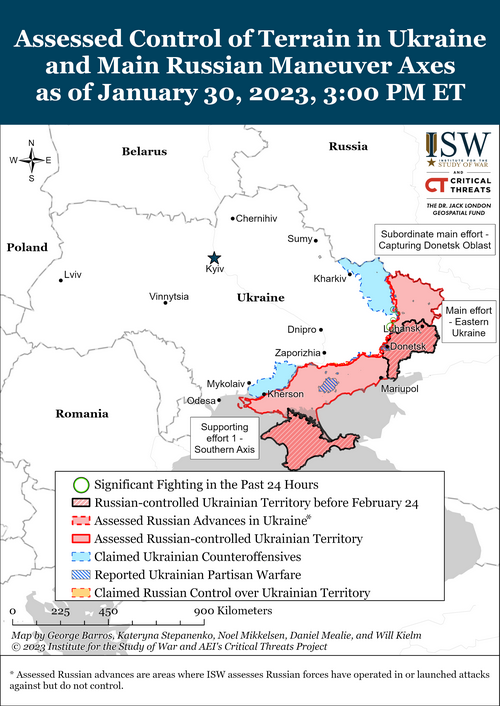
From The Institute For The Study of War:
Russian Offensive Campaign Assessment, January 30, 2023
Karolina Hird, Grace Mappes, Layne Philipson, George Barros, Kitaneh Fitzpatrick, Nicole Wolkov, and Frederick W. Kagan
January 30, 8:30pm ET
Click here to see ISW’s interactive map of the Russian invasion of Ukraine. This map is updated daily alongside the static maps present in this report.
Western, Ukrainian, and Russian sources continue to indicate that Russia is preparing for an imminent offensive, supporting ISW’s assessment that an offensive in the coming months is the most likely course of action (MLCOA).[1] NATO Secretary Jens Stoltenberg stated on January 30 that there are no indications that Russia is preparing to negotiate for peace and that all indicators point to the opposite.[2] Stoltenberg noted that Russia may mobilize upwards of 200,000 personnel and is continuing to acquire weapons and ammunition through increased domestic production and partnerships with authoritarian states such as Iran and North Korea.[3] Stoltenberg emphasized that Russian President Vladimir Putin retains his maximalist goals in Ukraine.[4] Head of the Council of Reservists of the Ukrainian Ground Forces, Ivan Tymochko, relatedly stated that Russian forces are strengthening their grouping in Donbas as part of an anticipated offensive and noted that Russian forces will need to launch an offensive due to increasing domestic pressure for victory.[5] Stoltenberg’s and Tymochko’s statements support ISW’s previous forecast that Russian forces are setting conditions to launch an offensive effort, likely in Luhansk Oblast, in the coming months.[6] Russian milbloggers additionally continued to indicate that the Russian information space is setting conditions for and anticipating a Russian offensive. Milbloggers amplified a statement made by a Russian Telegram channel that the current pace and nature of Russian operations indicate that the main forces of the anticipated offensive and promised breakthrough have not yet “entered the battle.”[7] This statement suggests that Russian milbloggers believe that Russian forces have not yet activated the elements required for a decisive offensive effort.[8]
Russia and Iran continued efforts to deepen economic ties. NOTE: This item appeared in the Critical Threats Project (CTP)’s January 30 Iran Crisis Update. Iranian state media reported that Iran and Russia established direct financial communication channels between Iranian banks and more than 800 Russian banks on January 29.[9] Iranian Central Bank Deputy Governor Mohsen Karami announced that Iranian and Russian banks have signed a Memorandum of Understanding (MoU) on financial messaging, effective immediately. Karami added that Iranian banks abroad were also included in the MoU and would be able to exchange standard banking messages with Russian banks.[10] Iranian officials and state-affiliated media outlets framed the MoU as a means to circumvent Western sanctions on Iran and Russia and compared the messaging system to the Society for Worldwide Interbank Financial Telecommunication (SWIFT), which serves as the world’s largest financial messaging system.[11] ISW has previously reported on the deepening of economic and military ties between Tehran and Moscow.[12]
Key Takeaways
- Western, Ukrainian, and Russian sources continue to indicate that Russia is preparing for an imminent offensive, supporting ISW’s assessment that an offensive in the coming months is the most likely course of action (MLCOA).
- Iranian state media reported that Iran and Russia established direct financial communication channels between Iranian banks and more than 800 Russian banks on January 29.
- Russian forces continued ground attacks to regain lost positions west of Kreminna as Ukrainian forces conducted counteroffensive operations northwest of Svatove.
- Ukrainian forces continued to strike Russian force concentrations in rear areas in Luhansk Oblast.
- Russian forces continued to conduct ground attacks across the Donetsk Oblast front line.
- Russian forces continued to make marginal territorial gains near Bakhmut.
- Russian forces did not conduct any confirmed ground attacks in Zaporizhia Oblast.
- The Russian Ministry of Defense (MoD) continued measures to professionalize the Russian military as it faces continued backlash against these measures.
- Russian forces and occupation authorities continue to target Crimean Tatars in an effort to associate anti-Russia sentiment with extremist or terrorist activity.
Go here to read the rest. Yet more reports of the coming great Russian offensive. Color me skeptical. The Russians can barely hold what they have now. I could imagine the Russians attempting such an offensive if they could get the dictator of Belarus to enter the War, but it would have much less manpower behind it than the failed Russian offensive which opened the War. We shall see.


The pro-Russian sources I see occasionally (because I don’t go looking for them) remain united in asserting that Russia is only playing the long game, a war of attrition, which these people (if they’re real people) insist will end in Ukraine’s total defeat, and within the next few months. It’s war, so it sounds and feels a little bit callous to say this, but I am fascinated that there are such completely opposite views of reality on display here, given modern communication tools. View A seems to be as I described above, with confident predictions that Putin will roll all the way through Ukraine and on into the rest of Eastern Europe when he so desires, daring NATO to retaliate. View B is the one presented by ISW, Strategy Page and other sources that seem more unbiased and credible than the “Russia is winning” crowd. If view B is correct, I do worry a little bit how Putin will react if his predicted Big Offensive fails.
That many Russian troops would provide quite a lot of targets. This is what happened in WW II with ten times as many troops. They prevailed over the Germans because of sheer numbers but the casualties were tremendous. The threat by Stalin to shoot shirkers provided the incentive to move forward.