
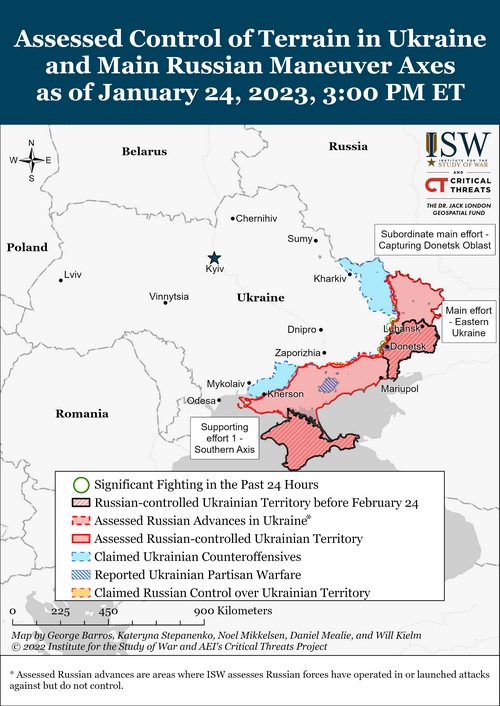
From The Institute For The Study of War:
Karolina Hird, Riley Bailey, Grace Mappes, George Barros, and Frederick W. Kagan
January 24, 9:30 pm ET
Click here to see ISW’s interactive map of the Russian invasion of Ukraine. This map is updated daily alongside the static maps present in this report.
A coalition of NATO member states reportedly will send Ukraine modern main battle tanks. The Wall Street Journal reported on January 24 that US President Joe Biden is preparing to send “a significant number” of Abrams M1 tanks to Ukraine and that the White House may announce the delivery as soon as January 25.[1] German newspaper Der Spiegel reported on January 24 that German Chancellor Olaf Scholz decided to deliver at least one tank company (14 tanks) of Leopard 2 main battle tanks to Ukraine in an unspecified time frame.[2] Poland likely will send Ukraine Leopard 2 tanks following Germany’s decision. Polish Defense Minister Mariusz Błaszczak stated on January 24 that Poland formally requested Germany grant permission to transfer Poland’s Leopard 2 tanks to Ukraine, and German Foreign Minister Annalena Baerbock stated that Berlin would not interfere if Poland wanted to send its Leopard 2 tanks to Ukraine.[3] British officials confirmed on January 16 that the United Kingdom would send Ukraine 14 Challenger 2 tanks to Ukraine.[4] French President Emmanuel Macron stated he would not rule out the possibility of France sending Ukraine Leclerc tanks on January 22.[5]
Western states’ provision of main battle tanks to Ukraine will help enable Ukraine to conduct mechanized warfare to defeat the Russian military and liberate Ukrainian territory. ISW previously assessed that the West has contributed to Ukraine’s inability to take advantage of having pinned Russian forces in Bakhmut by slow-rolling or withholding weapons systems and supplies essential for large-scale counteroffensive operations.[6] Ukrainian Commander-in-Chief Valery Zaluzhny previously emphasized in December 2022 that Ukraine needs 300 main battle tanks (among other weapon systems) to enable Ukrainian counteroffensives.[7]
Russian Chief of the General Staff Valery Gerasimov continued efforts to portray himself and the traditional Russian military command structure as the true defenders of Russia. Gerasimov reiterated on January 23 that Russian President Vladimir Putin approved Russian Defense Minister Sergey Shoigu’s plan to develop Russian forces’ ability to respond to “new threats to the military security” of Russia, and Gerasimov accused Ukraine and NATO states of aiming to threaten Russia.[8] Gerasimov invoked the Russian General Staff’s historical role in guiding and protecting Russia through several military crises, including the Great Patriotic War (World War II). Gerasimov claimed that “modern Russia has never known such a level and intensity of hostilities” and heavily implied that the current war in Ukraine presents the greatest threat to Russia since the Great Patriotic War, therefore necessitating the leadership and protection of the Russian General Staff under Gerasimov’s leadership. Gerasimov’s framing of the war and the General Staff’s ongoing revitalization efforts within the historical context of the Great Patriotic War is part of the continued campaign to counter the growing power and influence of Wagner Group financier Yevgeny Prigozhin, Chechen Republic Head Ramzan Kadyrov, and their respective paramilitary structures, all of which threaten Gerasimov and the Russian General Staff as ISW has previously reported.[9] It also continues Putin’s efforts to reframe the current struggle as an effort like the Great Patriotic War to justify protracted demands for sacrifice and mobilization by the Russian people.[10]
Russian outlet RBK claimed on January 23 that Russian Defense Minister Sergei Shoigu appointed Colonel General Sergey Kuzovlev as the Southern Military District (SMD) commander and Lieutenant General Yevgeny Nikiforov as the Western Military District (WMD) commander.[11] RBK claimed that Nikiforov replaced Kuzovlev as WMD commander after Kuzovlev held the position from December 13, 2022, to January 23, 2023.[12] The United Kingdom Ministry of Defense (UK MoD) claimed that the Russian Ministry of Defense (MoD) appointed Kuzovlev WMD Commander in late October of 2022.[13] RBK claimed that the Russian MoD had appointed Lieutenant General Roman Berdnikov as WMD commander in October of 2022, however.[14] The Ukrainian Main Military Intelligence Directorate (GUR) reported on December 26, 2022, that Nikiforov left his position as Chief of Staff of the Eastern Military District (EMD) to replace Kuzovlev as a part of the internal power struggles between Wagner Financier Yevgeny Prigozhin, Shoigu, and Gerasimov.[15] Nikiforov previously commanded Wagner Group fighters in Ukraine as commander of the 58th Combined Arms Army in 2014 and may have connections to Prigozhin.[16] The conflicting reporting on the WMD and SMD command suggests that military district command dynamics remain opaque, indicating that the Russian military is struggling to institute sound command structures and maintain traditional command.
Key Takeaways
- A coalition of NATO member states reportedly will send Ukraine modern main battle tanks.
- Russian Chief of the General Staff Valery Gerasimov continued efforts to portray himself and the traditional Russian military command structure as the true defenders of Russia.
- Russian outlet RBK claimed on January 23 that Russian Defense Minister Sergei Shoigu appointed Colonel General Sergey Kuzovlev as the Southern Military District (SMD) commander and Lieutenant General Yevgeny Nikiforov as the Western Military District (WMD) commander.
- Russian forces continued limited counterattacks along the Svatove-Kreminna line and Ukrainian forces reportedly continued counteroffensive operations near Kreminna.
- Russian forces continued to conduct ground attacks in the Bakhmut and Avdiivka-Donetsk City area. Russian forces made marginal territorial gains near Bakhmut.
- Russian sources claimed, likely to distract from the lack of progress in Bakhmut, that Russian forces launched an offensive around Vuhledar.
- Russian forces likely continued to conduct limited and localized ground attacks in Zaporizhia Oblast but likely did not make territorial gains, further undermining Zaporizhia Oblast occupation official Vladimir Rogov’s prior territorial claims.
- Ukrainian special forces conducted a raid across the Dnipro River in Kherson Oblast on January 23-24.
- Russian authorities are likely continuing efforts to mobilize ethnic minorities to fight in Ukraine.
- Russia’s defense industrial base (DIB) is reportedly increasing the production of drones and loitering munitions.
- Ukrainian partisans targeted a member of the Zaporizhia occupation administration.
Go here to read the rest.
From Strategy Page:
January 24, 2023: American leaders are stalemated over sending M1 tanks t0 Ukraine. Most politicians and Americans in general prefer sending Ukraine the M1s so the Russians will be pushed out of Ukraine sooner rather than later. Senior military officials insist that the Ukrainians won’t learn to use the M1s quickly enough to make a difference. The Ukrainians disagree and point to many recent examples of their quickly adapting to new weapons systems in terms of operators and maintainers. The American opposition is coming mostly from the same experts who initially predicted that the larger and better equipped Russian force would soon defeat the Ukrainians. The United States has thousands of M1 tanks in reserve. These are not the latest models but were seen as adequate replacements for M1 tanks lost in some future conflict. That conflict is going on now in Ukrainian except that, because Ukraine is not a NATO member, they are willing to do all the fighting if NATO continues sending all the weapons and munitions they need. The Americans have already stalled on sending some weapons (like longer range missiles and any tanks at all) for fear of angering the Russians and triggering an expanded war. That has not happened and the Russians have taken unprecedented losses. Senior American military officials appear to accept reality because it is so radically different from what they predicted.
Germany had a similar situation but was willing to allow other NATO members, like Poland, to send their Leopard 2 tanks anyway, without reference to what the Americans do with their M1s. Britain is ignoring American misgivings and sending fourteen of their similar Challenger 2 tanks. The problem is that there are thousands of unused Leopard 2 and M1 tanks available but only a few hundred Challenger 2s. Britain could not afford to build as many tanks as Germany and the Americans, and simply didn’t have many to send. Germany finally heeded the pleas of Poland, the Baltic States and Ukraine by no longer trying to block Leopard 2s from going to Ukraine. Poland borders Ukraine and has been preparing to move the tanks into Ukraine. The only NATO nation with M1 tanks is Poland, which ordered 250 and has already received seven to be used for training crews and maintainers. Poland has 247 Leopard 2s and a dozen are being sent to Ukraine immediately for training crews and maintainers. Some of that training may already have taken place in Poland. Sending Leopard 2s to Ukraine is a popular move to most Poles, who see themselves as next on the Russian invasion list. The Ukrainian can stop the Russians sooner with the tanks. Russia continues to make vague threats of reprisals if NATO “escalates” the situation by sending tanks. Ukrainians regard these as empty threats. Russia has already thrown everything it has at Ukraine and failed. The Russians are planning a Spring Offensive with new troops who are poorly trained, led and armed. This won’t succeed but it will get more Ukrainians killed and delay the expulsion of Russians from all Ukrainian territory. The Polish Leopard 2s enable Ukraine to hit the Russians first and speed up the end to Russian control of any Ukrainian territory.
While the Americans won’t send M1s, they have agreed to send a useful collection of other weapons and vehicles. This includes 59 Bradley IFVs (Infantry Fighting Vehicles) armed with 590 TOW anti-tank missiles and 295,000 rounds of 25mm ammunition for the 25mm autocannon each M2 has.
Also headed for Ukraine are 90 Stryker APCs (Armored Personnel Carriers) with 20 mine rollers. These are 8×8 wheeled vehicles introduced in 2002. Stryker was successful in Iraq and Afghanistan but only about 5,000 were built and the army no longer needs all it has.
The U.S. is also sending 53 MRAPs (Mine Resistant Ambush Protected Vehicles). Ukraine has already received some of these armored trucks and can use more.
Finally, Ukraine is getting 350 more hummers (High Mobility Multipurpose Wheeled Vehicles or HMMWVs). These are not combat vehicles but excellent for moving people and material cross country in a combat zone.
The U.S. is also sending additional missiles of the munitions for the NASAMS (National Advanced Surface-to-Air Missile Systems) Ukraine already has. Another eight Avenger air defense systems are going as well.
While the U.S. has already sent over a million 155mm artillery rounds (50,000+ tons), they are sending 20,000 more plus about 600 GPS- guided 155mm artillery rounds and 95,000 105mm artillery rounds for the few 105mm howitzers sent to Ukraine.
Along with the M2s, Germany is sending 40 similar Marder IFVs and France a dozen or more 6×6 wheeled AMX-10 RC armored reconnaissance vehicles. These have a crew of four and a turret mounted 105mm gun. The M2s, Marders and Strykers carry a squad of infantry in addition to an autocannon.
These IFVs are not as well protected or heavily armed as tanks but are useful because current Ukrainian tactics use similar Soviet-era armored vehicles and T-72/80 tanks for attacks. The tanks do not lead, but are behind the infantry vehicles providing direct 125mm cannon fire at targets the infantry designate. The Western IFVs are more effective than what Ukraine already has but Western tanks like M1s and Leopards can get out front because they are better protected and more reliable that T-72s. That has been demonstrated several times in combat since the 1990s. Ukrainian leaders point out that not having M1s or Leopard 2s means the war will last longer and more Ukrainians will be killed. Despite this, tanks are not being sent, but IFVs are.
Since September, Germany has been promising to send Ukraine a hundred Marders. Domestic politics and Defense Ministry problems prevented that. Germany is under increasing pressure from its NATO allies to deliver Marder 1A3 IFVs to Ukraine. The manufacturer, Rheinmetall, assured the government in March that it could upgrade 100 of the retired Marders to the 1A3 standard within weeks and send them off to Ukraine. Initially the German government agreed, but then, for the usual political and Defense Ministry reasons, halted the shipment of Marders to Ukraine. The problem was not Germans, who generally backed sending the IFVs, but German politics and most Germans were unsure of exactly what was going on here.
This is nothing new. German defense policy since the end of the Cold War in 1991 has been an inexplicable mess. Before the Soviet Union dissolved in 1991, West Germany (the Russians still occupied East Germany until 1990) was the largest, best equipped and formidable military force in NATO. In 1989 the West German military had half a million active-duty troops. Five years later a united Germany had a force of 250,000 and the reductions continued until 2014, when there were only 179,000 troops. The situation changed in 2014 because Russia seized portions of Ukraine. Ukraine mobilized forces faster than expected and halted the Russian operation in eastern Ukraine (Donbas). In 2022 Russia decided to finish the job and invaded all of Ukraine. That was a major disaster for Russia.
After 2014 Ukraine sought to rearm and asked for support from NATO, which NATO provided. Many NATO members, especially the East European nations that joined after 1991, saw themselves as next on the target list if Russia succeeded in Ukraine. These Russian attacks on Ukraine were a major disappointment for Germany. With the largest economy in Europe, Germany took the lead in establishing economic links with Russia. This was seen as the best way to keep the peace, including Germany becoming dependent on Russia for most of its natural gas and oil needs. Plus the Russians generously rewarded German leaders, and still do.
Meanwhile the German military never recovered from the huge personnel and budget cuts that occurred between 1991 and 2014. In 1990 Germany spent $40 billion (2.52 percent of GDP) on defense. By 2001 that was down to $26 billion (1.32 percent of GDP). By 2o14 defense spending was only 1.15 percent of GDP. By 2020 it was 1.4 percent and the German military was still lacking many basic weapons (armored vehicles, warplanes and warships) and the money to keep them operational. Often less than 20 percent of these weapons were combat ready. It was an endless scandal that was made possible by the inability to expand the size of the military. By 2019 Germany had only been able to expand its military by 5,000 troops (to 184,000.)
Ukraine went through similar reductions in defense spending and military personnel in the 1990s, but after 2014 rebuilt their military much more effectively than anyone, especially the Russians, expected.
Go here to read the rest. In late breaking news the US has committed to sending at least 30 Abrams tanks to the Ukraine. The finest main battle tank on Earth, the Abrams would be a superb armored spearhead for Ukrainian offensives this year. If I were a Russian general, upon hearing this news, my candid advice to my government would be: “Make peace you idiots!”.

