
Drake he’s in his hammock an’ a thousand miles away,
(Capten, art tha sleepin’ there below?)
Slung atween the round shot in Nombre Dios Bay,
An’ dreamin’ arl the time O’ Plymouth Hoe.
Yarnder lumes the Island, yarnder lie the ships,
Wi’ sailor lads a-dancing’ heel-an’-toe,
An’ the shore-lights flashin’, an’ the night-tide dashin’,
He sees et arl so plainly as he saw et long ago.
Drake he was a Devon man, an’ ruled the Devon seas,
(Capten, art tha’ sleepin’ there below?)
Roving’ tho’ his death fell, he went wi’ heart at ease,
A’ dreamin’ arl the time o’ Plymouth Hoe.
“Take my drum to England, hang et by the shore,
Strike et when your powder’s runnin’ low;
If the Dons sight Devon, I’ll quit the port o’ Heaven,
An’ drum them up the Channel as we drumm’d them long ago.”
Drake he’s in his hammock till the great Armadas come,
(Capten, art tha sleepin’ there below?)
Slung atween the round shot, listenin’ for the drum,
An’ dreamin arl the time o’ Plymouth Hoe.
Call him on the deep sea, call him up the Sound,
Call him when ye sail to meet the foe;
Where the old trade’s plyin’ an’ the old flag flyin’
They shall find him ware an’ wakin’, as they found him long ago!
WILL came back from school that day,
And he had little to say.
To where the gray-green Channel water
Slapped at the foot of the little town,
And to where his boat, the Sarah P,
Bobbed at the tide on an even keel,
With her one old sail, patched at the leech,
Furled like a slattern down at heel.
He stood for a while above the beach,
He saw how the wind and current caught her;
He looked a long time out to sea.
There was steady wind, and the sky was pale,
And a haze in the east that looked like smoke.
But he stood a long time looking down
Will went back to the house to dress.
He was half way through, when his sister Bess
Who was near fourteen, and younger than he
By just two years, came home from play.
She asked him, “Where are you going, Will?”
He said, “For a good long sail.”
“Can I come along?”
“No, Bess,” he spoke.
“I may be gone for a night and a day.”
Bess looked at him. She kept very still.
She had heard the news of the Flanders rout,
How the English were trapped above Dunkirk,
And the fleet had gone to get them out—
But everyone thought that it wouldn’t work.
There was too much fear, there was too much doubt.
She looked at him, and he looked at her.
They were English children, born and bred.
He frowned her down, but she wouldn’t stir.
She shook her proud young head.
“You’ll need a crew,” she said.
They raised the sail on the Sarah P,
Like a penoncel on a young knight’s lance,
And headed the Sarah out to sea,
To bring their soldiers home from France.
There was no command, there was no set plan,
But six hundred boats went out with them
On the gray-green waters, sailing fast,
River excursion and fisherman,
Tug and schooner and racing M,
And the little boats came following last.
From every harbor and town they went
Who had sailed their craft in the sun and rain,
From the South Downs, from the cliffs of Kent,
From the village street, from the country lane.
There are twenty miles of rolling sea
From coast to coast, by the seagull’s flight,
But the tides were fair and the wind was free,
And they raised Dunkirk by the fall of night.
They raised Dunkirk with its harbor torn
By the blasted stern and the sunken prow;
They had raced for fun on an English tide,
They were English children bred and born,
And whether they lived, or whether they died,
They raced for England now.
Bess was as white as the Sarah’s sail,
She set her teeth and smiled at Will.
He held his course for the smoky veil
Where the harbor narrowed thin and long.
The British ships were firing strong.
He took the Sarah into his hands,
He drove her in through fire and death
To the wet men waiting on the sands.
He got his load and he got his breath,
And she came about, and the wind fought her.
He shut his eyes and he tried to pray.
He saw his England where she lay,
The wind’s green home, the sea’s proud daughter,
Still in the moonlight, dreaming deep,
The English cliffs and the English loam-
He had fourteen men to get away,
And the moon was clear, and the night like day
For planes to see where the white sails creep
Over the black water.
He closed his eyes and he prayed for her;
He prayed to the men who had made her great,
Who had built her land of forest and park,
Who had made the seas an English lake;
He prayed for a fog to bring the dark;
He prayed to get home for England’s sake.
And the fog came down on the rolling sea,
And covered the ships with English mist.
The diving planes were baffled and blind.
For Nelson was there in the Victory,
With his one good eye, and his sullen twist,
And guns were out on The Golden Hind,
Their shot flashed over the Sarah P.
He could hear them cheer as he came about.
By burning wharves, by battered slips,
Galleon, frigate, and brigantine,
The old dead Captains fought their ships,
And the great dead Admirals led the line.
It was England’s night, it was England’s sea.
The fog rolled over the harbor key.
Bess held to the stays, and conned him out.
And all through the dark, while the Sarah’s wake
Hissed behind him, and vanished in foam,
There at his side sat Francis Drake,
And held him true, and steered him home.
Robert Nathan


Drake was a thoroughly unsatisfactory person. However his actions in support of England, to include a substantial financial benefice to the Queen and the treasury, helped keep England secure during a rather critical period. His prowess at sea sent a strong message to the Spanish that the English would not be a pushover in the event of war. Many of history’s most effective leaders had rather checkered characters but got the job done.
“Top 10 myths and muddles about the Spanish Armada”:
https://hispanismo.org/english/8854-top-10-myths-muddles-about-spanish-armada.html
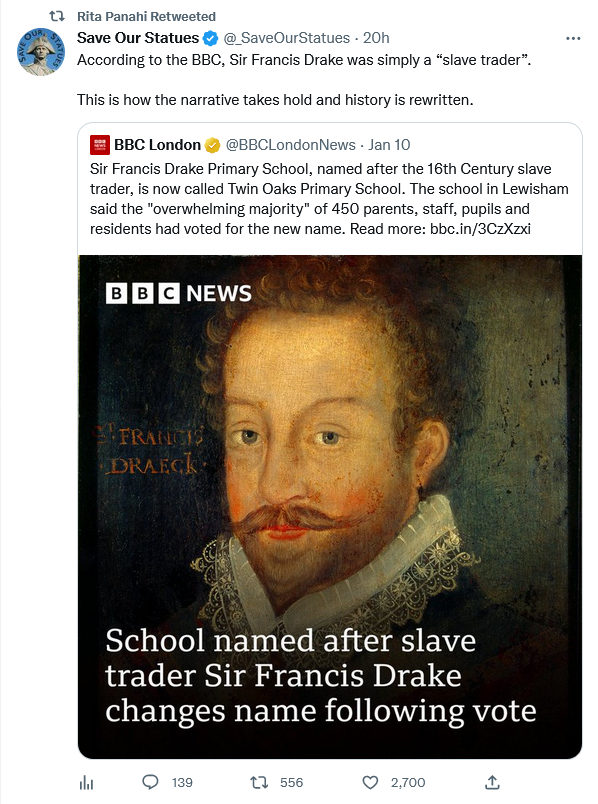
I want to know how these 460 people were selected among the school’s constituents.
Quotermeister, thanks for the link. All the myths were icluded in my University history classes. As I recall my Western Civ professor was a Harvard grad.
Compared to Drake’s global, massive successes, slavery would be a pinch of dust.
Go read Garrett Mattingly’s The Armada.
Agree with most of the refutations of the myths except Phillip II was intent on invading and removing Elizabeth I. He had ordered the Duke of Parma, long fighting in Flanders, to prepare transport and be ready for the cross-Channel jump. The Duke was unready – likely it was an impossible task given the heretics’ control of the inland waters and lack of shipping.
Also, the English galleons were far better sailers and their guns were far more accurate at distance than 90%+ of the Armada. England’s navy was an Atlantic navy. Spain’s was a Mediterranean.
Of course, Spain was not finished. Soon, significant victories were won in Flanders and Hilland. The ultimate decline took centuries.
The heretics damning one of their greatest heroes is beyond ironic.
The heretics damning one of their greatest heroes is beyond ironic.
They don’t have it in themselves to be heroes and they cannot bring themselves to admire it in others.
Destroying America and all Christian foundations, principles and values is their plan.