
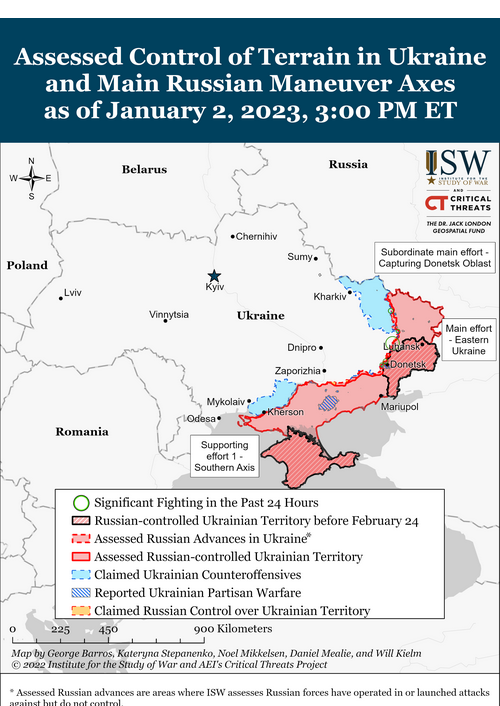
From The Institute For The Study of War:
Russian Offensive Campaign Assessment, January 2
George Barros, Kateryna Stepanenko, Angela Howard, Grace Mappes, Layne Philipson, and Frederick W. Kagan
January 2, 7 pm ET
Click here to see ISW’s interactive map of the Russian invasion of Ukraine. This map is updated daily alongside the static maps present in this report.
Ukrainian air defenses reportedly intercepted all drones from two consecutive nights of Russian drone strike attacks against Ukraine on December 31 – January 2. Ukraine’s air force reported on January 1 that Ukrainian air defense forces shot down all 45 Russian Iranian-made Shahed-136 drones that Russia fired at Ukraine on New Year’s Eve.[1] Ukrainian Air Force Spokesman Yuriy Ignat stated on January 1 that Ukrainian forces used the US-provided NASAMS air defense system to shoot down these drones.[2] The Ukrainian General Staff reported on January 2 that Ukrainian forces intercepted all 39 Shahed-136 drones launched against Ukraine between the night of January 1 and 2.[3] The Ukrainian General Staff again reported on January 2 that Ukrainian forces shot down all 27 Shahed-136 drones that Russian forces launched against Ukraine on January 2, though it is unclear if this figure includes the previously reported intercepts from the night between January 1 and 2.[4] Deputy Head of the Ukrainian Main Intelligence Directorate (GUR) Vadym Skibitsky reiterated on January 1 that Russian forces only have enough cruise missiles to conduct two to three more large-scale missile attacks against Ukraine.[5]
Russia’s air and missile campaign against Ukraine is likely not generating the Kremlin’s desired information effects among Russia’s nationalists. Russian forces conducted a cruise missile strike against an object in Khmelnytskyi Oblast — reportedly a base of the Ukrainian 8th Separate Special Forces Regiment — on December 31.[6] A Russian milblogger stated that the strike, while well-executed and a good information operation, is too little too late.[7] The blogger argued that Russia needed to systematically conduct such strikes earlier on in the war, that the strike should have had follow-up strikes to ensure maximum damage, and that the timing of this strike was inopportune since Ukrainian elements were unlikely to be at the base on New Year’s Eve.[8] The blogger noted that this was not the first time that Russian forces failed to deliver effective strikes due to an absence of secondary strikes and that Russia should generally be more thorough in its destruction.[9]
A devastating Ukrainian HIMARS strike on a Russian base in Makiivka, Donetsk Oblast, on December 31 generated significant criticism of Russian military leadership in the Russian information space. The Ukrainian General Staff reported that a Ukrainian precision strike on a Russian manpower and military equipment concentration point in Makiivka destroyed up to 10 pieces of equipment but did not release an official casualty number as of January 2.[10] The Department of Strategic Communications of the Ukrainian Armed Forces stated on January 1 that the strike killed 400 mobilized personnel and injured 300.[11] Geolocated footage published on January 1 also placed the aftermath of the strike at the Vocational School No. 19, fewer than 13km east of the frontline.[12] The Russian Ministry of Defense (MoD) acknowledged the strike, claiming that four of the six rockets killed 63 Russian servicemen.[13] Samara Oblast Governor Dmitry Azarov confirmed that among the deceased servicemen are residents of the oblast, and some Russian sources claimed that 600 servicemen of a mobilization regiment were in the school building at the time of the strike.[14] Some milbloggers claimed that the death count was about 110, with over 100 wounded personnel.[15]
The Russian MoD is likely attempting to deflect the blame for its poor operational security (OPSEC) onto Donetsk People’s Republic (DNR) officials and mobilized forces. DNR law enforcement officials told Russian state wires that the strike occurred when Russian servicemen violated operational security by using personal cell phones, allowing Ukrainian forces to conduct a precision strike at the base.[16] Kremlin-leaning outlets and some milbloggers amplified the claim, stating that Russian forces should not underestimate the Ukrainian ability to exploit poor OPSEC practices on the frontlines and called on the Kremlin to introduce stricter guidelines on cell phone use among servicemen.[17] Luhansk People’s Republic (LNR) Deputy Interior Minister Vitaly Kiselyov amplified milblogger reports that military commanders are demanding the resignation of DNR Head Denis Pushilin.[18] Some DNR public officials have also called for the punishment of the official who had decided to use the school.[19] The Russian MoD may have deliberately relied on the DNR officials to blame OPSEC violations on mobilized servicemen for the attack in an effort to make the DNR the responsible party.
The Russian MoD’s vague acknowledgment of the strike generated criticism towards the Russian military command, however. Wagner-affiliated milbloggers stated that Russian military command had made it easy for the Ukrainian forces to strike several hundred servicemen in one location, calling the DNR explanation of cell phone usage a “lie.”[20] A former Russian officer had also stated that Russian forces stored ammunition in the school’s basement, enabling the devastating strike.[21] Other milbloggers stated that the Russian command witnessed similar strikes throughout the past 11 months but were “criminally negligent” and failed to disperse the Russian forces quartered in Makiivka into smaller groups further in the rear.[22] Several milbloggers referred to a Putin statement about the necessity for the Ministry of Defense (MoD) to take accountability and listen to criticism on December 21 while calling on the Kremlin to punish the commander responsible for the OPSEC failures.[23] Wagner financier and avid critic of the Russian military command, Yevgeniy Prigozhin, offered an uncharacteristic and vague comment about the situation — stating that he could not reveal how Wagner prevents similar OPSEC problems.[24] ISW previously reported on two other instances of mass milblogger criticism: the failed Russian river crossing in Bilohorivka in May 2022 and the botched Russian offensive operation on Pavlivka in October 2022.[25]
Such profound military failures will continue to complicate Putin’s efforts to appease the Russian pro-war community and retain the dominant narrative in the domestic information space. Russian sources claimed that Russian President Vladimir Putin ordered the military and the Investigative Committee to investigate the incident in Makiivka by January 6.[26] Putin’s inability to address the criticism and fix the flaws in Russia’s military campaign may undermine his credibility as a hands-on war leader.
Russian sources responded lukewarmly to Russian President Vladmir Putin’s staged New Year’s address, while Russian milbloggers lauded Wagner Group financier Yevgeniy Prigozhin’s appearances on the frontlines over the New Year’s holidays. Several Russian milbloggers amplified social media criticisms that Putin used background actors rather than standing with real soldiers during his address.[27] These criticisms and a chain of Putin’s canceled public appearances and meetings with ordinary citizens may show Putin as out of touch. One pro-Kremlin milblogger acknowledged the debate via an editorial in a popular Russian newspaper in which he vehemently denied that Putin used actors at his speech.[28] Former militant commander and prominent Russian milblogger Igor Girkin drew a direct comparison between Putin and Prigozhin.[29] Girkin posted that he would not comment on Putin’s speech but that Prigozhin decided to fight bureaucracy and corruption and gave a sensational New Year’s speech.[30] Meanwhile, several Russian sources praised Prigozhin for a series of appearances with real Russian soldiers on the frontlines in Ukraine on New Year’s Eve and New Year’s Day.[31]
Prigozhin used reporting on deceased Wagner Group mercenaries and his prominence in New Year’s features to continue to push for legal recognition of Wagner Private Military Company (PMC) and to criticize bureaucrats not favorable to Wagner PMC. Prigozhin continues to seek increased legitimization of and state benefits for Wagner forces, although private military companies are illegal in Russia.[32] Prigozhin told a reporter who questioned why Wagner soldiers’ relatives are not receiving the bodies of their deceased soldiers that Wagner forces took care of the dead even on New Year’s while the Russian government, which is supposed to provide death certificates, has “[rested] since the beginning of the war.”[33] Prigozhin accused bureaucrats of desecrating the memory of the dead by treating dead servicemembers as objects in plastic bags.[34] Prigozhin publicly visited a Wagner-specific cemetery and memorial and the main base of the Wagner Group in Krasnodar Krai on January 1.[35] Prighozhin has previously complained that Russian authorities refuse to allow for the burial of Wagner mercenaries in Russian military cemeteries, as ISW has reported.[36]
The Kremlin is likely co-opting some Russian milbloggers who are willing to sell out in exchange for political prestige. Prominent Russian milbloggers Alexander Sladkov and Yevgeniy Poddubny attended the Kremlin primetime New Year’s Eve television show Goluboy Ogonek 2023 in Moscow on December 31.[37] This program airs immediately after Putin’s annual New Year’s Eve speech and is attended by Putin and Kremlin political and cultural elites. Sladkov and Poddubny have both criticized the Russian military’s failures in Ukraine. The creators of the prominent Telegram channel Rybar had also stated that they received offers to create an open-source intelligence (OSINT) program to benefit Russian private businesses and force structures.[38] Rybar added that they already gave a lecture at the elite Russian state-run Moscow State Institute of International Relations (MGIMO) and are continuing to work in Putin’s “special military operation” working group.
Key Takeaways
- Ukrainian air defenses reportedly intercepted all drones from two consecutive nights of Russian drone strike attacks against Ukraine on December 31 – January 2.
- Russia’s air and missile campaign against Ukraine is likely not generating the Kremlin’s desired information effects among Russia’s nationalists.
- A devastating Ukrainian HIMARS strike on a Russian base in Makiivka, Donetsk Oblast, on December 31 generated significant criticism of Russian military leadership in the Russian information space.
- The Russian MoD is likely attempting to deflect the blame for its poor operational security (OPSEC) onto Donetsk People’s Republic (DNR) officials and mobilized personnel.
- Russian sources responded lukewarmly to Russian President Vladmir Putin’s staged New Year’s address, while Russian milbloggers lauded Wagner Group financier Yevgeniy Prigozhin’s appearances on the frontlines over the New Year’s holidays.
- Russian forces continued to carry out unsuccessful attempts to improve their tactical positions northwest of Svatove after reportedly conducting a tactical pause.
- The Ukrainian Center for Defense Strategies reported that Russian forces are continuing to deploy personnel on the Kharkiv-Siversk frontline.
- Ukrainian officials reported that Russian forces are redeploying along the eastern axis while struggling to maintain their pace of artillery strikes.
- Russian forces attempted limited offensive operations in Zaporizhia Oblast and continued efforts to reinforce defensive structures.
- Russian President Vladimir Putin continues to extend financial promises made to Russian soldiers as Ukrainian officials continue to warn of an impending wave of Russian mobilization.
Go here to read the rest. The year begins as it ended with the Russians playing, and losing, at war.

