

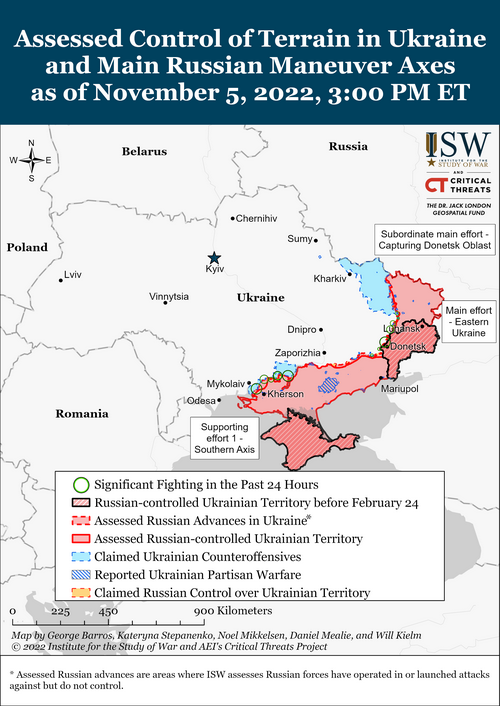
From The Institute For The Study of War:
Karolina Hird, Kateryna Stepanenko, Riley Bailey, Angela Howard, and Mason Clark
November 5, 6:30 pm ET
Click here to see ISW’s interactive map of the Russian invasion of Ukraine. This map is updated daily alongside the static maps present in this report.
Wagner Group financier Yevgeny Prigozhin seeks to obfuscate his efforts to strengthen his independent power base with an appeal to the concept of Russia’s historic unity. Prigozhin provided a vague response to a media inquiry regarding his recent visit to Kursk Oblast on Russia’s Unity Day (November 4), during which he had indirectly implied that Wagner forces are involved in upholding Russia’s unity.[1] Prigozhin stated that Russian people, businesses, government, and army need to come together to fight for Russia’s sovereignty and its great future while deflecting from the journalist’s question regarding Prigozhin’s reported meeting with Kursk businessmen about the organization of an unspecified people’s militia – outside of formal Russian military command structures. Prigozhin also noted that Russia has all the ingredients to achieve its goals including a strong president, cohesive army, and great nationhood, which he concluded with an out-of-place greeting from Wagner fighters. Prigozhin later claimed in a follow up media response that his “independence” does not contradict Russian President Vladimir Putin’s politics as some audiences have interpreted.[2]
Prigozhin’s rather sarcastic statements have several underlying implications for his perception of his power within Russia. ISW previously reported that Kursk Oblast officials announced the construction of second and third lines of defenses in the region, and if Prigozhin’s meeting with local businessmen took place, may indicate that he is attempting to expand his influence in the region.[3] Prigozhin’s comment on Russia’s “cohesive army” next to Putin was likely thinly-veiled sarcasm, given that Prigozhin has repeatedly criticized the Russian Armed Forces on numerous occasions.[4] Prigozhin also directly recognized that he is an independent entity, which as ISW previously assessed, relieves him of some obligations to the Kremlin and the Russian Ministry of Defense (MoD).[5] Putin’s dependency on Prigozhin’s forces around Bakhmut also allows Prigozhin privileges such as voicing his criticisms of the Kremlin or the Russian Armed Forces without significant ramifications. Prigozhin has also coincidentally opened his Wagner Center in St. Petersburg on Russia’s Unity Day.[6] However, Prigozhin is notably shielding his efforts to build an independent power base and shape the conduct of Russia’s invasion of Ukraine with language focused on Russian Unity – likely both to appeal to Russian nationalists and civilians and to deflect criticism of his fairly overt efforts to build an independent power base.
Prigozhin continues to rely on ineffective convicts to staff his forces. Prigozhin declined to comment on a reporter’s question regarding ongoing recruitment drives at Krasnoyarsk Krai penal colonies, despite previously openly discussing prisoner participation in the war with Russian outlets like RiaFan.[7] Russian opposition outlet The Insider, however, found that over 500 prisoners recruited into Wagner units have died in the past two months.[8] The publication added that Wagner lost between 800 and 1,000 mercenaries in Ukraine, indicating convicts comprise a large proportion of Wagner’s forces in Ukraine. Ukrainian intelligence officials also previously reported that many prisoners suffering from infectious diseases infected Wagner troops, to which Prigozhin responded that he does not discriminate on the basis of illness.[9]
Iranian Foreign Minister Hossein Amir-Abdollahian confirmed that Iran sent Russia combat drones. Amir-Abdollahian stated on November 5 that Iran “gave a limited number of drones to Russia months before” the war in Ukraine.[10] Amir-Abdollahian also claimed that if Ukrainian officials could prove that the Russian military has used Iranian-made drones in Ukraine then Iranian officials would “not be indifferent” to the concern – falsely and ridiculously implying that Russia has not used the drones that he admitted Iran has provided.[11] Iran’s confirmation of the drone shipments further supports ISW’s previous assessments that Russia is sourcing Iranian-made weapons systems to address the depletion of its high-precision munitions arsenal.[12] ISW previously assessed that Iran is likely already exploiting Russian reliance on these Iranian-made weapons systems to request Russian assistance with its nuclear program.[13] The nuclear assistance requests and the recognition of the drone shipments are both indicators that Iranian officials may intend to more clearly establish an explicit bilateral security relationship with Russia in which they are more equal partners.
Former Donetsk People’s Republic (DNR) Security Minister and current DNR military commander Aleksandr Khodakovsky claimed on November 5 that Russian friendly fire may have caused up to 60% of total Russian losses since the end of Russian offensive operations in Mariupol in mid-May.[14] Even if this statistic is exaggerated, the fact that a Russian commander is publicly speculating on such a damning indicator of Russian and proxy competency indicates the deep challenges Russian forces face. Friendly fire typically does account for a limited number of losses in war but ordinarily nowhere near 60% of total casualties, which demonstrates a lack of communication and command and control coordination between Russian forces. Russian and Ukrainian sources also reported that a Russian rotation returning to its base near Pavlivka, Donetsk Oblast on November 5 drove into a ditch constructed by army subcontractors without prior discussion or warning, further demonstrating a widespread lack of cross-training and coordination between Russian troops.[15] The frequent replacement of Russian military leaders, promotion of inexperienced soldiers, and cobbled-together Russian force composition including Russian contract soldiers, Russian mobilized soldiers, DNR and Luhansk People’s Republic (LNR) forces, and Wagner Group forces exacerbate the fragmented nature of the Russian chain of command and ineffectiveness of Russian forces and likely contributes to frequent friendly fire incidents.
Key Takeaways
- Wagner Group financier Yevheniy Prigozhin seeks to obfuscate his efforts to strengthen his independent power base with an appeal to the concept of Russia’s historic unity.
- Iranian Foreign Minister Hossein Amir-Abdollahian confirmed that Iran began providing Russia drones before February 24, but strangely denied that Russian forces have used them in combat.
- DNR military commander Aleksandr Khodakovsky claimed that Russian friendly fire may have caused up to 60% of total Russian losses since mid-May.
- Ukrainian troops reportedly continued counteroffensives along the Svatove-Kreminna line.
- Russian forces continued to set up defensive positions along the Dnipro River.
- Ukrainian forces continued to target Russian logistics and transportation in Kherson Oblast.
- Russian forces continued to attack around Bakhmut and claimed unspecified advances.
- Russian forces continued unsuccessful offensive operations in the Avdiivka-Donetsk City area and in western Donetsk.
- Continued poor conditions for mobilized soldiers catalyzed a large-scale protest in Kazan.
- Unknown actors reportedly attempted to assassinate high-profile Donetsk People’s Republic (DNR) Supreme Court Judge Aleksandr Nikulin.
- Russia continues to deploy personnel to staff administrative positions in occupied areas.
- Russian forces continued forced evacuations in Kherson Oblast. Over 80% of Kherson residents reportedly have evacuated.
Go here to read the rest.
From Strategy Page:
November 5, 2022: SADARM (Search And Destroy Armor Munitions)-equipped 155mm artillery shells proved so successful in Ukraine against armored vehicles that over 20,000 of these shells were provided to the Ukrainian forces in the last five months. Unlike the United States, Germany produced these shells mainly for use against local threats, like Russia. The Ukraine war saw the Russians using thousands of tanks and losing most of them to Ukrainian troops armed with Western anti-tank weapons featuring top-attack capability.
SADARM tech was developed during the 1980s, perfected in the 1990s and when it was sent to Ukraine, it turned towed and self-propelled artillery into very effective anti-vehicle weapons. SADARM was able to destroy all sorts of vehicles and, because of flaws in tank design and protection, especially Russian tanks. Ukraine asked for all the SADARM shells NATO nations could provide and most European NATO members sent nearly all SADARM shells they had.
Germany, Britain, Italy and Sweden manufacture 155mm artillery shells carrying two each Sense and Destroy Armor Munitions. Originally called SADARM munitions by its American developer (Textron), it had completed development when the Cold War suddenly ended in 1991. SADARM was not as effective as expected and the 155mm version was canceled in 2001. The U.S. Air Force has more success with the SADARM submunitions used in the CBU-105 cluster bomb (40 submunitions per half-ton cluster bomb) because a bomb undergoes much less stress when used than an artillery shell. The air force and six export customers purchased hundreds of these bombs but sales were not high enough to keep CBU-105 in production after 2017.
Meanwhile the U.S. Army noticed the success of an improved German SADARM shell called SMART as well as the similar Swedish Bonus. Both entered service in 2000 and both were successful as “Improved SADARM”. The U.S. Army began ordering BONUS shells in 2018 and ordered more in 2020.
BONUS is described as a fire and forget guided 155-millimeter ammunition designed for destroying armored targets. BONUS was a joint project by Britain, France and Sweden with the Swedes taking the lead in production. BONUS can be fired from standard NATO 155mm artillery and has a maximum 35-kilometer effective range. The round carries two submunitions, each with their own multiband IR (heat) sensors backed by laser radar. BONUS uses small winglets to slow its descent rather than small parachutes that are used in earlier similar submunitions, like the German SMART shell. The parachutes are easier to spot and more expensive and complex to use.
The submunitions separate from the shell over the target location (using a time-on-target fuze) about 175 meters above the target areas and scan for targets. Each warhead can scan about 32,000 square meters and hit even moving targets within that area. The destruction is achieved by an Explosively Formed Penetrator (EFP) able to punch through more than 130 mm (five inches) of armor. This doesn’t seem like much but the tank armor is strongest at the front and not at rear or top. The only defense against this “top attack” EFP is APS (Active Protection Systems) such as Trophy, but even these have difficulty dealing with things like EFPs. The APS systems work great against HEAT warheads because these disperse cumulative streams of superheated gasses, but not against molten metal projectiles formed by an EFP. Moreover, thanks to two submunitions per shell, the artillery halts for a shorter time to fire, so they are less likely to get caught by enemy counter-battery fire. The major defect of SADARM shells is that they are more expensive than GPS guided Excalibur shells.
Each submunition weighs 3.4 kg (7.5 pounds) and uses 945 g (2.08 pounds) of Octol explosives, which was designed to effectively form the self-forging penetrator. Most of the submunition weight goes to the sensors (including batteries) and design elements that slow descent and rotate the sensors to find a target. The use of batteries and various types of explosives in a SADARM shell means they have a limited shelf life. After twenty years or so, SADARM shells must be refurbished or disposed of. Many of the European SADARM shells were approaching their expiration date so it made sense to send all the old, but still functional, ones to Ukraine. Now these SMART and BONUS shells must be replaced. Germany found that many of the key components were no longer available and had to invest over hundred million dollars to revive production. Initially, Germany has ordered 10,000 new SMART shells at a cost of $81,000 each. Because of the components problem it will take five years or more before production is completed. The only new SADARM shell is the Italian V9lcano 155 shell. Several hundred of these were sent to Ukraine because the Volcano shell is currently completing development. Ukraine will get to test the new shell. There are two versions of Volcano 155; one that is similar to SMART and BONUS but with a range of up to 50 kilometers. The Volcano 155 GR has a range of up to 70 kilometers and includes GPS guidance to ensure the shell arrives at the target location. If the war goes on into 2023, the Volcano GR may reach Ukraine.
These SADARM shells plus the effective Ukrainian use of battlefield surveillance UAVs (most of them developed and produced by Ukraine) were a key factor in Russia losing so much territory in the last four months. Russia was forced to keep its armored vehicles away from the front line unless urgently needed. Even then, there were not enough Russian armored vehicles or artillery (self-propelled or towed) left to use. Ukraine used regular and some GPS artillery shells to hammer Russian supply storage sites, towed artillery, supply trucks and headquarters within range. American satellite surveillance also provides some target information, but not as quickly as Ukrainian UAVs and frontline troops.
The original American M898 SADARM dates back to the late 1970s when the army started to look for a “smart” anti-armor 155 mm projectile. About a decade later SADARM had been developed and prototypes built but budget restrictions in 1990 slowed down the program. In 1993 the first tests were unsatisfactory because SADARM hadn’t been able to hit a moving target and overall accuracy was poor. The manufacturer promised to improve the technology, and a year later the program was approved for limited low-rate production. Unfortunately for SADARM the later (1995, 1998 and 1999) tests showed only a little improvement. In all trials, the SADARM struggled to get an 80 percent reliability rate. This together with significant cost overruns were reason enough to end production in 2001. This failure did not mean the end of the SADARM SFW submunition technology, which was subsequently adopted by the U.S. Air Force as well as the developers of the SMART and BONUS shells who achieved effective reliability in the late 1990s. The submunition was always meant to be carried by a wide variety of projectiles including MLRS rockets, mortar shells and cluster bombs.
Reliability of the SADARM submunition improved enough to work as the payload of CBU-105 half ton cluster bombs. Each of these bombs carries and disperses 40 submunitions Each SADARM submunition has its own radar and heat sensor that searches for armored vehicles below and destroys them. SADARM sensors can search and attack vehicles within an area of roughly 150 x 360 meters as they slowly descend. The self-forging metal projectile used by the SADARM submunition punches through the thinner armor on the top of the vehicle. If a target is not found, SADARM self-destructs. CNU-105 has not shown up in Ukraine because the Russians rarely use large enough concentrations of armored vehicles to justify use of CBU-105. Ukraine prefers to save its aircraft for air defense and use artillery and guided rockets for distant targets.
Go here to read the rest.
Kherson will almost certainly fall early last week. The Russians seem to be trying to delay this long enough to prevent the Ukrainians having enough time prior to the onset of winter to cross in force to the east side of the Dnieper





A big wild card is the November 8 election. I suspect it will be more difficult for this “Administration” to provide help for Ukraine
I wonder how much friendly fire is premature detonation of aging or faulty munitions.