

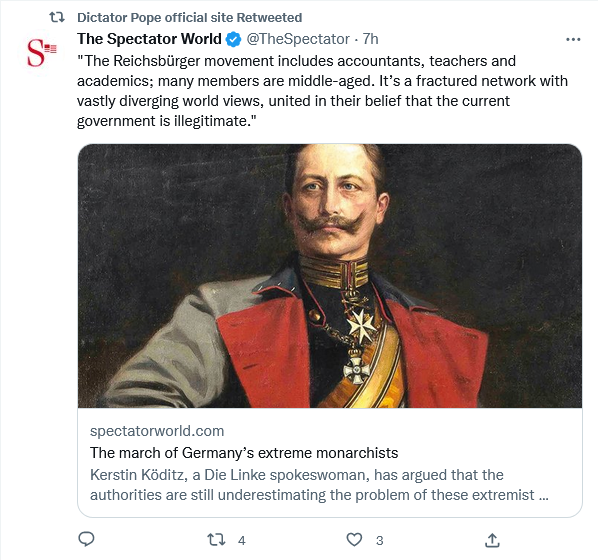
“Things were so much happier here in Germany when we had an Emperor, oh boy! What am I saying? That’s treason. I say nothing!
Sergeant Hans Schultz, Hogan’s Heroes
Go here to read the story. Longing for Kaiser Bill, unless in comparison to Der Fuhrer, seems perverse.
You [recruits] have sworn loyalty to me. You have only one enemy and that is my enemy. In the present social confusion it may come about that I order you to shoot down your own relatives, brothers or parents but even then you must follow my orders without a murmur.
Kaiser Wilhem II, November 23, 1891
Ah, Kaiser Bill. In World War I he became a monstrous figure in Allied propaganda, a bloodthirsty ghoul thirsting for world conquest. The reality was rather different. This grandson of Queen Victoria, who spoke English fluently with only a trace of an accent, fancied himself an autocrat of supreme genius to be feared and obeyed. Actually he was a weak-willed man of limited intelligence, easily dominated by those around him if they were craftier than him, which was not a high bar to clear. His tendency to give blood curdling, tough guy utterances, was the dismay of every German government during his reign. Otto von Bismarck, the Iron Chancellor who made the Second German Reich, and who the young Wilhelm II dismissed from office, had the measure of his sovereign, who he regarded as a blundering young idiot who would lead Germany to ruin. That was an accurate assessment. The Kaiser was the worst type of fool, one who regarded himself as a genius and had no clue as to his limitations. During World War I the Kaiser became a sad, pathetic figure, as the Army increasingly ran Germany, paying only lip service to him as Supreme War Lord. Lusting for conflict throughout his reign, he was dismayed as millions of German youth died in the war that he so long had wished for. In his long years of exile in Holland, he died in 1941, he continually blamed the Jews and the English for his downfall, and never demonstrated any insight at all as to the dismal role he played in propelling Germany down the path that led to Hitler, a man who had nothing but contempt for the man in whose Army he had served.
Go to 1:35: 46 to see how Imperial Germany managed to enlist the US among its enemies. The confrontation between President Wilson and the German Ambassador is fictional, the German policies described are not. No, any nostalgia for Imperial Germany is mistaken by Germans in my opinion.



No, any nostalgia for Imperial Germany is mistaken by Germans in my opinion.
Why? It was an affluent country with a vigorous military, a vibrant public life, and accomplished in many endeavours.
and never demonstrated any insight at all as to the dismal role he played in propelling Germany down the path that led to Hitler,
There was no ‘path that led to Hitler’. The period running from 1918 to 1933 was not an integral whole, much less the period running from 1890 to 1933. Hitler’s ascent in 1929-33 required a perfect storm of bad decisions by Germany’s political class. The exiled Kaiser had no part in that.
Why? It was an affluent country with a vigorous military, a vibrant public life, and accomplished in many endeavours.
It was an Army with a country Art. World War I was inevitable and could have broken out a half dozen times prior to 1914 due mostly to the bellicosity of Imperial Germany under the Kaiser and the outsized role the Army played in foreign policy.
There was no ‘path that led to Hitler’.
Beg to differ Art. Defeat in World War I and the fall of the German Empire were the two necessary ingredients for the rise of the Nazis under Hitler. The only other ingredient the Nazis needed was hard economic times. Short lived Weimar prosperity delayed their ascent to power but did not stop it.
It was an Army with a country Art.
This statement does not make any sense.
World War I was inevitable
Political scientists promote the idea that you can derive mechanistic norms from observing political life. That doesn’t mean you have to take it seriously.
Defeat in World War I and the fall of the German Empire were the two necessary ingredients for the rise of the Nazis under Hitler. The only other ingredient the Nazis needed was hard economic times. Short lived Weimar prosperity delayed their ascent to power but did not stop it.
Perhaps necessary, not sufficient. A number of contingencies might have broken the other way and derailed Hitler. The volkisch element in the German electorate was never that numerous prior to 1930. During the entire period running from 1893 to 1929, their level of support bounced around 2.5% of the electorate. They did notably better than that just once, in 1924, when Hitler and Gen. Ludendorff formed an electoral pact. It took the loss of the war, the hyperinflation of 1922-23, and the economic implosion in 1928-32 to create a constituency for Hitler. Sensible monetary policy in 1922 or in 1930 might have contained the Nazi Party’s support to the usual level for a volkisch outfit. Or, had Karl Jarres been elected President in 1925 and not the senescent and manipulable Hindenburg.
This statement does not make any sense.
What part did you fail to understand Art? The observation was made originally as to Prussia and was commonly applied to Imperial Germany, denoting in both cases the unusual role the Army played in both states.
A number of contingencies might have broken the other way and derailed Hitler.
Other than his death or decades long prosperity for Weimar, Hitler and his party were poised to take power once the conventional parties ran into bad economic times. Hitler and the Nazis provided Germans a way out of a dismal present into what they portrayed as a glorious future. Unlike normal parties, they remained ceaselessly active between elections, growing their membership and the geographical reach of the party.
Sorry, Art, but Mr. McClarey is right. Imperial Germany’s lust for empire and its “day in the sun” did indeed lead to Hitler.
No love lost here for Wilhelm, who referred to Poles as dogs who should just die.
The Germans (Prussians) instigated the final downfall and partition of the Polish Lithuanian Commonwealth. Throw in the Kulturkampf, and Ludendorff’s support of Lenin…and you have a rotten empire. Germany got off easy in WWI. Germany was not invaded or occupied. Germany had to give up its puny empire and leave Greater Poland after the Poles threw them out. What an affront.
One correction:
The German national anthem in WWI was a tune set to “God Save the King”, not “Deutschland uber alles”. That tune (originally Hayden’s birthday present to Holy Roman Emperor Francis II) was used for the Austrian Imperial anthem.
The problem was not the Army, it was Prussia, and its ambition to dominate the German states and Eastern Europe. Bismarck wanted that domination to be economic, not military, and could have succeeded if Frederick III had not died so young. Since Prussia is extinct, a new German monarchy could conceivably built on another dynasty not associated with Hohenzollern. Historically the Emperor was elected, and that tradition could serve, if anyone was interested.
I have no dog in such a fight, but as a German-American (part Upper Rheinlander) I’m tired of the relentless equation of German = Nazi, and the endless groveling people expect from a thousand-year-old culture for two horrible decades. As for the Kaiser: surely Napoleon was no better morally, but the French have no trouble celebrating him.
Aside from getting [what?] 20 million killed in WWI and unrestricted submarine terror war, everything was . . .
BTW. They tragically learned they couldn’t take over Europe and the World by industrialized terror and violence. Now, they’re learning they don’t know crappola about World leadership by economics and policy.
Anyhow, “Higan’s Heroes” was entertainment and farce.
Correct. Weimar Germany adopted it as the national anthem of Germany in 1922, although the song was popular in what would become Germany from 1848.
As for the Kaiser: surely Napoleon was no better morally, but the French have no trouble celebrating him.
Napoleon was certainly better for the Poles and the Jews than the Kaiser. Napoleon was also quite possibly the greatest general in the history of the world, while the Kaiser was a blowhard of limited intelligence.
Sorry, Art, but Mr. McClarey is right. Imperial Germany’s lust for empire and its “day in the sun” did indeed lead to Hitler.
No love lost here for Wilhelm, who referred to Poles as dogs who should just die. The Germans (Prussians) instigated the final downfall and partition of the Polish Lithuanian Commonwealth. Throw in the Kulturkampf, and Ludendorff’s support of Lenin…and you have a rotten empire. Germany got off easy in WWI. Germany was not invaded or occupied. Germany had to give up its puny empire and leave Greater Poland after the Poles threw them out. What an affront.
I don’t get paid to listen to you free associate.
Poland was jointly partitioned by Russia, Prussia, and the Hapsburgs, an event which occured > four generations before Hitler took power and was a consequence of the refractory character of Poland’s nobility. Around 22% of the ethnic Poles in eastern Europe were located in one of four provinces of Prussia in 1910 – mixed in with Germans and a majority some places, a minority in others. (About 1/2 of all Poles were in Tsarist Russia’ “Kingdom of Poland”, the rest in one of two Hapsburg provinces). Collectively, they amounted to about 5% of the German Empire’s population; I have no clue why you find this of interest in this discussion, even if the Kaiser’s insult is something other than apocryphal .
The kulturkampf was a set of tangles between the Reichstag and the Bismarck ministries on the one hand and the Church on the other. In its acute phase, it went on for about a half-dozen years. Again, no clue why you think these disputes are salient in regard to regime breakdown 50+ years later. I suspect if you did an inventory, you’d discover the contention was less injurious to the Church than contemporary French policy, so I guess the 3d Republic was rotten too. For reasons of state, the German government permitted Lenin’s part to traverse their territory in March 1917, so in your mind that implicates the German government in every single thing the Russian communists did subsequently and makes the whole German state and society rotten.
Whatever the German Empire was or was not, it was not ‘puny’. Portions of Silesia, Posen, and West Prussia were awarded to the reconstituted Polish state by the Treaty of Versailles; I’ve no clue why you fancy this was consequent to some sort of Polish uprising.
Of course, none of this bears any relation to the breakdown in the German political order in 1929-33.
Other than his death or decades long prosperity for Weimar, Hitler and his party were poised to take power once the conventional parties ran into bad economic times.
The Nazis won 3% of the vote in the 1928 elections. They were a small sect and of only modest consequence. The Communist Party had prior to 1930 a popular base 4x as large as the Nazis and financial pipelines from Soviet Russia. The Nazis had a couple of advantages in 1930 – they weren’t implicated in any of the three disasters which had hit the country since 1914 and they weren’t the Communist Party. The thing is, both the 1922-23 disaster and the 1928-32 disaster were a function of bad policy. Policy reversals would have contained or prevented them, as eventually happened in both cases. The same man, Hjalmar Schacht, conceived and implemented the policy adjustments on both occasions. He’d been appointed not by Hitler but by Franz von Papen. Hitler retained him. (He spent the last years of the war in a concentration camp. After the war, numskulls put him on trial at Nuremburg). Germany did not need ‘decades of prosperity’. it needed to get through one particular economic crisis. Just devaluing the currency in 1930 might have done the trick. A number of other European countries weathered the crisis and in some of them the constitutional system broke down; Germany’s misfortune was that the man in the wings was a malevolent kook. Germany needed a Svinhufvud or a Dollfuss and what they had in the toolbox was Hitler.
A couple of points from a German-American whose paternal and maternal family emigrated to the US when they determined that Wilhelm II was quite unhinged. A war, though not necessarily worldwide, was inevitable. France would be forever committed to recovering Alsace and Lorraine, lost to Germany in 1871. Also, had Frederick III, Wilhelm’s more moderate father, lived Germany’s diplomatic activities might not have been so influenced by the military and its glory hounds. Finally, the activities of the Allies at Versailles, though understandable, were quite short sighted and somewhat surprising as they had the example of the mess that Russia had become. Sensible state craft would have opted for a strong and effective central Europe rather than a weak one that was always one step away from collapse and/or conflict. Alas, there was no Metternich and his foil Tallyrand to carry the flag of pragmatism.
They were a small sect and of only modest consequence.
They were a growing party led by a national, and charismatic for many Germans at that time, figure who offered a completely different path for Germany from that being offered by the conventional parties. Hitler made no bones about the fact that after the Nazis achieved power by the ballot box, they intended to do away with the ballot box. The Communists in Germany helped as an excuse for the necessity of the Nazi party. The Nazis were ready to seize power once a substantial portion of the German people lost confidence in parliamentary democracy.
From “The Ex-Kaiser” in Great Contemporaries by Winston S. Churchill (1937)
Kaiser Wilhelm I & his grandson were both baffoons. It would have been a better world and less bloody century had Frederick III lived.
A little testy, aren’t you, Art? Put bluntly, I don’t need a history lesson from you. I know damn well how the Commo wealth came to an end. It was divvied up by three ethnic Germans (Austrians are Germamic). Frederick counterfieted Polish currency to destroy the Polish economy amd then melted down the Polish crown jewels.
There is a 40 minute progrsm produced by the Polish state TV network TVP that goes into detail what the German Empire did to Poland.
As for the Kulturkampf, my mother is mostly German and her ancestors, named Decker, ended up in the USA from Frankfurt because of the Kulturkampf.
Versailles Treaty or not, Poland had to fight to get back Wielopolska (Greater Poland).
Thomas Sowell has an excellent video on YouTube about the German people. Sowell is obe pf the great minds of this or any age and he profusely praises the German people and their accomplishments.
Where Germany has fallen short is its politics and its sins of political aspirations.
An immense responsibility rests upon the German people for their subservience to the barbaric idea of autocracy. This is the gravamen against them in history—that, in spite of all their brains and courage, they worship Power,
Wilhelmine Germany was not an autocracy and the mundane responsibility for policy implementation lay with the Imperial Chancellor and other ministers. The German Emperor had more discretion than the British King; he still had to contend with other power centers, the Reichstag foremost among them. We do not benefit from 1,000 words worth of bafflegab from Winston Churchill based on premises which were false and which he had to have known were false.
A little testy, aren’t you, Art? Put bluntly, I don’t need a history lesson from you.
You need to focus on the subject under discussion. The partition of Poland is irrelevant to the subject under discussion. You would benefit from a history lesson from someone.
They were a growing party led by a national, and charismatic for many Germans at that time,
Median performance for volkisch organizations was about 2% of the electorate in 1893-1912 and 3.5% in 1919-28. The one time they did appreciably better was in the election of May 1924, when the Nazis set up a joint list with Gen. Ludendorff’s organization, which was initially staffed with disaffected members of the National People’s Party. Ludendorff shortly broke with Hitler’s men on the outside and subsequently dissolved his organization. By the end of 1924, the volkisch parties had lost half the support they’d had in May and they did not do any better in 1928. Any ‘growing’ they’d done was between 1920 and 1924.
Wilhelmine Germany was not an autocracy
Correct Art, but it was far from a parliamentary democracy. The Kaiser would have been close to a dictator in vast areas of the Executive if he had the ability to do so. What happened in practice is that his titular subordinates worked around him, usually presenting him with fait accomplis.
Median performance for volkisch organizations
Electoral performance was only a small part of the inherent power of the Nazi party. It was this power which caused Hitler to receive a slap on the wrist sentence of five years after having been convicted of high treason and then being pardoned by the Bavarian Supreme Court a few months later. After getting out Hitler devoted himself to speeches and left the growth of the party to some extremely talented men who turned the Nazi party into a mass organization. They also engineered the take over of smaller Nationalist parties with Hitler becoming the acknowledged leader of almost all organized German nationalist groups. Without the Great Depression I doubt that the Nazis would have taken power, but they prepared themselves well for the opportunity when it arose.
It was this power which caused Hitler to receive a slap on the wrist sentence of five years after having been convicted of high treason and then being pardoned by the Bavarian Supreme Court a few months later.
I’ll suggest it wasn’t power, but the biases of the German judiciary at work. Gen. Ludendorff was working with Hitler at the time (and was acquitted at trial).
Don and Art:
According to Paul Johnson, the problem was the Prussian military-industrial aristocracy, who felt that they had won the essential war (in the east, against Russia) and that Germany was betrayed by the Armistice. They didn’t care about the Emperor (and Wilhelm I had to be persuaded by Bismarck to accept the title, for which he never bothered to commission a physical crown), only about power. Johnson suggests they bided their time, hid and developed assets for war materiel that the Armistice required be destroyed, and when they saw the popularity of the Nazis and their opposition to Communism (of which they were terrified), came to support the movement. So what came to power on ’33 was a populist fascist movement cobbled together with the old Prussian officer class.
As history, shows, it didn’t hang together very well and neither faction completely trusted the other. Hitler hadn’t Stalin’s management skills and German industry and the military struggled with directions that often made no strategic sense, part of why they lost the war, ironically to the same people they feared: Russians and Communists.
According to Paul Johnson, the problem was the Prussian military-industrial aristocracy,
AFACT, the social background of Hitler’s cabinets was all over the map. Half a dozen or so came from the nobility or the career military, Two were gone from the government by the summer of 1934, a third by February 1937. One was a senior officer who held office from 1938 to 1941. Most of the noblemen and hereditary knights weren’t Prussian either.