
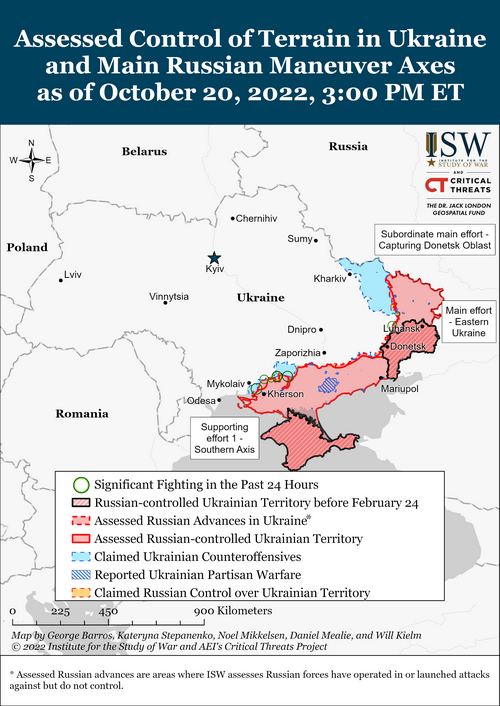
From The Institute For The Study of War:
Karolina Hird, Katherine Lawlor, Riley Bailey, George Barros, Nicholas Carl, and Frederick W. Kagan
October 20, 7:00pm ET
Click here to see ISW’s interactive map of the Russian invasion of Ukraine. This map is updated daily alongside the static maps present in this report.
Russia is likely continuing to prepare for a false flag attack on the Kakhovka Hydroelectric Power Plant (HPP). Ukrainian President Volodymyr Zelensky stated on October 20 that Russian forces mined the dam of the Kakhovka HPP and noted that the HPP holds over 18 million cubic meters of water, which would cause massive and rapid flooding of settlements along the Dnipro River, including Kherson City.[1] Zelensky emphasized that the flooding would impact hundreds of thousands of people.[2] Russian sources, however, continued to accuse Ukrainian forces of shelling the Kakhovka HPP and have widely circulated graphics depicting the flood path in the event of a dam breach.[3] As ISW reported on October 19, Russian sources are likely setting information conditions for Russian forces to blow the dam after they withdraw from western Kherson Oblast and accuse Ukrainian forces of flooding the Dnipro River and surrounding settlements, partially in an attempt to cover their retreat further into eastern Kherson Oblast.[4] Continued Russian preparation for a false-flag attack on the Kakhovka HPP is also likely meant to distract from reports of Russian losses in Kherson Oblast.
Russian forces are likely setting conditions to remove military and occupation elements from the west bank of the Dnipro River in anticipation of imminent Ukrainian advances. Kherson City Telegram accounts claimed on October 20 that Russian forces disbanded and looted a fire station in Kherson City and ferried fire trucks, stolen civilian cars, and other miscellaneous household items across the Dnipro River to Hola Prystan.[5] ISW cannot independently confirm those reports. The Ukrainian service of Radio Free Europe / Radio Liberty also reported on October 20 that Russian forces are moving military equipment from the west bank to the east bank of the Dnipro River in the face of recent Ukrainian advances, and posted satellite imagery that shows a Russian cargo ferry traveling across the Dnipro River from Kozatske (west bank) to Nova Kakhovka (east bank).[6] Radio Liberty noted that the ferry is fully loaded when it arrives at Nova Kakhovka and empty when it returns to Kozatske and suggested that this movement has been ongoing since early October.[7] Taken in tandem, these reports indicate that Russian troops are likely deliberately removing large amounts of personnel and equipment from the west bank of the Dnipro River. Russian forces have likely learned, at least in part, from their failures during the panicked Russian retreat from Kharkiv Oblast in the face of a previous Ukrainian counteroffensive. The militarily sensible thing would be to remove men and equipment in good order to avoid another devastating rout. Such a rout in Kherson could trap Russian forces and equipment on the west bank of the Dnipro River.
The White House confirmed on October 20 that Iranian military personnel are in Russian-occupied Crimea, Ukraine, to assist Russian forces in conducting drone attacks on Ukrainian civilians and civilian infrastructure. US National Security Council Spokesperson John Kirby told reporters that “a relatively small number” of Iranian personnel are in Crimea to train Russian personnel in the use of unfamiliar Iranian-made drones.[8] Kirby emphasized that “Tehran is now directly engaged on the ground and through the provision of weapons that are impacting civilians and civilian infrastructure in Ukraine, that are killing civilians and destroying civilian infrastructure in Ukraine” and warned that Russia and Iran will continue to lie about their partnership. Russian officials have continued to deny their purchase of Iranian drones, but the existence of the deal is increasingly common knowledge even within Russia. A member of the Russian Ministry of Defense Public Council, Ruslan Pukhov, believed he was not being recorded when he told a Russian television host live on air on October 20 that “we won’t rock the boat too much, so I ask you not to [focus] too much on those Iranian [drones], like that classic story: ‘you have an ass but no word for it.’ We all know that they’re Iranian, but the authorities are not admitting that.”[9] Iranian officials have also denied the sales despite the widespread Russian use of Iranian drones in Ukraine since mid-September, but Iranian Supreme Leader Ali Khamenei boasted on October 19 that ”a few years ago, when pictures of [Iran’s] advanced missiles & drones were published, they said they’re photoshopped pictures! Now they say Iranian drones are dangerous [and ask] why do you sell them to so & so?”[10]
Iran is providing military support to Russian forces in Ukraine despite new international sanctions likely in part because Iranian leaders believe that they need Moscow’s help to upend the US-led global order. The European Union imposed additional sanctions on Iranian officials and the manufacturer of the Shahed-136 drones that Iran has sold to Russia for use in Ukraine on October 20.[11] Senior Iranian officials and state media frequently argue that Tehran must expand strategic relations with Russia and China to cooperate toward countering US global influence.[12] Iranian leaders may worry that a Russian failure in Ukraine would seriously disrupt this vision and possibly threaten Vladimir Putin’s hold on power and, therefore, Iran’s security. Iran could further expand its military support to Russia in the coming months.
The risk of a Russian offensive from Belarus into northern Ukraine remains low despite a prominent Ukrainian official’s October 20 warning that the risk of a Russian offensive from Belarus is “growing.” The deputy chief of the Main Operational Department of the Ukrainian General Staff, Brigadier General Oleksiy Hromov, stated that the risk of a renewed offensive from Russian forces against northern Ukraine is growing.[13] Hromov stated that Russian forces may attack northwest Ukraine to disrupt Ukrainian supply lines from Western partner countries. Such a course of action remains unlikely in the coming months given that Russian forces lack the capability even to interdict Ukrainian supply lines from the west with a ground offensive. The nearest Ukrainian east-west rail line is 30 km from the Belarusian border, and the Pripet Marshes in northern Ukraine and Belarus make maneuver warfare across the international border in Volyn and Rivne oblasts exceptionally difficult. Ukraine’s road and rail network has sufficient nodes with Poland, Romania, Slovakia, and Hungary that a Russian incursion from Belarus could not seriously degrade Ukrainian logistical lines without projecting deeper into Ukraine than Russians did during the Battle of Kyiv, when Russian forces were at their strongest. Those forces are now significantly degraded. A Russian milblogger reiterated on October 20 that the Russian force group in Belarus is too small to threaten Kyiv.[14] White House National Security Council spokesperson John Kirby reiterated on October 20 that Belarus may concentrate manpower on the border to fix Ukrainian forces in northern Ukraine and prevent their deployment to the active area of operation in southern and eastern Ukraine, as ISW has assessed.[15]
Key Takeaways
- Russia is likely continuing to prepare for a false-flag attack on the Kakhovka Hydroelectric Power Plant (HPP).
- Russian forces are likely setting conditions to remove military and occupation elements from the west bank of the Dnipro River in anticipation of imminent Ukrainian advances.
- The White House confirmed on October 20 that Iranian military personnel are in Russian-occupied Crimea, Ukraine to assist Russian forces in conducting drone attacks on Ukrainian civilians and civilian infrastructure.
- Iran is providing military support to Russian forces in Ukraine despite new international sanctions likely in part because Iranian leaders believe that they need Moscow’s help to upend the US-led global order.
- Iran is providing military support to Russian forces in Ukraine despite new international sanctions likely in part because Iranian leaders believe that they need Moscow’s help to upend the US-led global order.
- Russian sources continued to claim that Russian forces are consolidating limited regained positions in northeastern Kharkiv Oblast on October 20 despite Ukrainian reports that Ukraine has liberated all but 1.8% of Kharkiv Oblast.
- Russian sources indicated that Ukrainian troops have advanced in northern Kherson Oblast as Ukrainian forces continued their interdiction campaign.
- Russian forces continued to conduct ground assaults in Donetsk Oblast but Russian sources contradicted their own claims on control of Bakhmut. Russian forces are likely continuing to falsify claims of advances in the Bakhmut area to portray themselves as making gains in at least one sector amid continuing losses in northeast and southern Ukraine.
- Russian regional governments and the Russian Ministry of Defense (MoD) continue to blame each other for military administrative failures.
Go here to read the rest.
From Strategy Page:
October 20, 2022: Since February 2022 Russia has lost nearly 4,000 tanks and other armored vehicles in Ukraine as well as nearly a thousand other specialized vehicles, including towed artillery. Over a thousand military trucks have been lost, which are also specialized for military purposes and there weren’t enough of them even at the war’s beginning. Russian was further crippled by the absence of a replaceable item on all Russian railroad cars. While Russia needs its railroad less because of the many businesses shut down by sanctions, the shortage of railroad cars is growing and soon it will disrupt the movements of needed civilian and military cargo. Russia has also used more guided missiles and artillery ammunition than it can replace.
All this has crippled Russian military operations in Ukraine and enabled Ukrainian forces to go on the offensive. Since early September the Ukrainian offensive has been continuous, clearing most of north easter Ukraine of Russian forces and now driving Russian forces out of Donbas and the two provinces north of Crimea. Poor Russian leadership, tactics and training resulted in Russia losing six times as many troops as Ukraine, a country with a population 30 percent the size of Russia’s.
Expanded sanctions on Russia, backed up by American experience dealing with Iranian, North Korean and now Russian smuggling efforts, are increasingly effective. The success of these efforts to disrupt smuggling efforts depends on discovering what the sanctioned nation needs most at any time and to block access to those items as much as possible.
Since Russia invaded Ukraine in 2022, the sanctioned items Russia misses most are key components of munitions and vehicles lost in combat. Increased American efforts in 2022 revealed sanctions imposed since 2014 that Russia had found substitutes for. Access to these items was then blocked. Destroyed or expended Russian weapons and munitions were scrutinized to determine which components Russia imported and could least afford to lose access to. These efforts have not halted all Russian production but has disrupted efforts to produce many, if not most, weapons, vehicles, munitions and other vital military equipment.
That is how Russian forces reached the current dismal states they are in. There are fewer new armored vehicles or trucks to replace those lost. It’s the same with many weapons, including towed artillery and rocket launchers, radars and communications equipment. At the same time, Ukraine continues to concentrate its attacks on Russian logistics, seeking out the locations of Russian supply storage sites and hitting them with guided missiles supplied by the Americans who, along with NATO allies, supplied Ukraine with a continuous supply of weapons and equipment it requested. Russia has been unable to disrupt such supplies coming into Ukraine. Meanwhile Ukraine has a growing network of local civilians in Russian occupied territory who are trained and equipped to quickly report the GPS location for Russian supply storage sites and headquarters and temporary concentrations of troops and vehicles. Russian losses have been so large and continuous that after six months of fighting the Ukrainians have a decisive edge. These Russian losses have been so large that the situation has become a problem back in Russia, where the government had used its control over the media to make it sound like Russian victory in Ukraine was imminent. The opposite is now seen as obviously true even in Russia. Ukraine sees an opportunity to clear the Russians out of Ukraine by the end of the year or shortly thereafter. In desperation the Russians have threatened to use nuclear weapons. This had a negative impact on Russians and especially Russian soldiers in Ukraine or Russians civilians who might soon be in the army and in Ukraine. Russians, more than anyone else, are aware of the unreliability of Russian nukes. Many of the details were revealed after the Soviet Union dissolved in 1991. Most Russians do not want Russia to be the first nation to use nukes since 1945, Both NATO and many Russians fear their current leader, Vladimir Putin, may be desperate or deranged enough to use nukes and bring upon Russia even greater retaliation.
Go here to read the rest. Russia traditionally has relied on outnumbering its adversaries and, during World War II, outproducing Nazi Germany. Neither of these advantages have been with the Russians in the Ukraine War. Instead Putin assumed the Ukrainians would collapse at the beginning of the War. A war plan which relies upon an enemy not fighting is a mere exercise in self delusion.


While not related to Russia & Ukraine, China plans occupation of Taiwan in 2027:
https://www.youtube.com/watch?v=TY-AoT2lcUY
Meanwhile, the US plans to retire 77 Naval ships by 2027, replacing them with 51 ships. President Xi Jinping is well aware of this and planning accordingly.
How are we going to maintain the pressure on Russia, fight Taiwan, and deter both Iran and North Korea if we are retiring so many fighting ships?
PS, the question is rhetorical.