
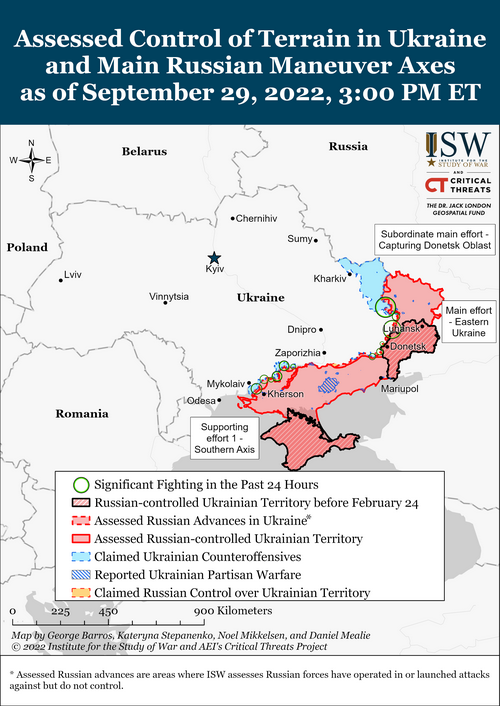
From The Institute For The Study of War:
Kateryna Stepanenko, Karolina Hird, George Barros, Riley Bailey, and Frederick W. Kagan
September 29, 7:30 pm ET
Click here to see ISW’s interactive map of the Russian invasion of Ukraine. This map is updated daily alongside the static maps present in this report.
The Kremlin continues to violate its stated “partial mobilization” procedures and contradict its own messaging even while recognizing the systematic failures within the Russian bureaucracy just eight days after the declaration of mobilization. Russian President Vladimir Putin acknowledged and deflected the blame for repeated “mistakes” during the first week of mobilization in his opening remarks at the Russian Security Council meeting on September 29.[1] Putin recounted instances of mobilizing men without prior military experience, assigning servicemen to the wrong specializations, and unfairly mobilizing men with health conditions or large families. ISW has previously reported that Kremlin-state media began exploring similar complaints just days after Putin’s declaration of “partial mobilization.”[2] Putin called on the Russian General Staff, Ministry of Defense (MoD), and federal subjects to fix the reported problems with mobilization, while noting that prosecutors and working groups within enlistment centers will monitor all complaints. Speaker of the Russian State Duma Vyacheslav Volodin also announced that Russian men with a military registration cannot leave their permanent residence without the approval of enlistment centers.[3] Volodin and the Kremlin’s Spokesperson Dmitry Peskov later retracted these statements, noting that the Russian MoD informed him that Russian officials may only restrict the movement of military-registered men in case of full mobilization.[4] Republic of Dagestan Head Sergey Melikov also condemned a police car with a loudspeaker that ordered all men to appear at the enlistment center while driving around Derbente, Republic of Dagestan, stating that local authorities did not authorize such announcements.[5]
The Kremlin’s contradictory statements and procedures demonstrate the fundamental nature of the systemic weakness of the Russian military establishment that have characterized the entire invasion. Russian officials continue to execute a supposed reservist call-up as a confused undertaking somewhere between a conscription drive and the declaration of general mobilization, likely issuing conflicting orders to already flawed bureaucratic institutions. CIA Director Williams Burns noted that even if the Kremlin manages to mobilize 300,000 men it will not be able to ensure logistic support or provide sufficient training and equipment to the newly-mobilized men.[6] Ukrainian military officials noted that Russian forces have already committed mobilized men to Kharkiv Oblast who have since told the Ukrainian forces that they did not receive any training prior to their deployment around September 15.[7]
The bureaucratic failures in the Russian partial mobilization may indicate that Putin has again bypassed the Russian higher military command or the Russian MoD. The deployment of mobilized men to centers of hostilities on the Kharkiv or Kherson frontlines may suggest that Putin is directly working with axis commanders on the ground who are likely clamoring for reinforcements, rather than following standard military practices (that are also required by Russian law) such as providing training to the mobilized prior to their deployment to the frontlines. ISW has previously reported that Putin bypassed the Russian chain of command on numerous occasions when making decisions regarding the progress of the Russian “special military operation” in Ukraine, likely because he had lost confidence in the Russian MoD.[8] The contradictory and inconsistent narratives used by Kremlin officials and the Russian MoD about mobilization procedures could indicate that Putin, as the supreme commander, issued divergent or contradictory orders.
Belarus remains highly unlikely to become directly involved in the war in Ukraine on the part of Russia, despite statements made by Ukrainian sources on September 29 that Belarus is preparing to accommodate newly mobilized Russian servicemen. The Ukrainian Main Intelligence Directorate (GUR) reported that Belarus is preparing to accommodate up to 20,000 mobilized Russian men in existing civilian premises, warehouses, and abandoned agricultural facilities in Belarus.[9] Deputy Chief of the Main Operational Department of the General Staff of the Armed Forces of Ukraine, Oleksiy Hromov, similarly stated that actions are being taken to expand the Luninets Airfield (50km from the Belarusian-Ukrainian border) and to repair storage and military infrastructure.[10] Independent monitoring organization Belarusian Hajan Project also reported that Russia delivered Su-30 aircraft to the Baranavichy airfield in Belarus.[11] These data points may indicate that Russia hopes to use Belarusian military facilities and infrastructure to hold and potentially train newly mobilized Russian forces, but it remains exceedingly unlikely that these are leading indicators of imminent Belarusian involvement in Ukraine on Russia’s behalf. Hromov also stated that there are no signs of Russian troops forming a strike group to target northern Ukraine, which suggests that Russian forces are unlikely to use Belarus as a launching pad for ground attacks into Ukraine despite reports of troop and equipment accumulations in Belarus.[12] These reports more likely suggest that Russian President Vladimir Putin is continuing to leverage his relationship with Belarusian President Alexander Lukashenko in order to use Belarusian land for the development of Russian military capabilities. ISW has previously assessed that Lukashenko cannot afford the domestic ramifications of Belarusian involvement in Ukraine.[13] ISW also assesses that Russia does not have the ability to form a ground strike force from scratch or from existing units in Belarus quickly.
Key Takeaways
- The Kremlin continues to violate its stated “partial mobilization” procedures and contradict its own messaging even while recognizing the systematic failures within the Russian bureaucracy just eight days after the declaration of mobilization.
- Belarus may be preparing to accommodate newly-mobilized Russian servicemen but remains unlikely to enter the war in Ukraine on Russia’s behalf.
- Ukrainian troops have likely nearly completed the encirclement of the Russian grouping in Lyman and cut critical ground lines of communication (GLOCS) that support Russian troops in the Drobysheve-Lyman area.
- Ukrainian military officials maintained operational silence regarding Ukrainian ground maneuvers in Kherson Oblast but stated that Russian forces are deploying newly-mobilized troops to reinforce the Kherson Oblast frontline.
- Ukrainian troops continued to target Russian logistics, transportation, and military assets in Kherson Oblast.
- Russian troops continued ground attacks in Donetsk Oblast.
- Russian forces have likely increased the use of Iranian-made Shahed-136 drones in southern Ukraine.
- An independent Russian polling organization, the Levada Center, found that almost half of polled Russians are anxious about mobilization, but that support for Russian military actions declined only slightly to 44%.
- Ukrainian officials reiterated their concerns that the Kremlin will mobilize Ukrainian citizens in occupied oblasts following Russian President Vladimir Putin’s annexation announcement.
Go here to read the rest. The Ukrainian counter offensive is likely going to make another territorial lead in the coming weeks. It appears that Putin has nothing left in his bag of tricks except nuclear weapons. Let us hope his generals and advisors have well developed survival instincts.


Notwithstanding all the saber rattling and mass manpower mobilization by Putin, the Ukrainians must be turning the Donbas into a total killing field for the Russians. A pro-Russia website, WhereIsRussiaToday (translated) stated that a senior Wagner Group paramilitary commander, Alexei Negin, was killed in fighting around Bakhmut Sep. 20th— fairly indisputable, because the putative CEO of the Wagner Group, the infamous Yevgeny Prigozhin, attended the public funeral in Volgograd held either yesterday or Wednesday. Negin had been a veteran fighter of the Chechnyan, Georgian, and Syrian campaigns. The fact that the Ukrainians punched his ticket signals they’re having some serious lethal effect on even Russia’s most veteran mercenary fighters.
One enormous favor that the Ukrainians are doing the west is completely eroding the Wagner Group.
It is simply unintelligible as to why senior Russian commanders have not called a retreat for their forces from Lyman. Lyman is likely well supplied but almost certainly tactically lost, with virtually zero capacity of any rescuing Russian mobile force breaking the encirclement.
Perhaps the Russian high command thinks they can force the military units left behind to fight the Ukrainians to the death and cost them manpower: but the Ukrainians tend to husband their soldiers’ lives, and with highly improved and very accurate tactical Ukrainian HIMARS artillery, it is impossible to see how that is a good bet.
But no doubt Putin has channeled Hitler: “ No retreat!”