
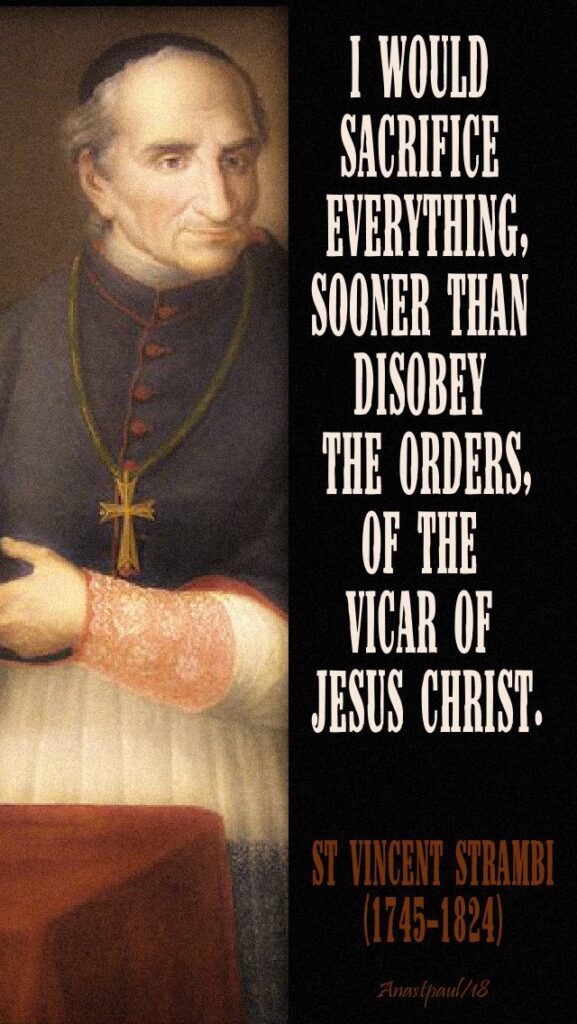
Vincent Strambi was the son of a druggist, and was born on January 1 at Civitavecchia, Italy. He resisted his parents’ wish that he become a diocesan priest, and though he studied at the diocesan seminary and was ordained in 1767, he joined the Passionists in 1768 after attending a retreat given by St. Paul of the Cross. Vincent became a professor of theology, was made provincial in 1781, and in 1801, was appointed bishop of Macera and Tolentino. He was expelled from his See when he refused to take an oath of alliance to Napoleon in 1808, but returned in 1813 with the downfall of Napoleon. When Napoleon escaped from Elba, Murat made Macerta his headquarters, and when his troops were defeated by the Austrians, Vincent dissuaded him from sacking and destroying the town. He imposed reform in his See that caused threats to his life, labored for his people during a typhus epidemic, and resigned his See on the death of Pope Pius VII to become one of the advisers of his old friend Pope Leo XII in Rome. Vincent died on January 1, and was canonized by Pope Pius XII in 1950. His feast day is September 25.
Vincenzo Strambi (1 January 1745 – 1 January 1824) – in religious Vincenzo Maria di San Paolo – was an Italian Roman Catholic prelate who was a professed member from the Passionists and served as the Bishop of Macerata-Tolentino from 1801 until his resignation in 1823. Strambi became a Passionist despite its founder Saint Paul of the Cross refusing him several times due to Strambi’s frail constitution. But he practiced Passionist austerities which continued after his appointment as a bishop that saw him favor his religious habit rather than the usual episcopal garb. Strambi was known for his charitable projects that included the care of the poor and the reduction of diocesan expenditures in order to provide for them; he took special interests in the education and ongoing formation of priests.[2]
Strambi was exiled from his diocese 1808 after he refused to take an oath of allegiance to the First French Empire under Napoleon who had annexed Macerata as part of his empire. He spent that time in Novara and Milan before he managed to return to his see in a triumphant return in 1814.[3] He served as bishop for the remainder of the pontificate of Pope Pius VII before his successor Pope Leo XII accepted Strambi’s resignation and summoned him to Rome as his advisor. But the sudden illness of the pope – which seemed to prove fatal – prompted Strambi to offer his own life to God so that the pope could live. Leo XII rallied to great surprise but Strambi died of a stroke within the week.[4]
His canonization cause opened after his death on 25 June 1845 and he was named as Venerable on 1 April 1894. Pope Pius XI beatified Bishop Strambi in 1925 while Pope Pius XII later canonized him a couple of decades later in 1950.[3]
Go here to read.

