From The Institute For The Study of War:
Kateryna Stepanenko, Grace Mappes, Angela Howard, and Frederick W. Kagan
September 17, 9:30 pm ET
Click here to see ISW’s interactive map of the Russian invasion of Ukraine. This map is updated daily alongside the static maps present in this report.
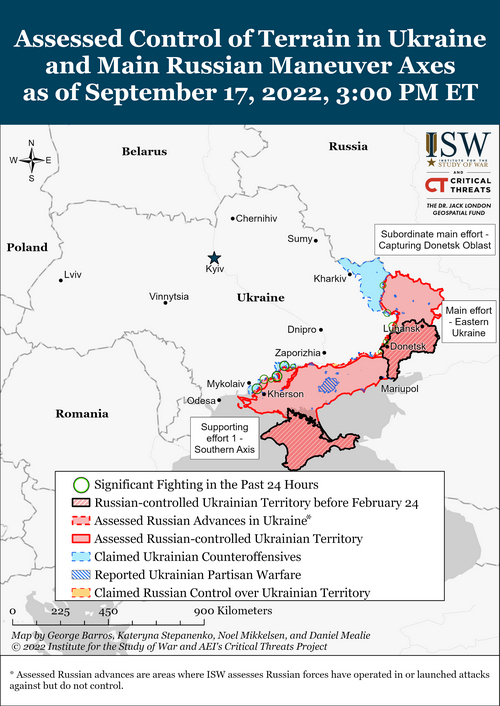
Russian forces continue to conduct meaningless offensive operations around Donetsk City and Bakhmut instead of focusing on defending against Ukrainian counteroffensives that continue to advance. Russian troops continue to attack Bakhmut and various villages near Donetsk City of emotional significance to pro-war residents of the Donetsk People’s Republic (DNR) but little other importance. The Russians are apparently directing some of the very limited reserves available in Ukraine to these efforts rather than to the vulnerable Russian defensive lines hastily thrown up along the Oskil River in eastern Kharkiv Oblast. The Russians cannot hope to make gains around Bakhmut or Donetsk City on a large enough scale to derail Ukrainian counteroffensives and appear to be continuing an almost robotic effort to gain ground in Donetsk Oblast that seems increasingly divorced from the overall realities of the theater.
Russian failures to rush large-scale reinforcements to eastern Kharkiv and to Luhansk Oblasts leave most of Russian-occupied northeastern Ukraine highly vulnerable to continuing Ukrainian counter-offensives. The Russians may have decided not to defend this area, despite Russian President Vladimir Putin’s repeated declarations that the purpose of the “special military operation” is to “liberate” Donetsk and Luhansk oblasts. Prioritizing the defense of Russian gains in southern Ukraine over holding northeastern Ukraine makes strategic sense since Kherson and Zaporizhia Oblasts are critical terrain for both Russia and Ukraine whereas the sparsely-populated agricultural areas in the northeast are much less so. But the continued Russian offensive operations around Bakhmut and Donetsk City, which are using some of Russia’s very limited effective combat power at the expense of defending against Ukrainian counteroffensives, might indicate that Russian theater decision-making remains questionable.
Ukrainian forces appear to be expanding positions east of the Oskil River and north of the Siverskyi Donets River that could allow them to envelop Russian troops holding around Lyman. Further Ukrainian advances east along the north bank of the Siverskyi Donets River could make Russian positions around Lyman untenable and open the approaches to Lysychansk and ultimately Severodonetsk. The Russian defenders in Lyman still appear to consist in large part of BARS (Russian Combat Army Reserve) reservists and the remnants of units badly damaged in the Kharkiv Oblast counteroffensive, and the Russians do not appear to be directing reinforcements from elsewhere in the theater to these areas.
Key Takeaways
- Russian forces continue to prioritize strategically meaningless offensive operations around Donetsk City and Bakhmut over defending against continued Ukrainian counter-offensive operations in Kharkiv Oblast.
- Ukrainian forces liberated a settlement southwest of Lyman and are likely continuing to expand their positions in the area.
- Ukrainian forces continued to conduct an interdiction campaign in Kherson Oblast.
- Russian forces continued to conduct unsuccessful assaults around Bakhmut and Avdiivka.
- Ukrainian sources reported extensive partisan attacks on Russian military assets and logistics in southern Zaporizhia Oblast.
- Russian officials continued to undertake crypto-mobilization measures to generate forces for war Russian war efforts.
- Russian authorities are working to place 125 “orphan” Ukrainian children from occupied Donetsk Oblast with Russian families.
Go here to read the rest.
From Strategy Page:
September 17, 2022: Russian intelligence agencies demonstrated a startling lack of effectiveness in predicting what the Ukrainians would do if the country was invaded, and compounded that error by not responding effectively to the problems Russian forces encountered and continued to have in Ukraine. This is all about an ancient Russian custom of telling the big guy (tsar, commissar or president) what they want to hear. As long as that goes on Russia is in trouble. That attitude eventually brought down the monarchy and the communist state that replaced it. After 1991 Russia became a democracy but after a decade of that former KGB officer Vladimir Putin was elected president and he turned Russia into a dictatorship with himself as president-for-life. Putin did not take bad news well and when his original invasion plans for Ukraine blew up in his face, he blamed his intelligence services. But he could not do that openly without admitting he made a mistake. The head of the intel services was turned into a figurehead to keep up appearances while his subordinates continued suppressing news of what was actually going on in Ukraine and while sending their own people to Ukraine for several months at a time to monitor what is actually taking place.
Putin has two foreign intelligence services available: SVR and GRU. The first one is the Russian Foreign Intelligence Service. It is the former First Chief Directorate of the Soviet era KGB, which has managed intelligence for decades. Its activities are well known throughout the world.
The second one is the GRU, Russian military intelligence. It is a part of the Defense Ministry. Its full name is much longer (The Chief Intelligence Directorate of the General Staff of the Russian Army). GRU has retained its Soviet era name, and just about everything else. GRU is seen as a living relic of Soviet times. That is why GRU is so much more secretive than the “Westernized” SVR. GRU officers are considered more patriotic (and old school) than those of the KGB/SVR. During the Cold War, there were fewer GRU defectors, still a GRU point of pride. GRU prefers to stay in the shadows. Western writers have not written many books about GRU, compared to the KGB. This is largely because GRU keeps its secrets better, and, in the West, is considered an obscure part of Russian intelligence.
Both GRU (Russian Military Intelligence) and SVR (Russian Foreign Intelligence Service) perform the same functions: Political Intelligence, Scientific and Technical Intelligence (industrial espionage) and Illegal Intelligence. Because of this, the two agencies have a very real rivalry going.
But there was, and remains, one area where only the SVR (and its predecessor, the KGB) participates; running counter-intelligence abroad. This was long a KGB monopoly because it was the KGB’s job to make sure the armed forces remained loyal, and GRU was, and is, very much a part of the armed forces.
When the GRU officers are working abroad, they are monitored by Directorate “K” (counter-intelligence) of the SVR. Those who serve inside Russia, are watched by the Directorate of Military Counter-Intelligence (The Third Directorate) of the FSB (Federal Security Service, successor to the KGB). Interestingly, in the Soviet period, it was also called the Third Directorate. It is not a coincidence but a continuation of the Soviet tradition. The Third Directorate of the FSB is still assigned to monitor the Defense Ministry, of which the GRU is a part. The head of GRU does not even report directly to the Russian President. GRU reports have to go through the Head of the General Staff and the defense minister before reaching the top man. GRU is very much number two in the Russian foreign intelligence business. As Number 2, they tend to try harder, and consider themselves more elite than those wimps over at SVR.
On the other hand, there also is one function monopolized by the GRU; battlefield intelligence. The battlefield intelligence is run in peacetime as well. For example, in preparation for future wars, the GRU sets up illegal weapon and ammunition dumps in the territory of many foreign countries. This is a risky operation. It usually involves groups of junior Russian diplomats secretly going into rural areas to bury rifles, machine-guns and other weapons. They have to do this discreetly and quickly, to avoid detection by the local counterintelligence service. It is considered a hard job.
Western analysts regard the GRU the most closed Russian intelligence service partly because it does not even manage its own press relations. That’s because GRU is one of many components of the Defense Ministry, and is not eligible to have its own press relations staff. The FSB and SVR are higher up in the government pecking order, and entitled to their own press relations operations. Formally, GRU is nothing but one of the numerous Chief Directorates of the General Staff of the Defense Ministry. It does not even report directly to the Minister of Defense. That is why, those foreign journalists who have questions about GRU, must address them to the Press Service of the Russian Defense Ministry. The questions are often handled by some press aide who knows little about intelligence work, while FSB and SVR press people are very well informed. So foreign journalists tend to seek out the SVR press department when seeking information on Russian intel operations.
Putin did not consider Ukraine a “foreign country” but rather a lost part of Russia, so his intelligence agencies behaved accordingly. That meant less emphasis on determining what foreigners are up to and more efforts in bribing or otherwise persuading locals to do what Russia (Putin) wanted. The reality was that Ukraine had developed its own, separate, identity and become a foreign country, s0 Russian efforts to ignore that only created more Ukrainian patriots as well as identifying the Russian agents. This came as a shock to Putin and his intel minions, whose first reaction was to blame NATO and prosecute any Russian journalists or commentators who were providing accurate news about Ukraine. Such reporting is still illegal inside Russia but it still occurs in the form of government approved, or tolerated, Internet based reporters and commentators. For this both Russians and Ukrainians use the encrypted Telegram cellphone app. This is text based, making it less effective for battlefield communications. It is used by Ukrainian and Russian journalists, especially popular bloggers, to report to the people back home what is going on.
The Russian military sponsored a lot of pro-Russian bloggers and allowed some to accompany combat troops and report from the combat zone. This worked for about two months, until some of these Russian bloggers reported that the war effort was being mismanaged and getting a lot of Russian soldiers killed. While these Russian bloggers were still pro-Russian, they risked losing their online followers, especially those in the military or related to someone wounded or killed in Ukraine. These Telegram users could also report what they knew, witnessed or experienced but their reports spread more slowly. There were so many of these reports on the Russian language Internet that the pro-Russia bloggers were forced to confirm them and demand changes in how the war was being fought. Russian forces were still not advancing while the Ukrainians were, on several fronts. There were also Ukrainian partisans showing up in Russian occupied areas. This was reported by pro-Russia bloggers as a tragic turn of events. The recent (early September) massive loss of territory by Russian forces in Kharkiv and Kerson provinces also involved extremely poor performance by Russian troops and their officers, particularly the untrained, unwilling and resentful forcibly conscripted troops from the contested Donbass region. Video of Russian troops fleeing the advancing Ukrainians and those same Ukrainians retaking towns and villages without a fight came as a shock to many Russians. Naturally the Ukrainian civilians hailed the end of Russian occupation. Russian bloggers speculated that the Ukrainians planned to use these same tactics to quickly drive all Russian forces from Ukraine. This offensive was the result of better Ukrainian leadership and intel. The Ukrainians effectively combined the American aerial and electronic surveillance with the Ukrainian agents and informants in the occupied territories. The northern (Kharkiv) offensive exploited Russian weaknesses and moved so fast the Russians forces panicked and many troops simply fled. Russia described the abandonment of over 3,000 square kilometers of territory as a planned withdrawal to reinforce the Donbas and Kherson and Crimea provinces in the south. This made no sense and Russians could consult the Internet-based commentators and the Western media for a more coherent explanation of the Ukrainian offensive.
Go here to read the rest. The Russians seem to be play acting at war now, doing the bare minimum of activity to satisfy their superiors and Putin and no more. I suspect almost all Russian officers in Ukraine view the War as lost, and have little desire to see more of their men die in it. Putin refuses to recognize this fact, but seems powerless to do more to strengthen the military position of the Russians in Ukraine.