
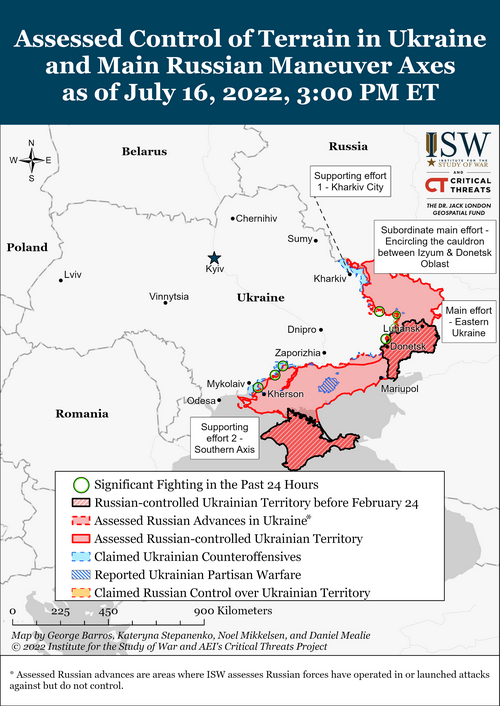
From The Institute For The Study of War:
Karolina Hird, Grace Mappes, George Barros, and Frederick W. Kagan
July 16, 6 pm ET
Click here to see ISW’s interactive map of the Russian invasion of Ukraine. This map is updated daily alongside the static maps present in this report.
The Russian Defense Ministry announced that the Russian operational pause has concluded on July 16, confirming ISW’s July 15 assessment.[1] Russian Defense Minister Sergey Shoigu ordered Southern Group Commander General of the Army Sergey Surovikin and Central Group Commander Colonel General Alexander Lapin to increase offensive operations on all axes on July 16, but the tempo of the resuming Russian offensive will likely fluctuate or stutter over the coming days.[2] Russian forces conducted fewer ground assaults on all axes on July 16 than on July 15, but maintained increased artillery and missile strikes on July 16.[3]
Shoigu indicated that Surovikin and Lapin will both continue to command forces on the Eastern Axis even though a force concentration and effort of this size should only require a single, very senior overall commander. Surovikin should in principle be in overall command because he outranks Lapin. Shoigu has not even named Surovikin as the head of Russia’s Southern Military District (SMD) despite the likely ousting of SMD Commander General of the Army Alexander Dvornikov and despite Surovikin’s experience commanding the Southern Grouping in Ukraine. Lapin, in contrast, has been and remains commander of the Central Military District.[4] The Kremlin‘s failure to use the operational pause to reorganize the Russian military command structure in Ukraine and its decision to instead retain an ad-hoc command structure is very odd. The apparent dual command of two very senior generals over operations in a very small area may hinder Russian operations going forward.
Ukrainian HIMARS strikes against Russian ammunition depots, logistics elements, and command and control are likely degrading Russian artillery campaigns. Ukrainian officials confirmed that American-supplied HIMARS arrived in Ukraine on June 23.[5] Ukrainian operators have been using the HIMARS to strike multiple Russian targets – notably ammunition depots – since June 25.[6] The destruction of these ammunition depots has likely degraded Russian forces’ ability to sustain high volumes of artillery fire along front lines. Detected heat anomalies from NASA’s Fire Information for Resource Management System (FIRMS) remotely sensed data decreased significantly in Donbas starting around July 10.
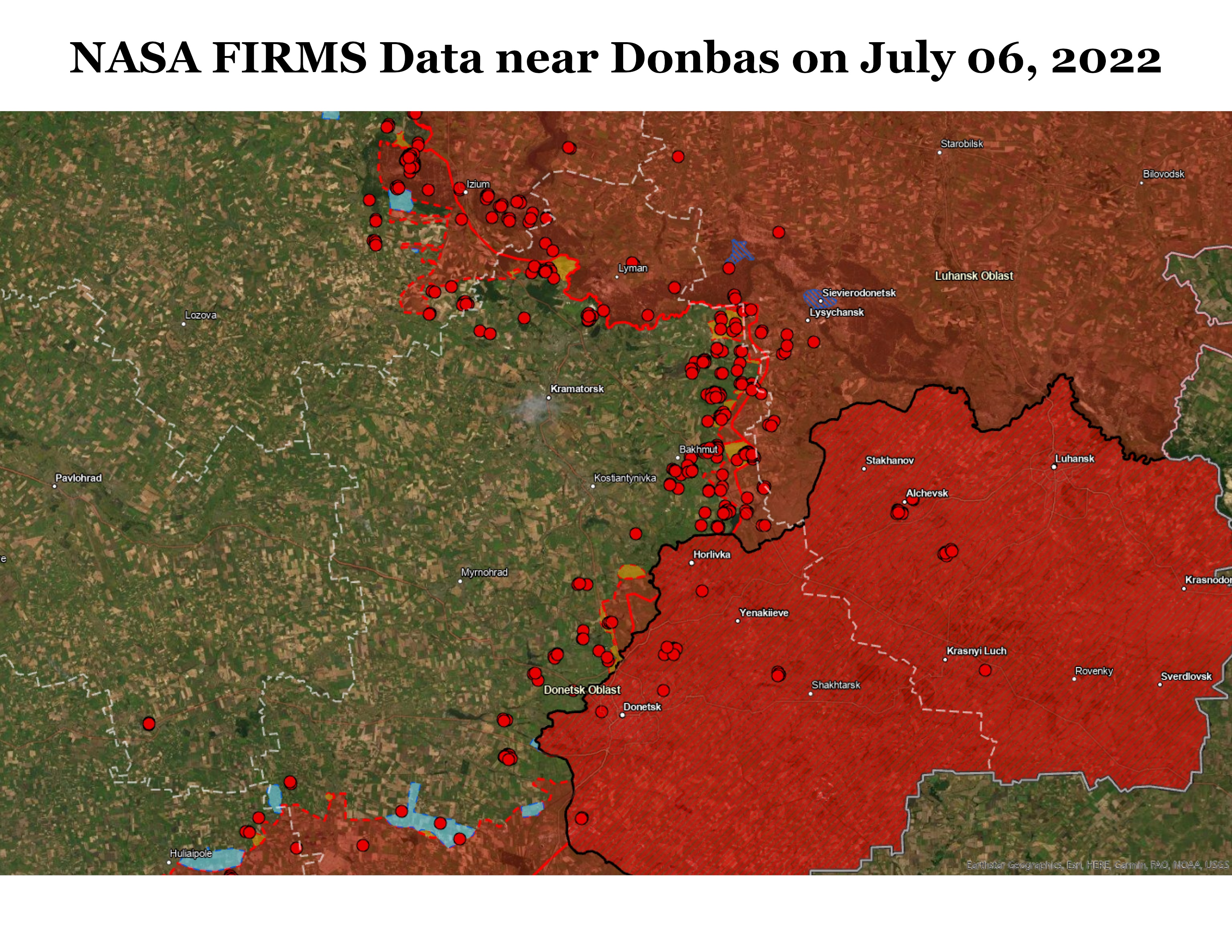
[Click here to enlarge the map. Source: NASA’s Fire Information for Resource Management System over Donbas, July 6 and Esri, Maxar, Earthstar Geographics, and the GIS User Community]
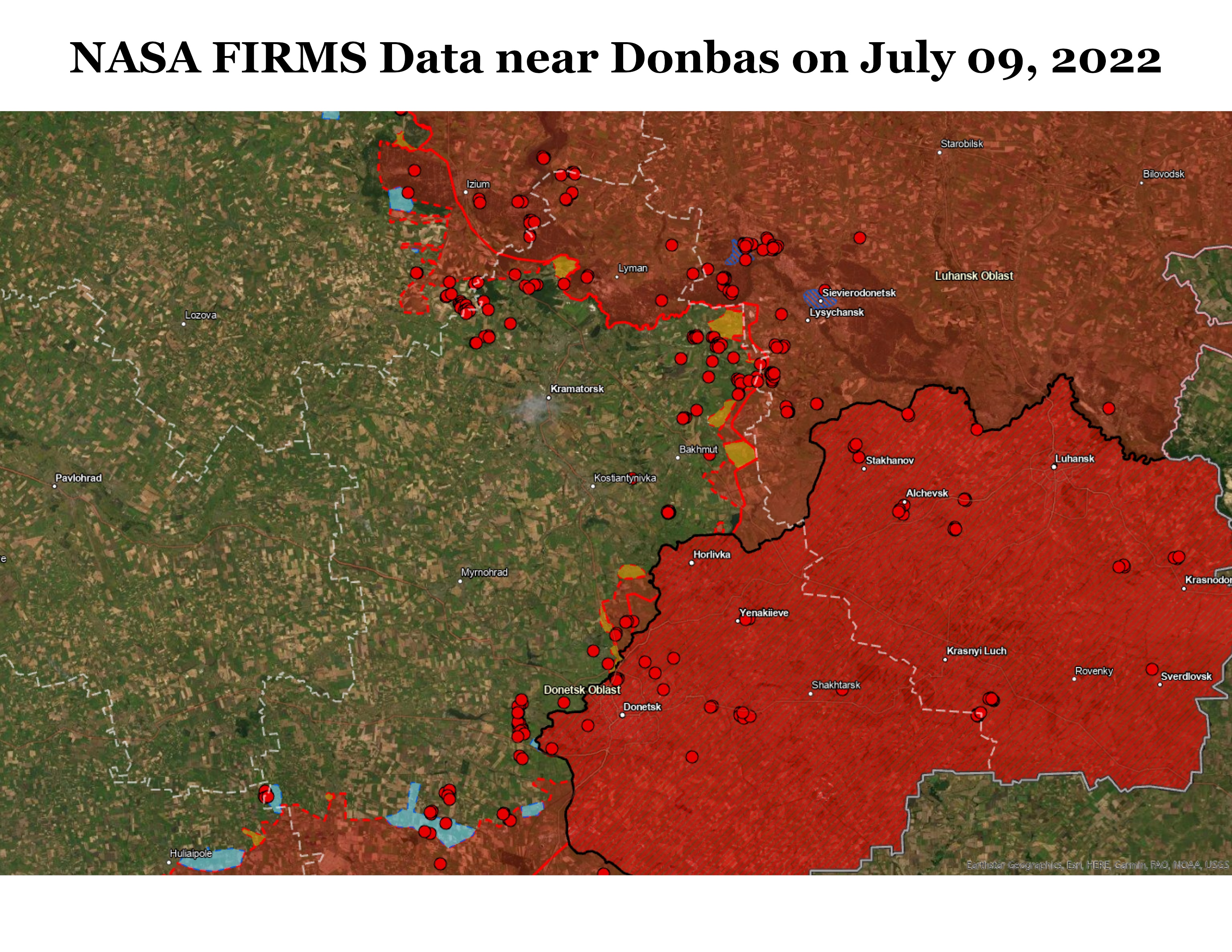
[Click here to enlarge the map. Source: NASA’s Fire Information for Resource Management System over Donbas, July 9 and Esri, Maxar, Earthstar Geographics, and the GIS User Community]
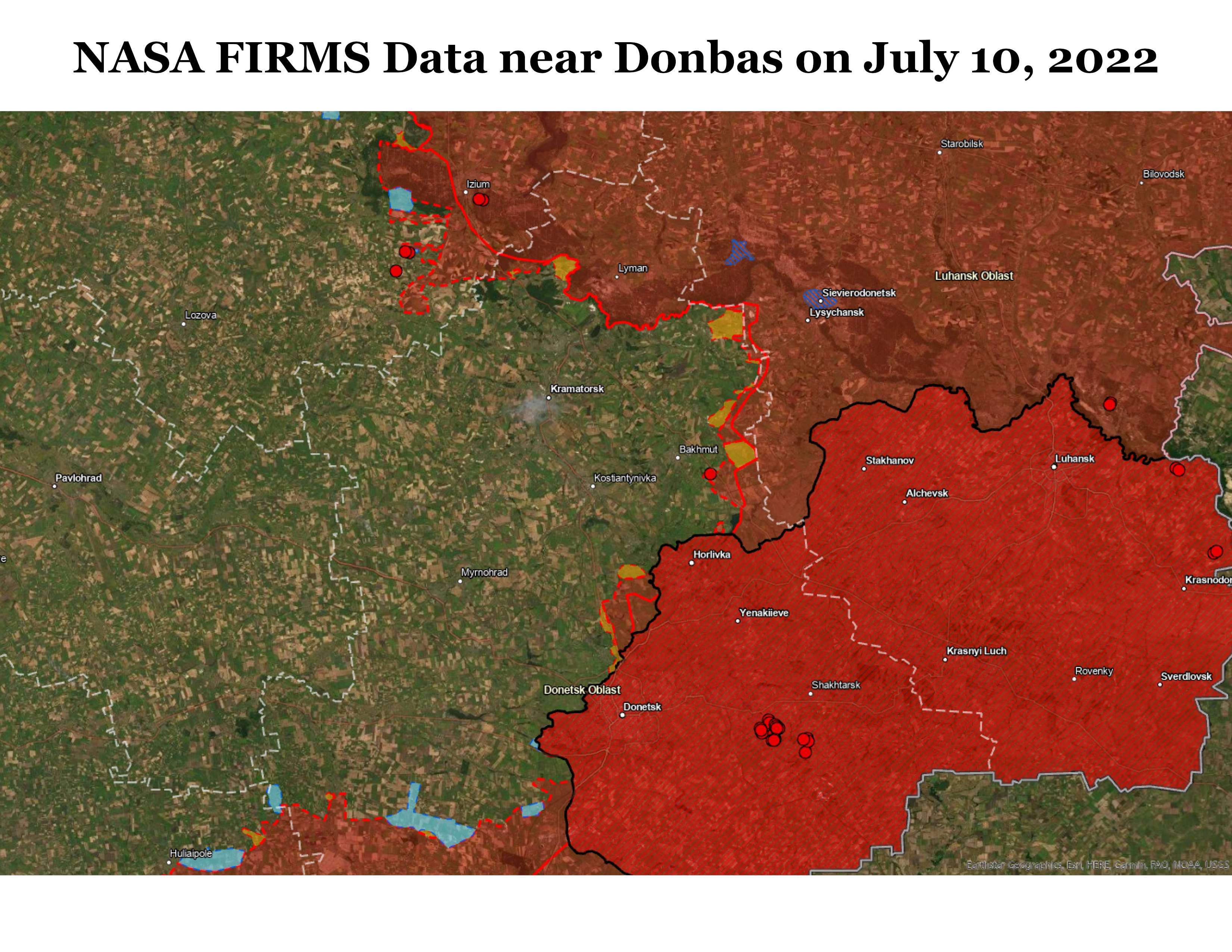
[Click here to enlarge the map. Source: NASA’s Fire Information for Resource Management System over Donbas, July 10 and Esri, Maxar, Earthstar Geographics, and the GIS User Community]
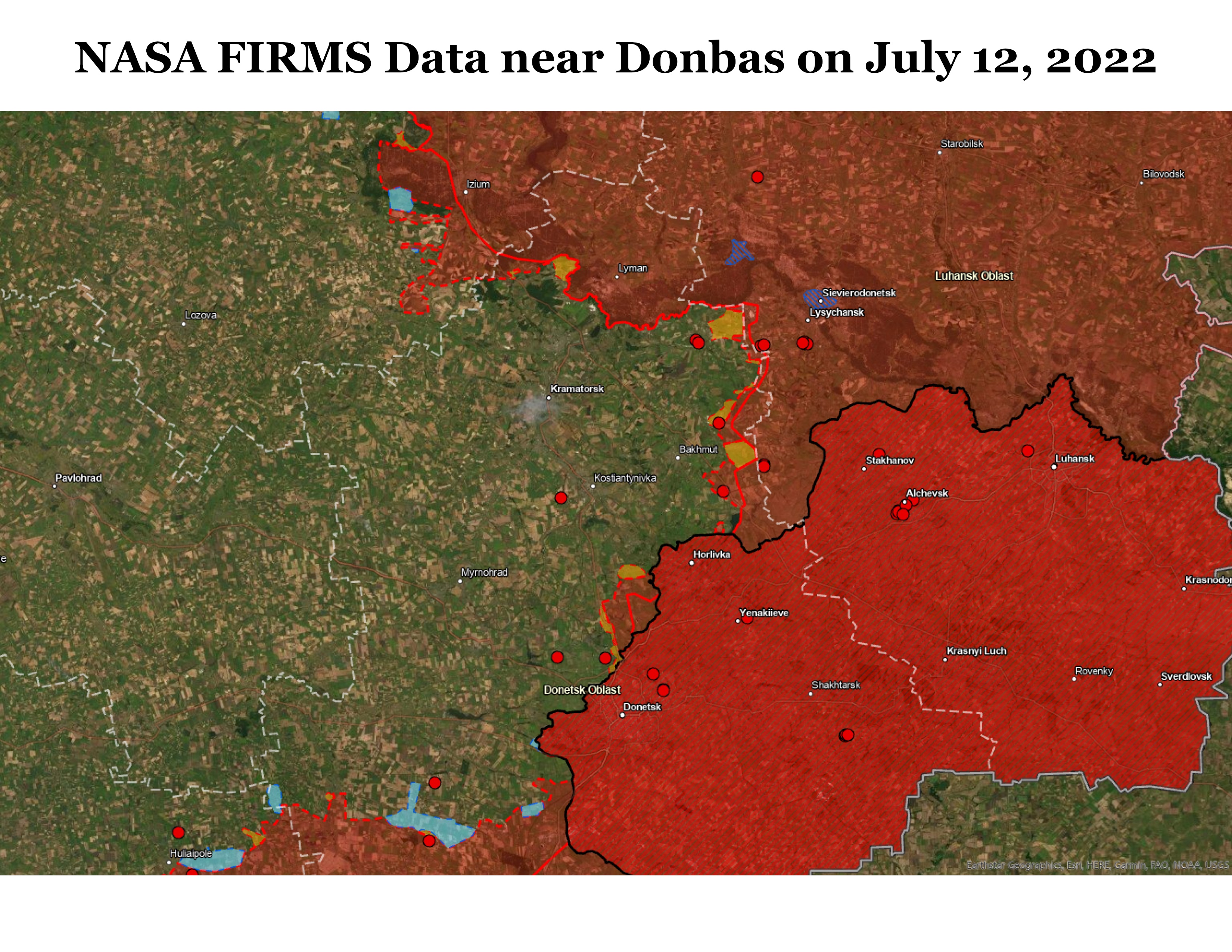
[Click here to enlarge the map. Source: NASA’s Fire Information for Resource Management System over Donbas, July 12 and Esri, Maxar, Earthstar Geographics, and the GIS User Community]
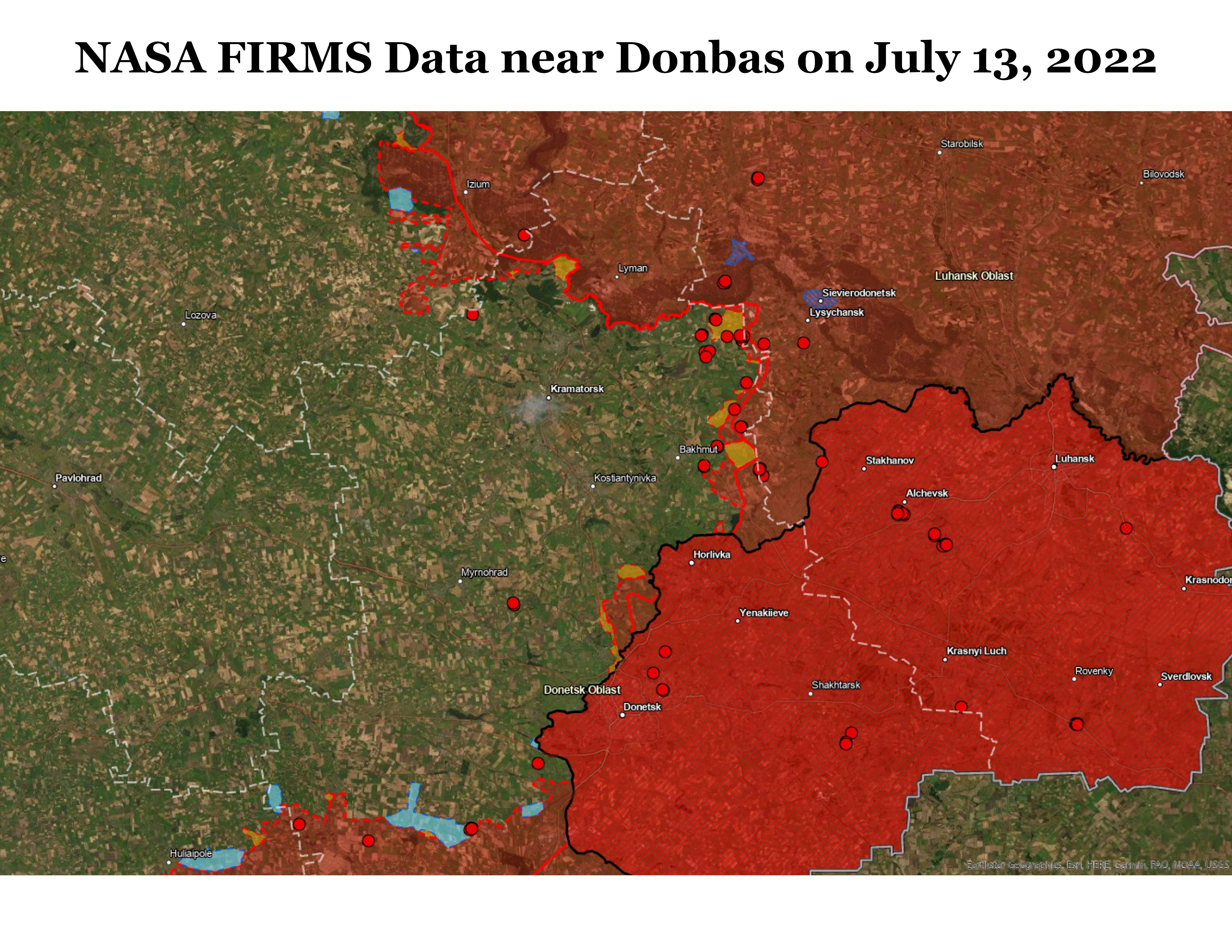
[Click here to enlarge the map. Source: NASA’s Fire Information for Resource Management System over Donbas, July 13 and Esri, Maxar, Earthstar Geographics, and the GIS User Community]
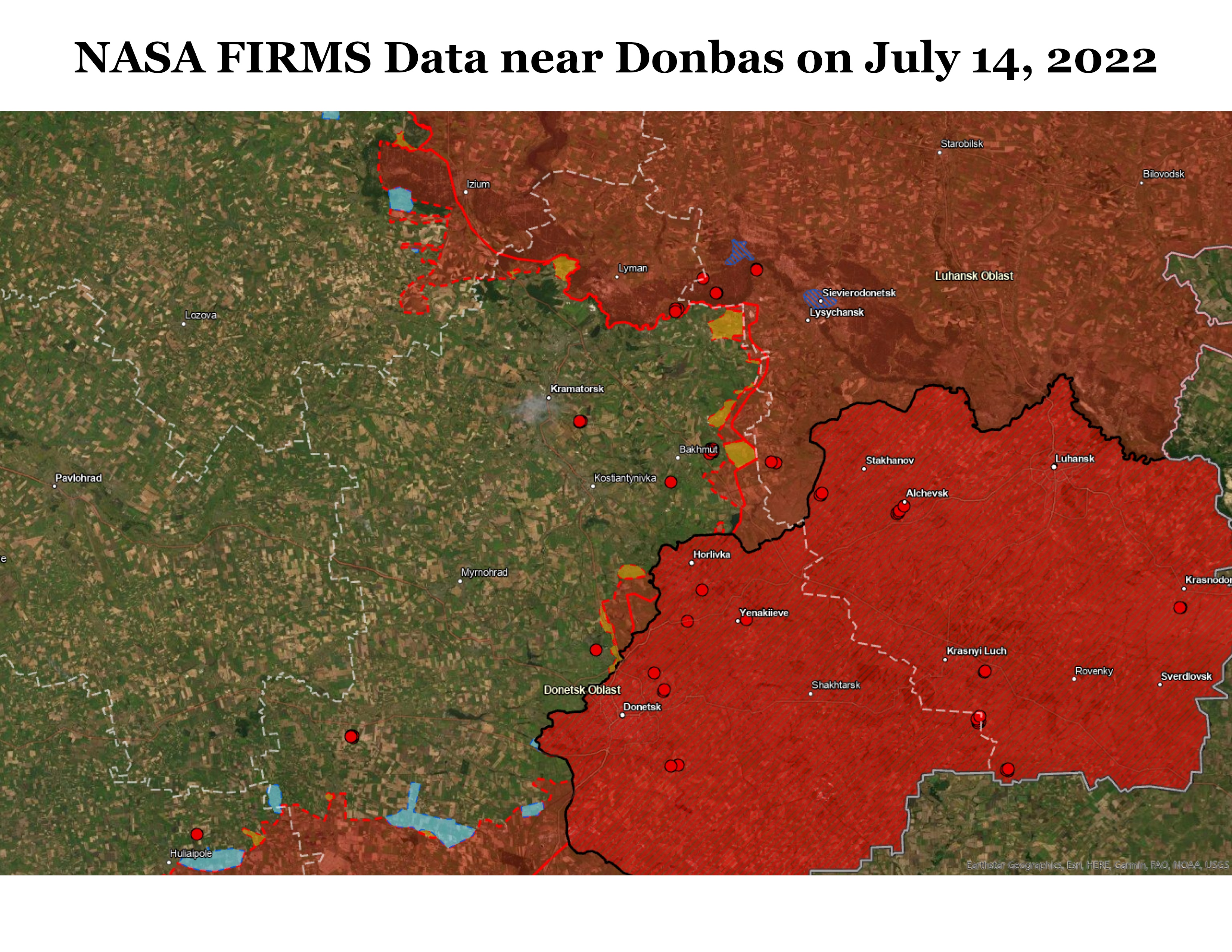
[Click here to enlarge the map. Source: NASA’s Fire Information for Resource Management System over Donbas, July 14 and Esri, Maxar, Earthstar Geographics, and the GIS User Community]
Ukraine’s destruction of Russian ammunition depots using HIMARS is likely one of several factors that reduced the quantity of observed heat anomalies in Donbas between July 10-15. The reduced number of observed heat anomalies also corresponds in part to the assessed Russian operational pause from July 6 – July 15.[7] The number of observed heat anomalies began increasing on July 15 – the day ISW assessed that Russian forces began emerging from their operational pause.[8] The intensity of Russian artillery attacks along the Slovyansk-Bakhmut axis in the coming days may clarify the degree to which the reduction in intensity was due to the operational pause or the result of Ukrainian attacks.
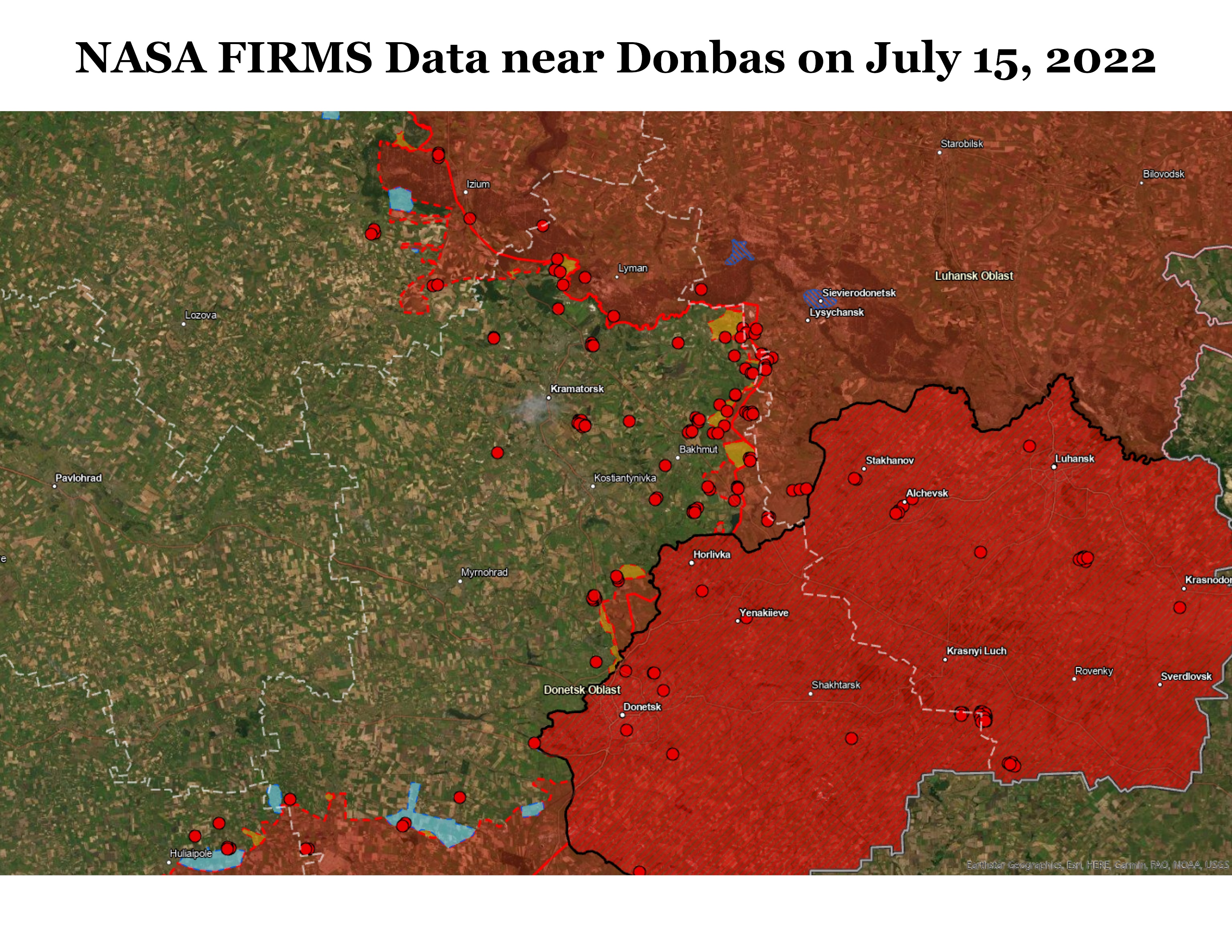
[Click here to enlarge the map. Source: NASA’s Fire Information for Resource Management System over Donbas, July 15 and Esri, Maxar, Earthstar Geographics, and the GIS User Community]

Key Takeaways
- The Russian Ministry of Defense announced the cessation of the operational pause, confirming ISW’s July 15 assessment that Russian forces are likely resuming ground attacks along multiple axes of advance. The cessation of the operational pause is unlikely to lead to a massive increase in ground attacks across Ukraine but will rather likely be characterized by continued limited ground assaults focused on the Slovyansk-Siversk-Bakhmut salient.
- The Kremlin may have ordered Russian forces to take control of the entirety of Kharkiv Oblast, despite the extraordinary low likelihood of Russian success in such an effort.
- Russian forces conducted limited ground assaults around Siversk and Bakhmut and otherwise fired on Ukrainian military and civilian infrastructure across Eastern Ukraine.
- Russian occupation authorities likely are responding to the perceived threat of Ukrainian partisan activities by strengthening administrative regimes in occupied areas.
Go here to read the rest. So the War resumes. It will be interesting to see if there is much change in the pace of the fighting.

