
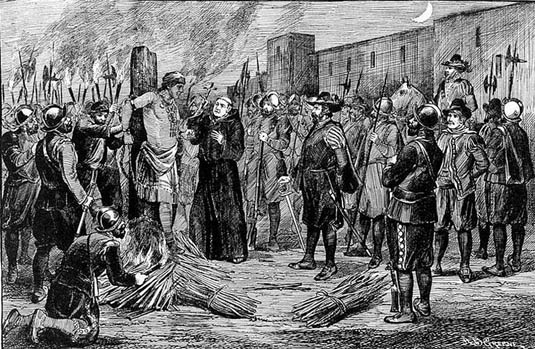
Twelve martyrs, seven men and five women, who suffered in Scillitan, Roman Africa. They are listed as Acyllinus, Donata, Felix, Cythinus, Generosa, Januaria, Lactantius, Narzales, Secunda, Speratus, Vestina, and Veturius. TheirActs are extant. St. Augustine preached three sermons in their honor.
The Scillitan Martyrs were a company of twelve North African Christians who were executed for their beliefs on 17 July 180 AD. The martyrs take their name from Scilla (or Scillium), a town in Numidia. The Acts of the Scillitan Martyrs are considered to be the earliest documents of the church of Africa and also the earliest specimen of Christian Latin.[1]
It was the last of the persecutions during the reign of Marcus Aurelius, which is best known from the sufferings of the churches of Vienne and Lyon in South Gaul. Marcus Aurelius died on 17 March of the year in question, and persecution ceased sometime after the accession of his son Commodus. A group of sufferers called the Madaurian martyrs seems to belong to the same period; in the correspondence of St Augustine, Namphamo, one of their number, is spoken of as an “archimartyr,” which appears to mean a protomartyr of Africa.
Go here to read the rest.


Donald,
I enjoy reading Marcus Aurelius’ meditations and excerpts from other Stoic philosophers in Ryan Holiday’s Daily Stoic each morning after morning prayer and Bible reading. Additionally, I just received from St. Martin’s press a graphic novel entitled Verissimus (the life of Marcus Aurelius) by cognitive behavioral psychologist Donald Robertson, and enjoy reading that as well.
https://donaldrobertson.name/
He disputes the assertion that Marcus Aurelius was an active promoter of persecution of Christians.
https://donaldrobertson.name/2017/01/13/did-marcus-aurelius-persecute-the-christians/
Is Donald Robertson correct in his essay linked above? Thanks!
Regards,
Paul.
No he is not. As Roman Emperor Marcus Aurelius viewed Christians as subversives and continued the policy of persecution. He did not regard them as a major issue and the persecution during his reign was fairly low level. Like his predecessor Trajan he probably would have said that Christians should not be sought out, but when they made themselves known they had to be punished but only after being given an opportunity to recant.
Thanks, Donald!
Supposedly there is a letter which Marcus wrote to certain Greek cities when he was a subordinate ruler under Antoninus, a letter in which he expressly forbids attacks against the Christians. Interestingly, the person who references the letter on his blog (https://howtobeastoic.wordpress.com/2017/03/28/marcus-aurelius-and-the-christians/) does not include a web link to whatever internet archive in which a translation of the letter (or the original Latin or Greek) may be found. To me that is always a red flag. In any event, here is what the person “quoted.”
“You harass these men [the Christians], and harden them in their conviction, to which they hold fast, by accusing them of being atheists. For indeed they would rather be thought to be accused and die for their own God than live. Consequently they even come off victorious, giving up their lives rather than comply with your demands. … And on behalf of such persons many Governors also of provinces have before now both written to our deified father, whose answer in fact was not to molest such persons unless they were shewn to be making some attempt in respect to the Roman Government, and to me also many have given information about such men, to whom indeed I also replied in accordance with my father’s view. And if any one persist in bringing any such person into trouble for being what he is, let him, against whom the charge is brought, be acquitted even if the charge be made out, but let him who brings the charge be called to account.”
Marcus himself demonstrated a negative view of Christians in Mediation 11.3:
“What a soul that is which is ready, if at any moment it must be separated from the body, and ready either to be extinguished or dispersed or continue to exist; but so that this readiness comes from a man’s own judgment, not from mere obstinacy, as with the Christians, but considerately and with dignity and in a way to persuade another, without tragic show.”
Thus, I am more inclined to go with your view than the view of secular apologists who try to sanitize history in order to cast a negative light on Christianity and make their agnostic or atheistic paradigm appear to be the right one. Nevertheless, I still like Marcus’ Meditations. But I cannot fathom how such a wise and brilliant man had such a blind spot towards Christianity.
Web link to the above quote:
https://archive.org/stream/thecommuningswit00marcuoft/thecommuningswit00marcuoft_djvu.txt
The quote is close to the end.