

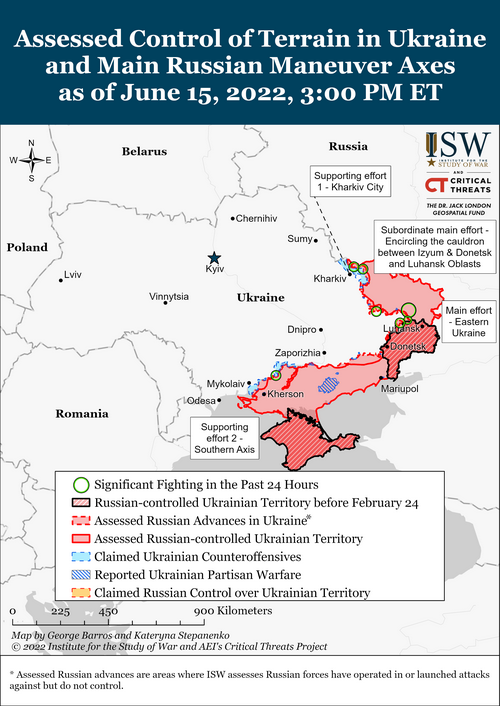
From The Institute For The Study of War:
Russian Offensive Campaign Assessment, June 15
Karolina Hird, Kateryna Stepanenko, Mason Clark, and Grace Mappes
June 15, 6pm ET
Click here to see ISW’s interactive map of the Russian invasion of Ukraine. This map is updated daily alongside the static maps present in this report.
Western officials announced additional military aid for Ukraine on June 15. US President Joe Biden pledged $1 billion worth of military aid, including coastal defense weapons, advanced rocket systems, artillery, and ammunition to support Ukrainian operations.[1] NATO members additionally announced they will additionally continue to provide Ukraine with heavy weapons and long-range systems and plan to agree on a new assistance package after consultations with Ukraine’s Defense Ministry.[2] This newest round of military aid will be invaluable to support Ukrainian operations, especially in the face of increasingly protracted and artillery-heavy fighting against Russian forces in Eastern Ukraine, though Ukraine will require further sustained support.
Key Takeaways
- Russian forces launched ground assaults in Severodonetsk and settlements in its vicinity but have not taken full control over the city as of June 15.
- Russian forces launched largely unsuccessful offensive operations around the T1302 Bakhmut-Lysychansk highway in an effort to cut Ukrainian ground lines of communication (GLOCs) to Lysychansk.
- Russian forces continued efforts to advance along the E40 highway to Slovyansk and southeast of Izyum.
- Russian and Ukrainian forces continued to fight in northeastern settlements around Kharkiv City.
- Russian forces continued to fortify fallback positions in Zaporizhia and Kherson Oblasts, while undertaking defensive measures to strengthen Russian presence in the Black Sea.
- The Kremlin and proxy republics continue to pursue ad hoc annexation policies in occupied territories.
Go here to read the rest. From Strategy Page:
June 15, 2022: Sweden is sending more weapons to Ukraine, including 5,000 additional M4 84mm Carl Gustav portable and reloadable recoilless rifles. The M4 was introduced in 2014 and was a major improvement over M2 and M3 models that are still in use. The Ukrainians found Carl Gustav extremely useful. The M4 is 30 percent lighter (at 7 kg/15 pounds) and seven percent shorter (at just under a meter, or 38 inches) than the M3. There is a new electronic sight that is designed to automatically make adjustments to improve accuracy, especially for shots at up to 1,000 meters. This is sometimes done by having the sight transfer data to some of the new rounds that can use it. This new high explosive round has a 1,000-meter range and is lethal out to more than ten meters from the exploding shell. The new sight also counts the rounds fired, making it easier to know when maintenance is necessary. The barrel will now last for ten times as many fired rounds (about a thousand).
The overall design of the Carl Gustav has been modified and improved based on extensive user experience in combat. This includes things like enabling the operator to carry the M4 into combat with a shell already loaded. Other improvements make it possible for the M4 to accurately fire that loaded round faster and more accurately than in the past. There are new ammo types available as well and more new ones in the works. New Carl Gustav users must be very careful of its backblast. Previous combat users found that the best way to use the Carl Gustav was with a two-man team. One carries and operates the Carl Gustav and is usually armed only with a pistol as a personal weapon. The other man carried 5-6 rounds of 84mm ammo and operates as a spotter for the Carl Gustav gunner. If you expect to encounter enemy troops some distance away, like over 500 meters, the Carl Gustav is the way to go and Ukrainians exploited that in a big way. Carl Gustav was very useful in Afghanistan and any place with wide-open spaces. Carl Gustav shells cost $500-3,000 each, depending on the type (and complexity). The launcher (with rifled barrel and sight) costs about $25,000 each. The M1 version of the Carl Gustav was introduced in 1948 and its reputation spread as more countries adopted it. NATO nations bordering Russia began using Carl Gustav in 2019 and Ukrainians quickly learned how effective it was.
Sweden is also sending several dozen portable RBS-17 anti-ship missiles. RBS-17 is a smaller version of the larger RBS-15 that was introduced in 1985 as competition for the American Harpoon. RBS-17 is similar to the American Hellfire missile and weighs 48 kg (105 pounds), is 1.8 meters (63 inches) long and uses laser guidance to hit targets 8 kilometers distant. Swedish troops who operate near the coast were given RBS-17 so they could quickly get to where Russian amphibious forces were headed and damage or destroy Russian landing craft before they reached shore. RBS-17 entered Swedish service in the 1980s and was used to arm Swedish CB90 18-ton fast attack boats. CB90s are used near the coast for patrol or combat and can carry 21 troops or 4.5 tons of cargo. The land-based version came later. Ukraine will use these to aid in the defense of Odessa from threatened Russian landings.
Sweden is also sending AG90 12.7mm sniper rifles. These are actually American Barrett Light 50 rifles in Swedish service. U.S. forces use this rifle as the M82A1. AG90 weighs 16 kg (35 pounds) and is effective against vehicles and individuals out to 1,000 meters. Ukraine already has some similar 12.7 rifles and wanted more.
The Ukrainians are receiving a new wake of weapons and ammunition. We will see how they use them.





The supplying of artillery by the West has been a laughably slow and half-measured side-show:
The much-vaunted initial supply of CAESAR 155mm howitzers by Macron in March only numbered 6. The latest “batch” is apparently only 12. The Russians have scores, if not hundreds, of 152mm -and-larger self-propelled as well as set-up artillery with which they are murdering Ukraine.
The Biden people according to various open source military sites refused to supply Ukraine with self-propelled 155mm “shoot-and-scoot” M777 units, instead finally sending after weeks of delays “for training purposes” initially only 18 M777A2’s—then as it became obvious the Ukrainians were getting pounded, finally throwing in 90 more units—so now a total of 108 much more vulnerable truck-towed units, and allegedly initially refusing the Ukrainians the more-accurate and greater long-distance Excalibur shells. It has to be terminally frustrating for Zelensky to deal with the genetically indecisive dithering Harvard badminton-and-debating team running the US administration.
Finally about a week ago it was announced that Poland on its own initiative was selling about 60 x 155mm self-propelled “Krab” units to Ukraine (Netherlands is also sending 5 similar self-propelled guns made by Rheinmetall.) Trusting the Polish government to actually quickly do so, this step may actually effectively help Ukraine.
And the Germans?
Will get back to you on that.
By the way, as related in the Sky News video discussion of Dr. Michael Clarke above, he confirms also the anemic response to Ukraine for the requested MLRS mobile long-range rocket systems: The UK has about 40, and plans to send 3 units. The US has over 600 and are sending—-wait for it—7.
With so few, the Russians could easily concentrate on taking them out, as Dr. Clarke infers, within a month or so. Obviously Dithering Tony Blinken and Co. don’t want to send any, and would like this war to go away.
But with friends like these in the West, does Ukraine need any enemies?