
Something for the weekend. El Cid March by Miklos Rozsa from the film El Cid (1961)
Bonus:
And it would be impossible for me to do a post on this film without including:
I have always loved this film for many reasons: the acting is of a high level (in spite of, or perhaps because, Sophia Loren and Charlton Heston cordially detesting each other); I find medieval Spain and the Reconquista inherently fascinating; the film has scenes of compelling beauty, as if painted sequences from a medieval manuscript have been brought to life; and, of course, it is simply a rattling good retelling of the legend of El Cid. However, the background story of the film is just as fascinating as the film itself.
Filmed on location in Spain, the film had the enthusiastic support of dictator Francisco Franco, including the use of thousands of Spanish troops in the battle scenes. Franco fancied himself as a modern El Cid, and the film fit right in with his belief that Spain was a great nation that had saved Christendom from the threat of expansionist Islam in the days of El Cid and Communism and Anarchism in the time of Franco.
Even the scenes of El Cid fighting with Muslims as allies in the film would have been congenial to Franco as he had used North African Morrocan Regulares during the Spanish Civil War. (Republican propaganda blasted Franco for bringing the Moors back to Spain.) The film portrayed El Cid as the hero who saved Spain from a foreign menace and unified Spaniards. That is precisely how Franco viewed himself.
The reality of the life of El Cid was somewhat more complex.
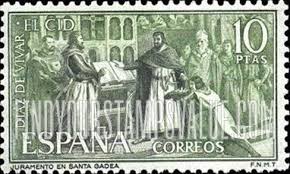
Rodrigo Diaz de Vivar, born into a noble family in Castile, made his way in the violent world of Eleventh Century Spain by his wits and his sword. Born in 1043, he fought in his first battle in 1057, and by 1079 was an experienced general, winning for Castile the battle of Cabra against the Moorish Granadan army. Running afoul of King Alfonso VI of Castile, he took service for several years in the Moorish kingdom of Saragossa. (Politics in medieval Spain made strange bedfellows, and it was not unusual for alliances to cut across the religious divide of Christian and Moor.) Under the Cid’s brilliant leadership Saragossa was held against assaults from enemy Moorish and Christian armies.
The Islamic fundamentalist movement, known to history as the Almoravids, began an invasion of the Iberian peninsula in 1086, sending wave after wave of black garbed Berber armies into Spain. At the great battle of Sagrajas, a combined Christian army under Alfonso VI was decisively defeated by Almoravid and local Moorish forces. El Cid was probably at this battle leading a contingent on the Moorish side. The battle and its aftermath effectively stalled the Reconquista for several generations.
In the aftermath of Sagrajas, Alfonso recalled El Cid from exile, realizing that he now needed the services of the best general in Spain. Leading combined Christian and Moorish forces, El Cid took the Moorish city of Valencia in May of 1094. Although technically a vassal of Castile, El Cid was now a king in all but name. After three years of peace, Valencia was besieged by the Almoravids, with El Cid dying from an arrow to the heart while fighting in the siege. Valencia fell to the Moors in 1102, with the Cid”s wife Jimena fleeing to Burgos with his body. Valencia would not come under Christian rule again for 125 years.
From the bare facts of his life it is somewhat difficult for me to see why Rodrigo Diaz de Vivar became a national hero, but become a national hero he did. His title of Cid was awarded to him by admiring muslims, the term meaning lord/master in Arabic (sayyid). He was often called El Cid Campeador, campeador being campi doctus, doctor of the camp, a reference to his mastery of the military art. His contemporaries regarded him as the greatest knight who ever lived, and since his time every generation of Spaniards have thrilled to his, mostly, fictional exploits, as legends became clustered about him even before his death, and minstrels and poets began to make him a myth before his corpse was cold.


When I was a young teen my girlfriend and I saw El Cid 3 times at one of the beautiful old theaters in downtown DC. We had a major crush on the leading man and each of us bought a souvenir book. Somehow we knew that Charlton Heston was staying at the Mayflower Hotel and prevailed upon one of our mothers to drive us downtown to the hotel where we sat in the lobby until Charleton Heston (El Cid) walked by. We almost lost our nerve but shyly approached him and he graciously signed our books. We were thrilled!
I saved my allowance and bought the album. To this day I think M. Roza’s score was perfect for the story.
I have never seen the Middle Ages more ably put on film CAM, and not just the look of the film. When King Sancho II is assassinated, for example, his first reaction is to cry out, “Confess me! Confess me!” The film gives us a loophole through time to experience another world.
I never met Heston myself, but I have talked to several persons who did and they all remark upon what a nice guy he was.