
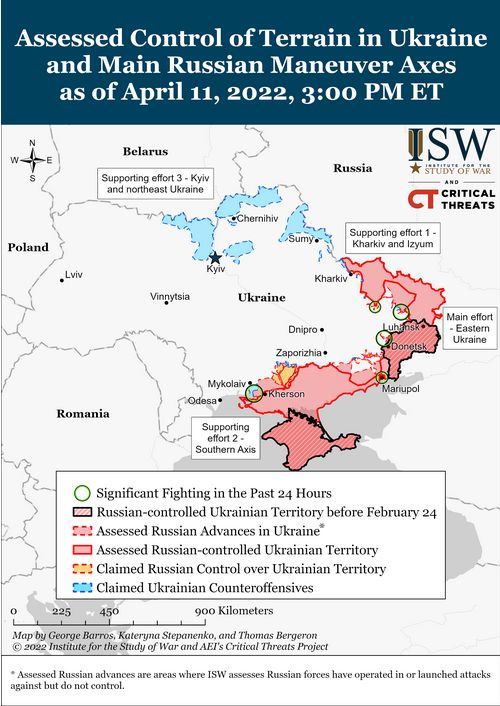
From The Institute For The Study of War:
Mason Clark, Karolina Hird, and George Barros
April 11, 8:30pm ET
Special Edition: Army General Aleksandr Vladimirovich Dvornikov
US intelligence reported over the weekend of April 9-10 that Russian Army General Aleksandr Vladimirovich Dvornikov, commander of the Southern Military District, is now in overall command of Russian operations in Ukraine. This news is unsurprising; Dvornikov is the most senior of the three Russian military district commanders involved in the invasion, and the Russian military is concentrating its efforts almost exclusively in the area of Ukraine that Dvornikov had already been commanding. Had Putin selected another officer to command the entire war effort, he would likely have had to relieve Dvornikov for these reasons. There is no reason to suppose, therefore, that Dvornikov was specifically selected to take control of the war effort for any particular skills or experience he might have. Nor is there reason to think that the conduct of the Russian war effort will change materially more than it was already changing from the abandonment of the drive on Kyiv and the focus on the east. This update, which we are publishing in addition to our regular military operations assessments, explains Dvornikov’s career history and experience in Syria, the challenges he faces, and what his appointment means for the Russian campaign in Ukraine.
Dvornikov has commanded the Southern Military District since September 2016, capping a military career that began in 1978. He graduated from the Ussuriysk Suvorov Military School—a Soviet military boarding school—at age 18 in 1978.[1] Dvornikov then served as a platoon commander, company commander, and battalion chief of staff in the Far Eastern Military District (the predecessor of Russia’s current Eastern Military District) throughout the 1980s.[2] From 1991 to 1994, Dvornikov served as deputy commander and then commander of a motorized rifle battalion assigned to the Western Group of [Soviet] Forces in Germany. From 1995 to 2000, Dvornikov served as chief of staff and then commander of an unspecified motorized rifle regiment of the Moscow Military District (which merged into the current Western Military District in 2010). He then served as chief of staff and commander of another motorized rifle regiment in the North Caucasian Military District (now part of the Southern Military District) until 2003, during which time he likely participated in the Second Chechen War. From 2005 to 2008 Dvornikov served as a deputy commander and then chief of staff of the 36th Army (part of the current Eastern Military District). Dvornikov commanded the 5th Red Banner Combined Arms Army of the Far Eastern Military District from 2008 to 2010. Dvornikov served as a deputy commander of the Eastern Military District from 2010 to 2012, then as chief of staff of the Central Military District from April 2012 to 2015.
Dvornikov commanded Russia’s forces in Syria from the official beginning of the Russian intervention in September 2015 to July 2016.[3] He has commanded the Southern Military District since September 20, 2016.[4] Putin promoted Dvornikov on June 23, 2020, to the rank of army general, the second-highest rank in the Russian military and one not held by any other military district commander.[5] Dvornikov is Russia’s senior-most military district commander, outranking the other two military district commanders involved in the invasion of Ukraine, and a likely candidate (along with the commander of the Aerospace Forces, Army General Sergey Vladimirovich Surovikin), to succeed Valery Gerasimov as Russia’s next chief of the general staff. [6]
Dvornikov’s career path is not unusual among senior Russian general officers.[7] Dvornikov’s foundational military experience—like many of his fellow general officers—was his assignment as a regimental chief of staff and then regimental commander in the North Caucasian Military District from 2000 to 2003, during which period he almost certainly participated in the Second Chechen War. Dvornikov’s promotion path from regimental command to Military District Commander was typical. Russian officers usually change military districts with each promotion, as Dvornikov did—moving through the contemporary equivalents of the Southern, Eastern, and Central military districts until taking command of the Southern Military District.[8] Dvornikov’s career path through 2015 was thus unremarkable for a very successful general officer.
Dvornikov’s experience commanding the Russian deployment to Syria—and targeting of civilians during that deployment—was also not in itself unique or an indicator of a particular skill set. Many Western media outlets have focused on Dvornikov’s experience in Syria and highlighted Russian targeting of civilians under his command. All of Russia’s current military district commanders, as well as the commanders of Russia’s Aerospace Forces, Airborne forces, and Military-Political Directorate, have served at least one tour of duty in Syria as chief of staff or commander of Russia’s forces in Syria.[9] It appears to have been Russian military policy to rotate senior officers through service in Syria and then select for further promotion only those who had served in Syria.[10] Dvornikov, in fact, has less experience in Syria than many of his contemporaries, serving one 10-month tour as commander. By comparison, Western Military District Commander Colonel General Alexander Zhuravlev and Eastern Military District Commander Colonel General Alexander Chayko served in Syria for two tours each, totaling 24 and 20 months respectively.[11] Dvornikov’s command of Russian operations in Syria that killed large numbers of civilians is similarly, and tragically, not unusual. Dvornikov has gained attention in Western media as the “Butcher of Aleppo,” but Russian forces targeted Syrian civilians and critical infrastructure throughout the Russian intervention in Syria, making all Russia’s current military district commanders and many of its senior military leaders complicit in such crimes.[12]
Dvornikov’s one unusual skill may result from his particular experience establishing new command structures in complicated coalition settings because he was the first Russian commander in Syria. Dvornikov established Russia’s initial command structure in Syria from the beginning of the Russian intervention in September 2015. Dvornikov has written extensively on the experience of standing up Russian operations in Syria, including a March 2016 retrospective published while he was still serving in Syria and several articles following his return to Russia.[13] He stressed the importance of establishing a unified command and control structure for Russian advisers, the Russian Air Force, and various conventional and unconventional pro-Assad forces. Dvornikov particularly claimed (likely exaggerating) in “Staffs for New Wars” (July 2018) that he rebuilt the shattered and demoralized pro-Syrian forces into a cohesive fighting force. Dvornikov’s writing additionally stresses the importance of creating a unified command structure for all Russian forces cutting across unit and service boundaries. Dvornikov’s Syrian experience may help him integrate the battered elements of the Western, Eastern, and Central military districts coming his way as reinforcements, as well as the Chechen forces of Ramazan Kadyrov and the proxy militias of the Donetsk and Luhansk People’s Republics.
His experience overseeing the pro-Assad offensive that recaptured Aleppo also likely gave him more insight into the conduct of modern urban warfare than his successors in Syria, although urban warfare in Syria was not confined to Aleppo. Dvornikov commanded the final pro-Assad offensive that recaptured Aleppo—Syria’s largest city, with a pre-war population of over 2 million—in 2016. Aleppo was one of the bloodiest campaigns of the Syrian Civil War and likely the main source of recent Russian lessons learned on modern urban combat.[14] But Dvornikov was not specially selected for command because of any experience in urban warfare. To begin with, he took command of the Southern Military District in 2016, likely years before Putin planned to invade and occupy Ukraine. If Putin or Gerasimov were specifically choosing an officer with experience in urban warfare experience to command something, moreover, it would have made much more sense to assign Dvornikov to the battle for Kyiv. Dvornikov has commanded Russian operations in Mariupol in the current Russian invasion of Ukraine all along. He may have been applying—or attempting to apply—many of the lessons learned in Syria, but his conduct of urban warfare in Mariupol has been unremarkable in terms of its success, speed, and cost in casualties. There is no reason to think that Dvornikov had been selected to command in Syria because of any skill or theoretical work on urban warfare, for that matter. He commanded the Aleppo campaign because it was Russia’s major campaign during his tenure in Syria, not as a specific appointment. The tactics and approaches used by Russian forces in both Syria and Ukraine are not unique to Dvornikov or any other individual Russian commander. Neither are they particularly effective.
Dvornikov is the natural choice of military district commander to command current Russian operations in Ukraine due to his command of the primary Russian area of operations and his seniority. Dvornikov’s command of the SMD from 2016 to 2022 grants him the greatest familiarity with operations in eastern Ukraine, as he oversaw the largely frozen conflict in Donbas in that period and is the direct commander of the primary Russian forces in the region—the 8th Combined Arms Army and forces of Russia’s proxy Donetsk and Luhansk People’s Republics. Dvornikov has commanded the Donbas and southern axes since the beginning of the current Russian invasion on February 24, and his forces have achieved the greatest successes of the initial period of the war. Had Putin chosen another officer to command the overall war effort now that he has condensed it to a focus on Dvornikov’s area of responsibility he would almost certainly have had to relieve Dvornikov of his command. Considering that Dvornikov’s performance in command was no worse, and in some ways better, than the performances of his lower-ranked colleagues, such a decision would have been odd indeed.
The Kremlin’s belated appointment of a single overall commander in Ukraine will not automatically solve Russian command, logistics, and morale issues, and Dvornikov faces several ongoing operations that may exceed his span of control.
Russian forces are currently carrying out the following missions in Ukraine:
- Defenses of their positions in Kherson Oblast from Ukrainian counterattacks from the west and north
- Possible advances north from Crimea toward Zaporizhzhia and Dnipro
- The capture of Mariupol
- Frontal assaults in Donetsk and Luhansk Oblasts
- Offensive operations on the Izyum-Slovyansk axis to encircle Ukrainian forces in eastern Ukraine (previously led by WMD forces)
- Operations to fix Ukrainian forces in place in Kharkiv (previously led by WMD and CMD forces)
- Efforts to reconstitute damaged and demoralized forces from all four Russian military districts to reinforce two axes, Izyum and Donbas
The Russian military’s previous approach to command in the war in Ukraine was apparently for three military district commanders (South, West, and East) to independently command their own axes of advance, leading to disjointed offensive operations. Collapsing the war effort into the east and south itself eliminates some of that problem, whoever took command. Dvornikov’s appointment as sole commander may well challenge his ability to conduct simultaneous operations focused on even this reduced list of Russian offensive operations, especially given the severe losses of senior commanders the Russian military has experienced. We have already seen indicators that Russian forces are unable to conduct simultaneous major offensive operations between Kherson, Donbas, and Izyum, and this challenge will likely continue.
Dvornikov will likely struggle to integrate units redeployed from western to eastern Ukraine into his ongoing operations, which have to date been conducted by Southern Military District troops under his direct command. ISW has assessed throughout the war that the SMD had been the most effective Russian district due to its unity of command, high readiness, and rate of large-echelon military exercises prior to the war—in contrast to units from Russia’s other districts, which were cobbled together prior to the invasion with little time to cohere unified structures and practice the high-end conventional warfare necessary for the current Russian campaign.[15] Damaged Russian units withdrawn from Kyiv and northeastern Ukraine continue to deploy to the Izyum axis and may eventually redeploy to Donbas. These units are unlikely to perform better just because Dvornikov is leading them as overall commander. Dvornikov will in fact likely face significant challenges integrating these units into ongoing operations.
Key Takeaways
- Russian Commander of the Southern Military District Army General Alexander Dvornikov is the natural choice to take overall command of Russian operations in Ukraine. There is no reason to suppose Dvornikov was selected for any particular skills or experience, nor is there reason to think the conduct of the Russian war effort will materially change more than it was already changing due to the Russian abandonment of northeastern Ukraine and focus on the east.
- Russian forces may have used chemical weapons against Ukrainian defenders in Mariupol, though ISW cannot independently verify Ukrainian claims at this time.
- Russian forces failed to make significant advances in continued assaults on Severodonetsk, Popasna, and Rubizhne in eastern Ukraine.
- Russian forces continued to amass troops in Kharkiv Oblast to reinforce offensive operations on the Izyum axis and conducted several minor attacks.
Go here to read the rest.
From Strategy Page:
April 11, 2022: The 2022 war in Ukraine revealed several unexpected but not unknown problems with the Russian military. Those who had followed failed efforts to reform the Russian army since the 1990s and the similar efforts by Ukrainian forces since 2014 were aware that Russian troops were no match for their Ukrainian adversaries when Russian leader Vladimir Putin went from talking about Ukraine being absorbed by Russia to sending more and more Russian troops to the Ukrainian border. Russia behaved like their dismal reform efforts had magically worked as nearly half their combat units assembled on the Ukrainian border. Reports from the Russian capital, which Ukrainian military leaders believed, indicated the decision had been made to invade despite obvious defects in the training, morale and equipment of Russian units. The reality of the differences between Russian and Ukrainian forces was soon made clear as the advance was stopped short of its goals and took heavy casualties in the process. Copies of the attack plan, which were only distributed to a few senior commanders leading the attack, showed that the Russians believed they could quickly reach and take the Ukrainian capital Kyiv and replace the government with a pro-Russian one and declare the war over. At that point the rest of Ukraine was supposed to surrender and get used to being Russian once more.
Many Russians, especially recent veterans or parents of sons approaching conscription age, knew the truth and were perplexed at the decision to invade when so many soldiers were poorly trained and suffering from low morale. Conscripts supposedly prohibited by law from service in a war zone were sent in anyway.
Much of the Russian population continues to cope with the continuing use of conscription, something that has been unpopular since the end of World War II. The post-1991 government goal of having an all-volunteer force failed because it costs more than the government could afford and not enough young Russians were willing to voluntarily serve, even as better paid and treated contract soldiers.
Even though over half of Russian military personnel are now volunteers (serving on contracts) or career officers, the ability of the military to hold onto those contract (“contrakti”) soldiers is always weakened if there are a lot of casualties or too much chance of being sent to a combat zone. This manifested itself in 2022 when contract troops refused to renew contracts. Most of the combat units sent into Ukraine were composed of contract troops who were killed in large numbers. When the survivors got back to Russia, either because of wounds or because many combat battalions returned because of heavy losses, there was a sudden shortage of contract soldiers. That was because most contract troops were near the end of their two-to-three-year contracts and refused to renew. The army had signed up many soldiers for the new (since 2016) short term (six to twelve month) contracts for former soldiers or conscripts willing to try it and found that there were far fewer vets willing to sign these short contracts because so few recent short-term contract soldiers had survived service in Ukraine.
Soldiers with time left on their contracts were a liability because they told anyone who would listen that the Ukraine “operation” had been a disaster for Russian troops because of determined and well-armed (with anti-tank weapons) Ukrainians regularly ambushing columns of Russian armored vehicles and quickly destroying most of them. While Russian troops were forbidden to take cell phones with them into Ukraine, the Ukrainians still had them to take photos and videos of the aftermath of these battles, and these were getting back to Russia where Russian veterans of the fighting confirmed they had seen the same grisly evidence of Russian losses or even survived one of these battles.
Russia played down these losses but the Ukrainian military maintained, and published daily updates of Russian losses in terms of soldiers killed, wounded or captured as well as equipment losses. After thirty days of fighting the Ukrainians were claiming that over a third of Russian troops sent into Ukraine had been killed, wounded or captured with even larger quantities of vehicles and weapons lost. After six weeks the Russian military admitted that losses were heavier than previously acknowledged but would not give exact figures. In part that was because an accurate count was not possible until most of the combat units (BTGs, or Battalion Task Groups) had returned or confirmed as having been eliminated inside Ukraine and survivors assigned to other BTGs. Few BTGs were wiped out but many were reduced to half or a third of their original size (about 800 troops and several hundred vehicles). Communications, even for BTG or brigade commanders, was unreliable inside Ukraine because of defective radios. That meant senior commanders of armies (which controlled over a dozen BTGs and many support units) were always using outdated data on unit strength and capabilities. This was reported back to Russia and was declared a state secret. In fact, Russia is making a major effort to keep Ukrainian reports on the fighting from spreading on the Russian Internet. That has been difficult because the Ukrainian after-action reports are all Russians can get as their own government refuses to release much data on casualties. Moreover, the Ukrainian data appears accurate because it often includes pictures and identities of the dead Russian troops and details on the losses individual BTGs suffered. The Ukrainians had better access to where these battles took place and proved it with photos and videos showing destroyed vehicles, some of them identifiable as belonging to a particular Russian unit.
Without a lot of contract soldiers Russia could not replace BTG losses. Replacing lost tanks and other vehicles also proved to be more difficult than expected. On paper Russia had thousands of fully armed and equipped tanks and other armored vehicles in reserve for quickly replacing combat losses. Not surprisingly those reserve vehicles were often in bad shape, having been poorly maintained by conscripts and larcenous civilians who made a lot of money by taking key items from these vehicles and selling them on the black market. These missing items were usually not reported missing until troops received these vehicles, which were generally mobile enough to be driven onto a railroad flatcar for transportation to units needing them. Once received these reserve vehicles were found missing equipment and in need of extensive repairs to make the vehicles combat ready. This was nothing new and has been common since the Soviet Union dissolved in 1991 and the mighty Red Army lost 80 percent of its personnel strength but few of its ships, aircraft, vehicles and heavy weapons. Most of these were “in reserve” even though most of them were found abandoned throughout Russia, and new groups of these resting vehicles are still being found in forests while known concentrations of these vehicles or aircraft have been picked clean of useful parts.
Conscription was in even worse shape, with the number of conscripts available declining each year. In April 2018 the Russian military only ended up with 128,000 conscripts during the semiannual draft call. This was the lowest since 2006, a year when there were more young men available as well as more deferments and rampant draft dodging. In the years since 2018 the decline was reversed by issuing fewer deferments, punishing more draft dodgers and enforcing laws against conscripts serving in combat zones. The one exception was if the fighting was in Russia and this was the excuse the government used as it claimed they were not invading Ukraine but reuniting Ukraine with Russia. The Ukrainians as well as Russian conscripts and their families disagreed with this interpretation of the invasion.
Another reason for fewer conscripts is that there were fewer young men to conscript because of lower birth rates and more young men who were in poor physical shape, or addicted to drugs, or had a police record and considered more trouble than they are worth if conscripted. All this was expected but since the 1990s Russia has been seeking solutions and finding none that work well enough to keep the military up to strength.
As early as 2012 a parliament-ordered investigation found that the army was short a third of the privates (lowest ranking enlisted troops) they were supposed to have. The Russian military (mainly the Army and Interior Ministry paramilitary units) are supposed to have a million personnel. But officials admitted in 2011, off-the-record, that the real number is closer to 800,000 and slowly but relentlessly declining. A subsequent investigation confirmed this. In 2021 it was still no more than 800,000. Since 2012 the military has come up with a growing list of solutions for the problem but all these efforts do is slow the decline of military manpower numbers, not reverse it. Current fixes involve calling up reservists (usually for a brief period to test the system) and instead of letting the reservists quickly return to civilian life the military is keeping many of the reservists for six months or more. This was one reason for the short-term (less than 12 month) contract. Doing this too often made reservists refuse to appear when recalled. The economic recession since 2014 (because of low oil prices and sanctions) was supposed to encourage more Russians to volunteer but that did not happen and there was less money for increasing the pay for contract soldiers. Recruiting foreigners had minimal impact and so the Russian military keeps fading away.
The military has 220,000 officers, also on contracts, and many veteran “contract personnel” who provide technical experts and other senior enlisted personnel. These are higher paid contract soldiers, some with a decade or more of service, who often become the long-absent Russian NCO (Non-Commissioned Officer, or sergeants) but there are not enough of these NCOs to make a difference. Conscripts still make up nearly half of the military and it’s getting harder and harder to find enough people to conscript or willing to sign a contract. This means there are two classes of Russian military personnel. Most (about 70 percent) are much less capable with most of them conscripts in for one year of service or new contract soldiers on two- or three-year contracts. These are supervised by the inexperienced junior officers and a much smaller number of career NCOs. A third of the military are more enthusiastic volunteers and conscripts. These staff the elite special operations, airborne, security and specialist units. In other words, while the government claims to have a million military personnel on duty, the reality is the reality is that there are only about 200,000 troops on active duty who are good at what they do and want to be in the military.
Conscripts are inducted twice a year, in April and October. In 2011, the April intake was nominally 220,000 but fewer than that actually made it into uniform. In 2018 the April draft was 128,000. In 2011 only about 75 percent of the men who showed up were considered fit to take. In 2018 standards of “fitness for military service” are much less strict and the military has to cope with a lot more recruits who are of marginal use.
By 2012 the military reluctantly accepted the fact that they would not be able to obtain more than 270,000 conscripts a year needed to reach the official strength of a million personnel. In the last six years maintaining anything close to that number meant taking less willing and able men. Senior leaders now accept that they will never command a million-man force.
Lowering their standards in order to make their annual quotas just fills the ranks with more troublesome people, who cause more of the good troops to get out. In the last few years, the military has quietly stopped accepting many volunteers or conscripts from Moslem areas, especially the Caucasus (particularly Chechnya and Dagestan). The wisdom of this was made clear when Russian intelligence reported that the most effective Russian Moslems who joined and fought for Islamic terrorist groups were military veterans. In contrast, Russian Moslems who had not served in the military were less likely to become Islamic terrorists and if they did, they were used as suicide bombers or support staff, not as long-term fighters. Moreover, commanders continued to report that if more than a few percent of their troops were Moslem there would be morale problems or worse.
The basic recruiting problem is two-fold. First, military service is very unpopular, and potential conscripts are increasingly successful at dodging the draft deliberately or otherwise. But the biggest problem is that the number of 18- year-olds is rapidly declining each year. By 2009 all draftees were born after the Soviet Union dissolved. That was when the birth rate went south year after year. Not so much because the Soviet Union was gone but more because of the economic collapse (caused by decades of communist misrule) that precipitated the collapse of the communist government. The number of available draftees went from 1.5 million a year in the early 1990s to less than half that today. Less than half those potential conscripts are showing up and many have criminal records or tendencies that help sustain the abuse of new recruits that have made military service so unsavory.
With conscripts now in for only a year, rather than two, the military is forced to take a lot of marginal (sickly, overweight, bad attitudes, drug users) recruits in order to keep the military and Ministry of Interior units up to strength. This worked during the cold war because conscript service was three years for elite units. With one-year conscripts elite airborne and commando units using some conscripts find that these eager conscripts take a year to master the skills needed to be useful and then they are discharged. Few choose to remain in uniform and become career soldiers. That’s primarily because the Russian military is seen as a crippled institution and one not likely to get better any time soon. With so many of the troops now one-year conscripts, an increasing number of the best officers and NCOs get tired of coping with all the alcoholics, drug users, and petty criminals that are taken in just to make quotas. With the exodus of the best leaders and a growing proportion of ill-trained and unreliable conscripts, the Russian military is more of a mirage than an effective combat (or even police) organization.
The military is unpopular for conscripts mainly because of the brutal treatment they receive. This has not been getting better and “hazing” incidents are still increasing each year. This is serious stuff. There are a lot of reasons for not wanting to be in the Russian Army but the worst of them is the hazing. One year conscription was supposed to solve this but new conscripts are tormented by conscripts who have been in a few months longer. It was thought that this sort of thing would speed the demise of conscription in Russia, once the Cold War ended in 1991. Didn’t work out that way. The government found that, even among the “contract soldiers” the old abuses lived on and that most of the best contract soldiers left when their contract was up. It was because of the brutality and lack of discipline in the barracks. The hazing is most frequently committed by troops who have been in six months or so against the new recruits. But this extends to a pattern of abuse and brutality by all senior enlisted troops against junior ones. It remains out of control. The abuse continues to exist in part because of the growing animosity against troops who are not ethnic Russians and especially against those who are Moslem. Because of higher birth rates among the Moslem populations, nearly 15 percent of eligible conscripts are Moslems and that is seen as more of a problem than a solution.
This hazing originally developed after World War II, when Russia deliberately avoided developing professional NCOs. They preferred to have officers take care of nearly all troop supervision. The Soviets failed to note that good NCOs were the key to effective troops. The Soviets felt that officers were more politically reliable, as they were more carefully selected and monitored. The NCOs that did exist were treated as slightly more reliable enlisted men but given little real authority. Since officers did not live with the men, slack discipline in the barracks gave rise to the vicious hazing and exploitation of junior conscripts by the senior ones. This led to very low morale, and a lot of suicides, theft, sabotage, and desertions. This hazing has been one of the basic causes of crimes in the Russian armed forces, accounting for 20 to 30 percent of all soldier crimes. This has caused a suicide rate that is among the highest in the world. Poor working conditions in general also mean that Russian soldiers are nearly twice as likely to die from accidents, or suicide, then American soldiers. Long recognized as a problem, no solution to the hazing ever worked.
Conscription itself, and the prospect of being exposed to the hazing has led to a massive increase in draft dodging. Bribes, and document fraud are freely used. Few parents, or potential conscripts, consider this a crime. Avoiding the draft is seen as a form of self-preservation. The government has cracked down on the parent-backed draft dodging with little effect. That’s because there is still so much corruption in Russia and evading conscription is seen by many as not really criminal, especially when the parents can afford to pay a bribe to keep their only son (and often an only child) out of the Russian military.
Go here to read the rest. Russian military history largely consists of huge Russian armies overwhelming their foes through sheer mass. Quantity has a quality of its own. The Russians can no longer field such armies, but they are still pursuing their traditional strategy. Hence their high casualties and lack of success. The Russians simply lack the troops to make their traditional way of warfare work.


Seems that Dvornikov will also make a most tempting target. His size and position will certainly draw attention.
The chemical weapon threshold is a worrying development. Despite difficulty in verification, I’d say it’s more likely than not that the Russians used it at Mariupol. There are a few sanction possibilities left, but not many effective ones. Or at least, not effective ones that can be universally embraced by the allies.
More nightmares beckon.
Don, I haven’t been diligent in following your updates, and I understand that the fog of war makes any daily updates uncertain. Would you mind writing a weekly update or a review up til now?
Probably after Easter Pinky. Things are fairly busy for me right now.
This isn’t a negotiation!
🙂
I know these are involved, but I find these daily Ukraine War reports by ISW very useful, particularly in their confirming information I have seen from other sources.
Presently the US military conducts basic training lasting about 10 weeks long (Army, Navy), the Marines a little longer (13 weeks). After that, personnel are streamed into various areas of “AIT,” Advanced Individual Training, which can last anywhere from a month to 52 weeks. Training in the “SV” (Sukhoputnyee Voyska, literally “ground forces”), the Russian army, is much shorter, perhaps one month, and advanced individual training
may last 3-6 months—-But the overall reputation of the training is very poor. This conflict appears to bear that out that view. As this article mentions above, the fact that there is very brutal hazing demonstrates a serious lack of military discipline and of higher values which problems start from the very beginning of Boot Camp.
Second, intercepted unencrypted cell call transmissions by Russian soldiers in the field continue to mention delays in their pay, including combat pay, and apparently the pay is very low by western standards—-between $500 and $600 USD per month. One Russian interpreter pointed out that where a lot of the soldiers come from, rural hamlets and small towns, the standard of living is so poor that this is an incentive. But not to those who are from the big cities like Moscow. This is also why when, after the pull back from Kyiv, they were stealing everything from air conditioners and washing machines to items of very nominal value. Many of the soldiers were shocked at the much higher standard of living of Ukrainians according to their phone calls and wondered why.
Lastly, this report above by ISW echoes many other reports, that the vast armored vehicle and tank reserves that Russia (reputedly up to 10,000 tanks and APV’s) has are not in good shape and have not been updated or upgraded for contemporary battle at all. The military requisitions departments are rampant with kleptocracy (as mentioned above) and much essential work is never done. If Dvornikov goes into battle with this equipment, it is likely going to be another bloodletting for the ordinary “contraktiki” Russian soldier.
Supposedly from RT:
Russia’s military action in Ukraine is meant to put an end to the US-dominated world order, Russian Foreign Minister Sergey Lavrov has explained. Washington has been seeking supremacy by imposing ad-hoc rules and violating international law, he claimed, in an interview aired by Russian television on Monday.
<b>He was referring to America’s attempts to impose its own so-called “rules-based international order,” which have met with strong resistance from Moscow and China.</b>
“Our special military operation is meant to put an end to the unabashed expansion [of NATO] and the unabashed drive towards full domination by the US and its Western subjects on the world stage,” Lavrov told Rossiya 24 news channel.
“This domination is built on gross violations of international law and under some rules, which they are now hyping so much and which they make up on a case-by-case basis,” he added.
At the rate they’re going, it’ll take ’em about three years to conquer a substantial, populous, lower-middle income country. Then our domination is history.