
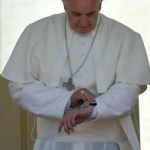
Sandro Magister reminds us that the current Vicar of Christ opposes traditional Catholic teaching on war:
Day after day, with a crescendo of indignation, Pope Francis is condemning as “unacceptable” and “sacrilegious” the “war of aggression” Russia has unleashed against Ukraine, albeit without ever calling by its name the aggressor state, nor its monarch.
Francis has also tacitly allowed his secretary of state, Cardinal Pietro Parolin, to acknowledge that “the right to defend one’s life, one’s people and one’s country sometimes also involves the sad recourse to arms,” and that therefore even “military aid to Ukraine can be understandable.”
At the same time, however, the pope continues to launch invectives against the manufacture and distribution of weapons by “the economic-technocratic-military power,” which he considers “madness,” “a scandal that dirties the soul, dirties the heart, dirties humanity,” the true origin of all wars. He even said he was “ashamed” to read that “a group of states have pledged to spend two per cent of GDP on arms purchases.”
So going by Francis’s logic the Ukrainians, the attacked, if they really wanted to continue to defend themselves, should do so with their bare hands. And so should the free states of Europe and the North Atlantic.
This one on peace and war is not the only unresolved contradiction that characterizes the current pontificate. But it is perhaps the one most fraught with political consequences, not least the growing irrelevance of the Holy See on the world stage.
*
It is in the twentieth century that Catholic doctrine on peace and war had its most complete formulation. This can be read in the 1997 “Catechism of the Catholic Church,” in the 2006 “Compendium of the Social Doctrine of the Catholic Church,” as well as – clearly ahead of its time – in such a classic of twentieth century Christian thought as “Les Chrétiens devant le problème de la paix” by Emmanuel Mounier, from 1939, just republished in Italy by Castelvecchi with the title “I cristiani e la pace” and with an introduction by Giancarlo Galeazzi, professor at the Pontifical Lateran University and a specialist in “personalism,” the philosophy developed by Mounier himself and by Jacques Maritain.
It is a doctrine that, under precise and stringent conditions, legitimizes the use of force. Going so far as to allow, in Pope John Paul II’s speech at the beginning of 1993 to the diplomatic corps, armed “humanitarian intervention” in defense of a state that has ended up “under the blows of an unjust aggressor.”
For Pope Francis, however, this doctrine has had its day. In his view war in defense of those who are victims of aggression may perhaps be fought as a lesser evil, but in any case no longer calling it and judging it as “just.” He also said this in the video conversation he had on March 15 with Moscow patriarch Kirill: “Once even in our Churches there was talk of holy war or just war. Today one can no longer speak like that. Wars are always unjust.”
Francis made the starkest break with the doctrine and formula of “just war” with the message for the January 1 2017 day of peace, entirely dedicated to non-violence “as the style of a politics for peace.”
But then, during the press conference on November 26 2019 on the flight back from Japan, he said he thought the time was not yet ripe, although he had laid the groundwork for this, to issue an encyclical dedicated to peace and non-violence, which would make the pivot official. He maintained that the question is open and must be re-examined. And he added that for the moment it still remains legitimate to resort to arms in the cases admitted by moral theology.
The fact is that this continual waffling on the part of the current pope also sends the Church tottering in one direction or the other.
The Community of Sant’Egidio, in particular, the so-called “UN of Trastevere,” has recently made itself promoter of a quite varied, and therefore faithful, application of Francis’s contradictory magisterium.
Mario Giro, a leading representative of the Community in international politics, wrote without admitting exceptions: “The popes tell us that war is an evil in itself, that every war is evil and that there is no such thing as a just war. It is she who is the absolute evil.”
Founder Andrea Riccardi launched an appeal, from the first days of the aggression against Ukraine, to have the capital of Kyiv declared an “open city” in order to spare it from destruction. Without making it explicit, however, that technically an “open city” is a city that by explicit agreement of the parties at war is left to occupation by the enemy, in this case Russia, without putting up any resistance. In other words, a capitulation to the new empire of Vladimir Putin.
As for Matteo Zuppi, archbishop of Bologna and cardinal, he too one of the founders of the Community of Sant’Egidio but also and above all papabile, in an interview with the newspaper “Domani” of Sunday March 20 that ran to two pages preferred to say in vague words a little of everything: both that “no war is just” and that “in a situation of open and tragic conflict like the one we are seeing, there is the right to defend oneself.”
Still much more straightforward – while awaiting the “re-examination” confusedly hinted at by Pope Francis – is the classical Catholic doctrine on peace and war, as outlined by Mounier in the essay now republished and as developed above all by John Paul II.
To get an idea of this, as applied to today’s war in Ukraine, here is a short excerpt from the preface to the French thinker’s book.
The author of the preface is Stefano Ceccanti, professor of comparative public law at the University of Rome “La Sapienza” and senator of the Democratic Party, as well as student president of Catholic universities in his youth.
*
THE UNEASY LESSON OF EMMANUEL MOUNIER
by Stefano Ceccanti
Despite the spread of radical pacifist positions in the bosom of the Catholic Church, ethically most admirable on an individual level, and the need for a diplomatic and ecumenical role of the Holy See that leads it, with the “pro tempore” pontiff in office, whoever he may be, not to take a hard line against aggressor countries, as in the case of Putinian Russia today, the complexity described in his time by Emmanuel Mounier, albeit with a few important updates, remains at the center of the Church’s magisterium today.
The 2006 “Compendium of the Social Doctrine of the Catholic Church,” at number 500 (on the conditions of legitimate defense) re-proposes the four conditions set out by Mounier, with an addition of greater caution on the “power of modern means of destruction.” On the question of legitimate authority, number 501 recalls the UN Charter and the role of the security council. Paragraph 506 (on the duty to protect oppressed minorities) leaves open, under similar conditions, forms of humanitarian intervention within the individual state, thus bringing state sovereignty into question and commending the establishment of the international criminal court.
With respect to Mounier’s reconstruction, Catholic doctrine therefore seems to show greater doubt with respect to the canon of proportionality, since the destructive power of the means has grown, but it seems to extend the right intention to humanitarian intervention as well.
The two most relevant updates, in other words, confirm the complexity of the doctrine, because the one urges greater prudence while the other extends the purposes that can legitimize the use of force.
Go here to read the rest. The embrace of pacifism at the highest echelons of the Church was brought about largely by two causes.
First, trendy Leftism among clerics. Contemporary Leftists, until Ukraine, usually promoted pacifism at the same time, and the contradiction is ever evident, they embraced Leftist wars of so-called liberation. Usually what this meant was pacifism for the West, while the enemies of the West were free to take up arms. In Ukraine Pope Francis, never an intellectual genius, has run into a war by a Western nation that most Leftists are in support of, and he has responded with the usual contradictory statements about war he has learned by rote.
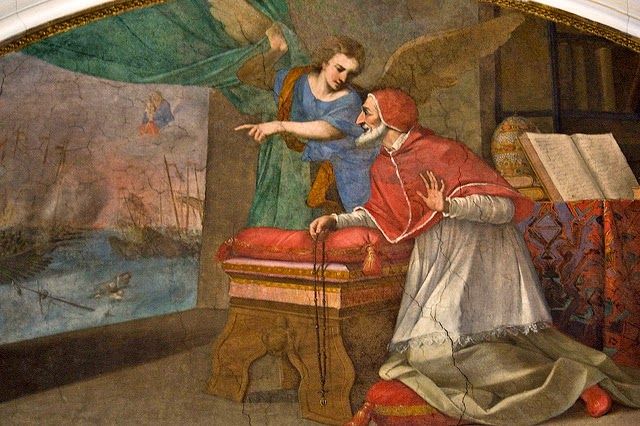
Second, the growth of ivory towerism among clerics. Popes now rule a postage stamp principality dependent upon begging for its substance. The Popes are now free to embrace stances that simply work very poorly in the real world. When the Popes ruled the papal states they engaged in wars and pacifism was never on the agenda of the Church. Practical men with experience governing usually became pope. Now men of an academic bent are our popes. Even a pope too dimwitted to get a doctorate, like our current pope, pretends to be a deep thinker and philosopher. The Church needs quite a bit more common sense and a lot less woolly academic, and pretend academic, speculation. One Pope Pius V is worth ten of our current crop of literary “genius” popes.


“…the…Vicar of Christ opposes traditional Catholic teaching….” ( Maybe we could have stopped right there?)
As to justified violence, I alway recall Christ fashioning a whip to protect his father’s holy temple.
Don L,
You are not alone in that recollection.
PowerLine posted a ‘humorous’ photo-shop of Jesus whipping PF. It isn’t farce, it’s tragedy.
Third, they aren’t Christian. Rather, they are their own gods.
The near-extinction of Catholic monarchs as functional peers is another factor that contributes to the “ivory tower” effect. When popes were part of a network of such, it helped keep them grounded. Another anchor to reality gone.
“So going by Francis’s logic”-Francis and logic have never met.
I wouldn’t attribute ‘ivory towerism’ to the loss of the Papal States. If he had the Papal States, he’d be supported by tax revenue and he’s suffer the same disorientation our politicians suffer.
Clergymen live in a very odd economy wherein they are supported by donations and endowment income, paid stipends whose value is completely divorced from any sort of measure of productivity, and undertake activities which lack robust measures of competence. Ivory towerism is an occupational hazard. It might have been mitigated in the case of Francis due to his employment prior to his ordination. Alas, he’s from Argentina, the occidental world’s most economically illiterate society.
I’m not seeing a way out of ivory towerism short of having clergyment moonlight as tentmakers. I think in John Paul’s case, his liberal learning was so extensive that he was able to capably ponder things abstract from his daily life. Francis just recycles the attitudes of common-and-garden NGO employees.
“ Vicar of Christ opposes traditional Catholic teaching….” ( Maybe we could have stopped right there?)”
Agree. Stop. Right there. As a Catholic can self excommunicate, so can a Pontiff self dethrone.
Just as a man who saws off the branch he standing on does-
Does the Vatican still own shares in Beretta or in mutual funds that have shares in armaments manufacturers?