
(I originally posted this back in 2010. It seems sadly appropriate today.)
The second in my series examining the poetry of Kipling. Kipling liked to keep his religious views obscure. In 1908 he described himself as a “God-fearing Christian atheist”. There are many other remarks he made about his religious views which are just as cryptic. Why he did this is hard to say, except perhaps for his own amusement. Kipling had a well-developed sense of humor and enjoyed practical jokes both literary and otherwise. He was an enthusiastic mason for a number of years, but there is little evidence he viewed it as anything other than an amusing convivial organization.
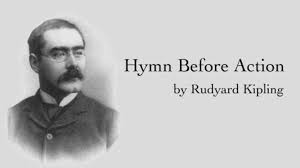
In his poems Kipling did not shy away from religious themes. More than a few of his poems, short stories and novels have a fairly strong religious element. Perhaps his most strongly religious poem is a Hymn Before Action which he composed in 1896:
The earth is full of anger,
The seas are dark with wrath,
The Nations in their harness
Go up against our path:
Ere yet we loose the legions —
Ere yet we draw the blade,
Jehovah of the Thunders,
Lord God of Battles, aid!
High lust and froward bearing,
Proud heart, rebellious brow —
Deaf ear and soul uncaring,
We seek Thy mercy now!
The sinner that forswore Thee,
The fool that passed Thee by,
Our times are known before Thee —
Lord, grant us strength to die!
For those who kneel beside us
At altars not Thine own,
Who lack the lights that guide us,
Lord, let their faith atone!
If wrong we did to call them,
By honour bound they came;
Let not Thy Wrath befall them,
But deal to us the blame.
From panic, pride, and terror,
Revenge that knows no rein,
Light haste and lawless error,
Protect us yet again.
Cloak Thou our undeserving,
Make firm the shuddering breath,
In silence and unswerving
To taste Thy lesser death!
Ah, Mary pierced with sorrow,
Remember, reach and save
The soul that comes to-morrow
Before the God that gave!
Since each was born of woman,
For each at utter need —
True comrade and true foeman —
Madonna, intercede!
E’en now their vanguard gathers,
E’en now we face the fray —
As Thou didst help our fathers,
Help Thou our host to-day.
Fulfilled of signs and wonders,
In life, in death made clear —
Jehovah of the Thunders,
Lord God of Battles, hear!
Kipling makes clear at the outset of the poem that this is a prayer: Jehovah of the Thunders, Lord God of Battles, aid! God is referred to as Jehovah, a common mistaken spelling of Yahweh, and is referred to as the Lord God of Battles, a hearkening back to the Old Testament prayers of the Hebrews for victory in battle.
However, the Hymn is not a simple prayer for victory. The next section is a confession of sin:
High lust and froward bearing,
Proud heart, rebellious brow —
Deaf ear and soul uncaring,
We seek Thy mercy now!
The sinner that forswore Thee,
The fool that passed Thee by,
Our times are known before Thee —
Lord, grant us strength to die!
Kipling recognizes that those who praise God in time of need often ignore Him in time of plenty and safety. They need forgiveness for this and their other sins.
The next section of the poem I’ve always found fascinating. A British imperial force would contain non-Christian units: Muslims, Hindus, Sihks, Buddhists, Pagans, Animists, etc. Kipling remembers that they also need God’s mercy:
For those who kneel beside us
At altars not Thine own,
Who lack the lights that guide us,
Lord, let their faith atone!
If wrong we did to call them,
By honour bound they came;
Let not Thy Wrath befall them,
But deal to us the blame.
Kipling asks God to not punish them if they die in an unjust cause, but to blame those who called them. He also asks God to allow their faith to atone for not worshiping at God’s altar. This passage has always reminded me of a section of the Screwtape Letters: “Let us therefore think rather how to use, than how to enjoy, this European war. For it has certain tendencies inherent in it which are, in themselves, by no means in our favour. We may hope for a good deal of cruelty and unchastity. But, if we are not careful, we shall see thousands turning in this tribulation to the Enemy, while tens of thousands who do not go so far as that will nevertheless have their attention diverted from themselves to values and causes which they believe to be higher than the self. I know that the Enemy disapproves many of these causes. But that is where He is so unfair. He often makes prizes of humans who have given their lives for causes He thinks bad on the monstrously sophistical ground that the humans thought them good and were following the best they knew.”
The next stanza asks God to guard the petitioners from sins all too common in war:
From panic, pride, and terror,
Revenge that knows no rein,
Light haste and lawless error,
Protect us yet again.
Cloak Thou our undeserving,
Make firm the shuddering breath,
In silence and unswerving
To taste Thy lesser death!
Kipling asks God to give them the courage to face the lesser death. Death of the body of course being the lesser death, and damnation being the greater death that all Christians fear and strive not to earn.
Then we have the sweetest passage for a poem written by a non-Catholic, a prayer to Mary for intercession:
Ah, Mary pierced with sorrow,
Remember, reach and save
The soul that comes to-morrow
Before the God that gave!
Since each was born of woman,
For each at utter need —
True comrade and true foeman —
Madonna, intercede!
Note that Kipling asks intercession also for true foemen as well as for those on his side. He remembers that Mary was herself pierced with sorrow and asks that she remember those born of woman, the sons of mothers tasting death as her Son tasted death. Men dying on battlefields often cry out for their mothers, and I’ve long thought that the Blessed Virgin is very near to those men at the hour of their death. I don’t think a Catholic author could have written a more touching Marian petition.
The poem concludes with a reminder that God has aided their fathers, and that in death, as well as in life, he is Lord.
E’en now their vanguard gathers,
E’en now we face the fray —
As Thou didst help our fathers,
Help Thou our host to-day.
Fulfilled of signs and wonders,
In life, in death made clear —
Jehovah of the Thunders,
Lord God of Battles, hear!
When Kipling tasted the lesser death, I hope this prayer counted against his sins.


Thank you for reposting this…and yes, a timely post, sadly.
My take on the illness that is as terrible as war is the bill before Congress. The deceiving Womans Health Protection Act, HR 3755
This is a monster.
I’m afraid it’s going to squeeze through, and “good Catholic” Joe will sign it in.
Kipling’s Hymn before Action is possibly being prayed and sung from choruses on high. Prayers that one or two Senator’s in blue are pierced through and through to Act with courage and love for the victims of abortion.
This 49 year war is about to change imo. A dramatic event will befall America if the fools proceed to support the killings. Or, if courageous SC Justices acted bravely, a turning point in favour of the victims…yet the battle will not be over. State by state, the battle will be fought for the future generations and the sovereignty of America.